
![In ‘Mr. and Mrs. Andrews,’ Thomas Gainsborough blends portraiture and landscape in order to showcase the couple alongside the land that defined their wealth and status. [Image Credit: Thomas Gainsborough (1727–1788)
Mr. and Mrs. Andrews, ca. 1750
Oil on canvas
27 1/2 × 47 in. (69.8 × 119.4 cm)
© The National Gallery, London; used by permission]](https://thesciencesurvey.com/wp-content/uploads/2026/04/JonesGainsborough1-1200x705.jpg)
“Fashion, let it consist of false or true taste, will have its run, like a runaway horse,” said eighteenth-century British artist Thomas Gainsborough.
At The Frick Collection, this idea comes to life in Gainsborough: The Fashion of Portraiture, the first exhibition in New York dedicated to the artist’s portraits, currently on view through Monday, May 25th, 2026. Past the museum’s gleaming, delicately carpeted staircase, through the grand archway, and to the right of the East Gallery lies a treasure trove of fashion, faces, and artistic flair. Gainsborough’s portraits do more than display wealth and style — they reveal a complex network of tensions between identity and status in eighteenth-century British society.
To fully appreciate this exhibit, one must first understand fashion as more than what people wore. When I had the pleasure of interviewing Aimee Ng, the Peter Jay Sharp Chief Curator of The Frick Collection who organized the exhibit, she told me that “there is actually a definition of fashion that is a specific social class between the nobility and the ‘vulgar,’ so there’s sort of this social class known as the person of fashion, which we don’t really have in our societies today.” With this in mind, Ng focused the exhibit on how fashion functioned not merely as clothing, but as a tectonic force that permeated all aspects of society, compelling individuals from all walks of life to contemplate their identity and sense of self.
Ng said that her goal in curating the exhibit was to “reintroduce the artist in a way that acknowledges the complexity of the social world he and his sitters lived in and the role of portraits in that social world.”
Thomas Gainsborough was born in Sudbury, Suffolk in 1727. His artistic talent was evident from a young age, as he spent much of his childhood sketching the nature surrounding Sudbury. At just 13 years old, Gainsborough’s passion for art inspired him to move to London where he immersed himself in the artistic scene surrounding St. Martin’s Lane Academy, a hub for artistic training. Gainsborough secured an apprenticeship under French painter and illustrator, Hubert-François Gravelot. Through this experience, Gainsborough acquired a profound understanding of the French Rococo style, known for its elegance, light colors, and fluid lines, which influenced many of Gainsborough’s earlier works.
After marrying Margaret Burr in 1746, Gainsborough returned to Sudbury to work as a portrait painter. Although Gainsborough held an affinity for landscape painting from a young age, landscapes were far less prestigious and lucrative than portraits, so he was ultimately pressured into entering the “curs’d face business,” as he later called it. In Sudbury, Gainsborough embarked on what would become an expansive artistic journey across England.
Mr. and Mrs. Andrews, featured as the article’s main image, is one of Gainsborough’s most famous works of art. It has been described as a “triple portrait” for its tri-faceted focus on Robert Andrews, his wife Frances, and their bountiful land. There is no clear consensus on why Gainsborough approached the painting in this way; it may be because Mr. Andrews wanted to flaunt his modern farming techniques and productive land, but it could also be because Gainsborough wanted to show prospective clients his talent for landscape painting. Either way, modern scholars deem the portrait “radical” for its atypical devotion to the land.
Mr. Andrews’ hunting attire is indicative of the couple’s upper-class status, reflecting their abundance of land to hunt on. Similarly, Mrs. Andrews’ hooped dress, straw hat, and pink satin mules show her at the height of fashion, demonstrating her ability to afford such luxuries. Together, these details underscore the couple’s wealth and firmly establish their place in the upper-class.
Modern scholars also claim to be able to identify the very oak tree under which the couple sits — a testament to the precision with which Gainsborough approaches the portrait. By dedicating the same attention to the sitters as he does to the land and foliage surrounding them, Gainsborough blurs the boundary between portrait and landscape.
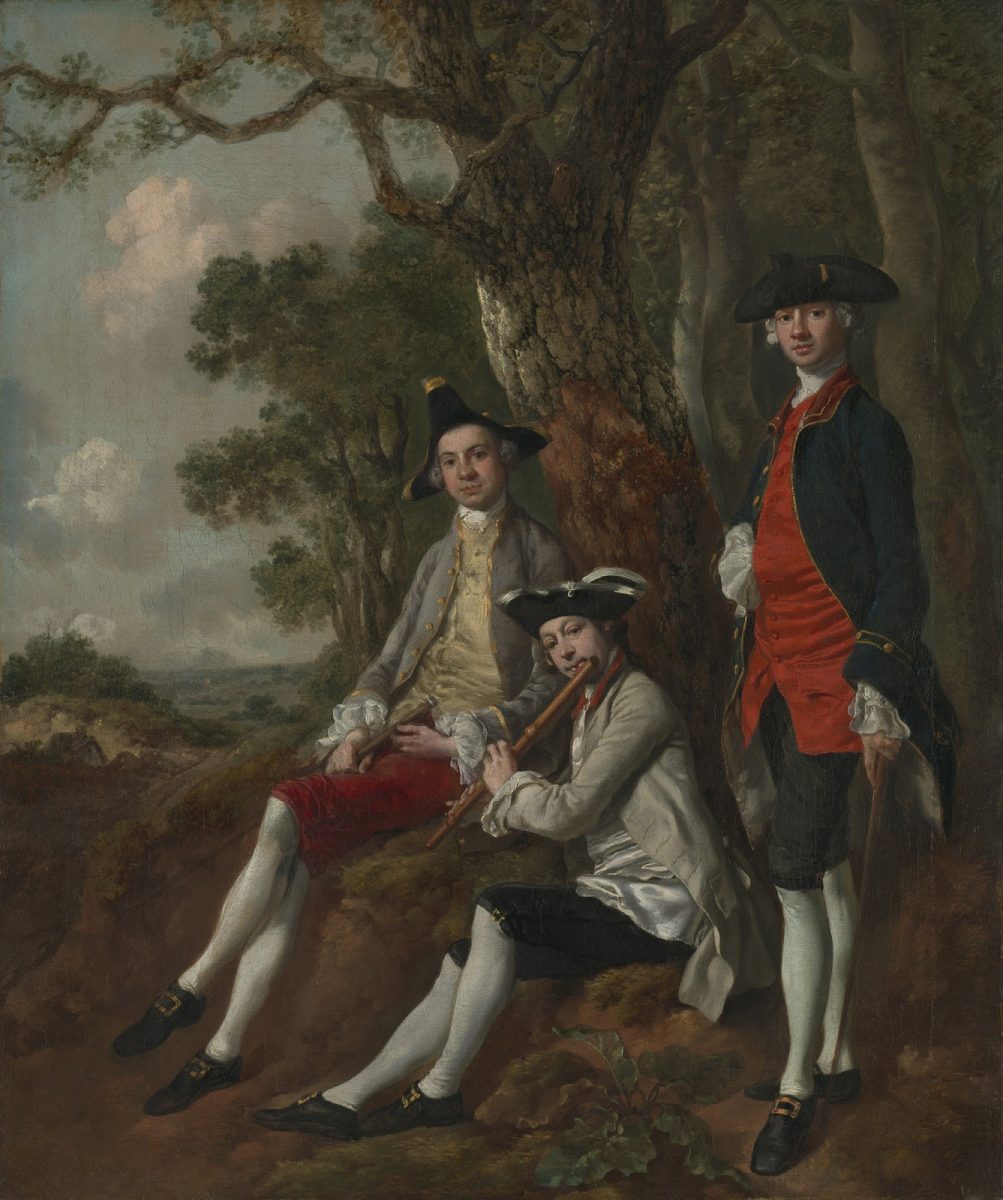
While in Sudbury, Gainsborough also painted Peter Darnell Muilman, Charles Crokatt, and William Keable. Group portraits of small-scale figures like the one depicted above are called ‘conversation pieces’ and were a popular type of portraiture in Britain in the early eighteenth century. The two men on either side of the tree, Muilman and Crokatt, are sons of wealthy immigrant families from the Netherlands and Carolinas, while the one in the center is Keable, a local Suffolk painter and musician. Here, we begin to see Gainsborough utilizing fashion as a tool to distinguish between classes. Keable lacks a couple of key indicators of upper-class status that the men to his sides possess, including the gold trim on their coats, their powdered wigs, and gold tricorn decorations on their hats.
Gainsborough also manipulates the figures’ body language and facial expressions in order to illustrate their place in society. For example, Keable is depicted playing his flute, thereby distorting his mouth in a way that would have been inappropriate or informal for landed gentry like Muilman and Crokatt. It is unknown why Gainsborough painted the three men together in the first place, but the piece serves as a prime example of fashion’s intersection with portraiture.
In 1752, Gainsborough relocated to the larger port town of Ipswich with his wife and two young daughters to access artistic opportunities in a bigger market. In The Gravenor Family, Gainsborough depicts local politician John Gravenor and his family, likely commemorating his appointment as bailiff in 1754. In contrast to the innovative nature of Mr. and Mrs. Andrews, Gainsborough opted for a more conventional, rigid mode, which may reflect the preferences of his patron.
The dresses worn by Gravenor’s wife Ann and his two daughters feature stiff bodices and panniers, which are hooped structures that create a wide, dramatic silhouette. At the time, panniers signified elite status, reserved for upper-class women and typically worn only for court appearances or special occasions.
According to Aimee Ng’s essay in the exhibition catalogue, “the portrait appears close in style and composition to paintings by Gainsborough’s teacher, Francis Hayman,” reflecting his ability to take inspiration from those around him, while also bringing his own unique approach to each of his pieces.
Gainsborough masterfully paints the intertwined trees in the background and the bed of grass on which the women sit, reflecting his enduring love for nature and landscape painting. The brook and wheat field, as well as the flowers held by the young women, allude to the family’s wealth and prosperity, continuing his use of setting as an indicator of social class.

In 1759, Gainsborough and his family moved to Bath, where the artist shifted away from conversation pieces and towards the grand life-size portraiture that would catalyze his rise to fame. According to Ng’s essay in the exhibition catalogue, author Philip Thicknesse (1719-1792) encouraged Gainsborough to “try his talents at portrait painting” in “that fluctuating city,” so Gainsborough did just that.
Mary, Countess Howe is one of Gainsborough’s first full-length female portraits, showcasing the refinement he developed in Bath, as well as the elite standing of his new patrons. Countess Howe is depicted wearing an elegant loose-fitting dress of pink silk (known as a “nightgown”), a Leghorn hat made of woven straw, and heeled shoes with shiny buckles. These luxurious items, along with the abundance of pearls draped across her neck, indicate her elevated social status.
Countess Howe’s decorative lace apron folds back on itself, creating the illusion of translucency and movement in a still painting. Upper-class individuals like Countess Howe commonly went on walks not for exercise, but to flaunt their finest attire — an early form of conspicuous consumption.
Moreover, Bath was home to a dynamic social scene characterized by balls and concerts, where people would compete to wear the newest clothing and accessories. Gainsborough set up his studio and showroom at the center of the action, with his sister’s milliner shop conveniently next door, setting him up for success.
It is also important to consider that Gainsborough’s rise to fame ran parallel with the first wave of industrialization in Great Britain. Industrialization fueled rapid urbanization, widening the wealth gap between the upper and lower classes. These circumstances ultimately enabled Gainsborough’s success, as elites increasingly commissioned portraits to display their status to the public. His work reflects the complexity of this shifting social and economic landscape.
Another prominent product of Gainsborough’s time in Bath was Mary, Duchess of Montagu. In 1766, Mary and her husband assumed the recreated Montagu dukedom, which had ended with the death of her father. Gainsborough claimed that the portrait reflected his “latest manner,” referring to what he considered his newest painting style.
In the portrait, Gainsborough conveys an appreciation for old age, rendering the fine lines and depths of the Duchess’ face with a sense of grace. He contrasts her restrained expression with the extravagance of her attire: her delicate lips stand in quiet opposition to the cascade of velvet red fabric behind her, while her calm, steady gaze is set against the richness of her blue silk robe, puffy sleeves, and lace kerchief draped across her chest.
Her clustered earrings would have been made from as many as 200 diamonds, which speaks to the sheer magnitude of her wealth. Once again, the increasing wealth and influence of Gainsborough’s sitters fits into the larger trend of Gainsborough’s growing desirability as a portrait artist.
In a departure from portraits of the white upper-class, Gainsborough famously depicts Ignatius Sancho, a Black musician and writer born on a slave ship. As a child, Sancho worked for three sisters who mocked him and called him Sancho Panza from Don Quixote. He later adopted the name and used it of his own accord. After attracting the attention of the Duke and Duchess of Montagu through his intellectual talent, he was employed in their household as a servant, ultimately serving as their valet.
In his portrait, Gainsborough depicts Sancho in a dignified manner, making him appear poised and independent, despite his status as a servant. He wears professional and expensive attire, omitting any trace of the subservient Montagu livery that he would have worn while working. His posture is confident, with one hand tucked into the pocket of his waistcoat, making him appear a gentleman.
Though he earned his livelihood as a servant, Sancho was also an accomplished composer, musician, writer, and abolitionist. According to Ng’s essay in the exhibition catalogue, he was the first and only known eighteenth-century Afro-Briton to have voted in parliamentary elections and lived to see slavery outlawed in Britain in 1772. Additionally, he was the first Afro-Briton to receive an obituary in the British press, demonstrating his ability to overcome hardship and have a lasting influence on British society.
“The idea that Gainsborough paints Sancho in a portrait not as a servant but as an individual, as a man, as a gentleman, shows the complexity of the human story that is woven through all of these pictures. Each one of them has not only a story, but multiple identities at the same time,” said Ng, speaking to Sancho’s multi-faceted experience.
The portrait was likely a gift to Sancho from the Montagus or Gainsborough himself, as it would have been too expensive for Sancho to afford on his own. Gainsborough had mutual musical friends with Sancho, and he was known to trade paintings for musical instruments and lessons, so this is a likely explanation for how Sancho obtained the portrait.
Gainsborough’s portrait of Sancho reflects how Gainsborough did not limit his art to the wealthy and powerful, and instead, made efforts to involve a broader range of people in his works. In fact, this is believed to be the only independent portrait of a servant by a major artist of this period, speaking to Gainsborough’s versatility as an artist.
Master John Heathcote is one of Gainsborough’s few independent portraits of children. Heathcote wears a lightweight dress made of muslin, a plain woven cotton initially imported from India and eventually made in Europe. This attire fits the standard of boys and girls dressing similarly until around age seven, reflecting Georgian ideals of childhood freedom and liberality.
In nearly all ten of Gainsborough’s portraits of children in his career, the subjects wear similar muslin frocks and red shoes emerging from the skirts, according to Ng in the exhibition catalogue. They are also all portrayed in idyllic outdoor settings, further reflecting contemporary ideals of bliss and innocence in childhood.
Heathcote holds a large black feathered hat, likely meant to signify mourning. Heathcote’s parents reportedly lost their other children to an outbreak of illness that had been raging across different parts of the kingdom and requested that Gainsborough portray their surviving son before it was too late. Heathcote lived to the age of 71.

As one of the most desired portraitists in the nation, Gainsborough finally moved to the capital city of London in 1774. Although he struggled to keep up with the ever-growing demands of portraiture, he found pleasure in creating portraits of his friends and family.
For instance, Gainsborough captured a moment of his friend Carl Friedrich Abel composing for the viola de gamba, a precursor to the modern cello. In the portrait, Abel appears a wealthy gentleman, from his satin-lined brown coat to his gold-buckled leather shoes, even though his financial situation did not permit him to afford such clothing or commission the portrait in the first place. It is likely that Gainsborough painted the portrait in exchange for a musical experience of some sort, a common practice of his to make his portraiture more accessible.
“Gainsborough produces a number of portraits of people like the German composer Abel not for money, but instead, he’s either trading things, exchanging things, or cementing friendships and using his painting to elevate people who otherwise would not have had the privilege of being seen as an independent person of respectable means,” said Ng.
Small details such as Abel’s pet pomeranian dozing off in the bottom left corner and the viola de gamba resting on his leg add a personal and informal touch to the piece, with critics deeming the work “the finest modern portrait” of the time.
Gainsborough went on to spotlight Abel’s pomeranian and her pup in a separate portrait, despite the relative unpopularity of pet portraiture at the time. In Pomeranian and Puppy, Gainsborough masterfully captures the personalities of the dogs, using their facial expressions and posture to bring them alive. Abel’s pomeranian gazes off into the distance with an eager look in her eyes, while her pup appears adventurous, perhaps searching for something on the ground beneath them. Gainsborough’s careful brush strokes add a third dimension to the portrait, making the dogs’ fur appear soft and full, almost as if the viewer can reach out and pet them.
By devoting himself to pet portraiture, Gainsborough subverted the traditional artistic norms of his time and further rendered himself as an unconventional artist. “He came to establish a painting style that is so singular and unique to him, that even in his day, people could tell that it was a Gainsborough painting just because of how loose and obvious and brushy the paintbrush strokes were,” said Ng.
Gainsborough also uses his talent for portraiture to display affection for his wife, Margaret Gainsborough. After thirty years of marriage, Gainsborough depicted his wife with an unmatched sense of dignity and intimacy, despite hitting some rough spots during their time together. In the portrait, she appears poised and collected, with a posture that radiates sophistication and confidence. Reportedly, Gainsborough painted Mrs. Gainsborough every year to commemorate their anniversary.
When I asked Ng which portrait in the exhibit was her favorite, she said, “Every day, I have a different favorite, depending on my mood. Today, let’s talk about Margaret Gainsborough. It’s such an intense, beautiful portrait of somebody who is so close to Gainsborough’s life, and he wasn’t always a great husband — people go through ups and downs — and yet he can picture her so beautifully and intensely.” From the portraits that he dedicated to his friend Abel and his wife Mrs. Gainsborough, it is clear that Gainsborough used his talent for portraiture not only for professional success, but also to strengthen his closest personal relationships.
Gainsborough’s pieces were also displayed in London’s Royal Academy every summer, attracting the attention of the international community. The Royal Academy was home to the latest works of portraiture, displaying well-known actors, aristocrats, and societal figures and ultimately serving as a hub for art criticism.
In Grace Dalrymple Elliott, Gainsborough depicts a controversial figure, infamous for having scandalous affairs with prominent men in British society. After her parents died when she was a child, Mrs. Elliott was raised in a convent in France. At seventeen years old, she got married to Dr. John Eliot, a wealthy physician who was significantly older than her. However, he soon divorced her after learning of her affair with the married Lord Valentia. She continued to go by Mrs. Elliott, but spelled it with two “t”s to distinguish herself from her ex-husband.
Gainsborough presented the portrait to the Royal Academy in 1778, in the midst of Mrs. Elliott’s divorce and subsequent relationship with George, 4th Earl of Cholmondeley, who likely commissioned the portrait.
In the portrait, Gainsborough depicts Mrs. Elliott in a stunning, multi-shaded yellow dress. Set partly outdoors, she appears to have just returned from a walk, further supported by the way she holds her dress to her torso. She stands confidently with a towering bun, alluding to her nickname “Dally the Tall.” Gainsborough portrays Mrs. Elliott modestly and beautifully, while also subtly commenting on her disreputable status with the darkness that imbues the portrait. Critics alluded to her “errors,” but overwhelmed by her beauty, were inclined to “forget them all,” suggesting a largely positive interpretation of the portrait.
Additionally, Gainsborough emulates the elegant and naturalistic style of Anthony Van Dyck, a seventeenth-century Flemish Baroque artist who revolutionized portraiture. “Gainsborough not only takes Van Dyck’s style dress and applies old fashions onto his contemporary sitters, but also the elevation and dignity that Van Dyck brought to English portraiture. Gainsborough is able to bring the dignity of history and of being connected to a respectable past, and I think that he’s getting that from Van Dyck very clearly,” said Ng.
In 1782, Gainsborough painted Mrs. Elliott once again, but this time around, his audience responded very differently. Shifting away from a full-length profile view, Gainsborough depicts a bust-length straight-on portrait of Mrs. Elliott, making the painting feel more close-up and intimate. In a departure from Van Dyck dress, she wears contemporary, more fitted attire, with her neckline outlining the contours of her breasts and a black ribbon at her chin.
Gainsborough’s second portrayal of Mrs. Elliott inspired disapproval from art critics at the time. While they had previously looked past her notoriety, they now tackled it head-on. One critic wrote: “A wanton countenance; and such hair; good God!” Moreover, Mrs. Elliott had just given birth to a daughter, reportedly fathered by the Prince of Wales but raised in the household of the Earl of Cholmondeley. Given this context, critics disparaged the portrait as a glorification of prostitution.
According to Ng’s essay in the exhibition catalogue, “the transparency and frankness of Gainsborough’s presentation of Elliott elicited criticism that revealed contemporary expectations for female portraiture to represent virtue, at least in the public sphere, and especially under the auspices of the Crown,” exposing how gender roles also played a part in art criticism.
Thomas Gainsborough is the last of Gainsborough’s self-portraits, portraying him as a gentleman in his posture and attire. He wears a dark green jacket over a striped orange-and-white waistcoat and a cravat tied with a bow. Gainsborough painted the portrait as a gift for his closest friend Abel in 1787, but Abel unfortunately died before Gainsborough delivered it.
In the portrait, Gainsborough makes no reference to his work with the Royal Academy, instead presenting himself as an independent-minded artist. His quick, airy brushstrokes are evident of his dedication to artistic expression and movement, rather than formality or convention, which he confidently carries with him throughout his career.
The Frick Collection’s Gainsborough: The Fashion of Portraiture provides a window into the complexities of British society. Gainsborough’s portraits are more than beautiful works of art; they offer insight into the rich history of eighteenth century identity, status, and performance. Across aristocrats, servants, musicians, friends, and even pets, Gainsborough uses fashion to remind us that behind every portrait lies a deeper, more complex human story.
“The portraits give us a view of a relatively rigid social hierarchy and the ability of portrait painters like Gainsborough to subvert or complicate that hierarchy,” said Ng.
“Gainsborough produces a number of portraits of people like the German composer Abel not for money, but instead, he’s either trading things, exchanging things, or cementing friendships and using his painting to elevate people who otherwise would not have had the privilege of being seen as an independent person of respectable means,” said Aimee Ng, the Peter Jay Sharp Chief Curator at The Frick Collection.