

In the novel Fahrenheit 451, in a world where books were burned, Ray Bradbury famously wrote, “There must be something in books, something we can’t imagine, to make a woman stay in a burning house; there must be something there. You don’t stay for nothing.”
What do you stay for?
The Morgan Library & Museum’s new exhibit, Come Together: 3,000 Years of Stories and Storytelling, currently on view through Sunday, May 3rd, 2026, attempts to answer this question. The exhibition organizes over one-hundred-and-forty objects into five sections: Belief and Belonging, Shaping Stories, Picture This, Life Stories, and New York Stories. I found myself uncovering my own narrative of “what I stay for,” as I am sure you will too.
What The Story Does For Us
What makes humans human is the ability to imagine. It is, in fact, what many argue has allowed our species to thrive. Millions of people who have never met feel a deep connection towards strangers, either due to the name of their nation or the religion they follow. This ability that unites can also divide. Such has been seen when it comes to answering one of the earliest questions of all: How do you explain nature?
Why does a river rise, eating up the land around it? When does it happen?
Early civilizations were plagued with this question. In ancient civilizations such as Mesopotamia and others in the Mediterranean regions, floods were extremely common.
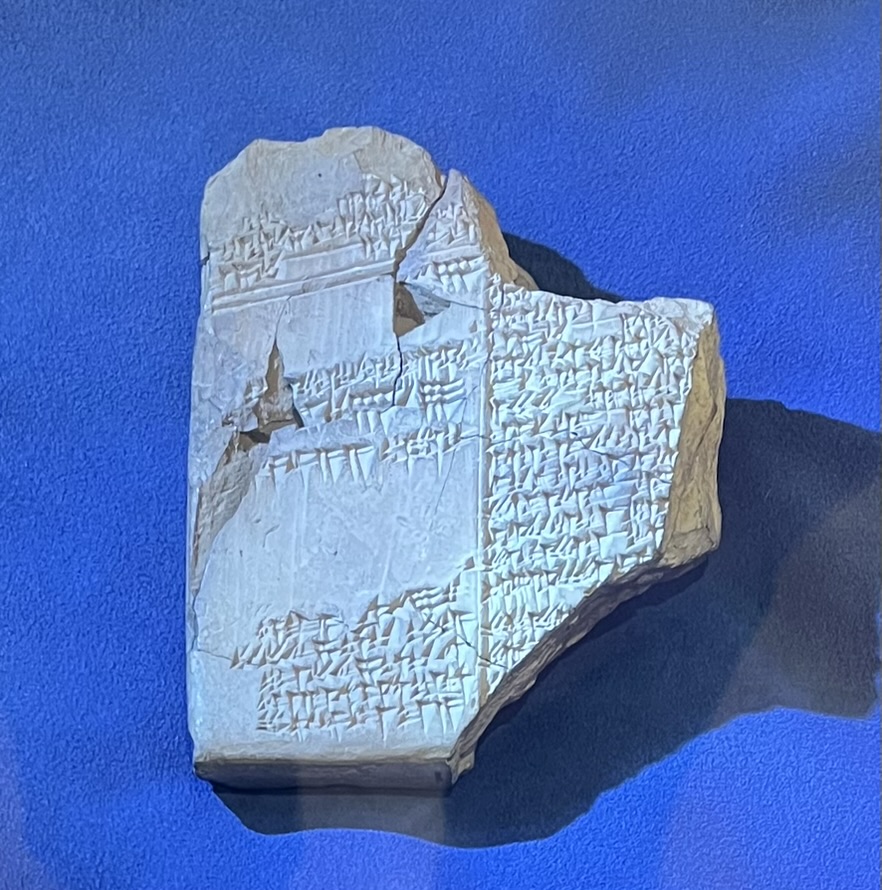
The Epic of Atrahasis offers an explanation. The rough beige surface was dented 3,500 years ago by the junior scribe Azag-Aya. As he pressed his reed into the wet clay, he transcribed a long, orally recounted tale. Enlil, the god of wind and storms, was furious at humans, who had multiplied exponentially, filling the world with their noise and chaos. Seeking the past, a reality where the gods could sleep without being woken, Enlil sent a flood to destroy the people. Atrahasis, whose name means “exceedingly wise,” was told by Enki, god of water and wisdom, to build a boat for “himself, his wife, and pairs of animals.” The clay of this cuneiform tablet has long since dried, and it is distant from its home in the Babylonian city of Sippar.
Change the name Atrahasis, the location of Sippar, and this story begins to feel very familiar. In the sixth chapter of the Old Testament in the Book of Genesis, God finds Noah is the “one good person in a world full of evil and corruption.” Noah survives the flood after spending 120 years building a boat according to God’s instructions. Along with him are two of every animal, his wife, and his son’s wives. In a Hindu legend, a holy man, Manu, survives worldly destruction by making a large boat and “tying it to the horns of a giant fish.” In the Quran, Noah is a prophet prior to Muhammad. This story is also in a section of the Torah, known as the Hebrew Bible.
The Book of Genesis reappears in Albrect Dürer’s two provocative portraits, Adam and Eve. Dürer was a German artist during the Renaissance, well-known for his distinct printmaking work. In the first, the two stand in what is called the Garden of Eden – but is anything but the dense, thriving, and seemingly-utopian Eden as described in The Bible. The second has a simple black background.
Instead of only Eve holding the apple – the forbidden fruit – Adam and Eve both hold one in Dürer’s reimagining. This Biblical retelling in the 15th century suggests that Eden was as human as Adam and Eve were about to be.
It is incredible to see how ideologically separate religions have originated in an attempt to explain the same thing. In some cases, like that of floods, the stories have a similar vein. But what about the stories that explain spiritual rifts, or when these similar ideas began to vary enough to become separate theories?
In the Jewish religion, the “telling,” or Haggadah, is read aloud over Passover seder. The table also prompts memories of when the Israelites escaped Egypt. This, in some respects, is a defining story in Judaism. The bitter and roughly textured unleavened bread, or matzah, is consumed contemplatively, as Jews taste the pain of their relatives: enslavement, and not enough time even to let bread rise. Within the Belief and Belonging section of the exhibit, one can pass upon an aging leaf from the 13th century Paris. Writing on the side is in multiple languages – Latin, Persian, and Judeo-Persian – telling the story of God instructing Moses to part the Red Sea. Right below, in a glass case, sat a tiered seder set that had been sent to New York during the 1939 Nazi invasion of Poland. Each layer holds different foods and liquids. But before the meal, it is tradition that the youngest child asks four questions, one of which is, “Why is this night different from all other nights?” This prompts the retelling of the Exodus from Egypt – the same one inscribed in Paris, the same one desperately sent to New York. The value, perhaps, is the origin, not of all mankind, but of a specific identity within a group of people.
Stories can provide an explanation for why, for example, Jewish people continue to be intertwined with the journeys of their ancestors. But we can also hide behind them.
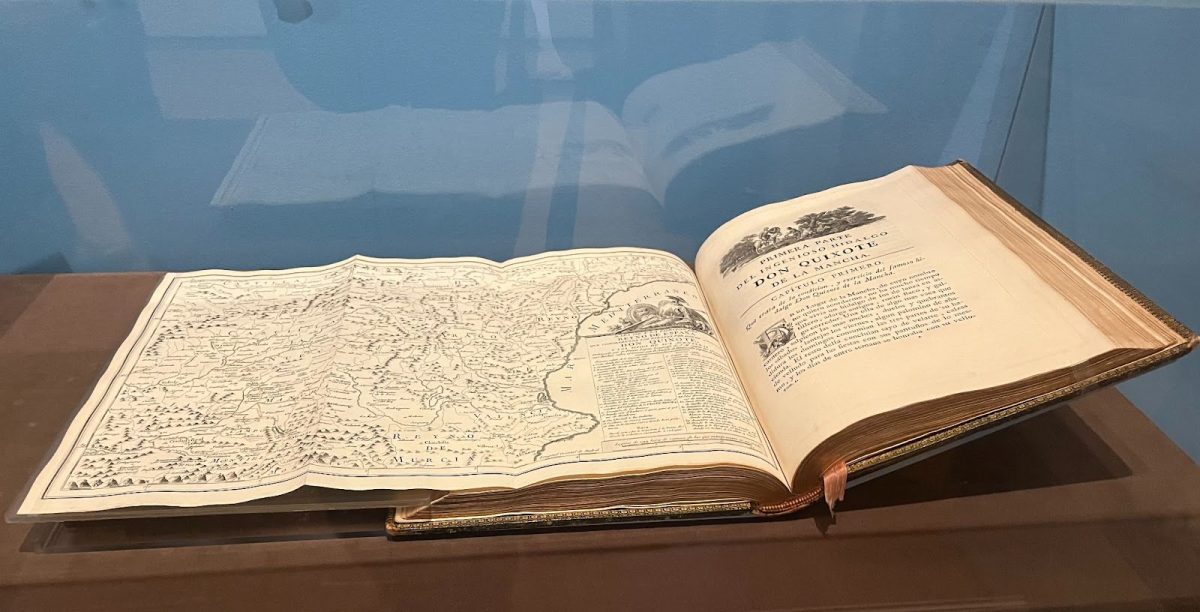
Don Quixote, a stupendously famous novel, tells the story of an old man, Alonso Quijano, enchanted by ancient adventure. As author Miguel de Cervantes Saavedra wrote, “Finally, from so little sleeping and so much reading, his brain dried up and he went completely out of his mind.” Alosono Quijano became the knight Don Quixote, and attempted to relive his fantasies through a series of whimsical adventures. Stories can do this to us. Deirdre Jackson, Assistant Curator of Medieval and Renaissance Manuscripts and curator of the exhibition at the Morgan Library, calls it “a story about storytelling.” In the Myths, Epics, Legends section of Belief and Belonging, there is a map of Quixote’s routes. Two beige sketches of the artist’s impressions of Don’s life are plastered above the map. One, by Thomas Rowlandson, shows Don Quixote and his sidekick Sancho Panza taking a bathroom break. This slightly repulsive imagery is nothing that Don Quixote sees. So, are stories for Don Quixote a welcomed escape? Or does Rowlandson re-portray Don Quixote through the eyes of an outsider, as a cautionary tale?
Duane Michals’ black-and-white photograph, A Letter from My Father, is pasted above Michals’ handwritten thoughts: “As long as I can remember my father always said to me that one day he would write me a very special letter… I know what I hoped to read in the letter. I wanted him to tell me where he had hidden his affection. But then he died and the letter never arrived. And I never did find that place where he had hidden his love.” An older man stares with vexation at a teenage boy, whose face is parallel to the camera. Beside the man is an older woman, lost in something off in the distance. The side-profile of the boy is blurry, dissociated. You can almost hear the father scolding him, the hollow affection and the lingering question that melts the boy from reality: “Where he had hidden his love.” The boy is Michals’ brother. Although the moment was captured in 1960, Michals didn’t publish it and write the notes until 1975, the year his father passed away. We, the audience, are helpless. There is no person the work needs to speak to more than the father, but it will forever be too late. But had the father been immortal, Michals might have never realized his pain. That can be a bitter-sweet theme of storytelling – told too late, but otherwise never told at all.
Following World War I, parts of France were demolished, leaving people homeless, and many children parentless. In response, Anne Tracy Morgan and Anne Murray Dike founded the American Committee for Devastated France in 1918. Tracy Morgan created a photograph album, most of the moments captured by Henry Lachman. In the four on display, the background is dark, and natural light pours through the windows on children holding books or smiling. Projected on the wall, the silent film Life in the Zone Rouge depicts a library, with people checking out books and a focus on a young girl reading. The absence of words goes unnoticed because everything is communicated visually. What people wanted, amongst a loss of their parents or worrying about their next meal, was an alternate reality to delve into.
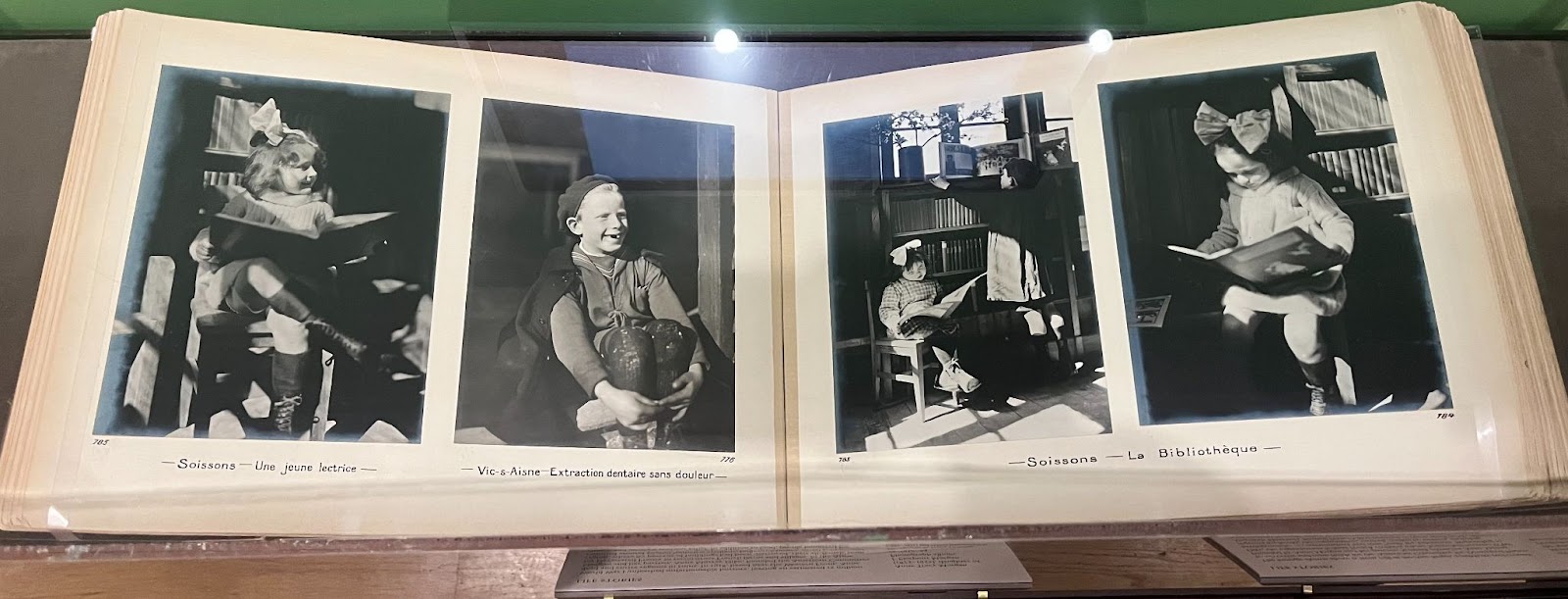
Another question for the American Committee for Devastated France’s work: Why invest in photography or film when you could invest in more medical care, for example? Murray Dike had said, “You can travel in a motor going forward in a straight line for fifteen hours and see nothing but ruins.” By capturing the tragedy, it preserved a reminder of the consequences of war. Photos were often included in American newspapers, encouraging donations and aid, and films were made publicizing the Committee. What I believe as well is that there is something indescribably empowering in writing what you see. So what does a story do for the creator?
What The Story Does to The Creator
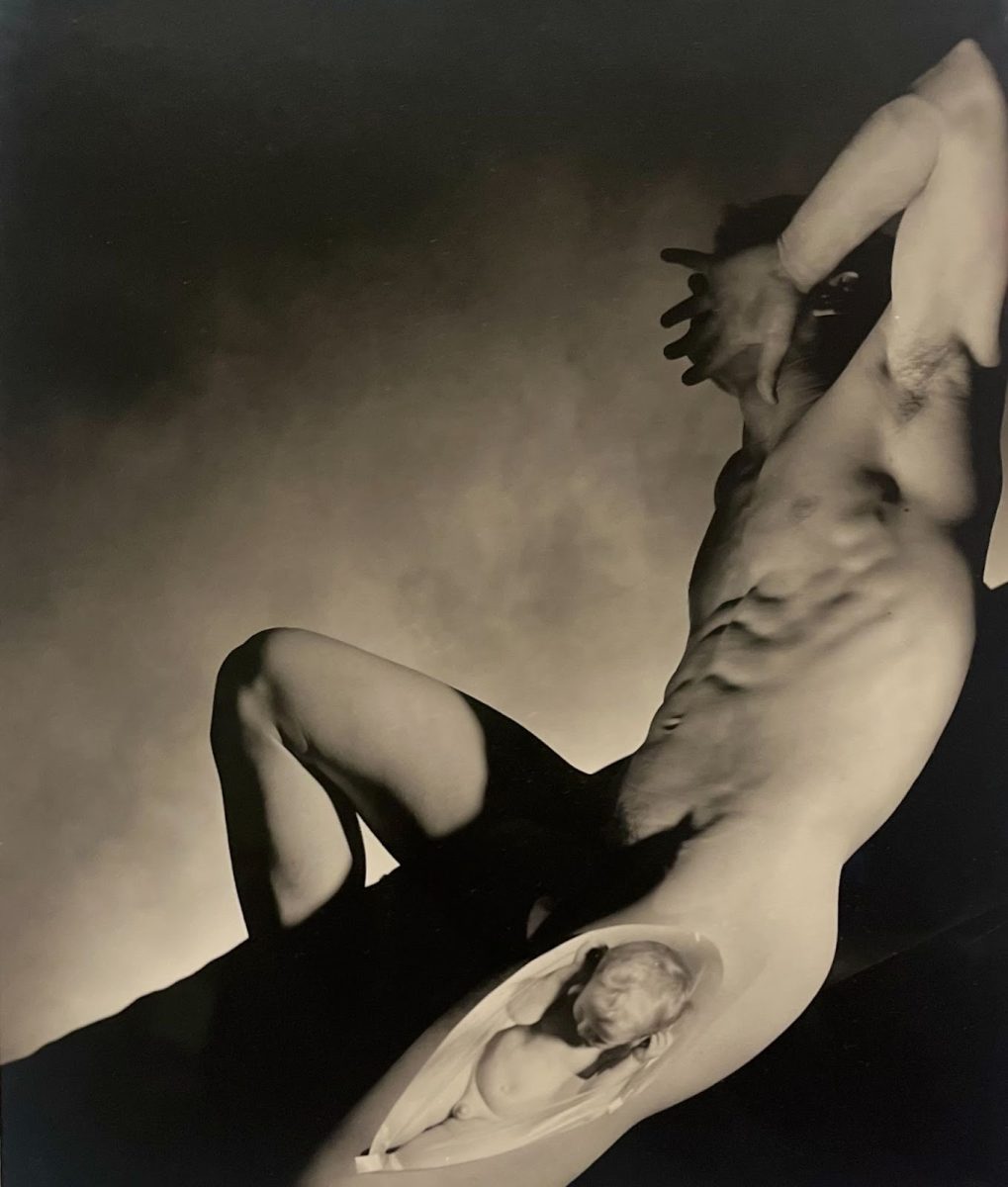
There is a Greek myth of the birth of Zeus’ half-mortal son, Dionysus. His mother was dying as she gave birth to him, and Zeus saved him by magically putting Dionysus in his thigh. Dionysus was saved.
The retelling of this event has been shown to exist even in the 4th century B.C.E., on an ‘Apulian red-figure volute krater.’ Here, Zeus is leaning back, and the upper half of a young man comes from his quad. In 1945, George Platt Lyne recreated this. But it was the 20th century, when French surrealism was taking the world by storm. Artists like Man Ray were changing the rules of art. The lighting of Lyne’s image harshly contours Zeus’ body. Zeus covers his face dramatically with the back of his hand, and a baby is emerging from a gaping slash on his leg. Zeus’ role in the birth of Dionysus is startling – how could a man give birth? And that confusion is what makes it malleable into so many art forms. Through the eyes of a 4th century B.C.E. vessel, Zeus took the role of a woman with ease, yet from the shadows of Lyne’s print, even an immortal god strains with birth. It is the creator who turns the tale of the son of both an immortal and mortal into a tangible representation that helps us to form our opinions.
But how do they do that? In the Shaping Stories section, there is a display of Stories by Children. What caught my eye was Charlotte Brontë’s page. It was packed with dense handwriting, and it was taken directly from one of her works of juvenilia, Arthuriana. As Brontë and her siblings wrote the novel, they produce a world that was pieced together by their surroundings. Toy soldiers, for example, were derived from characters from stories that they had read. With writers like Charlotte Brontë, who are so utterly unique in their work, it is difficult to understand that their ideas evolved from someone, and from something else. In that sense, we all have the potential to become creators.
We can easily define “storytelling” as something oral or written, but in any case, storytelling involves words. If we all can be creators, why do those who use words choose them? Henry David Thoreau – inspired by Ralph Waldo Emerson, and inarguably a man who spearheaded the Transcendental movement. In Walden, each chapter delves further into his stay in his self-built cabin in the woods of Concord, Massachusetts. As a reader, I was influenced by his emphasis on self-reliance, or as Thoreau writes, “Live in each season as it passes; breathe the air, drink the drink, taste the fruit, and resign yourself to the influence of the earth.” In Come Together, it was looking into the glass case with the authentic journal of the man himself, aside from a pinewood box that he built, that I saw firsthand how we see what the words do to the creator. For Thoreau, being able to write granted him freedom. He wrote in Walden, “A written word is the choicest of relics. It is something at once more intimate with us and more universal than any other work of art. It is the work of art nearest to life itself.”
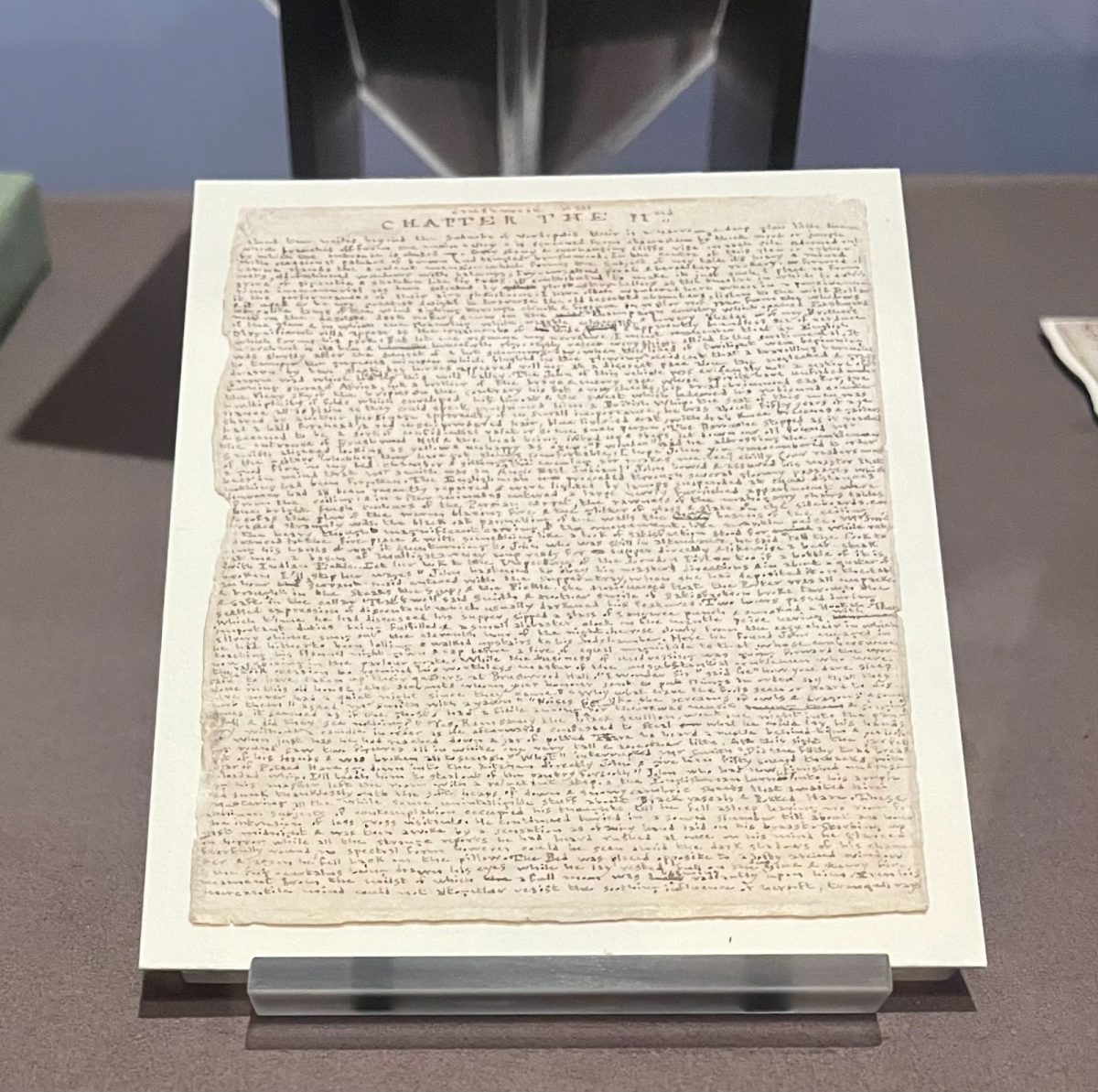
When we can separate “storytelling” from words, the reality becomes clear – we are all creators. Not all can be known, passed down generationally like the Birth of Dionysus or remembered as a Transcendentalist classic, but all can be told. Every author controls a new narrative, whether that is benevolent or not.
Everlasting Ideas
“Sing in me, Muse, and through me tell the story of that man skilled in all ways of contending, the wanderer, harried for years on end.” – Homer, The Odyssey
Where did Homer’s creativity come from, which led him to create an epic of a witty man and his heroism, mixed with human mistakes? It could have been a muse, but I doubt that we will ever know. What we do understand is where it went. A prime example is James Joyce’s Ulysses, which is the Latin translation of ‘Odyssey.’
Ulysses takes place in Dublin, Ireland, in one single day – June 16th, 1904. Leopold Bloom, a Jewish husband, father, and advertising agent, wanders the streets of Dublin in a painful attempt at escaping thoughts about his wife’s infidelity with another man. He is like Odysseus, only instead of a ten year journey home to Ithaca from war, he is in a single day, one that feels tragically endless. His wife Molly is the modern equivalent to Odysseus’ wife Penelope, who is deeply loyal to Odysseus in Homer’s text. These allusions go on, a testament to the seven years that Joyce spent in what T.S. Eliot called the “mythical method.” In Eliot’s words, “It is simply a way of controlling, of ordering, of giving a shape and a significance to the immense panorama of futility and anarchy which is contemporary history.” Joyce used Homer’s The Odyssey as a baseline to invent one of the most famous sections of text in his Ulysses – Molly’s fifty page stream-of-consciousness monologue in the final chapter of the book, Episode 18 entitled ‘Penelope,’ with almost no punctuation. This manipulation was clearly a model for T.S. Eliot, who alludes to The Odyssey throughout his work, The Wasteland.
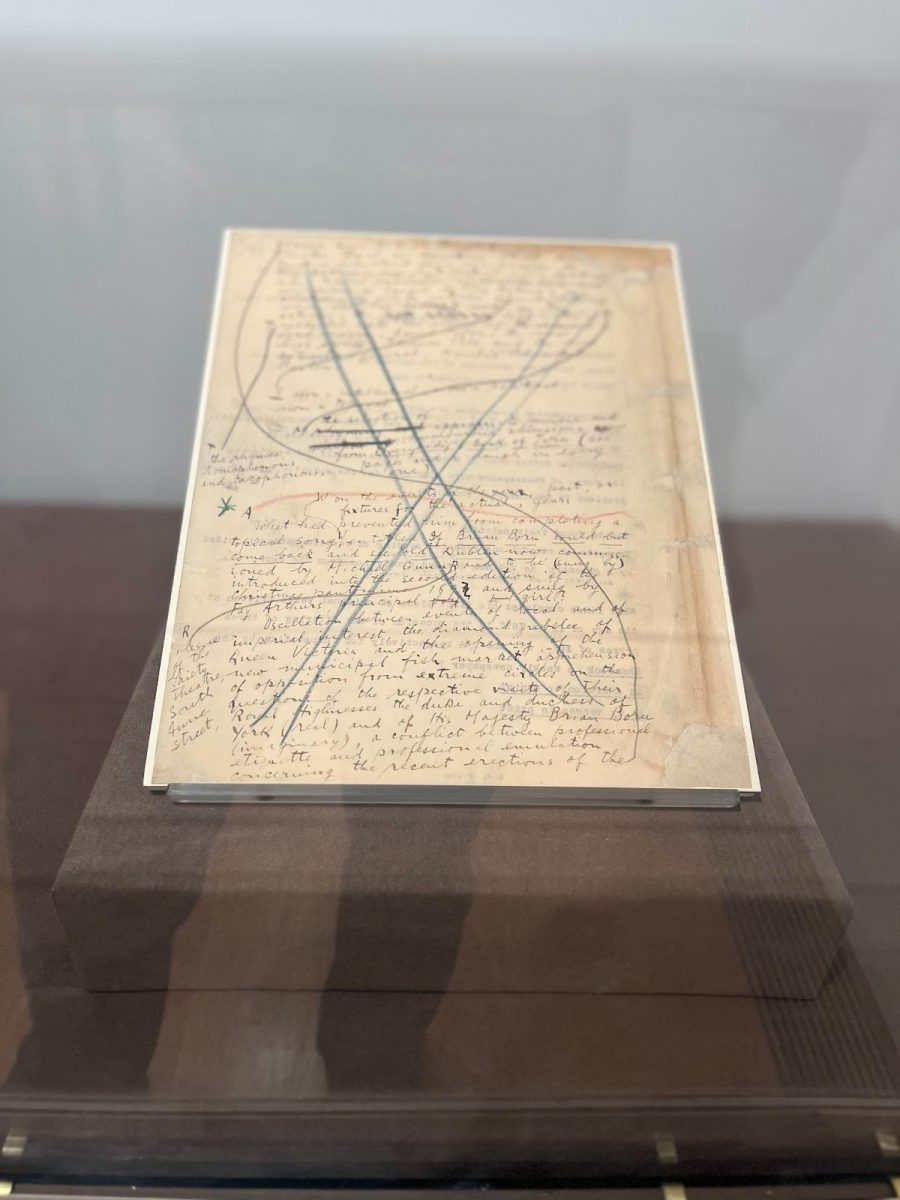
Little did Homer know that creating The Odyssey would plant seeds for whole other forests of ingenuity. This is especially seen with Homer’s inclusion of the character of Tiresias, a blind seer in Greek mythology, who transformed from a man to woman as a curse from the queen of Greek gods, Hera. Eliot wrote The Wasteland in an attempt to bring clarity to the disillusionment after World War I. In the poem, Eliot writes, “I Tiresias, though blind, throbbing between two lives / … can see /At the violet hour, the evening hour that strives / Homeward, and brings the sailor home from sea.” Blindness was a symbol of prophecy in Homer’s time, as it was in Eliot’s.
Stories written many moons ago can speak to people more now than then. That is the immortal magic that humans cannot help but be drawn to. After visiting Come Together: 3,000 Years of Stories and Storytelling, you will find the answer to Bradbury’s question – ‘What do you stay for?’
Do you stay for an explanation of where you came from? For a piece of inspiration from your own muse? Or, like myself, do you stay due to an allure that you cannot quite explain?