

On one of several afternoons in 1913, Emmanuel Radnitzky made his way towards 291 Fifth Avenue in Manhattan, the home of a quaint yet unremarkable brick building. Eccentric and slightly tousled, Radnitzky was then just an aspiring painter, spending most of his days working odd jobs and frequenting the arts. So when he learned of the 291 Alfred Stieglitz gallery, Radnitsky was thrilled. Even the famed photographer Stieglitz couldn’t have predicted it himself — from the grassroots of that gallery, Radnitsky would make his ascent to one of the most revolutionary, innovative artists of the modernist scene. To fit the part, he would rename himself ‘Man Ray.’
The pieces spanning Man Ray’s career, including his paintings, photographs, objects, prints, and innovations, are currently on display at Man Ray: When Objects Dream at the Metropolitan Museum of Art, on view through Sunday, February 1, 2026. Through the exhibit alone, visitors gain their first-ever glimpse of Man Ray’s artistic journey, with over 60 rayographs and 100 paintings comprising the show. Curators Stephanie D’Alessandro and Stephen C. Pinson diligently organized the exhibition in order to circulate around Man Ray’s mysterious rayographs, or “cameraless photography,” tackling the task of displaying them in a way that is novel and interesting. “One thing we really wanted to take on together is: how do we approach a well known artist with fresh eyes and with a fresh approach?” C. Pinson said,. “We realized that looking at the rayograph was a way for us to link the works that he did in this period across media.” Prior to Man Ray’s famous discovery of the rayograph, he experimented with paints, photography, film, gizmos, chess, writing, and cartography, which later aided his discovery of new styles like the aerograph and solarization. In a sense, his experimentation was precisely what made Man Ray such a distinct creator: he spent the majority of his artistic career trying multiple mediums, hoping one would finally “scratch his curiosity.”
The exhibit opens with the quintessential Man Ray artworks, presenting the creations that he considered to be his peak work: the book of rayographs, Champs Délicieux. The rayographs at the beginning of the exhibit are nothing short of mysterious, some depicting common everyday objects like keys and hairbrushes, while others depict shapes that may be harder to identify. They hold an air of mystery, mixing grays, blacks, whites, and some brownish outlines to create the very pictures that have tantalized the modern world. Yet what is most ominous is not necessarily the subject itself, but Man Ray’s methodologies, such as how he managed to make some items bright white and others a hazy gray. C. Pinson continues, “This is the way, of course, that people first saw [rayographs] in 1922, but then we stepped back in time and we discovered, with Man Ray, the various steps that led to this moment.”
One of those steps was notably Man Ray’s experimentation with paintings. Back at the Stieglitz gallery, Man Ray discovered Mann, Dove, Hartley, and Weber, to name a few, and began to learn of artists who became some of his primary inspirations. At one point, he fell in love with works by Paul Cézanne, whose usage of watercolor gave his artworks an unfinished air, and cubist works by Pablo Picasso, who eventually inspired some of Man Ray’s first paintings in the early 1910s. The exhibit features a wall of his colorful paintings, with one wall displaying his collection ‘Revolving Doors.’ The paintings consisted of bold primary and secondary colors, with squiggles and boxes to imitate the essence of various objects: a concrete mixer, dragonfly, or a meeting. Some are more difficult to interpret than others, making the collection quite intriguing, as viewers are challenged to dissect Man Ray’s artistic vision.
Stieglitz hadn’t just introduced Man Ray to modernism, however, but also to the beauty of photography. Man Ray recalls an eventful visit when Stieglitz — who frequently took photographs of artists, friends, and visitors of his exhibit — asked Man Ray to stand as still as possible before one of the gallery walls. While the shutter was open, Stieglitz stretched a cheesecloth over the head of the subject in order to diffuse the light, resulting in a muted, slightly hazy effect on the photo. One may think that the short interaction was enough to spark Man Ray’s interest in photography, but it came slightly later after Man Ray’s initial experiments with painting, “I bought a camera one day because I didn’t like the reproductions of my work done by professional photographers,” Man Ray said in a 1974 interview, “I studied very thoroughly, and after a few months, I did become quite expert.” As he studied photography for longer, he began to let go of painting and largely transition to photography.
In the next section of the exhibit, visitors get a tour of Man Ray’s creative mind from the late 1910s to early 1920s, featuring photographs that Man Ray took of objects like weapons, magnets, and irons. At the time, photography was actively contested as a true form of expression, thus Man Ray’s photographs of simple objects nearly made his artworks, as D’Alessandro says, “doubly contested.” To photograph an eggbeater, he hangs it on the wall and lights it dramatically, giving its edges a strong highlight and the shadows a cold brown hue — he named it “L’Homme,” or man. In close succession, he then photographed a companion piece “La Femme,” meaning woman, featuring an assemblage of clothespins, bowls, and possibly a metal rod. Though neither photograph is of a living being, he successfully captures the likeness of each through his compositional choices — the eggbeater imposing, dark, and photographed from below; the bowls bright, quite beautiful, with a line of six clothespins casting six delicate shadows.
In this section, viewers may also look towards his aerographs: he would use an air brush to construct a work which he considered — just like his impression of Cezanne’s works — unfinished, or at least in appearance. “It was thrilling,” he reflected, “to paint a picture, hardly touching the surface — a purely cerebral act.” In his piece titled Aerograph, it emulates that same unfinished appearance, with buildings and shapes that seem particularly draft-like. With an airbrush borrowed from his prior profession at an ad agency, he placed gouache onto the canvas and moved it around using the airbrush. Man Ray loved the air brush for its new perspective on painting, finding it intriguing how the brush size increased when closer to the paper, and shrunk as he pulled his brush away. It was his next step towards adding a three-dimensional quality to his flat paintings. “I tried above all,” he explained, “To create three-dimensional paintings on two-dimensional surfaces.”
Still, photography hadn’t quite scratched the curious itch Man Ray so desperately wanted to relieve, and in 1920, he created Obstruction. Found past Man Ray’s photographs and paintings, Obstruction was one of the final experimental pieces Man Ray created before his discovery of the rayograph — using none other than the medium of clothes hangers. When first observing the sculpture, what stands out the most is its incredible ability to hang 62 identical clothes hangers in an entirely plumb and balanced fashion, creating the effect of duplication. This balancing act is no coincidence, but an example of arithmetic progression, with Man Ray drilling two hangers into one, then two hangers into the next, then the next and next. The result is a single hanger appearing to duplicate itself constantly until it, essentially, “obstructs” the room. As Man Ray reflects, “It would have been amusing to keep going and obstruct the whole universe.” At this moment, the impacts of Dadaism and Marcel Duchamp were evident in Man Ray’s work, as Man Ray began to associate closely with Duchamp in the years before the creation of Obstruction. In the light of the nonsensical, anti-art movement, the sculpture cast a splintered, uninterpretable shadow on the surface under and around it.

The relationship between Duchamp and Man Ray holds much more than a loose association with, or occasional inspiration from, the other. Duchamp and Man Ray met back in 1914 during a simple tennis game in New Jersey. They played without a net, and neither spoke the other’s language. Man Ray recalls that he “called the strokes to make conversation: ‘fifteen, thirty, forty, love,’” with Duchamp repeating after each stroke, “yes.” Yet the effects of Duchamp had taken hold a year earlier at the 1913 Armory Show, when Duchamp’s art and other modernist and dadaist works reverberated deeply through Man Ray’s mind. Inspired, though stumped, Man Ray made no artworks for six months after the show. Now meeting Duchamp for the first time, while using Man Ray’s French-speaking wife as an interpreter, they were soon to bond over their blooming modernist ideas.
In 1921, Man Ray moved to France, writing that “Dada cannot live in New York. All New York is dada, and will not tolerate a rival.” Now in Paris, Man Ray gradually picked up the French language, He met some of the most exciting artists and most influential friends of his career. Among many, he met James Joyce, Pablo Picasso, Salvador Dali, and Ernest Hemingway, frequently photographing them and sharing his swelling love for modernism. Most notably, he met famous performer Kiki of Montparnasse, who became his living muse and obsession — Man Ray divorced his last wife before leaving for Paris, subsequently falling in love with Kiki. Man Ray deeply admired the structures of the female body, viewing them as instruments to photograph just like his other subjects, stating, “How astonished they would be if I told them that they are participating for exactly the same reasons as a quartz gun, a bunch of keys, hoarfrost, or fern!” His obsession with the female body is displayed throughout the films shown at the back of the exhibit, as well as through a variety of photographs located throughout the show.
One day in his studio, Man Ray left some objects on photosensitive paper, then flicked on the light. What was originally an accident turned into an entirely new artform — to Man Ray, as the rayograph did exist before Man Ray’s usage of it — creating photographs without an actual camera itself. Man Ray recalled, “One sheet of photo paper got into the developing tray… regretting the waste of paper, I mechanically placed a small glass funnel, the [glass] graduate and the thermometer in the tray on the wetted paper. I turned on the light; before my eyes an image began to form.” To the understanding of most artists today, the rayograph was created by varying the level of light exposure to the paper, with the whitest part of the art piece the least exposed to light, and the darkest the most exposed. What makes these rayographs especially extraordinary is Man Ray’s masterful use of the medium, creating in-between gray shades, overlapping shadows, speckled patterns, and gradients with bright white outlines and deep contrasts. Still, Man Ray remained true to his dadaist friends, using a random assortment of objects to continue pushing the boundaries of the art world, as well as adding to the wonders of his modernist world. Truly, the rayograph was the pinnacle of Man Ray’s career, and as he exclaimed himself, “I have freed myself from the sticky medium of paint and am working directly with light itself!”
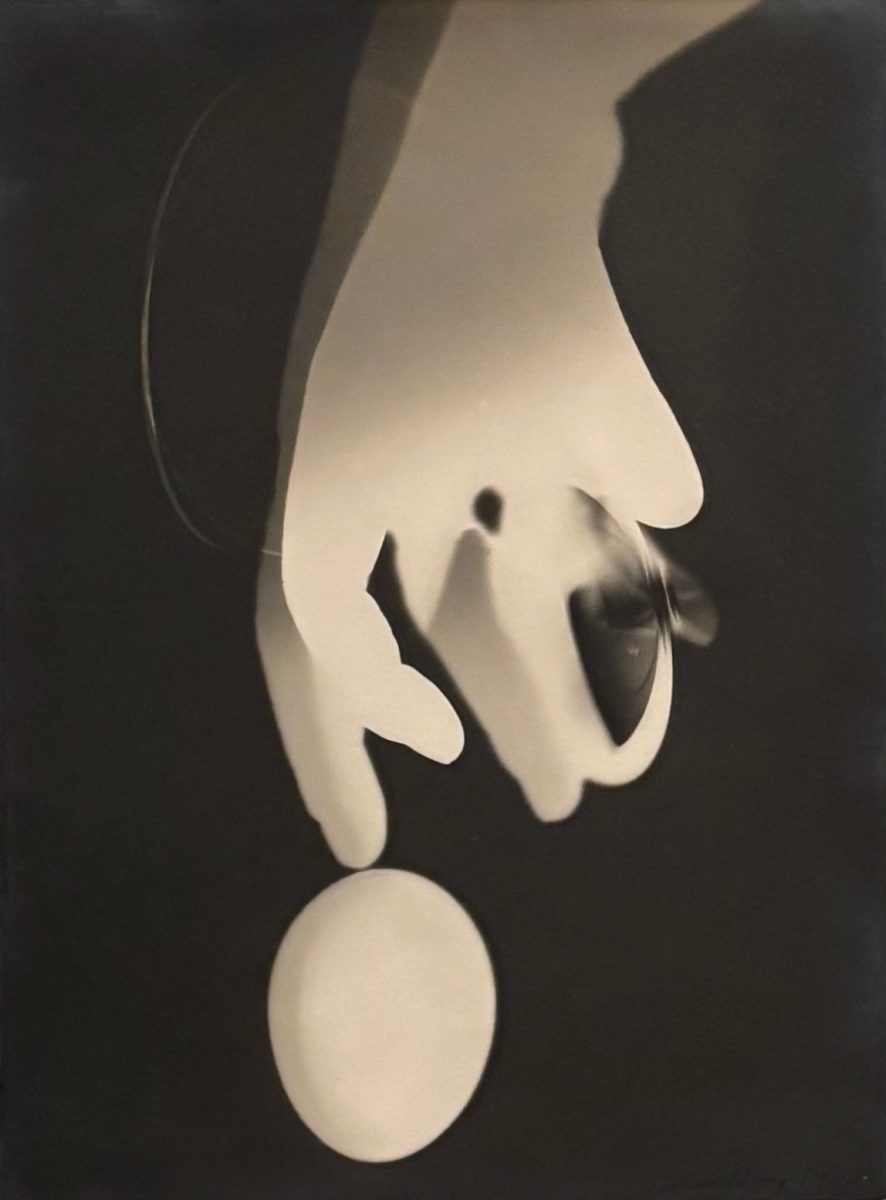
In the center of the exhibit, visitors finally reach the rayographs. The dark walls envelop the rayographs in a shadow of mystery, and viewers are left even more puzzled, if not already, by Man Ray’s marvelous imagination. Running down the center of the exhibit is a line of simple objects, such as wrenches, coins, springs, and screws, as well as a film tape. Man Ray’s assemblages accompany the rayographs perfectly, and they nearly seem to emulate the rayograph before it is transferred onto the paper, and before the objects are removed to reveal the photosensitive paper. Then, illuminated inside a bright display case, the film tape is lined with dancing white lines and speckles against a backdrop of dark gray, creating shapes and scribbles that move fluidly across the thin strip.
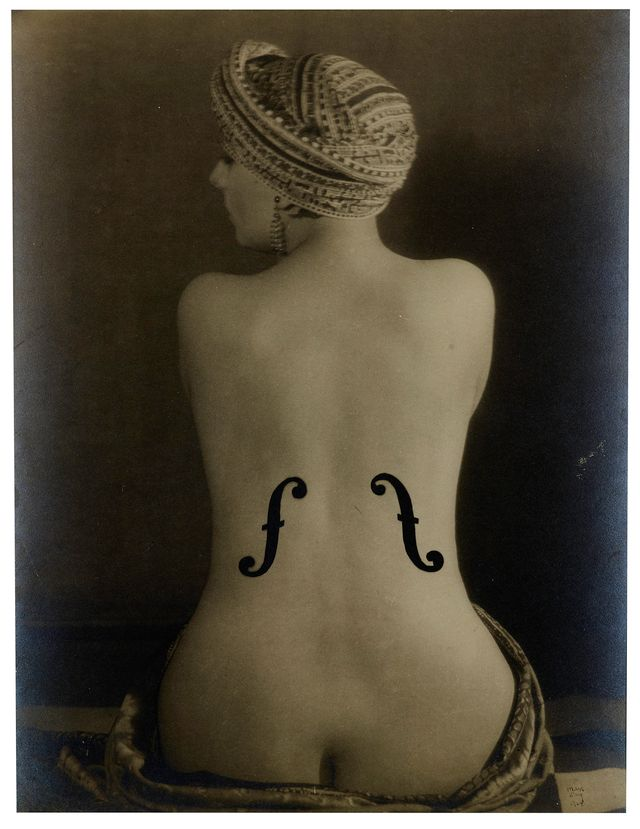
Finally, viewers are brought to the pinnacle of the exhibit: Le Violon d’Ingres, considered the Mona Lisa of the show. Depicted is a photo of Man Ray’s lover, Kiki de Montparnasse, which sold for $12.4 million at auction — the most expensive photograph to be sold to date. Yet Man Ray goes beyond just photographing his lover, combining his rayograph technique with the photograph by flashing sound holes onto Kiki’s back. The result is a continuation of Man Ray’s love for the objectification of a human body, or perhaps his consideration that his lover’s body was musical in structure.
The rayograph inarguably had a monumental effect on Man Ray’s future artworks. Eventually, he found solarization, a process of photo-modification first discovered in the 1850s. In 1929, Lee Miller, an artist and photographer herself, worked as an assistant for Man Ray, helping him create photographs in his dark room. However, one afternoon in the studio while the lights were shut off, Miller felt a rat run over her foot, and she instinctively turned on the lights. Realizing her mistake, she shut off the lights immediately afterwards, unaware that she had accidentally solarized a photograph. The process of solarization involved turning on the lights while a photograph was still developing, subsequently inverting the colors and giving the image its distinctive hazy black halo. In Man Ray’s next collection of photographs, he turns them all into solarized images, adding a magical glow — photography was an artform Man Ray proved he would relentlessly improve and experiment with.
As a beautiful close to the exhibit, Man Ray returns to his original medium of paint. With the rayograph still engraved into his mind, he couldn’t help himself from painting rayographs directly onto his canvases. The curators put some of the rayographs side by side with the paintings, as his inspiration were undeniably present — some had the same shapes, patterns, or compositions as specific rayographs. These are also paintings that have been considered overlooked for likely decades, with their last exhibitions taking place as far back as the 1930s.
From 1930 and on, Man Ray continued making his works, oscillating between France and the United States, garnering fame from his photographs, and displaying his works occasionally at exhibits. In the process, Man Ray fostered a mania for his art that few people will ever encounter in their life. When asked what his passion was, he first replied ‘liberty,’ then continued, “When they said I was ahead of my time, I said, ‘No, I’m not, I’m of my time, you are behind the times.’”
“When they said I was ahead of my time, I said, ‘No, I’m not, I’m of my time, you are behind the times.’”