

Paris, one of the most picturesque cities of Europe, is photographed every day by tourists, professionals, and aspiring social media stars alike. Images of the Eiffel Tower and les Champs-Elysées have populated travel guide websites and books for decades, bringing millions of tourists to the city every year. But before these edited, embellished photos of Paris’s most popular landmarks, and before content creators were the ones to convince us to add Paris to our list of dream destinations, there was Eugène Atget (1857-1927 C.E.), the French pioneer of documentary photography whose photos of old, local Parisian architecture captured the city’s character like no other. Until Monday, May 4th, 2026, you can experience these photos for yourself at the Eugène Atget: The Making of a Reputation exhibit at the International Center of Photography on the Lower East Side, curated by David Campany.
Atgèt was not just a photographer– he was a flâneur, the French term for a leisurely stroller. The word refers to someone who frequently spends their time wandering around observing urban life with no clear purpose. They walk around cities for hours upon hours, absorbing the world around them for the sake of appreciating it. A quintessential New York City flaneur is Joseph Mitchell, the renowned writer for the New Yorker who spent decades strolling through New York City, finding niche stories along the way. He frequently profiled ordinary, sometimes marginalized New Yorkers who had deep roots in underappreciated parts of the city.
Atget was not a journalist, but he captured his own city in just as remarkable a manner as Joseph Mitchell did. Instead of finding people to interview during his walks through 19th and 20th century Paris, he would snap a photo of anything he found interesting. This kind of photography is referred to as documentary photography, which has the goal of showcasing real-life events and social issues. This art form was frequently used by American activists in order to expose the terrible living conditions for working-class Americans in the same time period. For example, Jacob Riis wrote a book entitled How the Other Half Lives, which featured shocking photographs of tenements and overcrowded immigrant neighborhoods.
Atget’s work did not have such an emphasis on societal problems — instead, he highlighted the rapid modernization of Parisian architecture during his lifetime. In the early 1900s, the previously dominant Haussmanian style shifted to Art Nouveau: ornate curves, iron, and reinforced concrete. Some argue that the shift erased Paris’s rigidity, diversifying its architecture in order to appear more vibrant and organic, but looking at Atget’s photographs makes the transformation feel like a loss. He took casual photos of buildings, vehicles, shop windows, and street scenes (courtyards and residential interiors), honoring the beauty and romance of “Old Paris” as it was actively being replaced.
A common technique used by Atget throughout his career was extremely long exposure times. To allow his viewers to focus only on the architecture in his pictures, he erased the people walking in these environments by making his camera take much longer than usual (sometimes up to 20 minutes for one photo) to capture light, making pedestrians invisible or look like faint blurs. Atget was also known for frequently taking his photographs at night time, which create atmospheric scenes with long, deep shadows. The nature of his photography equipment also contributed to this effect as he used a large format camera on a tripod with 180 × 240 mm gelatin glass plate negatives.
The result of Atget’s efforts is a remarkable collection of simple, but fascinating photographs of one of the most beautiful cities in the world. His images are quiet, humble, and barely edited, giving an honest impression of Paris and the way it used to be.
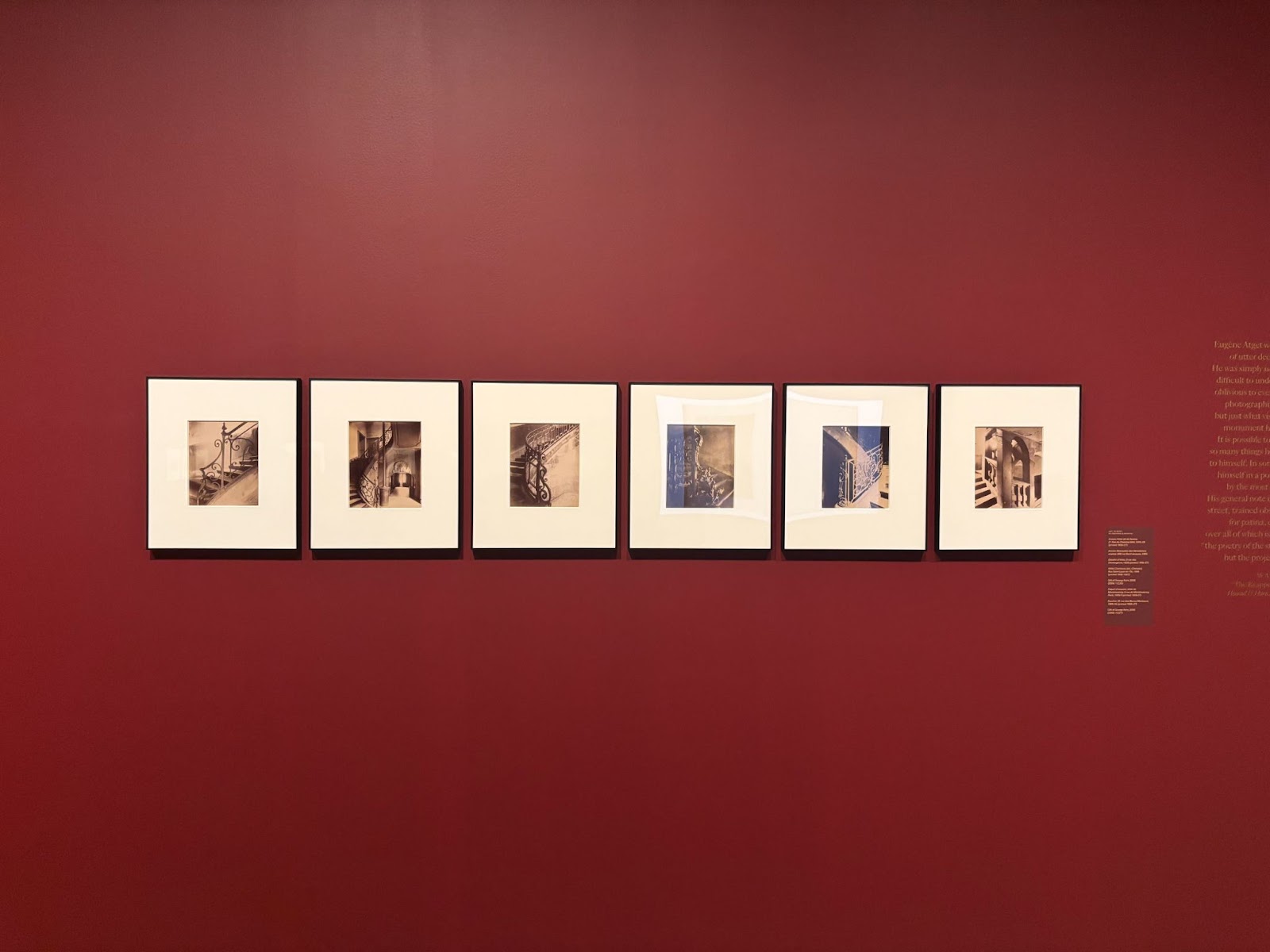
At the International Center of Photography, British curator David Campany gathered an impressive number of Atget’s works, and put them on display to honor his overlooked career. Indeed, Atget never received recognition for his photographs while he was still alive. He died in 1927 mostly unknown and in poverty. Though he did sell some of his pieces to various institutions before his death, his pictures were never seen as art, but rather as practical documentation of Parisian architecture.
We can appreciate Atget’s work today almost solely because of the work of a woman named Berenice Abbott (1898 – 1991 C.E.), an American photographer of the mid-nineties who discovered Atget while she was working as a darkroom assistant for Man Ray in Paris.
Man Ray (1890 – 1976 C.E.), for those who are unfamiliar with his work, was a key member of the American Dada and Surrealist movements in the 1900’s. Ray and Atget were neighbors in the 1920’s, both living on Rue Campagne-Première in Montparnasse in Paris. As artists do, Atget and Ray shared their work with each other, and Ray soon became captivated by the surreal quality of his neighbor’s photographs. He purchased between 40 and 50 of his pieces in 1926, right before Atget’s death, and published some of them in La Revolution Surrealiste, drawing attention to the late artist.
At the same time, Ray also shared these photos with his young assistant, Berenice Abbott, who was just as inspired by Atget as Man Ray was, if not more so. Upon experiencing a “sudden flash of recognition” with his work, Abbot instantly set out to purchase many of Atget’s pictures in order to ensure they would not be forgotten. She met with Atget in 1927 (the year of his passing), where she took the last three portraits of him during his lifetime. These portraits are featured in the ICP’s exhibit as an homage not just to Atget, the artist, but to Atget, the person.
Abbott then devoted the rest of her own career to acquiring Atget’s estate and all the prints within it, which she then brought to international attention. In 1964, Abbott published a seminal book entitled The World of Atget in the Horizon Press, which featured 180 of his works along with her own personal commentary. It is thanks to Abbott that Atget has wider recognition rather than being known only within intimate artistic circles. Thanks to Abbott’s promotion, by the 1930s, the quiet photographer had become a global sensation for all kinds of artists.
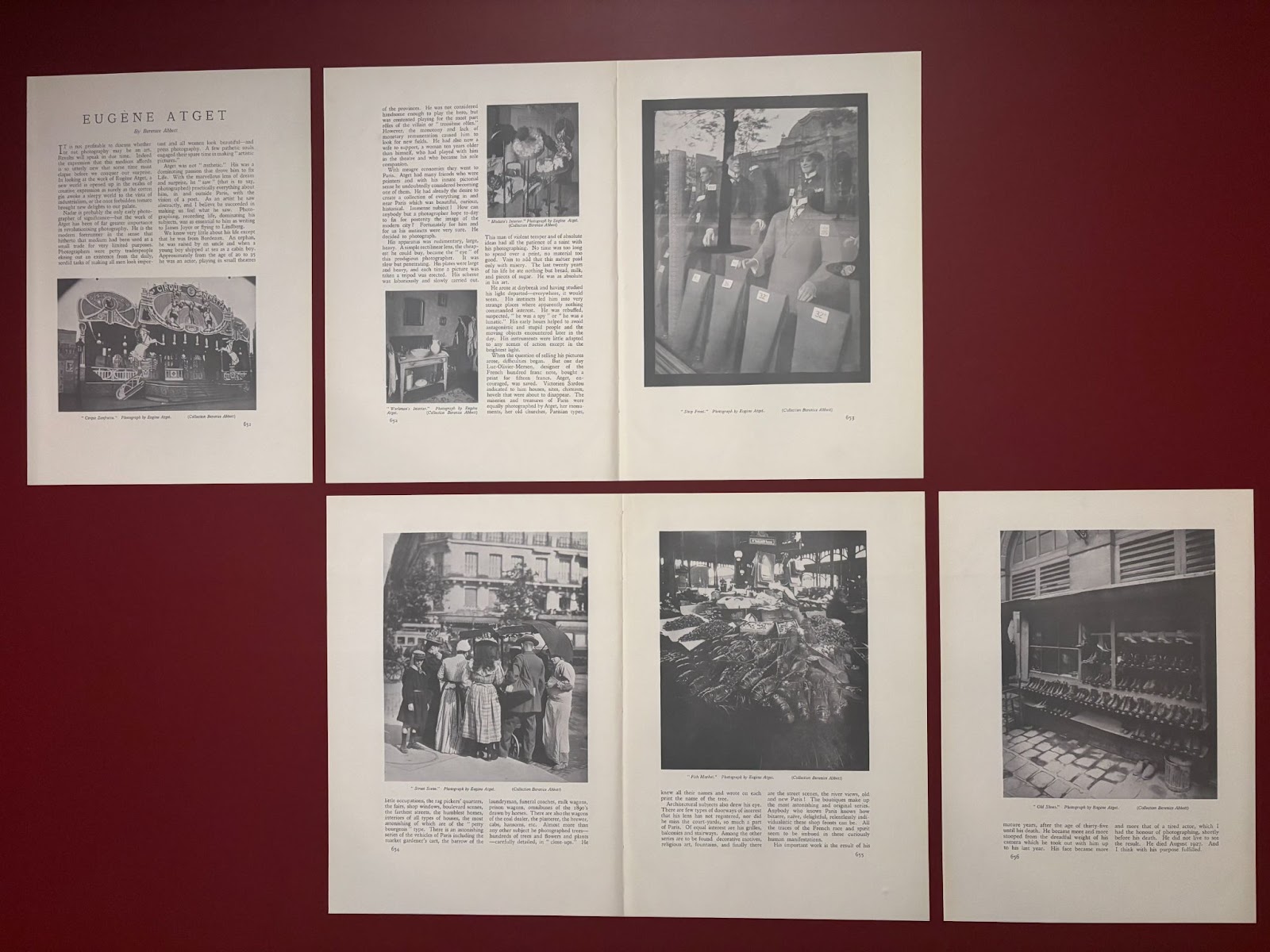
The ICP’s exhibit is just as much an ode to Berenice Abbott as it is to Eugene Atget. Alongside Atget’s original works are copies of the magazines and publications that helped to establish Atget’s wider audience, as well as images that were included in Abbott’s book. The rooms are filled with display cases that hold some of the first newspaper issues to include Atget’s work, which jumpstarted his official debut. The walls are also adorned with quotes from Abbott and other renowned photographers, praising Atget’s unique style and pondering over the messaging of his work. These reflect a deep respect for Atget, his artistry, and his legacy.
One of the first quotes in the exhibit, resting along the first photographs, is one by the French actor and film director Andre Calamettes (1861–1942 C.E.): “…May all the amateurs of what he had so much loved — I mean Paris, and all its treasures — in admiring what still exists, or in looking at the beautiful images that Atget made, pronounce his name, which is that of an artist, strong and courageous, an admirable image maker.” This crystallizes not just why Atget was worthy of recognition, but the success of Abbott’s efforts, turning Atget’s name into one of honor and praise. Leading off the exhibit in this way, with real, spoken words of admiration, prepares viewers for a fascinating exhibit, which they will experience knowing that it is one-of-a-kind.
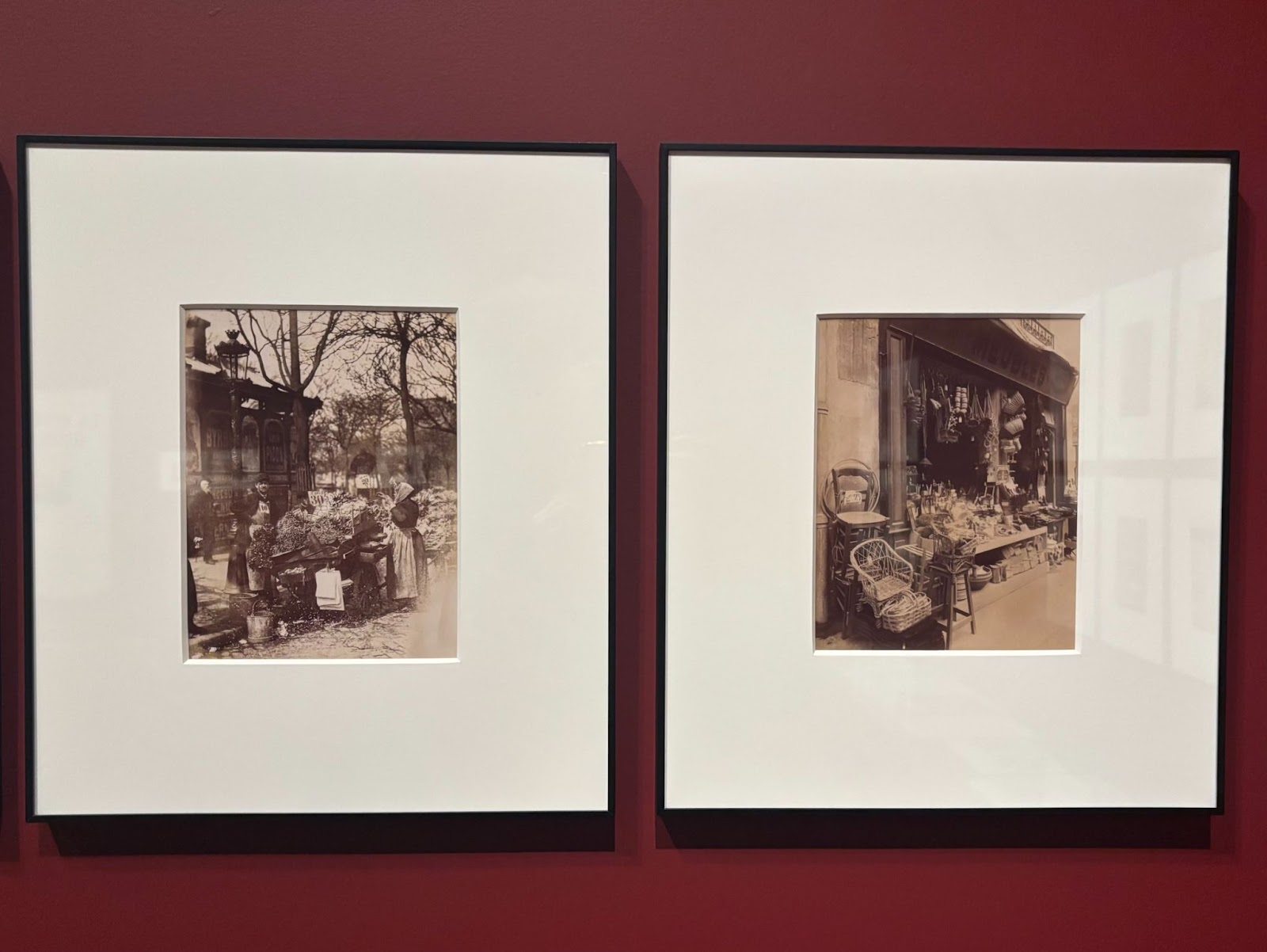
All throughout the room, photographs are strategically placed in groups in order to create different emphases. The first photos prominently feature nature, in its ugliest (Rue Lepic, a bare, straggly tree on a wide street) and its prettiest iterations (Marche de La Madeleine, a full tree casting shade on a market stand of flower bouquets). This duet emphasizes the duality of Paris: though it is considered one of the most beautiful and romantic cities in the world, no city is without its less extravagant parts.
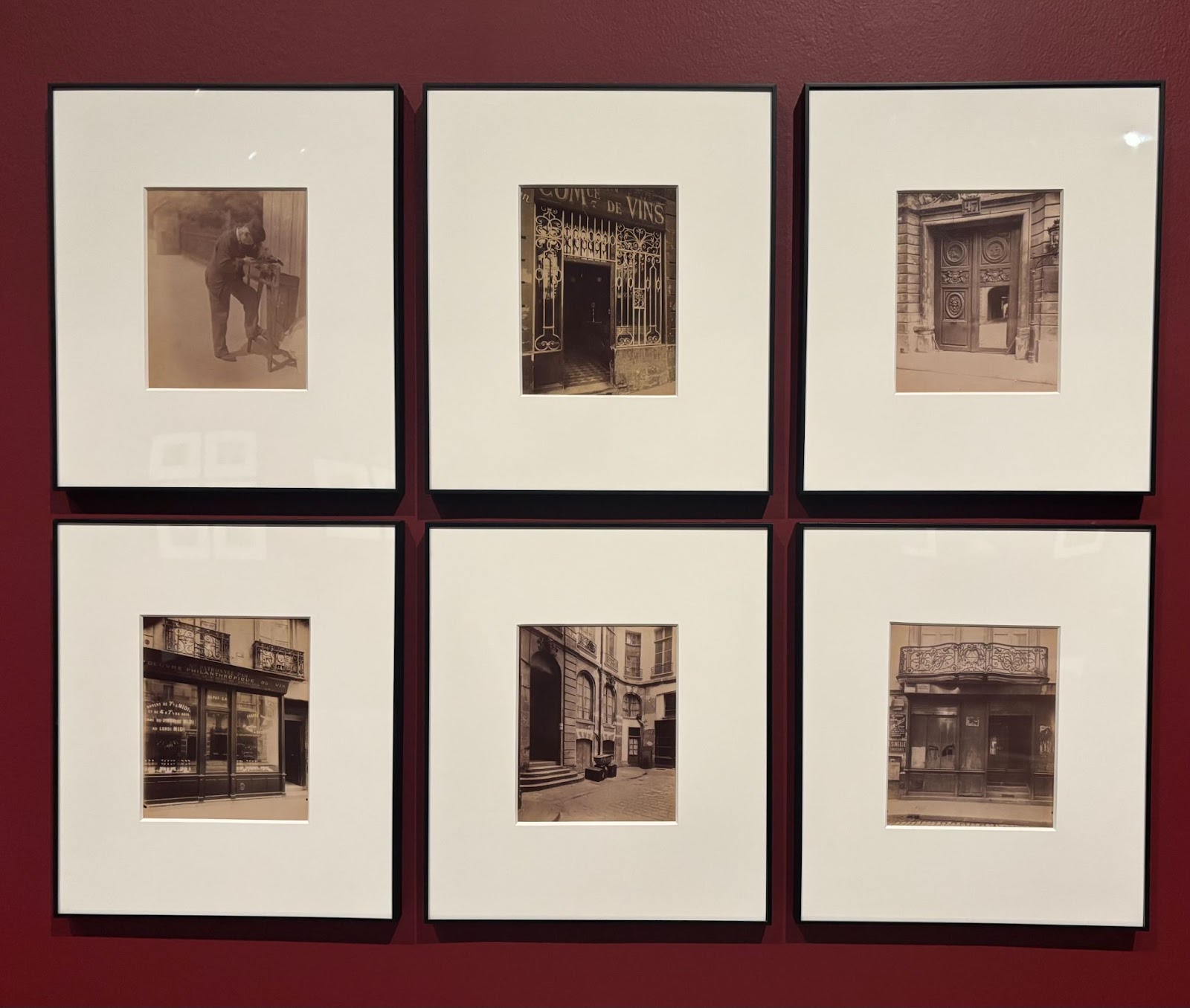
Later on in the exhibit, there is a collection of six photos that each contain a doorway, except for one, for an unknown reason. They include a door to an apartment building, a door attached to a storefront, a heavy metal door, and a door surrounded by impressive wrought-iron balustrades. Each of the photos can be identified as having been taken in Paris, mostly by the common feature of filigree (ornamental works created by twisted metal wires), although they are all in utterly different locations. These pictures articulate the consistency of Old Paris, which maintained its unique style around the entire city.
A final example of these small collections within the exhibit is another duet near the end. Hotel de Beauvais. 68 rue Francois Miron and Hotel du Marquis de Lagrange 4 et 6 Rue de Braque are both images of hotel interiors, which are remarkable mostly due to the presence of shadows. By taking photos surrounded by four walls and underneath a high ceiling, Atget manipulates the light in order to draw attention to the designs on the walls (as in the first photo) or on the breadth of the space (as in the second photo). The result is that Atget has created photos that draw you in, inviting you to follow the light.
Another one of the quotes, written by the French journalist, publisher, and author Florent Fels (1891 – 1977 C.E.), touches on a different aspect of Atget’s career. Fels writes, “Atget’s name is little known to the general public. There were only a few of us, writers and painters, familiar with his work and with the strange dwelling of this surprising man who sold, at a hundred sous the print, the most beautiful still lifes and the most hallucinating views of Paris.” Fels acknowledges the quietness of Atget’s career, that despite Abbott making his name known, she did not make it universal.
In fact, a large reason why Atget’s name is not known is because he did not want it to be. When he first sold his photographs to Man Ray and was told the pictures would be featured in an issue of La Revolution Surrealiste, Atget specifically requested for his name not to be attached. This can be observed on a copy of the issue itself, which is printed large for viewing at the exhibit. According to the ICP, Atget’s exact words were: “There are simply documents I make.”
Whether or not the photographer viewed his own works as artistry is a matter of intrigue. For all intents and purposes, Atget perceived his photographs to be of practical value, where he believe that he was not necessarily capturing the beauty of Paris, but instead was documenting its history. While these two purposes might seem synonymous when we think about them now (if historical Paris is beautiful, then isn’t any photo of it innately capturing its beauty?), to Atget, the two might have been a true dichotomy.
Regardless, the Eugène Atget: The Making of a Reputation exhibit does make one point abundantly clear: the name Eugene Atget will not slip through the cracks of fame.
The result of Atget’s efforts is a remarkable collection of simple, but fascinating photographs of one of the most beautiful cities in the world. His images are quiet, humble, and barely edited, giving an honest impression of Paris and the way it used to be.