

As you walk into the June Leaf: Shooting From the Heart exhibit at NYU’s Grey Art Museum, currently on view through Saturday, December 13th, 2025, you are confronted with works of art made from paint, charcoal, pencil, wire, photographs, and just about every other art medium imaginable. Yet, at the center of all of these sculptures, paintings, and drawings, lies the name of only one artist: June Leaf.
Born in 1929, Leaf grew up at the time when Fauvism, Expressionism, Cubism, and Futurism had all recently emerged in the realm of visual art, all in the early 20th century. With the Atlantic Ocean separating the young Chicagoan from the likes of Pablo Picasso and Henri Matisse, Leaf’s authentic artistic spirit resisted these modernist influences. It was an anomaly amongst artists at the time – who all wished to compose works comparable to those of the new “greats” – for Leaf to so adamantly maintain her personal style.
Yet, her work was not without evolution. Her early childhood compositions – expertly designed recreations of common stories and tales – underwent a transformation in her college years at the Institute of Design in Chicago, from which she emerged as a member of the existentialist art group with the moniker ‘Monster Roster.’ This group famously rejected abstractionism, opting for more emotional and figurative art. ‘Monster’ alludes to the grotesque and invasive quality of the movement’s most notable works, which dealt with the concepts of trauma and alienation in the aftermath of World War II and the advent of the Cold War.
Leaf herself, a more peripheral member of the movement, produced works that possessed a more dream-like, whimsical quality compared to those of her counterparts. She often included feminine subjects as the centerpieces of her work, elevating the theme of fragility. Her obsession with the human condition was not “monstrous,” but it incited that same feeling of intimacy with her viewers. Though not emphasized in the Shooting From the Heart exhibition, her works from this time period (mainly from the 1950’s) are incredibly powerful.
One of her most well known contributions to ‘Monster Roster,’ entitled ‘Carnival,’ transformed a portrayal of festivity into a distorted image of two, seemingly topless female characters (whose backs are turned) surrounded by unsettling, almost witch-like faces. With the two women not only lacking clothing but being taller than the rest of the subjects, there is palpable discomfort emerging from the painting. This work is a perfect example of how Leaf intersected her own personal artistic preferences – those being delicate, female figures as centerpieces – with the ideals of the ‘Monster Roster.’
Similar select pieces are showcased in the first room of the exhibition, which is devoted to some of Leaf’s earliest works. Featuring her iconic style and unique mastery of various art forms, the room is filled with paintings, sculptures, and even a diorama. These artworks are bright and colorful, yet provocative.
Perhaps the most eye-catching of them all is a painting of a woman with bright red hair and pink-toned skin, holding a canvas in her midriff and a rope in her left hand. The canvas is a dark grey background with a feminine figure in the center, who appears to be chained to the upper border of the canvas. Holding the other end of the chain is the woman, who seems to be using that figure as a puppet. The rope that the woman is holding in her left hand is suspending a couple, intertwined together in embrace. There is a masculine figure in her pelvic area, who is fully dressed and smiling, unlike the feminine figures. The woman herself has her tongue sticking out, smiling in an eerie, unsettling manner.
The painting draws your eyes in every direction. Looking at it, I was equally captivated and confused, sure of its brilliance but unsure of its message. The man in her pelvic area seemed to suggest themes of sexism and abuse, while the figure in the canvas – who seemed to me a representation of the woman’s soul – elevated the idea of fighting with and restraining one’s authentic self. It beautifully conveys the complexity of femininity, leaving viewers startled at the chaos.

Leaf continued to explore these ideas throughout the rest of her career. After three decades of living in Chicago, she received a Fulbright Scholarship to pursue self-study in Paris. There, she finally ventured into Abstract Expressionism, drawing inspiration from artists such as Paul Klee and Mark Tobey. When she completed the five months of her program in 1960, she returned to the United States. However, instead of going back to her hometown of Chicago, Leaf headed for New York City.
It was in New York City that Leaf’s life really took hold; she was producing endless amounts of art, had her first exhibition at the Allan Frumkin Gallery in 1968, and got married to the photographer, Robert Frank, in 1975. Frank had became famous with his iconic photography book The Americans, first published in France in 1958 and in America in 1959, with an introduction for the American edition by the Beat writer Jack Kerouac.
Looking at the couple now, as someone who knows of and respects the work of both Robert Frank and June Leaf, the pairing is nothing short of iconic. However, during her career and still today, Leaf’s work has been overshadowed by that of her extremely successful husband. Combined with the sexism in the art world, her marriage to Robert Frank surely did not help her popularity. But Leaf didn’t care. She was not preoccupied with the opinions of others, and rather only wanted to create art that satisfied her own, imaginative mind.
After featuring the earlier pieces from the 1940’s and 50’s, June Leaf: Shooting From the Heart progresses to her compositions from the seventies, eighties, and nineties in a non-chronological order.
However, the arrangement of the artwork is not without reasoning. As Sam Adams, curator of Modern and Contemporary Art at the Allen Memorial Art Museum at Oberlin College, and co-curator of June Leaf: Shooting from the Heart shared in an interview with me, “Many retrospectives of an artist are chronological, but [June Leaf] returned cyclically to a number of motifs. We wanted to organize the exhibit in a way that honored the way she worked.”
Stepping into the second room, there are clearly dominant themes being expressed by all of the pieces. Paintings and sculptures of women, needles, and angels surround you in the large space, elevating equally gentle and powerful themes of femininity. “There’s this one section we call ‘The Prophecy of Her Power,’ which is all of these feminine archetypes that recur throughout her works,” Adams explained. “[Leaf] herself was extremely beautiful and she was sexualized from a young age by people around her, and so she was very very aware of her own body and women’s bodies.”
A recurring motif of Leaf’s in this section is that of a feminine figure with a large, bulbous head. The image came to Leaf when she first saw it in the reflection of a boat mooring in the water near the ferry service for Little Narrows, Nova Scotia (where she lived part-time starting in 1969). One of its most famous depictions is in the form of a sculpture made from brass and steel rods entitled ‘The Head,’ made in 1980 and placed in the center of the room. The image also stands in the form of a multicolored, metal sculpture; the image is on the wall as drawings and sketches, and as more tin sculptures (one of which is entitled ‘Shooting From the Heart,’ after which the exhibition is named); the head confronts you almost aggressively, as you have nowhere else to look but straight at it.
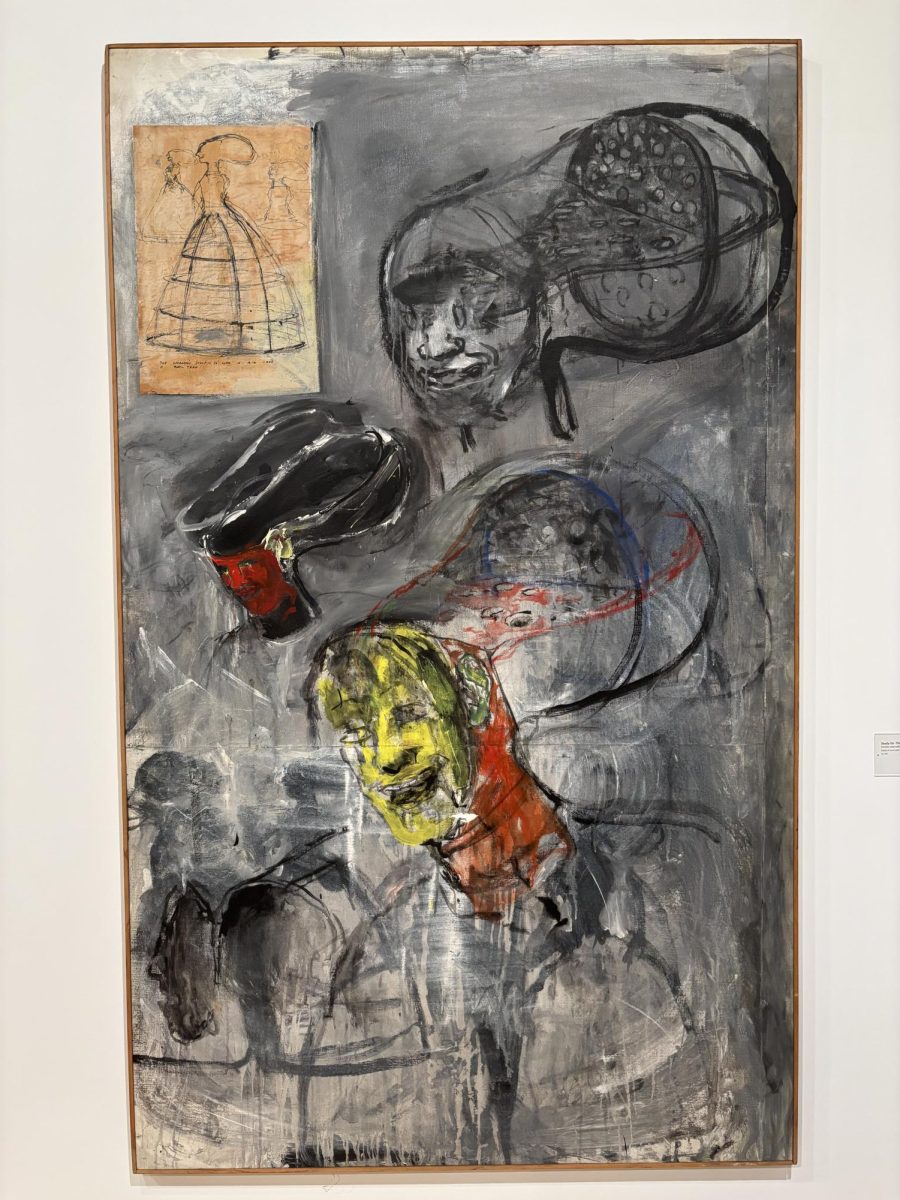
One of the sketches with the head on it also includes a text written by June Leaf: “She has a mind like a speedometer gone insane.” The words suggest that the motif represents the erratic, uncontrollable movement inside a woman’s brain. She is hyper-aware, full of energy and knowledge, rapidly racing from one thought to the next. Yet, her spectacularity is confined to the walls of her head. In another painting, the head rests atop the shoulders of a woman in a hoop skirt, an iconic, vintage symbol of pure femininity. To me, this spoke to the universality of female excellence, telling viewers that even picture-perfect female figures have a locomotive mind. The symbol defies the years of hypersexualization that Leaf experienced. It is deeply moving, inspiring, and uplifting.
Another frequent symbol in this section is the act of sewing. Various paintings show figures emerging from a very small needle, representing Leaf’s idea of “creating life out of life.” A hobby typically associated with women, the symbol of the needle reinforces Leaf’s devotion to female empowerment. The tin/wire sculpture entitled ‘Woman Drawing the Man’ is the quintessential embodiment of this motif, showing a seamstress who is drawing and crafting a male figure. The piece feels matriarchal, pushing the viewer to appreciate the precise craft of the woman.
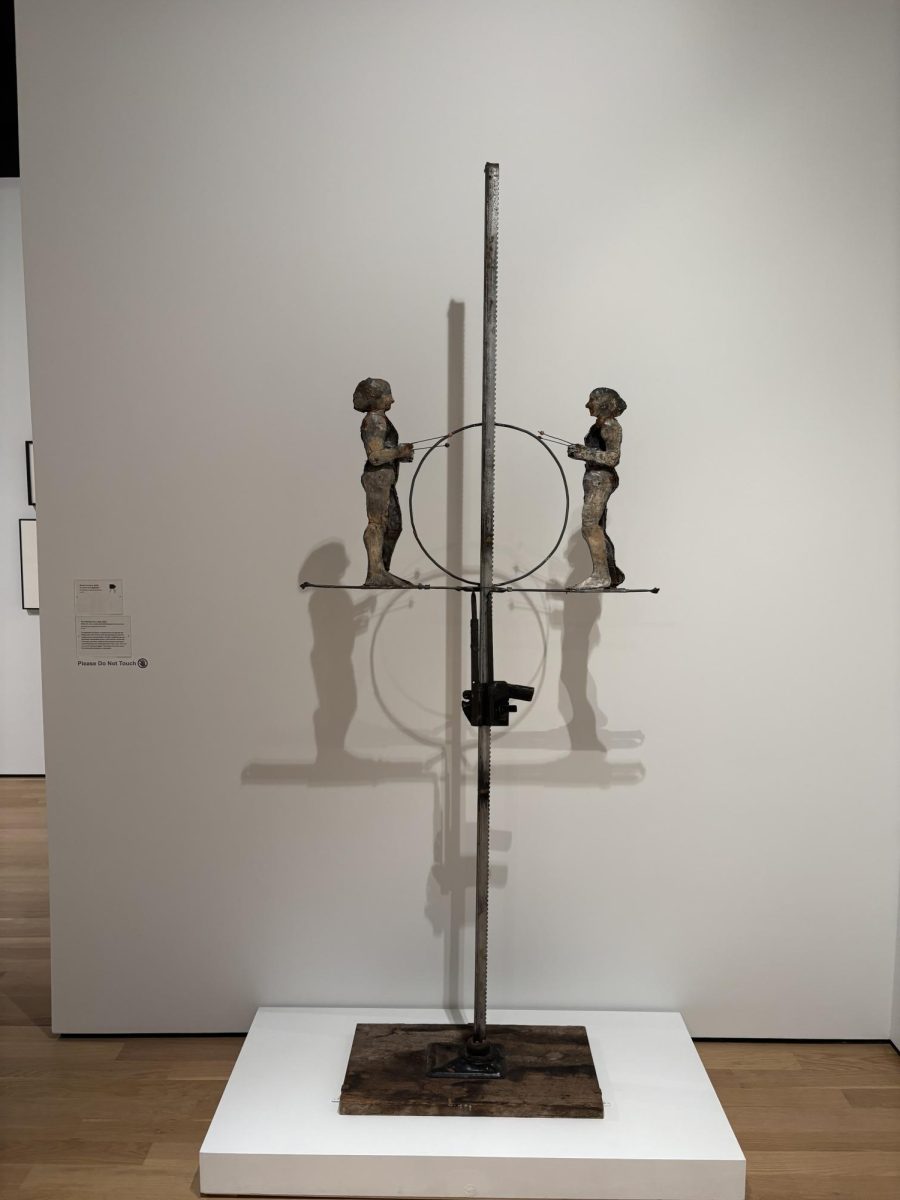
Moving into the next room, there is a distinct shift in theme. The exhibit transitions from female focuses to more undefined characters, often depicted as a couple. The sculptures are much less bright and grand, taking on more discrete forms with thinner wires, smaller human figures, and subtle meanings.
There are a few exceptions to this shift, one of the most notable being a large painting of a man and a woman, where a small, almost miniscule feminine figure is soothing a much larger male. Entitled ‘The Rescue,’ the painting places the two figures in direct contrast (the woman is bright pink, while the man is dark blue and red), emphasizing the man’s somber disposition against the woman’s serenity. Despite her size, the woman is taking care of the man on her own, displaying her influence over him.
The rest of the room is filled with the thin, symbolic structures mentioned before. They explore the tensions and comforts that exist within both romantic and platonic relationships. Leaf uplifts themes of partnership and solidarity, as well as betrayal and strain.
Something particularly fascinating about this section is the juxtapositioning of works: almost every sculpture has a matching painting or sketch by its side, where you can see the elements of the sculpture in 2D. Yet, walking through this room myself, I admit that few of the scenes made sense to me upon first glance (even with two mediums to view them through). I found myself circling around the small room for over half an hour, trying to piece together the works and come up with my own interpretation of the themes that Leaf has expressed.
Adams confessed that they, too, needed time to comprehend Leaf’s unique style. “The work did not immediately resonate with me because it is very muddy,” they explained. “It is the work of a DaVinci type genius who’s constantly layering ideas on top of each other. I found it really overwhelming at first… it’s like her brain was spilling out onto the page.”
My sense of confusion was somewhat relieved, however, as I entered the next and final room. This portion of the exhibit not only contained some of Leaf’s more unique works – those primarily being interactive sculptures (though you cannot touch them in the exhibit) – it also contained a narrated video of Leaf where she takes you through her creative process.
Though Leaf passed away recently in July of 2024, she still played a role in planning and organizing the exhibit. Adams themself shared about how they met Leaf on multiple occasions. “I am a convert. Seeing her studio and how she works. She went into her studio to weld metal every single day… just the strength that that takes is incredible,” they said. “She saved every ounce of energy she had to make art, so she’d be like ‘Yeah, yeah, thanks for doing the exhibit… I just want to get back to my studio and work.’ That was always her focus.”
Adams continued, describing their own experience in June Leaf’s studio during the organizing process of the exhibition. “She was constantly refiguring these sculptures and paintings and drawings. It was really like this magical workshop, kind of like a microcosm,” they revealed. “She had all these different landscapes and stories and figures and it was really theatrical, which we tried to recreate in the gallery.”
Indeed, Adams wanted to ensure that the exhibit was coherent with Leaf’s workshop culture, and the video played a large part in achieving that. For three minutes, viewers are invited to watch as Leaf creates ‘Sleeping Man,’ a composition made of metal, wire, acrylic on fabric, and wood. The metal and wires make up two, manually rotatable cylinders that are attached to a large sheet of fabric (which is also supported by a wire underneath). Resting along the bottom of this configuration is a figure made of wire, laying on its stomach in a helpless manner. In the piece’s wall text is a quote from Leaf that reads, “I just have to make things move, that’s all… So by making mechanical things, it encourages my drawings… It’s like I animate them. I make them move, breathe, you know, get up, talk back to me, you know. That’s what I want.”
Movement is a clear, consistent motif of Leaf’s artistry throughout the entire exhibition. From the puppetry in the first room, to the rubbings in the second space, to the actually movable works at the end, Leaf’s passion for the most natural human ability is evident. In fact, the artist has always been fascinated by this simple quality of human existence. “June always wanted to be a dancer,” Adams shared. “But at age 17, she decided her feet were too big and she was just going to be a painter.” Still, her obsession with dance did not subside, and it is one of the primary reasons why Leaf continued to integrate movement and unique gestures into her work during her career.
The other prominent reason for her fascination was her life in New York City. Upon moving there, Leaf became inspired by the constant “hustle and bustle” of the people around her. The movement in her art is just as much emulation of urban culture as it is a manifestation of her love for artistic dancing.
There is nothing comparable to June Leaf’s creations. The pieces on display in this exhibit are completely and utterly distinct from any art I have ever seen, and convey a passion so profound that it is beyond my imagination.
When asked what message Adams hoped to convey in this exhibit, they echoed exactly what I had been feeling. “As a curator, I’m usually talking to artists who want to make sure their exhibit gets noticed and that it’s going to be part of a contemporary conversation. [Leaf] didn’t care,” Adams explained. “She is one of the very few artists I can say did not care what anyone said or wrote about her work; she was going to make it in the way she was going to make it.”
Leaf’s career emphasizes the power of free will in making art. No matter the trends, no matter the criticism, art is a form of expression, and expression can be anything. She is a role model not just for young artists today, who are trying to find their footing in an ever changing domain – she is a role model for all young people (especially women) who want to discover their power.
Ending off our conversation, I asked Adams what they thought viewers should take away from the exhibit: “Just do your own thing.”
“She saved every ounce of energy she had to make art, so she’d be like ‘Yeah, yeah, thanks for doing the exhibit… I just want to get back to my studio and work.’ That was always her focus.”