

Dig deep into your mom’s closet.
You’ll probably find a pair of low-rise jeans or a band t-shirt (probably a band she’s never heard of). Maybe there are a few old, leftover tubes of sparkly lip gloss tossed in an old leather bag. Maybe the smell of Love Spell Body Mist by Victoria’s Secret is lingering in the air.
That is Y2K you’re smelling. Chunky highlights and flip phones decorated in rhinestones — we slowly see much of our Gen Z transition from Britney Spears to Taylor Swift.
The Y2K aesthetic, once defined by shiny lip gloss, low-rise jeans, micro skirts, and fur boots, is making a major comeback. What seems to have started as a revival across all social media platforms has soon exploded into a full-on fashion movement, especially among Gen Z. On social media like Instagram and TikTok, influencers are recreating early 2000s looks, thrifting metallic bags, and hunting down Juicy Couture tracksuits, and posting “Y2K outfit inspo” mood boards that have millions of views.
But what exactly is Y2K? The trend originally emerged around the late 1990s to early 2000s. Think shimmer, chunky accessories, playful colors, baby tees, butterfly clips, and flip phones. It was in an era full of maximalism and creativity.
Today’s resurgence of this era is fueled by nostalgia, thrifting culture, and the way trends spread rapidly online. Hashtags like #Y2K, #Y2Kfashion, and #2000sstyles have gathered billions of views upon many platforms. Celebrities like Bella Hadid, Olivia Rodrigo, and Dua Lipa have also joined in on the trend, much of their inspiration coming from major 2000s pop stars like Britney Spears and Paris Hilton.
As fashion cycles rise back up, Y2K’s return isn’t just a phase; it reflects the power of social media to revive an entire era and shape younger generations on what is considered “cool.”
Gen Z has truly experienced the “Hit Me Baby One More Time” moment, not by just living through the early 2000s, but by discovering it piece by piece. Through secondhand racks, algorithm-driven feeds, and archived paparazzi photos, an entire era has resurfaced in a way that feels both nostalgic and inventive. For Gen Z, Y2K isn’t just a memory; it’s an aesthetic, a form of self-expression shaped by the internet.
Resurfacing an era doesn’t just happen overnight; rather, it emerged quietly as many influencers began romanticizing digital cameras and bold, bright makeup. What seems to have started as an experimentation soon turned into a huge fashion moment. Shiny lip gloss and chunky belts not only began appearing in our closets but also in mainstream retail and luxury collections. Social media platforms like TikTok and Instagram have become digital archives; trends are revived, reposted, and reinterpreted for a new generation.
But unlike previous fashion revivals, Y2K’s comeback is inseparable from online culture. Trends spread like wildfire, fueled by influencers and viral videos. A single thrift haul or another “get ready with me” video can launch a once-forgotten style back into relevance. Fashion is no longer dictated by designers or what’s next on the runways of Paris or New York Fashion Week, but by algorithms and engagement. In this environment, Y2K thrives as it’s bold, recognizable, nostalgic, and striking — perfect for our teens.
The appeal of Y2K also lies in its contrast to the recent fashion era. After years dominated by minimalism and beige moms, neutral colors were everyone’s go-to. By the early 2000s, fashion had tainted our screens with playfulness and maximalism, choosing sparkly over subtlety or extra over minimal. Wearing these styles becomes a way to reject uniformity and reclaim individuality. Y2K invites creativity and experimentation, blending past influences with modern identity.
Beyond the clothes themselves, Y2K culture carries an attitude, one that embraces imperfection, humor, and extravagance. Early 2000s fashion was never about subtleness; it was about being seen and having that spotlight on you.
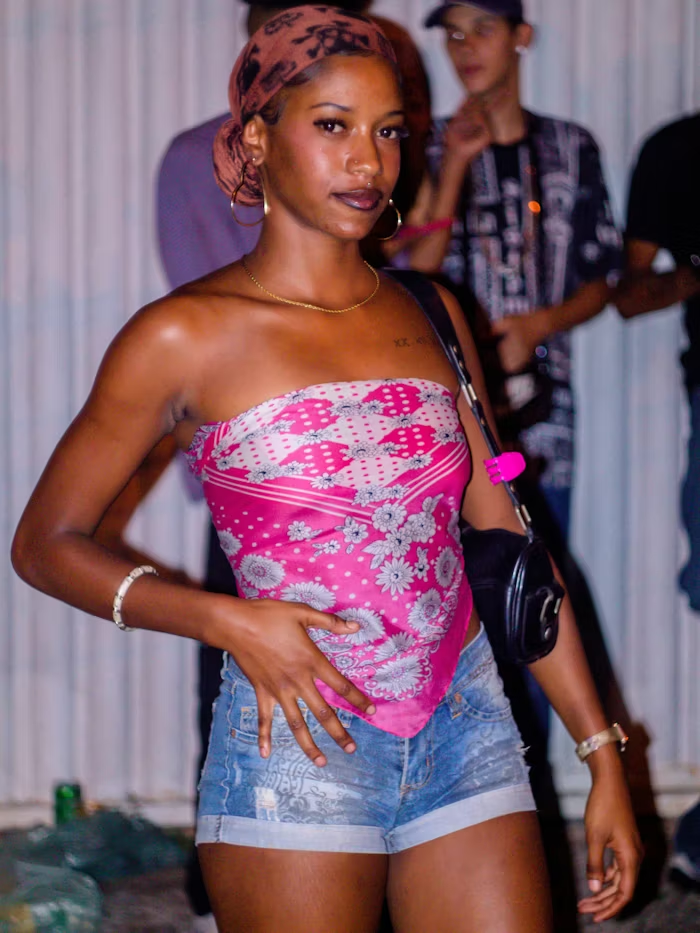
Logos were loud, and outfits often felt like a playful performance rather than carefully organized. This sense of freedom deeply resonates with Gen Z, a generation that seems to navigate around constant visibility online.
Dressing Y2K becomes a way to exaggerate your identity to the world, where it’s all over social media. It’s expressive, sometimes ironic, sometimes sincere, but always intentional.
Another reason Y2K fashion feels so compelling today is its accessibility. Unlike many fashion trends that rely on designer pieces, Y2K thrives in our mothers’ closets, thrift stores, vintage bins, and secondhand apps like Depop or even eBay.
But the hunt itself becomes a part of the experience, digging through racks to find the perfect rhinestone belt or tiny shoulder bag that feels like treasure. Sustainability also plays a role here. As Gen Z becomes more environmentally aware, thrifting Y2K pieces allows them to participate in fashion cycles without contributing as heavily to fast fashion waste. Old trends aren’t just reused, but rather they are repurposed and reimagined.
At the same time, Y2K’s revival raises questions about authenticity and commercialization. As brands catch onto the trend, many have begun to produce Y2K inspired collections. With this, there has been tension between individuality Y2K representation and how social media can flatten trends into uniformity. When everyone starts wearing the same baby tee, the line between self-expression and imitation starts to blur.
Despite this, Gen Z continues to adapt the trend in ways that feel personal. Modern Y2K isn’t a perfect replica of the early 2000s, but it’s filtered through the values of body positivity and identity. Low-rise jeans might make their comeback, but they’re often styled with oversized hoodies, platforms, or your dad’s old dress shirt paired with earbuds and matcha (#PerformativeMales).
Makeup styles inspired by frosted eyeshadow are now paired with graphic eyeliner or experimental color palettes. The aesthetic evolves as it’s worn, shaped by those who adopt it rather than those who originally created it.
In this way, Y2K exists in a space between past and present. It borrows heavily from a time defined by pop culture icons and consumer excess, yet it lives mostly on digital platforms that didn’t even exist when the trend first emerged. Every outfit post, mirror selfie, or edit adds another layer to the revival, expanding beyond fashion. Y2K becomes not just what you wear, but how you present yourself online and how you choose to stand out in a crowded digital world.
At Bronx Science, many students have embraced the Y2K revival not just as a fashion statement but as a form of self-expression. Walking through the hallways, chances are you might spot someone wearing a pair of low-rise jeans or platform shoes. For these students, thrifting isn’t just a way to save money, but rather it’s an adventure, a scavenger hunt that allows them to recreate the styles their parents or older siblings once wore. In this sense, Y2K offers both a nostalgic connection to the past and a new foundation for creativity.
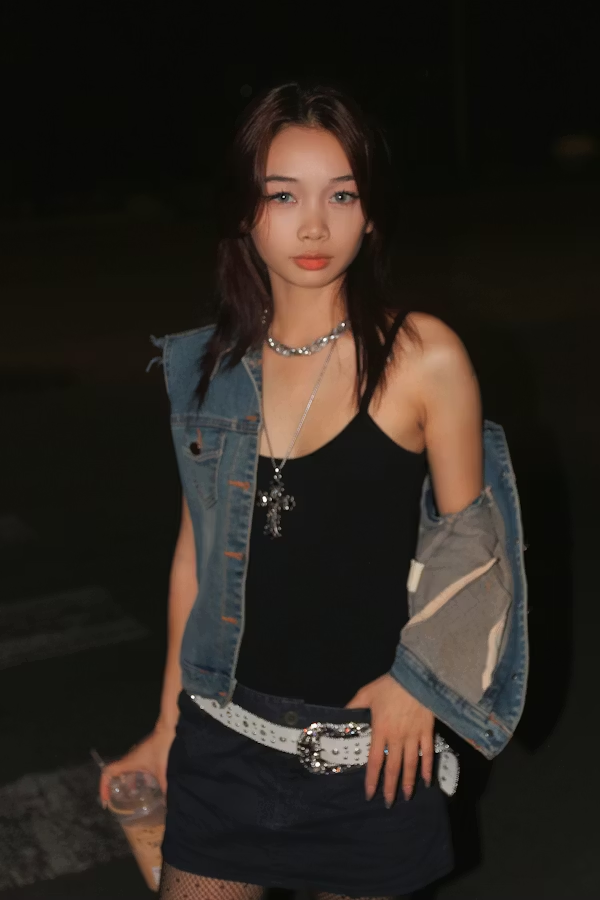
Social media has played a pivotal role in this whole revival. Thanks to platforms like TikTok and Instagram, it allows a space for students to flaunt their Y2K looks and draw inspiration all in one scroll.
As mentioned several times, Y2K has given the opportunity to express itself with a modern twist. Y2K revival is just another step into mixing the past with the present, creating looks that feel both nostalgic and contemporary. An old band t-shirt might be accessorized with chunky necklaces, or flared jeans might be worn with oversized jerseys. This fusion allows students to reinterpret the past through a modern lens, showing that Y2K isn’t just an era from the past but a flexible, evolving style that can allow space for creativity and fashion sense all at once.
And really, isn’t that what Y2K is all about? Sparkly lip gloss, Victoria’s Secret perfume, and butterfly clips — it’s messy, it’s fun, and it’s bold.
In the words of Britney Spears herself, Gen Z has truly learned to “Hit Me Baby One More Time,” but not as a mistake. It’s an invitation to embrace the past, experiment, and express ourselves however we like.
So go ahead and dig deep through those thrift racks and your mom’s closet. Pile on the shimmery eyeshadow and glittery lip gloss. Y2K reminds us why we all fell in love with fashion and the enjoyment in it.
Chunky highlights and flip phones decorated in rhinestones — we slowly see much of our Gen Z transition from Britney Spears to Taylor Swift.