
Home to the largest Greek population outside of Greece itself, Astoria has long been known by the nickname “Greek Town.” Economic struggles including inflation, political instability, and heavy government debt within the country during the early 1900s motivated a mass influx of Greek immigrants to the United States, with many of them choosing to settle in the peaceful neighborhood in Western Queens; walking through the area today, every storefront with a Greek flag hung in the window serves as a testament to their resilience and cultural pride. Greek immigrants have built new lives in America from the ground up, giving their families opportunities they may not have had back in their home country.
Of these endless rows of storefronts, one of the most popular is Omonia Café, a Greek establishment which opened its doors in 1977. “Omonia” – or “Ομόνοια” in its original Greek – is a word which most closely translates to harmony, unity, or concord, a name which the café certainly lives up to. Yet, this place is certainly not what one would think of when hearing the word “café” – a quiet, focused environment for sipping on a warm cup of tea and immersing yourself in schoolwork. Rather, it is a bustling place to grab a bite of authentic Greek fare and join a community of loyal customers who have routinely visited Omonia Café for almost five decades now.
Omonia Café is a is a place that is turbulent in the best way, buzzing with activity; this energy was intentionally curated by its founder, John Arvanitis. He immigrated to the U.S. from Greece, saving up money by working as a hot dog vendor until he opened the café at only nineteen years old. In contrast to what most New Yorkers are used to, cafés are not viewed as rushed spaces in Greek culture: nobody is cramming assignments, running in for a coffee between errands, or taking pastries out to-go. In Greece, cafés are instead revered as somewhat of a sanctuary, and people respect their significance by dedicating time to the experience. Visitors often sit for hours, talking, playing cards, and relaxing. The establishment almost becomes like an extension of the home.

That homey feel of an authentic Greek café is exactly the seed which Arvanitis has planted within Omonia Café. For those seeking a comforting piece of Greek culture served up on a plate, the restaurant’s doors are always open – at least, up until 1:30 a.m., the time at which their Astoria location closes, even on weekdays. From the beginning, Omonia Café quickly cemented itself as a neighborhood staple; its classy blue, brown, and white interior is framed by orange windows all along the building. This striking appearance gives Omonia Café that modern and trendy atmosphere it is so well-known for. The ferocious roar of N/W trains stopping at the nearby Broadway station seem to harmonize with the clinks of glassware and the constant warm chatter buzzing around the dining area. Aside from the aesthetics of the restaurant’s design and atmosphere, its menu is vast and the food, pastries, and beverages offered are phenomenal.
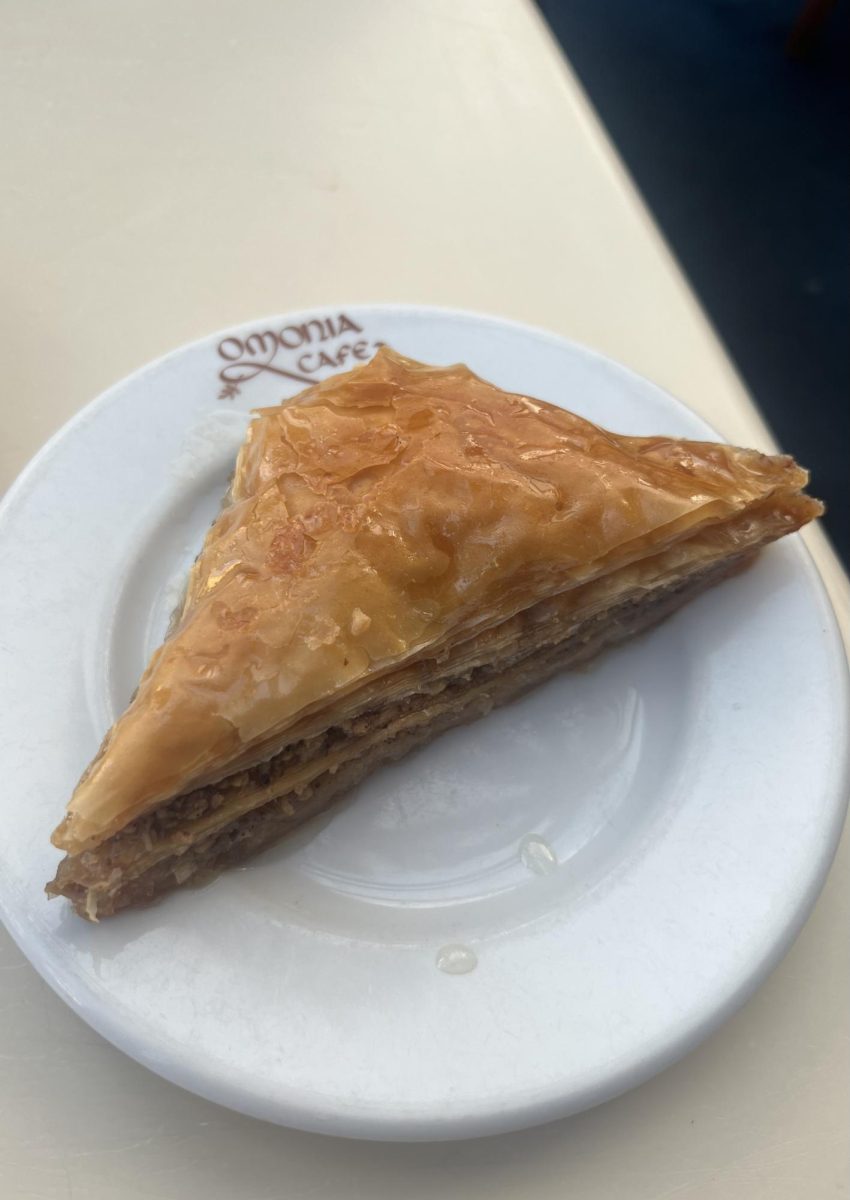
Most well-known for their desserts, they serve up authentic sweets like baklava (thin layers of crispy syrup-soaked phyllo dough filled with a mixture of walnuts, pistachios, and spices), galaktoboureko (sweet semolina custard baked in-between two layers of phyllo), and portokalopita (a light and spongy orange-infused cake). In terms of beverages, their frappe is certainly one of the most popular. It is made by blending instant coffee, sugar, and water, then pouring the foamy mixture over milk and ice; the result is a frothy, airy drink with a light sweetness that rounds out the bitterness of the coffee. For those looking for a more substantial meal, they also offer an impressively wide variety of breakfast foods, burgers, pasta, sandwiches, and pizza.
Right next to the main café, Omonia has a location aptly named Omonia Next Door. It is similar to a classic American bakery but with a Greek twist, and they serve full-size cakes for special occasions. Their main restaurant focuses on making traditional desserts which taste as though they were shipped straight from Greece; in contrast, their expansion incorporates quintessential Greek flavors into familiar American treats, with desserts like their baklava cheesecake being especially popular.

Walking down Broadway, one of the main streets in Astoria, the influence of the area’s history is palpable, even when mixed with the charged energy of a constantly changing neighborhood. Sandwiched in the heart of busy intersections, long-standing local shops, and new chains which seem to pop up daily, Omonia Café has remained an established fixture for decades, representing one of many stories of Greek immigration, cultural preservation, and adaptation in Astoria, a neighborhood that has long been defined by its diversity and resilience.
Astoria’s history began long before it became a cultural hub within New York City. Originally inhabited by Native American tribes like the Matinecock people, the area was later settled by the Dutch and English, becoming known as Hallet’s Cove in the 17th century. In the 1800s, Astoria developed into a semi industrial community, with the blend of factories and housing enticing working class families to move there. Its new name was chosen in honor of John Jacob Astor, a businessman and real estate mogul who was one of the wealthiest people in America at the time. Over many decades, waves of immigration reshaped the neighborhood, including Italians, Irish, and Germans. Later on, large populations from the Middle East, South Asia, Latin America, and Eastern Europe settled in the area.
The most influential wave arrived in the mid 20th century when thousands of Greek immigrants settled in Astoria; many came seeking economic opportunity and stability after World War II and the Greek Civil War. Astoria offered opportunities for a brand new life: affordable housing, factory jobs, and the chance to build a close knit ethnic community. By the 1970s, Astoria was widely recognized as the center of Greek American life in the United States. It was in this environment that Omonia Café, among many other Greek-owned businesses, was born.
The reputation of the Omonia Café eventually extended beyond the neighborhood. The café got the opportunity to showcase their delectable work on the big screen when they made the large strawberry wedding cake which appeared in the 2002 film My Big Fat Greek Wedding, an iconic rom-com movie about a relationship between an American man and a Greek-American woman with an overbearing – albeit hilarious – family. The movie was a massive success, grossing $368.7 million in the box office and introducing audiences around the world to Greek American culture. Omonia Café’s inclusion in the film only reinforced its status as a cultural landmark.

As Omonia Café continued to succeed in Astoria, it expanded to a second location in Bay Ridge, Brooklyn in 1996, an area which has long been another cultural enclave of Greek Americans. At the same time, the neighborhood of their original location has undergone dramatic changes. Over the past two decades, Astoria has experienced rapid gentrification, with residents battling steeply rising rent prices, new luxury buildings popping up overnight, and a ferocious influx of young professionals and artists who are attracted to its proximity to Manhattan.
In spite of the gentrification, Greek culture remains an important part of Astoria’s identity. Immigrants have faced many challenges in their journey planting roots in Queens, and pride for their countries has never wavered in the face of uncertain times. The Omonia Café now serves a more diverse clientele than ever before, with customers who come from many cultural backgrounds all drawn by the desserts, the atmosphere, and the café’s reputation alike. Omonia Café’s longevity is striking in a city where it is unfortunately routine to see the life cycle of a business conclude swiftly, like clockwork. The café’s success can be attributed to an immense attention to detail and care by the Arvanitis family that runs it, as well as its function as a community space for people to connect with each other in a time where people are more divided than ever before.
In some ways, Omonia Café’s journey to success mirrors that of Astoria itself; both were shaped by immigration, built through relentless work, and forced to adapt to constant change. As the neighborhood – and by extension, the entire city – continues to rapidly evolve, Omonia Café remains a reminder that communities are defined by the people and places that give them meaning.
Surrounded by the sounds of conversations in endless different languages and the clinks of plates of pastries passed across tables, it becomes clear that Omonia Café is much more than just a place to satiate your appetite. In a city that sometimes moves with dizzying speed, Omonia Café offers a space to settle down for a few hours and immerse yourself in the living history of Greek Americans.
In some ways, Omonia Café’s journey to success mirrors that of Astoria itself; both were shaped by immigration, built through relentless work, and forced to adapt to constant change. As the neighborhood – and by extension, the entire city – continues to rapidly evolve, Omonia Café remains a reminder that communities are defined by the people and places that give them meaning.