

“You shall not wrong or oppress a resident alien, for you were aliens in the land of Egypt.” (Exodus 22:21)
Despite what many choose to believe, The Bible undeniably instructs Christians to welcome immigrants and refugees. Besides Jesus’ basic teaching that we should “Love thy neighbor,” throughout God’s written word, there are many explicit calls to care for immigrants among us. In honor of this message, and in celebration of the influx of migrants to New York City in the past year, St Patrick’s Cathedral, the seat of the Roman Catholic Archdiocese of New York, has commissioned a brand new permanent mural.
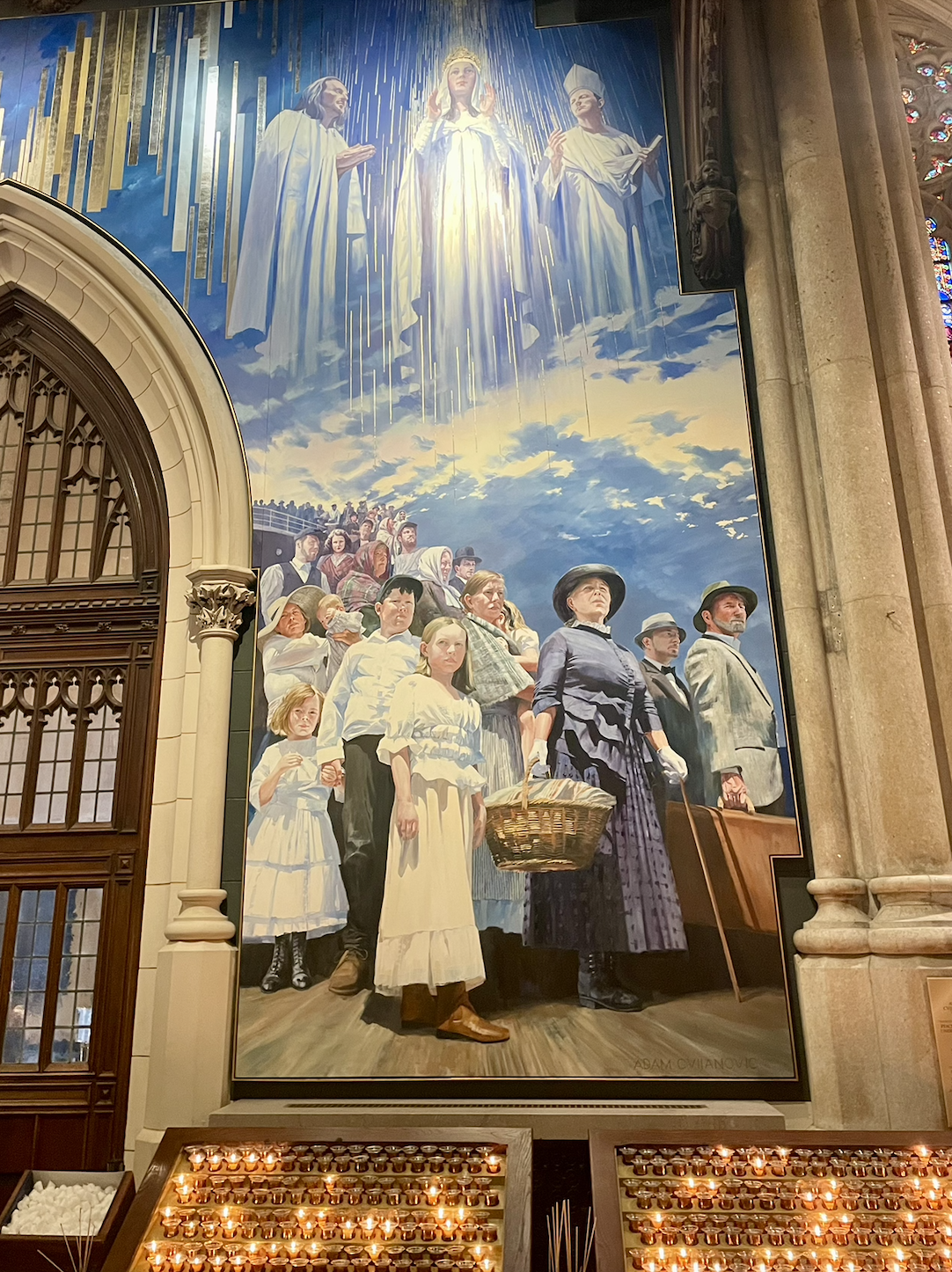
The mural, which opened for viewing on September 21st, 2025, features immigrants settling in New York beginning with the Irish in the early 18th century and extending across modern families arriving in pursuit of better opportunities in 2025. Spanning 1,920 square feet, the mural is breathtaking in scale. Arguably more impressive, however, is the mural’s generational significance: it is one of the few permanent art installations at the cathedral, intended to last for centuries.
The artist, Adam Cvijanovic, named the project “What’s So Funny About Peace, Love, and Understanding” as an ode to a song made popular by Elvis Costello, combining ironic humor with raw empathy to promote the mural’s message. The song’s lyrics are timely despite having been written in the 1970s, expressing the Church’s hope to unite the divided, polarized people of God:
And where is the harmony?
Sweet harmony
Cause each time I feel it slippin’ away
Just make me wanna cry
The bittersweet tone in the lyrics — and likewise in the mural — conveys fear of a political divide and hopefulness about a future in which people whose cultures are different live in harmony.
St. Patrick’s, now one of the most famous cathedrals in the world, was humbly founded with the same harmonic messaging in a historical period of overwhelming anti-immigrant sentiment. In the 1850s, Archbishop John Hughes was the head of the Catholic diocese of New York amidst one of the largest waves of immigration the city had seen, catalyzed by the Irish famine. An Irish immigrant himself, Hughes was the glue holding together a church riddled by deep political divides. On August 15th, 1858, Hughes laid the cornerstone of St. Patrick’s Cathedral.
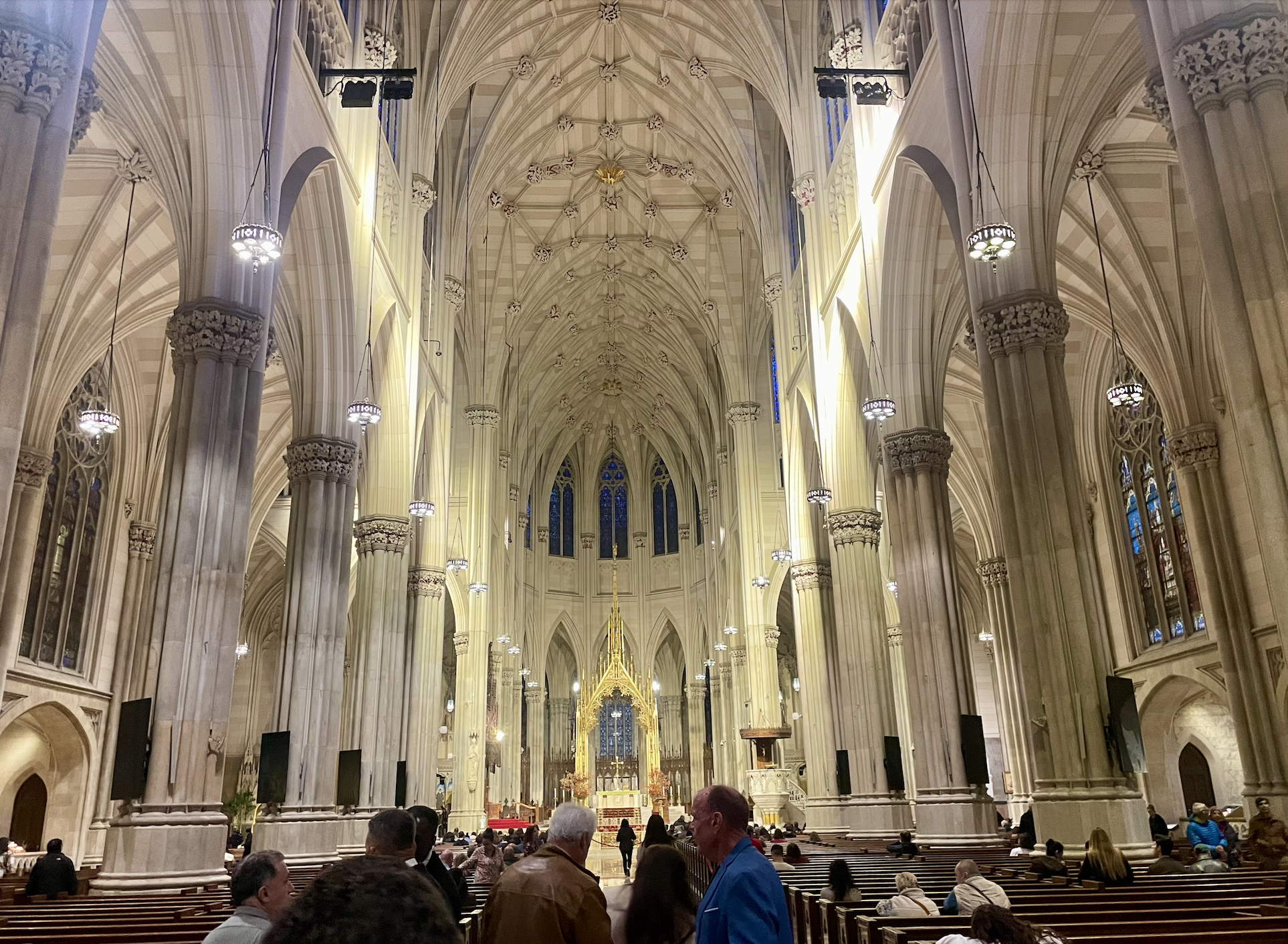
Because the cathedral was built in the Gothic style of the 19th century, new modern art installations contrast with and complement the architecture beautifully. The freshness of Cvijanovic’s style also symbolizes the need to reflect biblical ideas of love and acceptance in contemporary policy. It reminds us that to love everyone, no matter their country of origin, is not, as President Trump has said, propaganda from the “radical left,” but instead ingrained in centuries of tradition.
———
“When a foreigner resides among you in your land, do not mistreat them. The foreigner residing among you must be treated as your native-born.” (Leviticus 19:33-34)
Historically, art has been a medium for expressing religious themes and political opinions. Rarely, however, can a piece do both at once. Cvijanovic made deliberate stylistic choices that combine traditional aspects of religious art with modern, politicized details.
Compared with historical religious murals that airbrush flaws and overemphasize wings, haloes, and clothing as symbols of glory, this one celebrates ordinary people as heroes. “It was important that when someone looks at the mural, they see themselves, their grandfather, or their great-grandmother,” Cvijanovic explained. “Even the angels are modeled after real people.” The artist used 75 models to achieve this effect, mostly immigrants living across the United States.
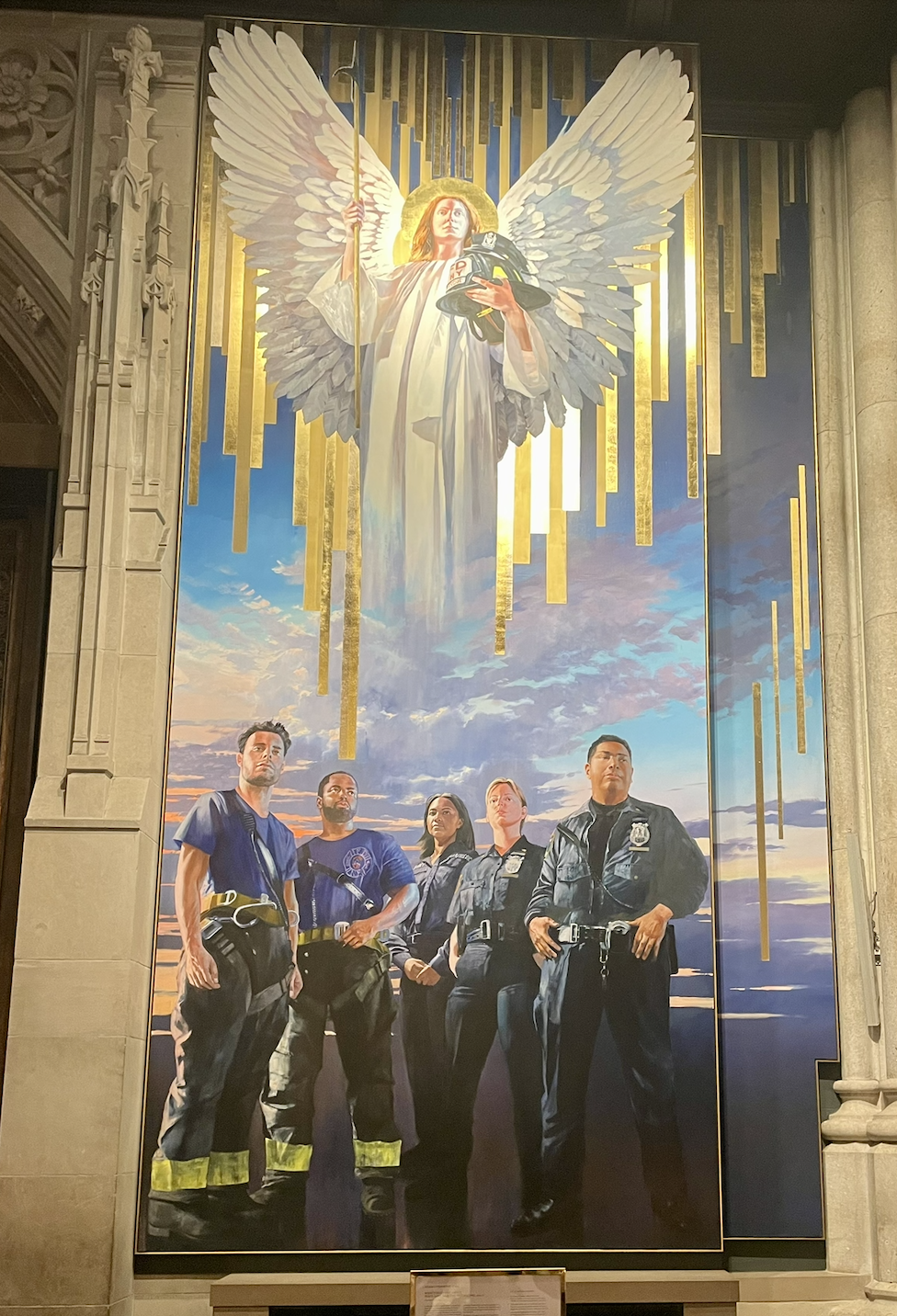
Cvijanovic is a 64-year-old artist born in Cambridge, Massachusetts. He is most renowned for large-scale pieces, many of which share themes of American hubris and power. His ability to articulate, through art, the spiritual and cultural meanings behind Americanness is truly admirable. At St. Patrick’s, this ability is on grand display.
The mural’s message, plainly, is to accept intersectionality as a vital part of the human experience. Cvijanovic celebrates every type of American that exists. “There’s only one person pictured here who is not an immigrant, or the child of an immigrant, or the grandchild of an immigrant,” Cardinal Timothy Dolan said. “St. Kateri Tekakwitha, the Lily of the Mohawks. Thank you for putting her in there, because it kind of reminds us that there were some people here in the beginning.”
———
“Do not oppress the widow or the fatherless, the foreigner or the poor. Do not plot evil against each other.” (Zechariah 7:10)
Immigration is not an easy topic to breach, through art or otherwise. Over the past decade, far-right parties have gained power across the world using nationalist rhetoric and anti-immigrant hate speech in order to sow chaos. In the U.S., the issue is uniquely divisive: a Gallup poll from 2024 found that 55% of Americans want legal immigration to decrease, the highest percentage since 2001. Still, immigrants make up 15.4% of the U.S. population, and the vast majority of them are here to stay.
Even though the church recognizes a cleavage between political groups both nationally and globally, the stated purpose of commissioning this mural at this time is to take a step towards universal acceptance. Cardinal Dolan made this clear when asked about the mural, saying, “Some have asked me, ‘Are you trying to make a statement about immigration?’ Well, sure we are, alright — namely that immigrants are children of God.” Without overly politicizing the issue, Dolan’s statement clearly defines the Catholic mission: to love everyone unconditionally.
The New York diocese, though one of the most liberal, is not alone in this mission — the papacy under both Pope Leo and Pope Francis has made clear its attitude towards immigrants and refugees across the world. In August of 2024, Pope Francis addressed an audience at St. Peter’s Square, stating, “Working to turn migrants away from the prospect of peace and security in a new country is a grave sin,” warning that the goal of limiting migrant inflow will not work “through more restrictive laws, nor through the militarization of borders, nor through rejections.” Pope Leo corroborated the message this past September 2025, preaching, “There are no enemies — only brothers and sisters. This is the culture of reconciliation.”
Despite clear statements of support coming from the Vatican, many Conservative Christians in America fear immigration, weaponizing cherry-picked Bible passages in order to fit their worldview. This contradiction shapes the dissonance between the pro- and anti- immigration voices impacting American policy (generally Democratic and Republican, respectively). The Christian nationalist identity that solidified during the Cold War envisions a weak America in need of protection and an imminent terrorist threat posed by every foreign-born person. The last decade has seen a rise in far-right social media rhetoric — on podcasts, Twitter (X), and video sites — which amplifies the role of the border as an area of extreme contention.
American conservatism has increasingly strayed away from the Social Gospel woven into the founding of our country. The Social Gospel mission is to prioritize the underprivileged, marginalized, and impoverished in society, while the modern Christian nationalist ideology preaches hatred of precisely those groups.
The Trump Administration targeted New York City as a hotspot for deportations, making this one of the most prevalent citywide debates. A report from the end of September 2025 found that ICE arrested at least 4,600 people in New York in seven months of 2025 — more than the total arrests by the agency in 2024. And these arrests are escalating in violence: on October 17th, 2025, FBI and ICE agents swarmed the Row Hotel, a shelter for migrants in the city, and arrested ten people. The scene became chaotic quickly, with people running out of the hotel in mobs and federal agents shoving a 12-year-old boy into a car for questioning.
Pope Leo condemned the recent U.S. immigration policies, noting that the country’s treatment of immigrants is “inhuman.” He went on to highlight contradictions in the MAGA ideology, clarifying that “someone who says I’m against abortion but I’m in agreement with the inhuman treatment of immigrants in the United States, I don’t know if that’s pro-life.” The political tension was growing before the paint on Cvihanovic’s mural dried.
———
“For I was hungry and you gave me something to eat, I was thirsty and you gave me something to drink, I was a stranger and you invited me in.” (Matthew 25:35)
If current U.S. politics have taught us anything, it is that our country has lost sight of the truth. This mural, along with Pope Leo’s statements and worldwide protests, outcries, and unrest, reestablished the Church as a moral voice. Cvijanovic’s work expresses the Biblical mandate to love unequivocally: the one commandment that everyone, regardless of religion, nationality, or political affiliation, should take to heart.
Spanning 1,920 square feet, the mural is breathtaking in scale. Arguably more impressive, however, is the mural’s generational significance: it is one of the few permanent art installations at the cathedral, intended to last for centuries.