

As the Class of 2025 prepares to graduate, it is now time for students to look back on their hard work, the community they’ve become a part of, and the interests they’ve developed, before they prepare for their future beyond high school. Two seniors in particular, Mary Loukaitis ’25 and Sebastian Merkatz ’25, are getting ready to share these reflective sentiments with their peers at graduation, as they have been named Valedictorian and Salutatorian, respectively.
Speaking about the nomination, Merkatz said, “I’m deeply honored and so grateful. I love Bronx Science, and I’m so happy to have received this award. It was not something that I was expecting, and I think it’s a reflection of the work that I’ve put into this school.”
Loukaitis said, “I wasn’t necessarily expecting it. I was just trying to get high grades, and when I found out recently, it was quite surprising.”
Over the course of four years at Bronx Science, Loukaitis earned a GPA of 99.104 and Merkatz earned a GPA of 98.7549, demonstrating their unrelenting commitment to the Bronx High School of Science. Taking challenging and introspective courses such as Post-AP Genetics and Holocaust Leadership, the two faced academic challenges true to the Bronx Science experience. Despite this, their teachers’ dedication and the resources offered by the school helped them to succeed.
“Linear algebra, taught by Mr. James Perna, is definitely the hardest class that I’ve ever taken, and it’s encouraged me to take advantage of all the resources that are offered to me, whether that was attending Small Group Instruction to ask questions, or through watching videos that Mr. Perna provided as part of the homework. All of these resources really helped me to solidify my understanding,” Merkatz said.
Loukaitis agreed with Merkatz on the abundance of resources at Bronx Science, and in her experience, the help of a teacher gave her all of the resources that she needed for success. Referring to her time at the Manne Institute under the guidance of Dr. Tracy LaGrassa, with whom Loukaitis worked for the past three years, Loukaitis said, “I was trying to work with this procedure which had been published online, but the Manne Institute did not necessarily have all the materials at that time, so I had to improvise a bit. I was specifically trying to isolate embryos of C. elegans; it was a really interesting experience, because I was able to observe the embryos divide under my improvised procedure,” Loukaitis said.
The wide array of unique classes offered at Bronx Science has been supplemented by teachers’ passion. Merkatz, who took A.P. American Studies as a junior, believes that, “Ms. Salinda Lewis and Dr. Todd Davis really honed my writing skills and made the content so interesting and enjoyable. I found those paired classes so fascinating—it was an amazing interdisciplinary experience.”
Outside of the classroom, Loukaitis and Merkatz have participated in a variety of activities centered on their interests. Loukaitis has taken part in work at the Manne Institute and Science Olympiad, where she replicated the same interpretation, design, application, and assessment that scientists do every day.
“I was very unconfident about completing this virtual competition [the BirdSO Competition for Science Olympiad] because I wasn’t accustomed to doing virtual competitions,” said Loukaitis, who went on to earn an honor in her field. However, this competition taught her that the key to these techniques lay in “not simply understanding the content that needs to be applied, but in applying it in a certain way that fits the prompt, after which I learned to change my priorities.”
Loukaitis furthered her research in C. elegans at the NYU Center for Developmental Genetics, helping her in being named a 2025 Regeneron STS Scholar. This work involved testing the effects of environmental perturbations on male tail development and the role of stress response pathways in maintaining growth under stress. She found a potential correlation between the tail tip development and the dauer entry pathway, which regulates transition into a non-feeding, stress-resistant alternative larval stage.

Loukaitis also enjoys creating art, both acrylic and digital, and she makes digital music. She combines original melodies from instruments “in order to create music that I can listen to when I work.” Similarly, Merkatz DJs at events and parties and finds it a fun activity away from academics.
Merkatz engages in his intended major, economics, through some of his extracurriculars, including being the treasurer of the Investment Society and his time attending the Bronx Science Summer Institute AI pre-internship at Citi Bank. “We got to work with employees from Citi Bank within their data analytics sector and ultimately learned the skills to deliver a capstone presentation at Citi Global HQ on AI and data science,” he said of the experience.
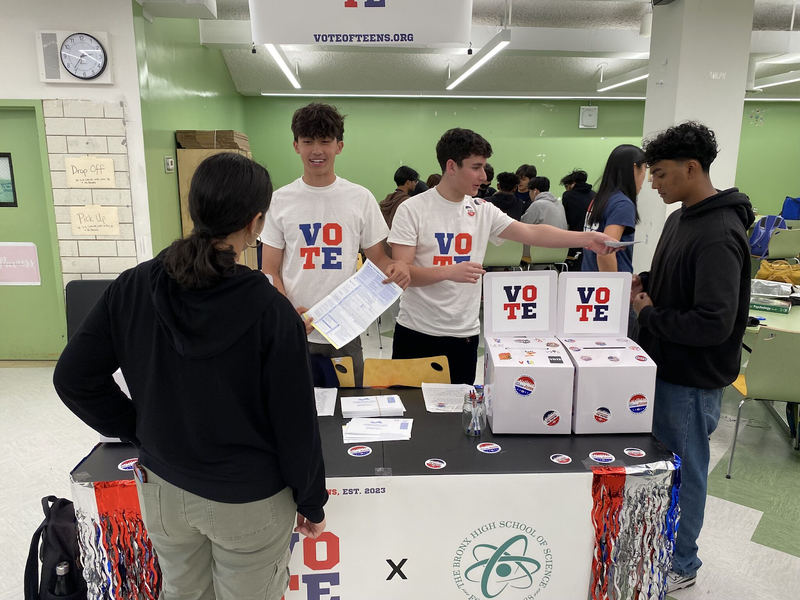
Another interest for Merkatz is local politics, for which he has helped establish VOTE (Vote of Teens in Elections) in order to run voter registration drives in Bronx Science as well as eight other schools. He also interned for Shaun Abreu—a councilman of the 7th District of New York City—for two summers, where he was “interacting with members of my neighborhood, picking up the phone, sending e-mails and hearing constituents’ complaints, and working with different city agencies and getting that first hand experience with public service, which was amazing.”
For Merkatz, volunteering also came in the form of working for and later Co-directing Science for Bronx, a free SHSAT tutoring program run by Bronx Science students. This year, five of their students received offers to attend Bronx Science. When asked how best to get involved in the community, Merkatz said, “Think local, as there’s a lot that can be done on a local level. People often have grand goals, which I think is great, but it’s good to start with something small, and I think grassroots efforts can always spiral into something bigger.”
Attending high school in New York City presents many opportunities to Bronx Science students, which Loukaitis and Merkatz expertly capitalized on. Merkatz is going to miss the nearby pizzerias, while Loukaitis hopes that there’s similar architecture that is “full of history” where she goes to college. However, they both agree on one thing. As Merkatz elaborated, “I’ve met people at Bronx Science from all walks of life, from all boroughs, and from countless different neighborhoods, religions, and backgrounds. Meeting these people has expanded my worldview and has introduced me to practices that I would have otherwise not been exposed to.”
It is this community in the school that truly elevates and encourages every student to become their best selves. In such a fast-paced environment, it’s easy to lose faith in yourself after a misstep. Loukaitis advocated that Bronx Science students should “stay motivated and do not just give up after you score a little lower than you would have wanted to.”
Merkatz offered that it’s important to rely on this community and friends to motivate you. “I was surrounded by a community of high achievers and people who set high standards for themselves, and it kind of became an expectation that you should work hard to achieve your goals and try to make an impact on your community,” Merkatz said. He attributes much of his success to following a philosophy of elevating those around you as well as yourself.
Despite their hard work, even the Valedictorian and Salutatorian can acknowledge that senioritis and procrastination have been challenges for them. Loukaitis mentioned that “senioritis did affect me, but the more I recognized my procrastination, the more I realized that I needed to work harder and increase my standards for the work that I was procrastinating.” She stressed the importance of not overworking yourself to the point of exhaustion but concurrently finding personal meaning as motivation.
Merkatz said that whenever Bronx Science students have the chance, they should study, because not only are they more likely to get good results, but they also get the personal satisfaction of knowing that they tried their best. Additionally, asking questions and attending SGI (Small Group Instruction) have been helpful tools for Merkatz. “For me, inquiry has made me not only a better student, but it has also expanded my interests, since questions lead to answers that make you want to keep asking more questions and keep exploring,” Merkatz said.
The two will carry this inquiry into college and continue to expand their knowledge in their majors and other interests. Loukaitis is heading to University of Wisconsin-Madison in the fall of 2025, with an intended major in molecular biology while also concentrating more on her physics and chemistry courses.
Speaking about molecular biology, Loukaitis added, “I want to understand how living systems function. In high school and middle school biology courses, I received an overview of the characteristics of life but not necessarily how these characteristics arise or interact to produce what most of us consider alive.”
Merkatz will be attending Princeton University in the fall of 2025, intending to major in economics and minor in finance and applied mathematics. In the future, he also plans to become involved in government.
Mary Loukaitis and Sebastian Merkatz will deliver their speeches to the Class of 2025 at the school’s 97th Commencement Ceremony on Thursday, June 26th, 2025, at The United Palace Theater.
UPDATE: Click HERE to watch the video of Bronx Science’s 97th Commencement Ceremony at The United Palace Theater, which was held on Thursday, June 26th, 2025, including the speeches by Bronx Science’s Valedictorian, Mary Loukaitis ’25 (at 1:01:29), and Salutatorian, Sebastian Merkatz ’25 (at 8:12).
“I was surrounded by a community of high achievers and people who set high standards for themselves, and it kind of became an expectation that you should work hard to achieve your goals and try to make an impact on your community,” said Sebastian Merkatz ’25.