

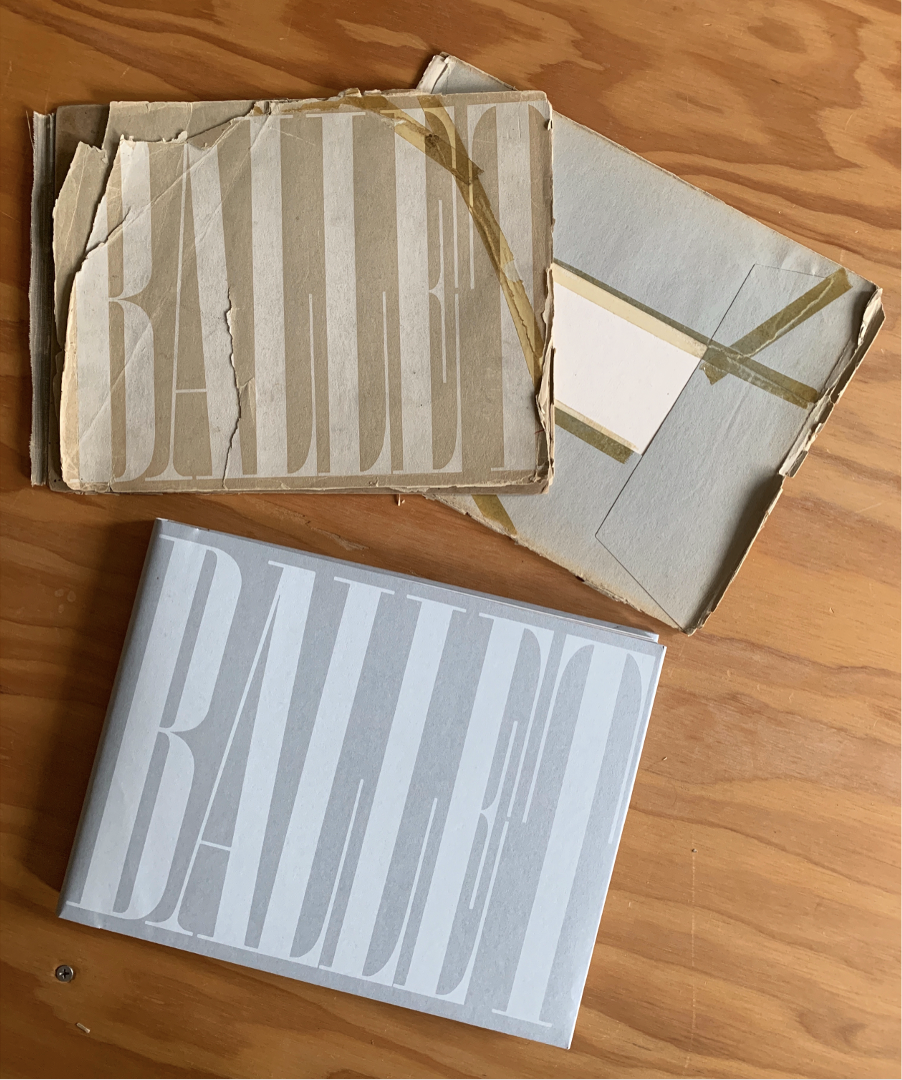
In a time when industrialization began to take the breath and soul out of photography, Alexey Brodovitch kept its heart beating. Ballet, first published in 1945, was Brodovitch’s first and only book of his own work. It features 104 photos of the Ballets Russes, an itinerant ballet company, performing in New York City from 1935 through 1939, some taken during performance and others highlighting the mystique and focus that was fostered backstage. Having worked alongside revolutionaries like Picasso and Stravinsky, Brodovitch left his mark on the modernist movement through photos that depict dance through a raw, impressionistic lens.
The publisher of the first edition, J.J. Augustin, published only 500 copies in 1945, and Brodovitch sought to hand them out exclusively to close peers, friends, and family. However, in 1956, a fire at his house in Pennsylvania destroyed much of his archive, including the remaining copies of Ballet. The influence of Brodovitch’s photographs persists to this day, and to honor his trailblazing contributions to photography and printing, Nina Holland, director of German publishing house Little Steidl, a boutique imprint of Steidl, has reissued Ballet with the same vibrancy and enthusiasm as Brodovitch himself. The reissued edition was edited by Holland along with Joshua Chuang, a photography director at Gagosian.
Brodovitch was born in St Petersburg, Russia, in 1898, but moved to Paris in the 1920s. There, he painted sets for Sergei Diaghilev’s Ballets Russes, and became acquainted with dance as an expressive and expansive art form. The opportunity to teach advertising design at the Pennsylvania Museum and School of Industrial Art (now the University of the Arts) pulled Brodovitch to the United States in 1930, just as Paris slowly began to lose its artistic allure. He moved to New York City four years later after his designs caught the eye of Harper’s Bazaar editor-in-chief Carmel Snow.
Brodovitch served as art director of Harper’s Bazaar from 1934 to 1958, revolutionizing visual culture in the mid-20th century with his use of ample white space and the incorporation of geometric principles from Dadaism and the de Stijl movement. Undoubtedly, he also incorporated principles he had learned from Diaghilev, finding the importance of movement in graphic design. “Every fashion photographer since Alexey Brodovitch has been influenced by him,” said Nina Holland, as we discussed her reissue of the book and its connection to Brodovitch’s career.
Though Holland herself has a background in dance and music, it was ultimately her admiration of Ballet’s influence and access to the necessary photography and equipment that compelled her to reissue the book. The ignition for the project was Holland’s visit to her friend John Gossage, a student of Brodovitch and an artist at Little Steidl. He showed Holland his original copy of Ballet from 1945 and asked if she wanted a taken-apart and torn copy for herself, hoping she would reconstruct it. Holland took it back to Germany with her and sat with it. She knew “it had to be remade, and it had to be remade within the context of Steidl,” because Steidl and Little Steidl are some of the only remaining book publishers with printing presses that could maintain Brodovitch’s humanizing approach to industrial press printing.
During Brodovitch’s process, he used the industrial printing machine as a way to extend our bodies and emotions onto the page. Rather than rejecting revolutionary science and technology as a detriment to art and the creative process, he sought to use them to his advantage. Steidl and Little Steidl continue to honor this sentiment to this day. When Holland offered to donate Steidl books to Bronx Science, I told her they might be better suited to an arts school. But she insisted that Brodovitch’s work embodies the beautiful interplay between chemistry, machine engineering, and art, making it perfect for a scientific yet versatile school like Bronx Science.
“Brodovitch’s own message in Ballet is that art and industry are intertwined in a way that industry, most artists, and the general public have overlooked. He envisioned a different path than the one that both industry and art ultimately took, much to the disadvantage of us all,” Holland told me.
The reconstruction of Ballet was Holland’s first time working with a non-living artist, and she was forced to deviate from her typical creative dialogue with the artist. As she took apart the Ballet book, however, she realized that it was better made than anyone had realized. The book’s acclaim and fame, its revolutionary contributions to the art of photography, could hardly do justice to Brodovitch’s skill and attention to detail.
The original book and the reconstruction differ only in the methods that were used to print the photos. Brodovitch used an experimental gravure printing method, in which he used a single black ink to produce all his tones. The approach was unpredictable, and no two copies looked alike, but Brodovitch embraced spontaneity, seeing it not as a flaw but as an element of the humanity that he sought to portray in his photos.
For the photographs themselves, Brodovitch used a hand-held 35-millimeter Contax camera in order to photograph the dancers, whom he saw as more than just subjects. “He was at home, one imagines, in the stage atmosphere the company created; he was not photographing strangers, he was photographing family; and that is why his pictures have so intimate a tone,” writes Edwin Denby, a poet and dance critic, in the essay that accompanies Ballet’s photos.
Despite the camera’s underwhelming nature, Brodovitch still strayed from the conventions of both his time and the present by using only available light. As a dancer myself, I’m familiar with the intense lighting setups for photo and video shoots that take dancers out of the present moment and force them to focus not on the sensation of dance but on appearance. Brodovitch’s refusal to add unnatural lighting or props underscores his determination to highlight movement in its rawest form.
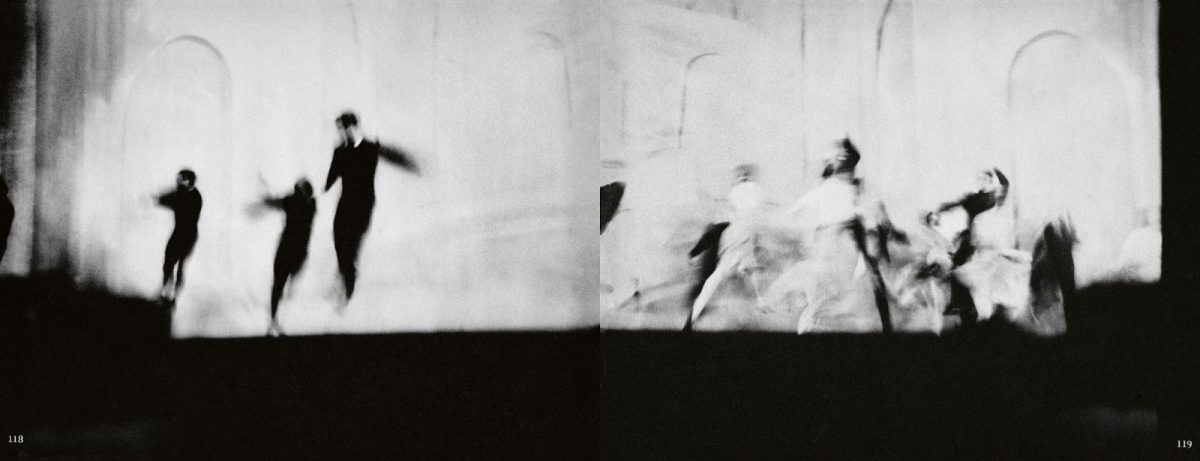
Holland’s printing process differed from Brodovitch’s, as she had access to more advanced technology and employed an experimental offset lithography method. Rather than using one ink, she used multiple trays and inks and was able to achieve 256 tonal levels with one ink, a greater spectrum than what Brodovitch was working with.
However, her determination to achieve minuscule detail made the process much more strenuous. While Brodovitch would run his sheets through the press only around 30 times, Holland ran hers 250 times each, which spanned over nine months, compared to Brodovitch’s two-week process. Additionally, Holland worked without assistants, managing a large vintage offset-lithographic press that was originally made for a male printer to use. Through her determination to honor Brodovitch’s photography, Holland defied both gender and creative norms. Still, her experimental method yielded moderate ink transfers and unpredictable changes, but she describes it not as a flaw but as a testament to Brodovitch’s determination to push creative boundaries.

With a difference in printing method comes a difference in interpretation. When she gave out the first copies of her reissue, Holland watched how people reacted differently to her book and the original. “I noticed people slowing down as they read mine, scanning each page and flipping through it slower than they did with the 1945 version,” Holland said. Perhaps they were drawn in by the different hues or by the freshness of each page. But Holland was intentional in emphasizing the importance of the analog world – digital remastering of the photographs simply cannot do them justice; it’s a beauty that you need to experience in person with the book itself in order to understand it fully.
The same goes for the very dances that the photographs portray. There is no replacement for sitting in the audience of a ballet performance and watching each dancer move with the utmost intention and passion; for being the one on stage, falling into the music and into a world where nothing exists except your body and its movement; or for the anticipation that is built backstage as you carefully apply your makeup and squeeze the hand of your best friend before you dance one last time together.
As I perused through Nina Holland’s reissue of Ballet for the first time, I felt the sensations that I always feel on stage, but instead translated into intimate visuals. I looked at the photo of Le Lac des Cygnes by Alexandra and Paul Petroff and felt the heat of the stage lights, the crescendo of the music, and the passion of the dance, taking me out of reality and into a world of pure expression. When I came to Brodovitch’s photographs of Ballets Russes dancers performing Massine’s Symphonie Fantastique, I recalled the joy of looking at my own friends dancing across the stage, each of us moving through the same movement but with different intentions. I remained captivated by the intimacy of watching Leonide Massine carefully apply his stage makeup, feeling every ounce of his focus and determination as he prepared for the approaching performance, captured in Brodovitch’s photo of him.
Alexey Brodovitch’s use of composition, negative space, and intentional blur in his photographs blends beautifully with Nina Holland’s determination to accurately capture each detail in the reissue through today’s advanced technology. Together, they have taken something scientific, industrial, and mechanical and used it to create a work of passion, beauty, and intimacy.
“Every fashion photographer since Alexey Brodovitch has been influenced by him,” said Nina Holland, as we discussed her reissue of the book and its connection to Brodovitch’s career.