

Most gray February days are mundane in our eyes. Getting out of bed in the morning is a trial — rolling out of plush covers into the biting cold, just the first step in preparation for the plain day ahead. Leaving my room, the comfortable light of Saturday morning sinks in. I move through the actions of getting ready like clockwork. The sounds of car engines permeate through the walls of my bedroom, and at last, the rumble of a bus rolling down my street signals to me that it’s time to go. Walking across the asphalt and through the frigid air, New York City is nimble and alive with its characteristic incessant buzz. The bus’s heater coughs an inconsistent grumble as its tires begin to turn and inertia pushes me back into my seat.
A student in a modern world, moving on a twenty-first-century hybrid electric-gasoline innovation accelerating through an established metropolis and global center of industry, I am the living embodiment of futurism.
Futurism is a social and artistic movement that originated in the early twentieth century pioneered by Italian poet Filippo Tommaso Marinetti. The artistic aspect of futurism leaned into abstraction and dynamism while the political aspect — the Futurist political party, later absorbed into the Fascist party — leaned into revolutionary syndicalism, aiming to abolish institutions of society that harmed the ‘common man.’
The art movement emphasized themes of speed, machines, and youth in an attempt to capture the movement of modernity; though it came with a background of glorifying intense violence and extreme nationalism. The growth of futurism came with an imagining of a ‘new man,’ non-human, mechanical beings.

(Photo Credit: Filippo Tommaso Marinetti, Public domain, via Wikimedia Commons)
Very much human, and nearly one hundred and seventeen years after the publication of Marinetti’s The Founding and Manifesto of Futurism on February 20th, 1909, I found myself walking down 150th Street towards the Manhattan-bound LIRR to a museum in midtown — Chelsea to be exact. I had heard of a particularly interesting exhibit, ‘The Future Was Then: The Changing Face of Fascist Italy,’ currently on view at The Poster House until Saturday, February 22nd, 2026. A collaboration between Italian-born curator B. A. Van Sise and Italian cultural institution Fondazione Massimo e Sonia Cirulli, the aptly named Poster House exhibition showcases seventy five posters encompassing the Mussolini era of Italy.
Following a brisk transfer to the F train, I emerge from the subway on West 23rd Street, just a block off of the Flatiron building and Madison Square Park. Moving past a couple rundown storefronts ingrained into the side of plain buildings, I reach a standout facade, a contemporary Beaux-Arts/Italian Renaissance Palazzo style storefront, with classic arches and defined voussoirs completed by a decorated keystone. Detailed lintels and cornice are carved out of the sand-toned stone, contrasting the modern look of sleek black metal window frames. The geometric nature of the first level of windows was enhanced by thick typeface boldly announcing the museum’s name, The Poster House, rotated every which way.

In the weeks prior, I had been in contact with the museum’s Executive Director, Angelina Lippert and the aforementioned curator, B. A. Van Sise.
The interior is a chimera. The building is split down the middle, half honey-toned bright wood and exposed brick, and half paneled gray stone. It is simultaneously a storefront, café, and museum. A marvel of modern architecture from award-winning firm LTL Architects, Poster House has a unique charm despite its sharpness.
Through a door central to the main hallway, a striking red block of color stands out — entering the exhibit, even more so.
Grayscale clippings form an introductory graphic: “Duce! Duce! Duce!” over the shoulder of a stoic Benito Mussolini and “FASCISTA” plastered over his chest, layered over by the rest of the scrapbook-style layers printed on the center of three blocky columns. On the left, thick white text interrupts the red-and-black background, delivering the first half of the exhibit’s title, ‘The Future Was Then.’ Completed on the column over Mussolini’s other shoulder is thinner text, reading ‘The Changing Face of Fascist Italy.’

‘The Future Was Then: The Changing Face of Fascist Italy’ is an ode to advertisement as an art and a grim reminder of advertisement as means to shape the minds of a population. The exhibit explores how Mussolini’s regime used design and visual culture to normalize authoritarian rule — compiled as a cross-section of culture and history.
Taking a quick once-over of the space, I found the exhibit itself follows the rest of the building’s thematic fusion of styles. Slender Corinthian columns are spaced in a row perpendicular to the entryway, with stone foliage and volutes tucked in an indented pocket of the ceiling.
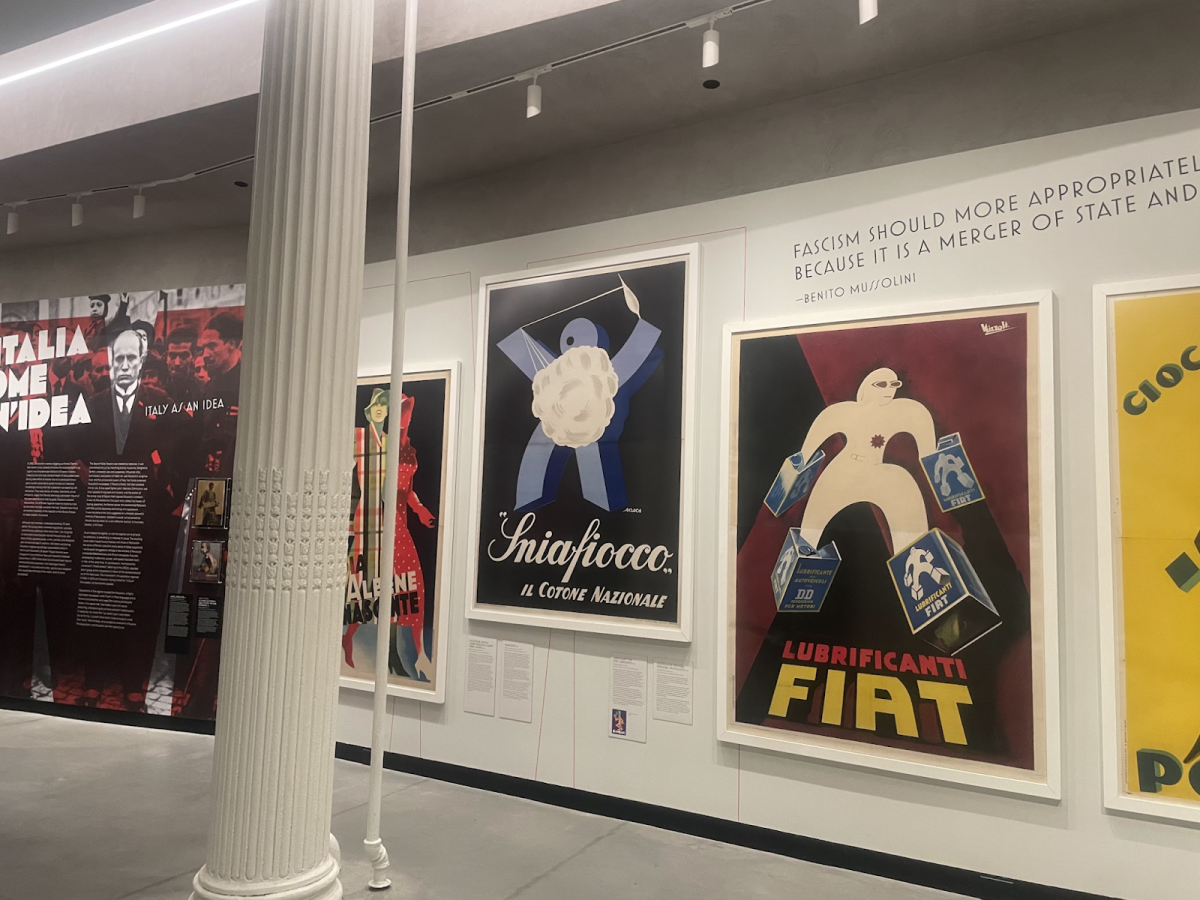
The interior side of the wall separating the exhibit from the rest of the museum is a warm beige-gray featuring mostly larger posters. This area of the exhibit, entitled ‘Italy as an Idea,’ features at the forefront many large pieces that are generally around five to six feet tall and four feet across. Subjects range from Italian car powerhouse Fiat’s car model, the 1933 Ardita, to the Rhodia and Albene Fabric Show.
‘As an idea’ casts a phenomenally wide net for a category — luckily, a graphic over the wall gives context.
This third of the 75-piece exhibit follows themes of unifying an Italian identity post-World War I. moving away from ‘has-been’ Italy framing “linguistically, culturally, and ethnically undefined” remnants of the great (but long-gone) Roman Empire. Under Mussolini, there is a movement towards a new face of Italy — ratified by and reflected back onto the artists, poets, writers, and designers of Marinetti’s Futurist Party that had merged with the National Fascist Party in 1919. Artists included Margherita Sarfatti, Carlo Carrà, and Gabriele D’Annunzio, to name a few.
Moving towards the opposite end of the exhibit, we reach the second section, ‘Italy at Home.’
L’Italia A Casa displays how fascism seeped into the foundations of Italian society: from the promises made between Mussolini and his people to the original fascist movement defining Mussolini’s symbols and principles far into the future. With great range — sculpted heads larger than bowling balls to cookbooks with images of chefs saluting to stencils of Benito Mussolini’s profile — this portion of the exhibit explores important iconography in detail.
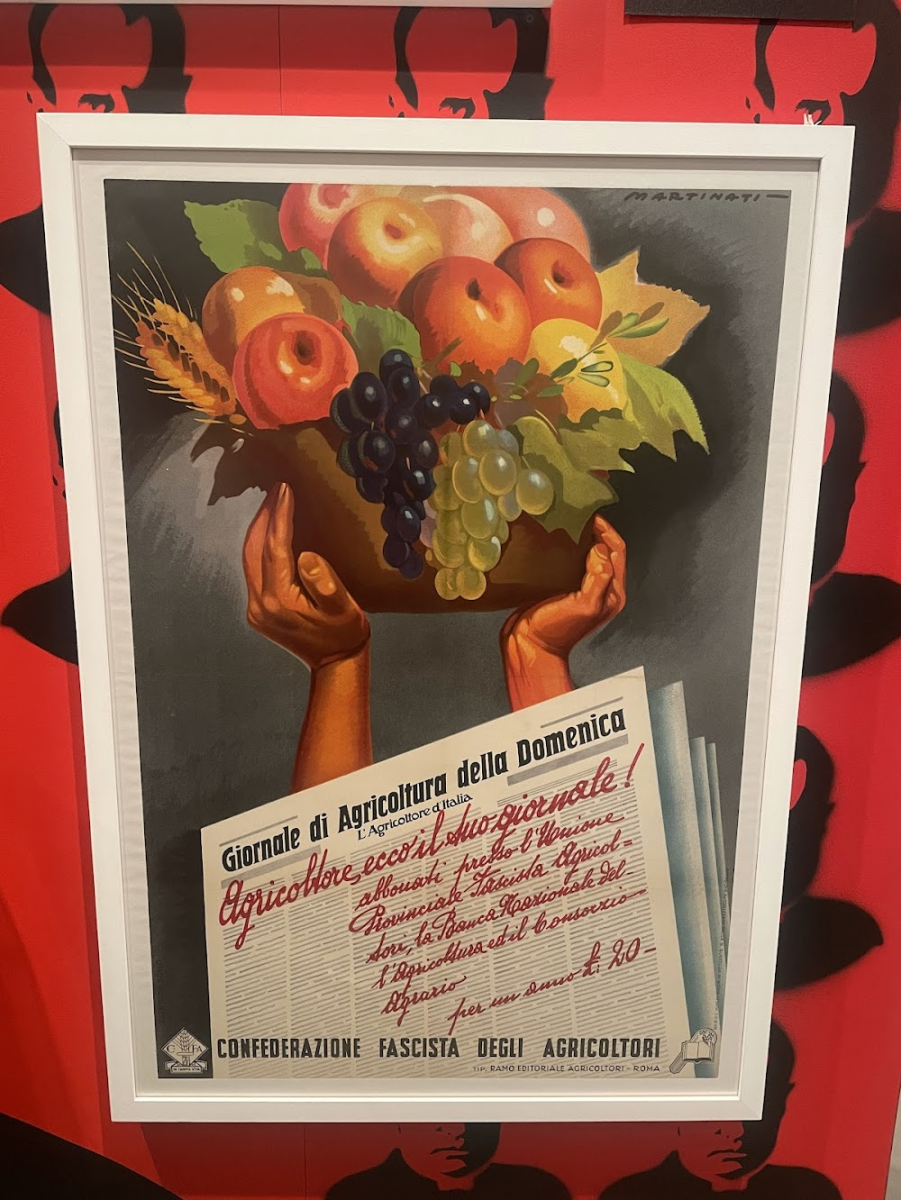
The last part of the exhibit continues after the visitor passes through a gap in the angled walls that are partitioning the room.
Out of every section, ‘Italy Abroad’ felt the most authentically comprised of advertisement. While the product placements in the first section was more specific in what exactly it was advertising, this section features posters that scream out with bold typeface and iconography — and through it inspects how fascism configures its following, specifically how far a cult of personality can lead people.
The themes range from sporting events to global conquests to novelty air travel to calling back to ancient history — and most of all, vincere, Victory.

Each piece is accompanied by a plaque, which is simply commonplace in the realm of art exhibits.
However, more than anything, the object labels and wall copy stand out by conveying the personality of the curator. The background, art style, and impact are all written for the average person. It feels more like a conversation than a history lesson — especially through the retrospective description of many pieces.
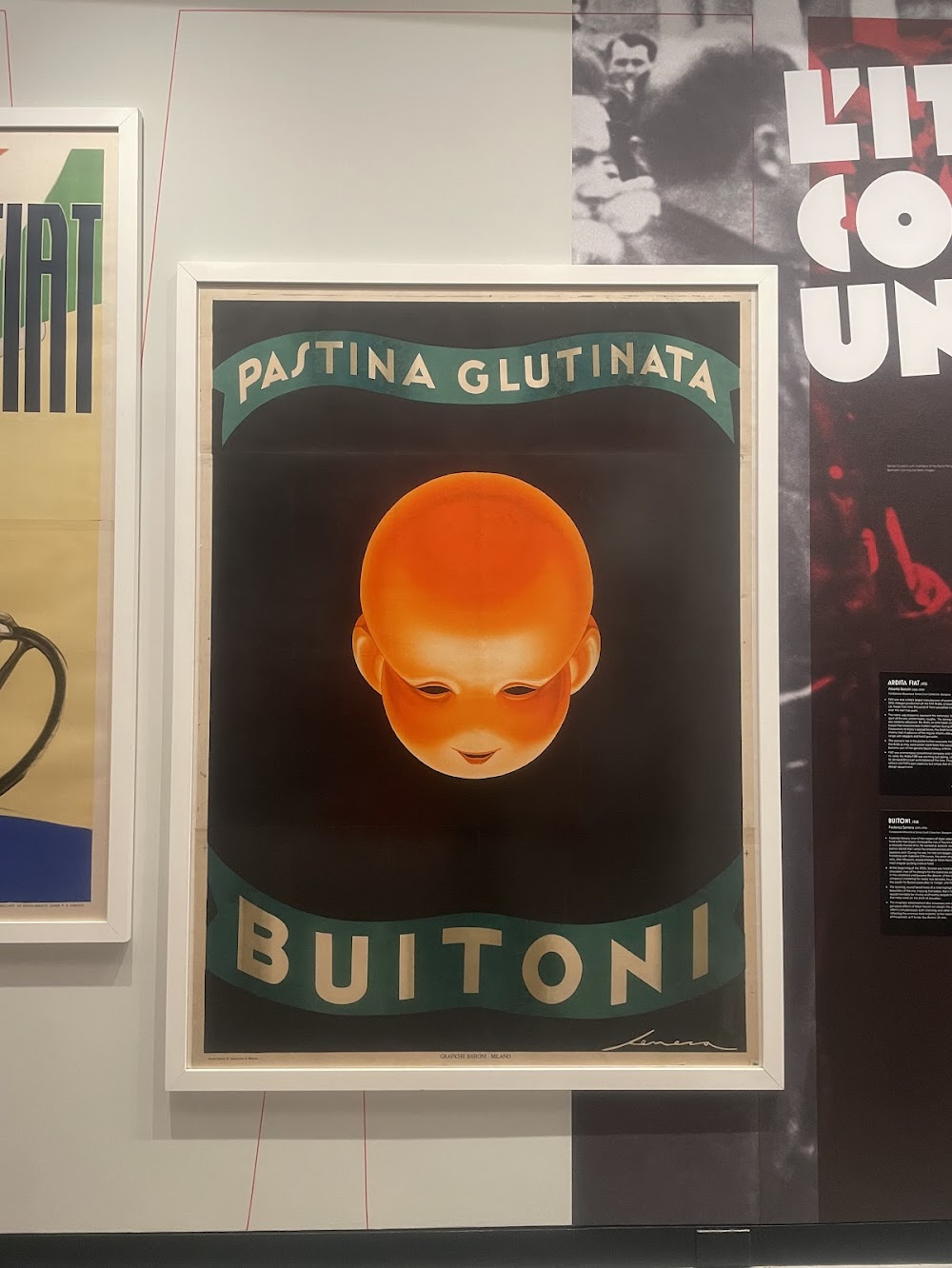
For example, under Buitoni (1928) by Federico Seneca, the wall copy notes, “The enigmatic advertisement also showcases one of the pervasive effects of Italian fascism on design; the glowing reflecting the ominous tone endemic to the national mood of the period, as if so to say: Buy Buitoni. Or else.”
And concluding the introductory segment to ‘Italy at Home,’ the wall copy notes, “In the beginning, Mussolini wanted to become Italy; in the end, Italy became Mussolini. Myriad sculptures, paintings, and posters were almost uniformly made to honor Il Duce and his acolytes — often fumbling mediocrities made mad with power. And what power it was: his violent, totalitarian and eventually ethno-nationalist regime ordered no fewer than 5,000 political assassinations, had many more thousands tortured and pulled Italy into a world war that would see 450,000 Italians dead by its end.
And in the end, the trains never did run on time.”
Hearing the curator’s voice while seeking to understand the depth of a piece has a charm that enhances the idea of an advertisement-based museum: layman’s speak is how ideas reach the people.
During my interview with the aforementioned curator of the exhibit, B. A. Van Sise explained his perspective of his creative ventures — and how curation falls into this category.
I: What do your various ventures in self-expression—nonfiction writing, poetry, photography, curating — mean to you?
V.S.: “There’s a great Robert Heinlein quote: “A human being should be able to change a diaper, plan an invasion, butcher a hog, conn a ship, design a building, write a sonnet, balance accounts, build a wall, set a bone, comfort the dying, take orders, give orders, cooperate, act alone, solve equations, analyze a new problem, pitch manure, program a computer, cook a tasty meal, fight efficiently, die gallantly. Specialization is for insects.”
I have more than one interest — it’s probably cost me a little in my career, as I can’t be reduced to one simple and saleable item, I’m not exactly Thomas Kinkade-painter-of-light over here — and I find that trying different things often improves, or perhaps augments, or at least just modifies the other.
Almost everything I work on begins as things I’m interested in: I read a lot, so then I write a lot. I love looking at photography, so I became a photographer. And I’d consulted on a lot of exhibitions and more importantly been shown in a lot of exhibitions before stepping up into curation.
It’s something I’d wanted to do for absolutely ever: when I was not much older than either The Science Survey’s writers or readers, I took a course in my sophomore year at Fordham University — Museum Methods, it was called, with a really impressive adjunct named Andrée Hayum.
Hayum had this really big presence and knew every curator in the New York area, took us to meet all of them, talked about how shows come together, about crafting narratives and telling stories well through imagery. It was, perhaps, the most influential course I took in my college career, because it taught me that curation, too, is an art form.”
***
The expression of curation as an art form takes center stage with ‘The Future is Now.’
That being said, when initially discussing his involvement with the exhibit, Van Sise conceded a significant amount of the creative process to the museum’s current Executive Director and Chief Curator Angelina Lippert.
VS: “The exhibition preceded me; Curator (now museum director) Angelina Lippert originally worked with the Massimo and Sonia Cirulli Foundation in Bologna, Italy on selecting the pieces, and handed me the reins when she was elevated to her new position in more rarified air. While it’s collaborative, the research and text are primarily mine; I expanded on and refocused the show a bit as well.”
***

In my interview with the museum’s Executive Director, Angelina Lippert, she corroborated and expanded the details of the formative period for this exhibit.
AL: “When the Italian Fascism show was first planned, I was still the curator and not yet the director. We plan shows five to seven years out, so this is a long time in the making.
Initially, I just wanted to be able to work with the Cirulli Foundation and thought the show would be about Italian marketing. However, when I went to Bologna to explore what they had, I realized that the collection was especially strong in the realm of posters produced under Mussolini. This changed the scope of the show.
I then selected work that expressed both obvious or overt propaganda as well as posters that demonstrated the subtlety of Italian Fascism at work — how a poster for chocolate or an automobile race reinforced an ideology. And, of course, all of this was done through the lens of the exceptionally modern and powerful Futurist movement.”
***
Of course, Lippert credits Van Sise for the distinct voice and feel that has been applied to a historical topic.
AL: “When B.A. Van Sise took over as curator, he brought a distinctly personal perspective to the material that I, as someone who is neither Italian nor an Italian scholar, would not have been able to do. That intimacy with the objects is what I believe has made the show so impactful — it brings a time period that may feel quite distant and floods it with immediacy in a way that contemporary audiences find resonance. Being able to express to an audience how a poster would have made a viewer at that time feel or think or respond is incredibly important to us as a museum, and BA does that beautifully.”
***
When prompted with the personal aspect of the exhibit in his own words, Van Sise exposed a much more personal stance than I expected.
I: What does this exhibit mean to you?
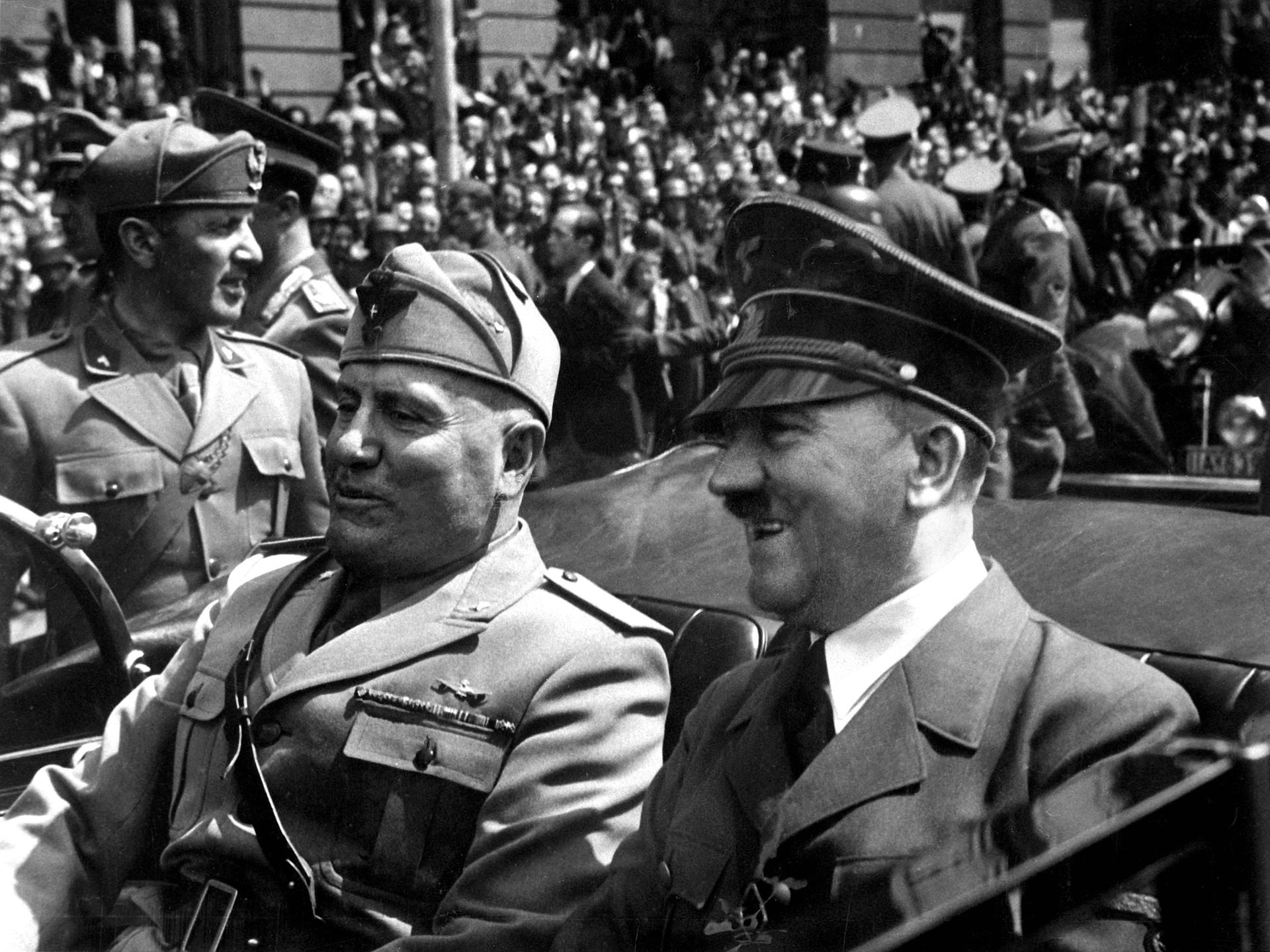
VS: “A lot, actually. My family — and I don’t mean in the abstract way, people I knew and knew well were alive for this, experienced this, were harmed by this, were raised in and by it. My grandfather was in the mob that hanged Mussolini — the exhibition makes an exemplar of him, which was actually Lippert’s idea — but my grandmother survived the war hiding in a church basement; my uncle (who was a seminal figure in my life) complained every day from that to his last about the bomb that blew up the movie theater across the street from him. Fascism climbs into the little things, like his little theater with its great big bomb in it: he’d go all the time, pay two bits and see movies until, as they so often do, the Nazis ruined everything. His two bits became my dollar prose.”
***
At first glance, this exhibit can be seen simply as an appreciation of early-twentieth century Italian advertisement. Looking further, you come across meaning where most see nothing more than a well-constructed graphic. Meaning and politics are the purported goal of a country micro-dosed in each piece of media decoded with retrospective analysis by a descendant of people who lived it.
Futurism, like fascism, strives to create the narrative that nothing is wrong, all while creating fissures and hierarchies. Whether it was the superiority of Italians over others or superiority of the state over the individual, media in this time period fell to political capitulation. Each piece seeks to create glamour from squalor and to gain support from the very people whom it would harm.
With ‘The Future Was Then: The Changing Face of Fascist Italy’ at the Poster House, you get a witty, informational breakdown of how exactly this phenomenon took over Italy. The viewer will see masterfully designed and thoroughly convincing advertisements, plastered across every wall under the watchful eye of Benito Mussolini’s profile around every corner. The experience of this exhibit provides the viewer with unique insight into the life of a consumer under a fascist regime.
‘The Future Was Then: The Changing Face of Fascist Italy’ is an ode to advertisement as an art and a grim reminder of advertisement as means to shape the minds of a population. The exhibit explores how Mussolini’s regime used design and visual culture to normalize authoritarian rule — compiled as a cross-section of culture and history.