

Right in the heart of downtown Chicago, amidst deep-dish pizza joints and intimidating skyscrapers, lies ‘The Bean.’ The incredibly large stainless steel bean, officially named ‘Cloud Gate,’ is poised in Millennium Park alongside other popular tourist attractions such as the Crown Fountain, the Art Institute of Chicago, and the Jay Pritzker Pavilion.
Despite its simplicity, The Bean has become an internet sensation. During my own visit to the city this past July, my sole mission was to get a picture with ‘The Bean.’ Given the sheer number of people blocking my view of it when I got there, I was definitely not the only one.
You might be wondering what exactly ‘The Bean’ is meant to represent. I, too, was curious.
The artist behind ‘Cloud Gate’ is Anish Kapoor, a British-Indian sculptor who is known for his large-scale, abstract pieces. Many of his works can be found lurking in public spaces, surrounded by amused yet slightly confused tourists.
Indeed, Kapoor’s works are not of the obvious type; they’re fun to look at, and even a bit “trippy,” which can make it hard to know what message he is trying to send. ‘The Bean,’ which might just be the most quintessential example of this, is named ‘Cloud Gate’ because 80% of its surface reflects the sky. It’s a “gate” because it connects the sky to the ground. Oh, that makes sense.
If you’re interested in testing your own ability to interpret the complex concepts of Anish Kapoor, the Jewish Museum on the Upper East Side currently has an exhibit that offers a perfect opportunity.
Anish Kapoor: Early Works, currently on view at the Jewish Museum through Sunday, February 1st, 2026, features Kapoor’s pigment structures from the late 1970’s and 80’s, widely viewed as his formative period, where his artistic style truly began to take form. He started to explore binaries such as male and female, dark and light, and earth and sky (such as with ‘The Bean’).
In this particular exhibit, which is composed of very simple, minimalistic art pieces, we can see Kapoor’s interest in primary colors. Many of the art pieces showcased in this exhibit are a part of Kapoor’s 1000 Names collection, which includes a large array of simple, but bright sculptures and paintings. These geometric forms define his perception of individuality, interiority, and infinite possibilities. The title “1000 Names” refers to the 1000 names of the Lord Vishnu, a central deity in Hinduism. This parallel emphasizes the origins of life, birth, and creation as Kapoor’s inspiration.
The 1000 Names collection notably features works with bright shapes and structures on fully black or white backdrops. The shapes are not necessarily special, in fact they are quite the opposite (recurring ones are pyramids/triangles, crescents, and circles/spheres), but the stark contrast between them and their background makes them jump out towards the viewer.
Individually, these works are intriguing, and entertaining to experience. In excess, like in this exhibit, they are consuming. The Jewish Museum has devoted a medium, if not small amount of space to Kapoor’s sculptures and paintings. The walls, floors, and ceilings are all practically bare, leaving the viewer alone with Kapoor’s bright works. You enter one of the rooms and immediately see large, monochrome pigment sculptures, and canvases with one incredibly bright shape as the focal point. It’s abstract in the truest sense of the word.
A common criticism towards abstract art is that it does not evoke emotion; viewers struggle to find meaning within simple geometric shapes. But the key with viewing abstract art is that you have to relish in this discovery. It’s these kinds of pieces that you should find yourself standing in front of for far too long, peering at them from different angles to try to find what they mean to you. It’s harder than with other artwork, and induces a lot more eyebrow furrowing, but there is a purpose to abstract art. The beauty of this movement is its subjectivity, and how it is often the entire point of the artist to get you to develop your own interpretation.
Kapoor’s art is no exception. As previously mentioned, this exhibit is set up so that you are alone with the art: a bare room, a couple bright lights, and pigment. In this environment, I could find meaning in many of the pieces (it is also helpful to take advantage of the descriptions on the walls if you’re really stuck).
The first pieces that stuck out to me were a collection of three, untitled canvasses. Like a lot of the artwork in this exhibition, these paintings had a very limited color palette, with each one being created from one of the three primary colors. This is recurring in Kapoor’s exhibit: essentially all of the paintings are made out of blue, red, and/or yellow (especially red, as you’ll notice in the photos). These three paintings showcase Kapoor’s experimentation with texture and emphasis. The yellow one was painted with a thicker medium, which juts out of the canvas into 3D forms. The red one creates an emphasis on a single brown form in the middle. The blue one creates such a strong contrast with a tiny white dot in the upper center of the painting, so much so that it makes you wonder: Is this a mistake?
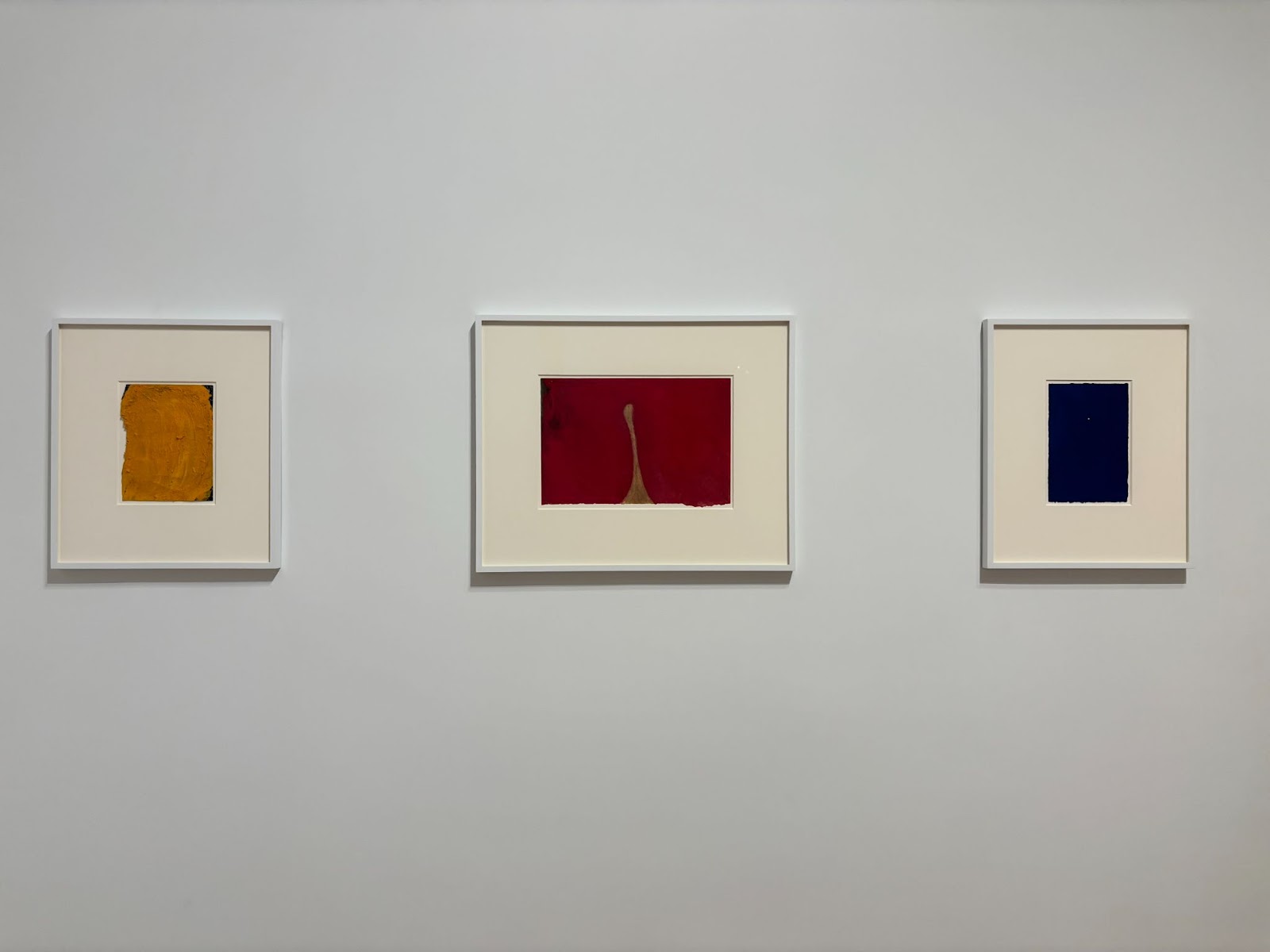
I found these paintings strangely captivating; I felt like I was witnessing Kapoor’s style come to life. In my experience, these were the first works that I saw in this exhibit, which felt very logical. The order in which I experienced the exhibit made it so the work got bolder and larger as I went on, though I noticed that other viewers took different paths and likely saw these works last. I wonder if they had the same perception of them as I did. Again, abstract art is subjective.
And of course, there are the pigment sculptures. I doubt you have ever seen artwork quite like these pieces. They are the selling point of the exhibit, and for good reason.
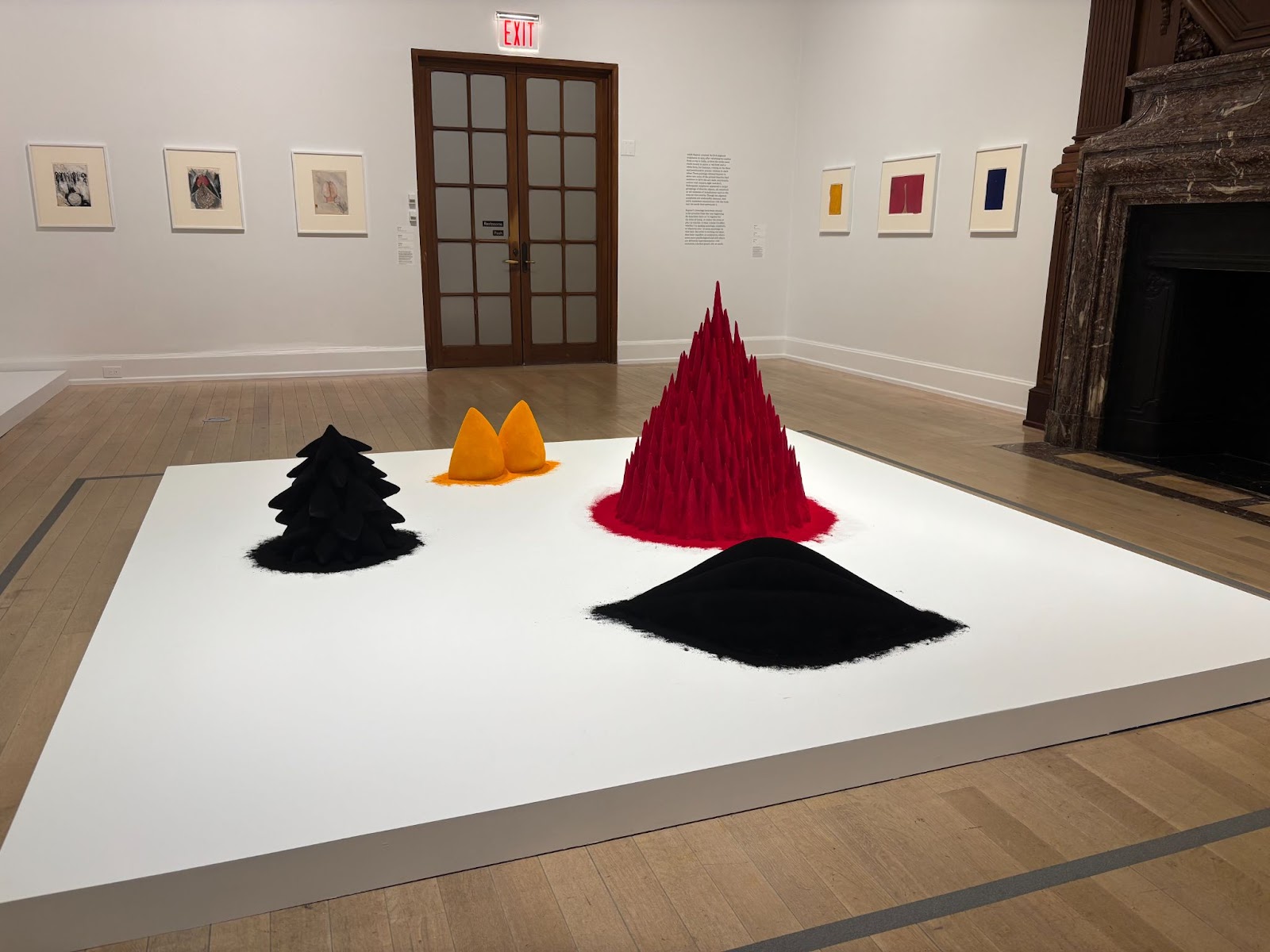
In the first room, the four sculptures on the floor are quite small, and showcase Kapoor’s exploration of sharp and dull forms. They make up one singular piece, entitled, ‘White Sand, Red Millet, Many Flowers.’ The tall red structure is a mountain of bright red icicle-like points, almost reminiscent of gothic architecture. In reality, this piece is a representation of millet, which are a group of small-seeded grasses that grow extremely upright and tend to have thicker stems than most grass. By contrast, the flat black pigment structure (which looks like black sand) in front of it is rounded, almost shy and timid in comparison.
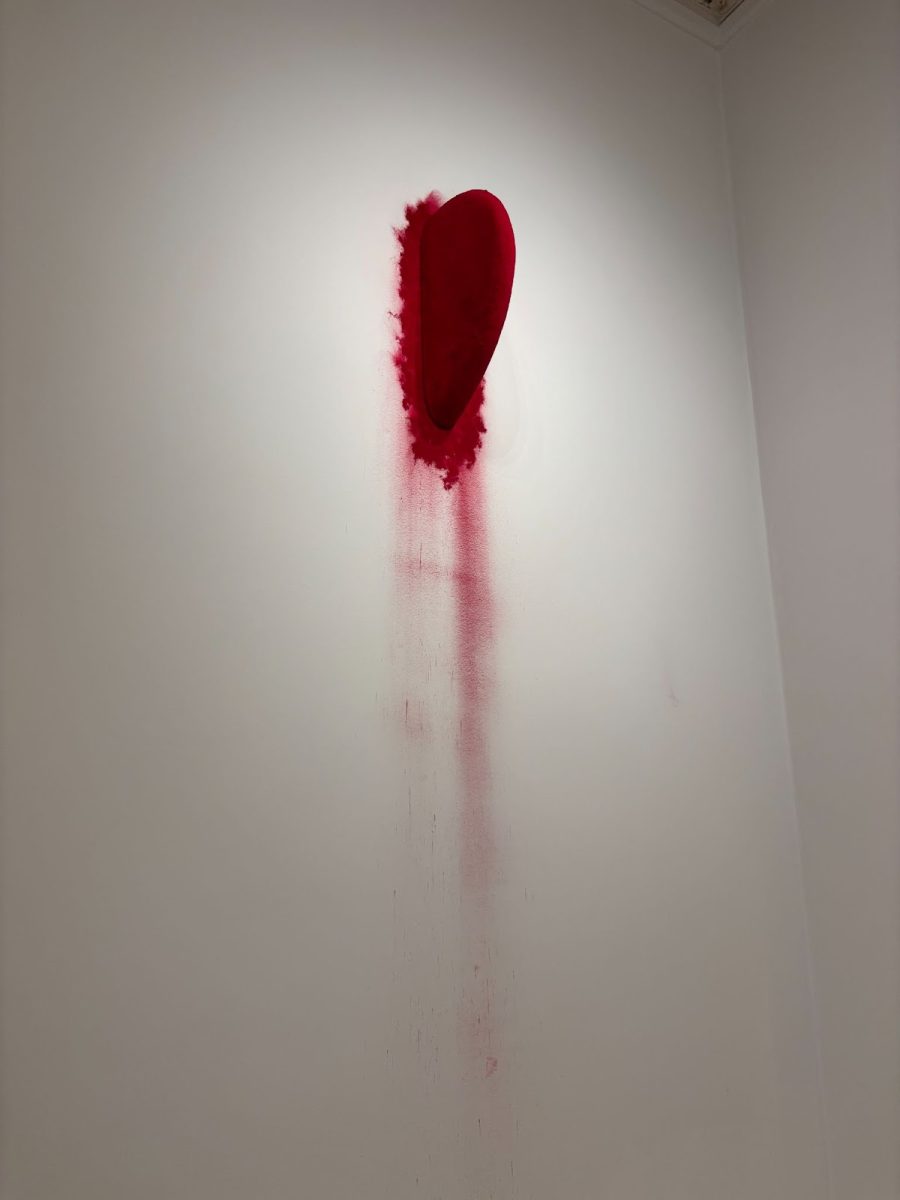
There is also a pigment sculpture on the wall of this first room: a red semi-circle that appears as though its other half is inside of the wall. Red pigment cascades down from this sculpture, further suggesting that it was literally forced into the wall.
The sculptures in the third room (pictured above) are similar to those in the first space.
I found that the most interesting sculptures were in the last rooms that I visited. Here, we are introduced to blue pigment, which I first noticed in the shape of a flower on the wall. Up until this point, there is a stark lack of blue. Unlike the red semi-circle from earlier, this sculpture seems more delicately placed on the wall, with no stray pigment around it. It is softer, calmer, and less violent. The use of blue (which tends to symbolize spirituality and trust) rather than red (a color often associated with danger and anger) also contributes to its quaintness.
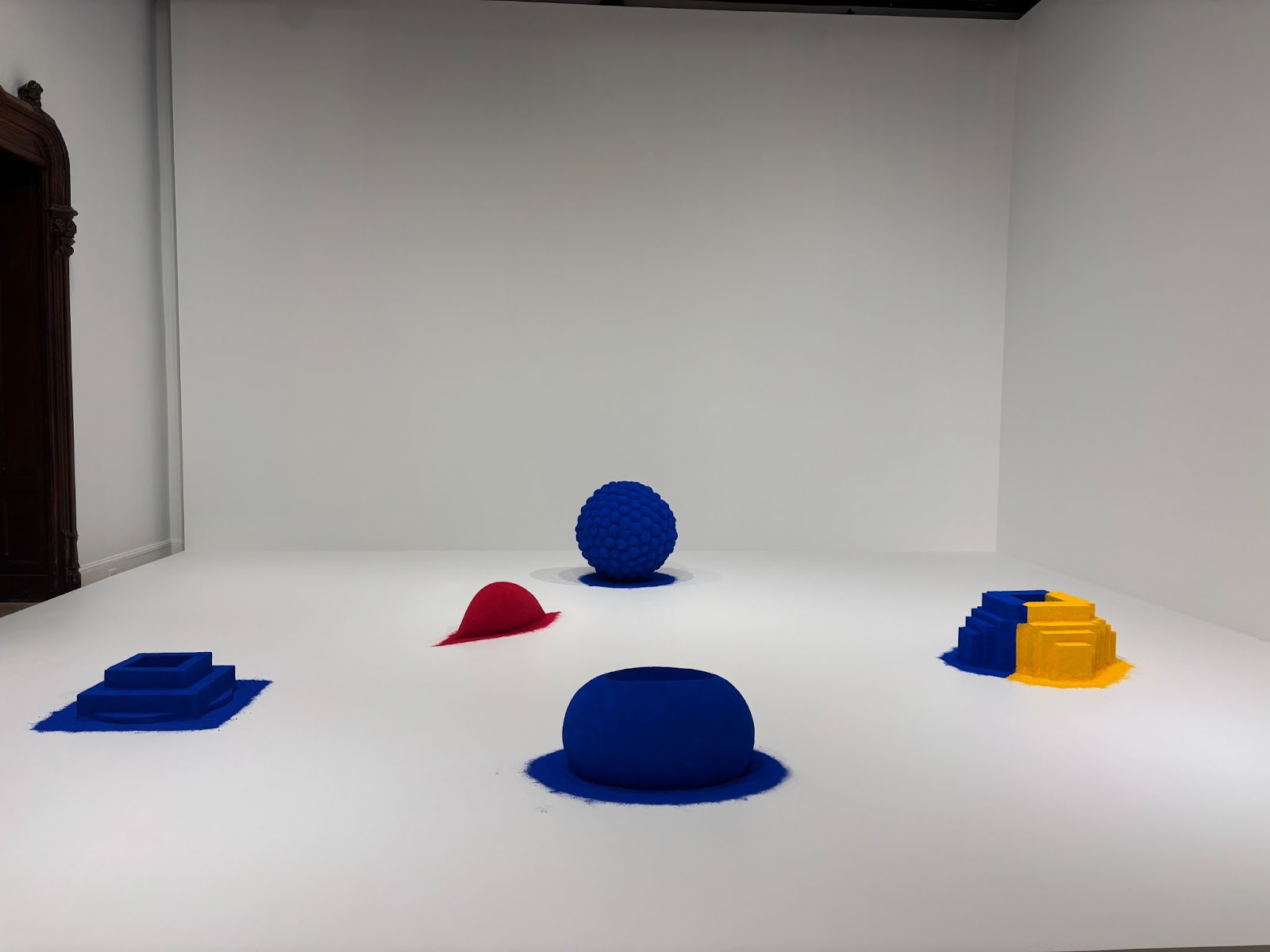
Similarly, the pigment sculptures on the floor of this room are mostly blue, with only one fully red one and one that is half yellow, half blue. Compared to the previous structures, these pieces are much more simplistic. We see the first square/rectangle shapes, and the rest are almost fully round. The one unique exception is the blue sphere at the back of the room, which is decorated with dozens and dozens of small semi-circles along its surface.
These sculptures are humble, small even. Compared to some of the other pigment structures, these are inherently less impressive. Yet, in terms of emotional impact, I found these to be the most substantial. The combination of rounder, smaller forms with a blue hue evokes a tangible sense of serenity.
Upon entering the last room, I was met with some of my favorite pieces from the entire exhibition. Showcased are Kapoor’s black pigment works, some of which are made of regular black pigment, and others which are coated in Vantablack, an extremely dark black medium that traps almost all light around it. The resulting effect is a complete lack of shadows, which, in artistic use, creates incredible illusions.
Kapoor started using Vantablack in 2014, so not all of the black-colored works in this exhibit are made from it. However, the ones that aren’t are still capable of the illusion. ‘Void,’ for example, which was in the previous room, is a large semi-circle made from fiberglass and black pigment. From the front, you cannot tell that it is a 3D shape, but change your angle, and you see that it in fact is. It is impossible to fully capture this effect in a photo, so I highly suggest that you go see it for yourself.
Observing these dark sculptures, made from Vantablack and not, I almost felt like I was falling. The illusion of depth is so powerful, it’s distorting and almost surreal.
Anish Kapoor: Early Works is a completely unique experience. The average viewer takes no longer than 30-45 minutes to view the exhibit, but will no doubt leave with a new, more diverse and eclectic perception of art. Kapoor invites you to find meaning in not just abstract geometric shapes, but also in the most simple colors. Pigment structures that are similar in shape, but different in hue can evoke contrasting emotions, something I’d personally never even thought about before visiting the exhibit.
Before the exhibit closes on February 1st, 2026, I highly recommend that you visit. It’s one of the most accessible exhibits you can find, prompting you to simply consider some of the most fundamental binary relationships, and challenge your brain to find meaning in a red semi-circle. And who knows, you may find something better than ‘The Bean.’
It’s these kinds of pieces that you should find yourself standing in front of for far too long, peering at them from different angles to try to find what they mean to you.