
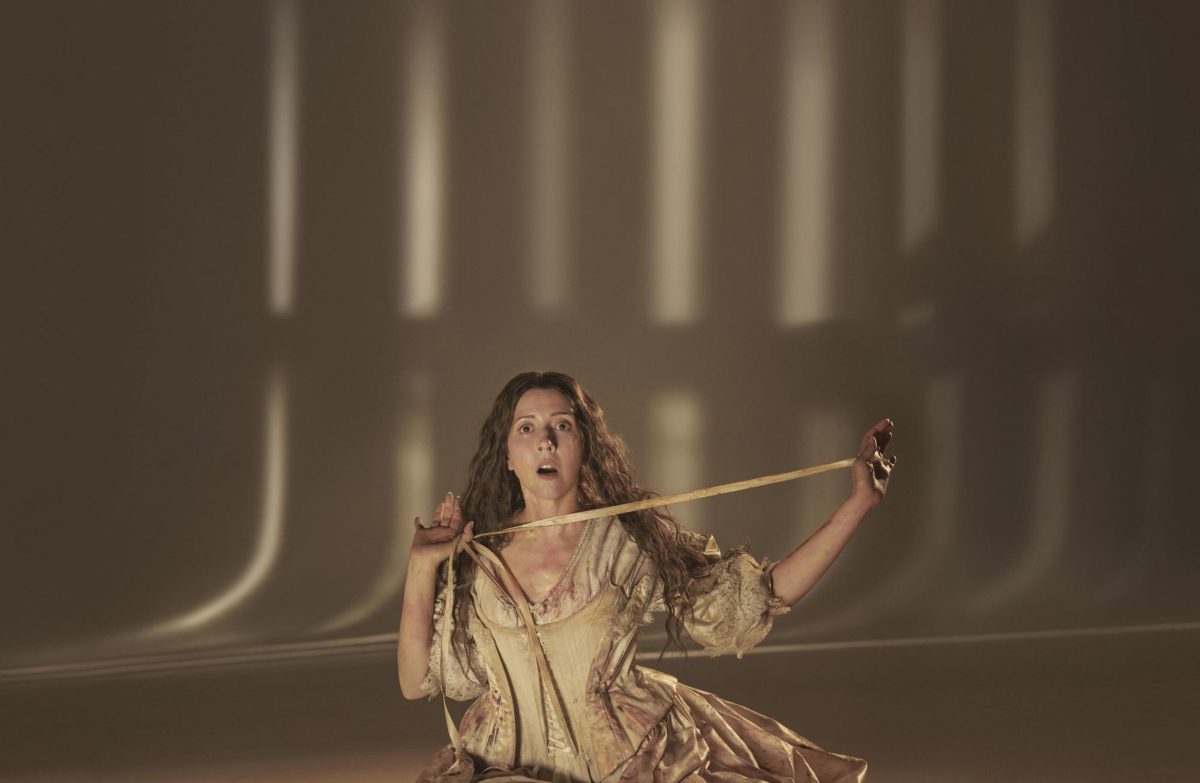
A rigid church room appears, soon to be gutted by wartime degradation. A Royalist son and a Puritan daughter sit across from each other, cautious and curious. Or, perhaps the most simple yet central comparison of all is joy versus madness. Contrasts were at the heart of the Metropolitan Opera’s recent production of I Puritani — and paired with superb singing, it made for a breathtaking production.
I Puritani was conceived by famous Italian composer Vincenzo Bellini in 1835 as his tenth and final opera. After troubles with the Paris Opera, the Théâtre Italien commissioned him to write a new Italian opera for a Parisian audience in 1834. Eventually, he found inspiration in the French play Têtes Rondes et Cavaliers, which was set during the English Civil War (1642-1651 C.E.), a conflict where the Parliamentarians — which included the Puritans — and Royalists clashed over regime ideology. The Parliamentarians fought against the established monarch, King Charles I, while the Royalists backed him. The Parliamentarians eventually won out, establishing the Commonwealth of England in 1649; turmoil and conflict, however, would continue, leading to a restoration of the monarchy in 1660.
But it was not the political conflict itself that had drawn Bellini to this story. Rather, it was the passionate love triangle that had been central to the play — featuring two men and one woman. As the acclaimed English language translator of modern Italian literature William Weaver argues, “It was clearly the heroine’s madness that attracted the composer and determined his choice.” From the very beginning, Bellini wanted his production to be an emotional melting pot, centered around love, betrayal, and maddening passion — so enthralling that this passion, instead of a raging war, should draw the unwavering attention of the audience. “Draw tears, cause horror, bring death, by means of song,” he told Count Carlo Pepoli, the librettist of the opera.
This desired emotional draw was not lost on Bellini and Pepoli as they created their two Romeo-and-Juliette-esque lovers: Elvira the Puritan and Arturo the Royalist. As a critic in VIALMA Classical writes, “Joy is felt with Elvira cheerfully announcing Son vergin Vezzosa (‘I am a Charming Virgin’), despair when Elvira begins to lose her sanity in Diletto, È In Ciel La Luna (‘Come, My Beloved, the Moon is in the Sky’), and deep love in Arturo’s famous declaration A Te O Cara (‘To you, my dear’).” This gravity is typical of the bel canto style, for which Bellini’s music was known. Elvira sings with dramatic dynamics and a yearning tone, spinning through coloratura riffs as she descends into madness. Military scenes boast booming bass and a nationalistic pride. Religious scenes show a rigid holy severity, enabled by a righteous-sounding chorus. Every part of this production had its own unique and compelling music, and each aria had an underlying emotional pull.
This season, the Metropolitan Opera’s production of I Puritani was directed by Charles Edwards, marking his directorial debut. The set itself, at first glance, is quite basic — a Puritan church room, practically monotone. But its mastery is revealed with time. As the audience follows the progression of the English Civil War through projected titles, the set slowly deteriorates. Windows are covered, pews are broken down — and by the ending scenes, the walls are degraded and crumbled. The set seems to mirror Elvira’s descent into crazed frenzies. But it also serves to mirror the Puritan army as a whole. In the ending scenes, the army hunts down the Royalists with torches and sticks, seemingly alluding to a sort of savagery. Edwards’ directorial decisions show his innate understanding of Bellini’s creation. ”You only have to listen to the music to discover that [the pieces]…contain great psychological truth,” Edwards said.
But in Edward’s eyes, the madness of Elvira is also her attempt to break out of the rigidity of strict Puritan norms. As such, he added a new spin to Elvira’s character: throughout the opera, she is drawing a portrait of Queen Enrichetta (the Italianization of the name Henrietta Maria) — the widow of the late King Charles I, who had been beheaded during wartime. The paintings, done by Edwards himself, were inspired by the portraits of the real Henrietta by Van Dyck. “Elvira has had to repress her self-expression, her sexuality, and her identity as a woman, so when she encounters Enrichetta, in a way she idolizes her,” Edwards explained. Later on in the production, when Elvira believes that her lover has abandoned her for the very same woman, Edwards believes that she goes through a kind of ego crisis. “For me, Elvira doesn’t go mad,” he said. “She just acts out everything that is inside her — her true personality comes out. And in this society, for someone to behave in such a liberated way leads everyone to believe something must be wrong with her.”
Lighting was also crucial for the set design, giving the production another contemporary feel. When Elvira goes mad after the perceived loss of her lover, her haunting melodies are accompanied by green light enshrouding the entire stage. This could very well be a reference to the Infantry Company Standards in the English Civil War, which in part categorized green as “loyalty in love.”
Synopsis
Act I
The music creeps mischievously as the projected subtitles read, “A time of tension between Puritans & Royalists.” Only a sliver of the stage is uncovered, giving the opening scene a constrictive feeling — just as the lovers are constricted in their true desires. Two wooden chairs are set across from each other; a man, sporting a gaudy royal blue outfit complete with poofed-up sleeves, enters. He pulls out a notebook, reclining on stage left. This is Arturo.
A young woman twirls out from stage right. Decked in full Puritan attire — a black gown with a white apron and bonnet — she moves towards the other chair hesitantly, clutching a drawing of Arturo. She soon rises to hand him a flower; he sniffs it, treasuring the gesture. These enchanting characters are Arturo the Royalist and Elvira the Puritan, the lovers.
The first line in the entire opera is sung by the Puritan chorus: “Awaken!” The supervisors of the two lovers come out: Elvira’s Puritan father, Commander Gualtiero, who rushes her away, and Lord Talbot, who guides Arturo offstage. The stage opens up to a modest church room, revealing a chorus of Puritan men. After their hymnals and prayers, they begin to grab weapons from the wings, spitting and peeing on a royal painting. It is 1641, and it is evident: the Puritans are invigorated for war with the Royalists.
Puritan women soon enter as jolly music swells. The women crowd around Elvira, throwing a bridal veil over her head — she is caught, a bug in a white web, perhaps alluding to her entrapment within the confines of a rigid, traditional society. But never mind. Wartime has not yet begun, spirits are high, and the Puritan chorus sings of a blessed marriage between Elvira and Arturo.
We soon learn, however, that Elvira had before been betrothed by her father to a Puritan commander named Riccardo, who laments the fact that Elvira does not love him as he does her. “What torment it is to remember the sweetness of a tender love!” Riccardo sings to Bruno, a soldier under his command. But Bruno is unmoved. “Forget the past and those dreams of love,” he tells his friend, imploring him to take up arms as an alternative for his ardor. Riccardo falls to his knees and cries of his innocent love, sustaining a yearning high note for a stunning twenty seconds.
The second scene begins with Elvira and her uncle, Giorgio. She heralds him as a second father, and he rejoices for her good fortune: “Today, you shall be married!” Elvira thinks that he speaks of Riccardo at first, and as the orchestra crashes, she cries out, “Bride! Never!” But Giorgio reveals that he has convinced Elvira’s father to allow her to marry Arturo — and she rejoices. Her innocent, childlike nature is revealed through her flitting runs as she delights in her future. Her beloved uncle, proud and paternal, tells her: “[You are] innocence in a human veil.”
To the sound of blaring royal trumpets, Arturo makes his grand entrance as Puritan men and maidens watch on. With a sweet and desperate tone, he serenades his bride-to-be. “Joy has banished sorrow from my heart!” he sings to her, holding up the treasured flower she had given him in the opening moments of the production. But, as the jubilance continues, Arturo becomes distracted with the sight of a captured Royalist noblewoman who is being led to a Puritan dungeon. Giorgio tells him that this is Queen Enrichetta, whose husband has recently been beheaded. Elvira takes no notice of this exchange, captivated by the idea of marrying the love of her life. She chirps in delight. “I pray [my veil] soon will hide me in its beauty!” She and her company leave to prepare her for the wedding ceremony.
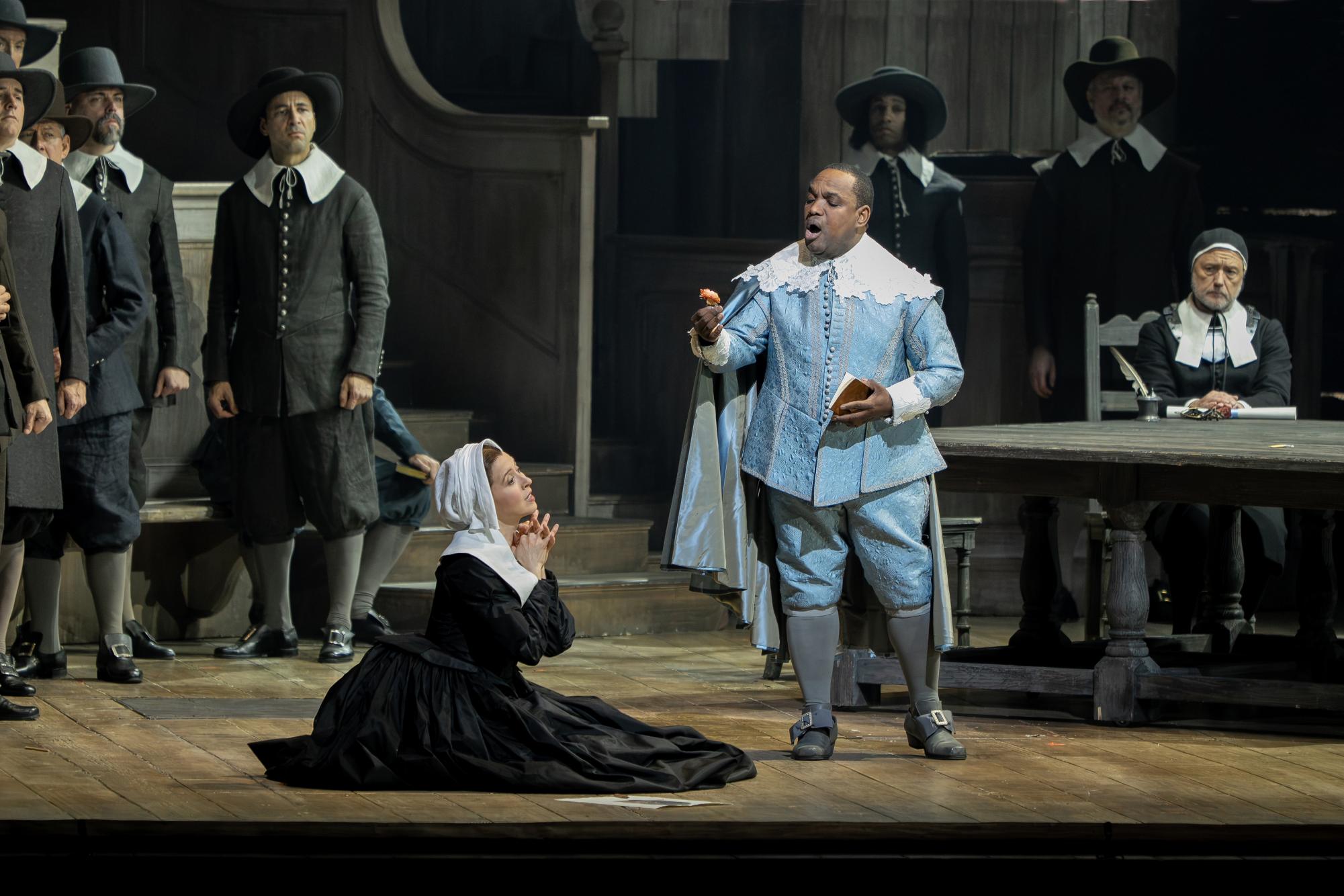
Arturo remains, ensuring that no one can see him. He himself is a Royalist, and his Royalist father had been killed by an enemy; as such, he feels a great loyalty to the widow of the king. “I tremble for my father’s memory,” he sings. Arturo implores Enrichetta to receive his assistance in helping her escape — even at the expense of his own life. “I’ll preserve thee, or with thee perish!”
As Arturo mulls over how to free Enrichetta, Elvira returns in her beautiful wedding gown. She prances around proudly, fluttering through birdlike riffs. “I’m a charming virgin in a wedding dress!” she proclaims. Her airy happiness is palpable. But as his innocent bride rejoices, Arturo takes note of her lacy wedding veil. His eyes light up as he realizes that it is the perfect disguise for Queen Enrichetta. When they are again in private, he tells Enrichetta his plan. “You will appear to be my bride…come.” Unbeknownst to anyone else, for fear of the Puritan army realizing their captive is gone, the pair departs.
But, as they attempt to leave the castle, they are suddenly stopped by a drunken Riccardo — who wields a menacing axe. “Stop!” he growls, stumbling. “In vain you try to kidnap every good I have on Earth!” As he sings, he grabs Enrichetta violently, thinking that she is Elvira. Light woodwinds from the orchestra sound as he challenges Arturo to a battle, signaling that his actions are out of his infatuation with Elvira. But, as the men begin to tussle, Enrichetta unveils herself to prevent the imminent bloodshed. When Riccardo sees that she is not Elvira, however, he does not stop the two from leaving. Because he knows that this will ruin Arturo in the eyes of the Puritans — and Elvira will finally be his.
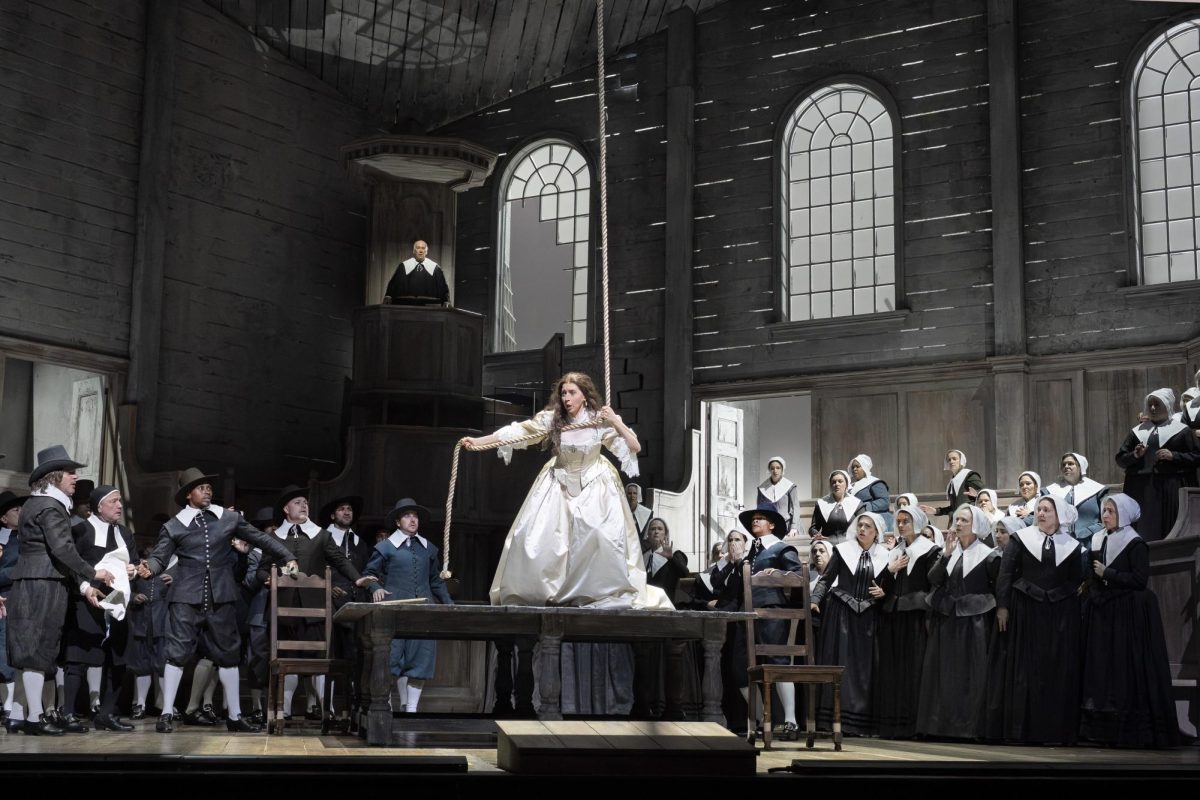
Elvira and her wedding party enter as the music quickens with happiness. “Where is Arturo?” Elvira asks lightly. Ricardo speaks. “Fled!” Drums crash as the chorus repeats what Riccardo has said, astounded. The soldiers sound the alarm bells and take up arms in pursuit of Arturo and Enrichetta. Elvira wails up and down scales in disbelief, beginning to question everything she has thought to be true. “Am I not Elvira?” she asks. Color drains from her face as she stands atop a table, wrapping the bell rope around her neck. A chorus of Puritans watches on, deeming her mad. “The light has left her eyes…reason deserts her.” They thrust out their hands as she snakes the rope around her delicate neck. “She descends into madness!”
But suddenly, her tone shifts. “Arturo then returned…still faithful unto me!” A harsh green light fills the stage as Arturo seemingly reappears, although it is obvious — this is not reality. The score takes on an old Disney, dreamy feel as she sings to a man who is not there. “Come to the temple, Arturo, my dearest! And there I will pledge to you endless faith.” She hands him a portrait — likely of Enrichetta, the woman whom she has idolized. The chorus around her, meanwhile, is horrified. “She thinks she’s at the altar…poor hapless maiden, she’ll die of love.” In the dream, Arturo caresses the portrait Elvira has given to him, but she suddenly rips it from his hands — jealousy has overtaken her. He runs off, abandoning her for a second time.
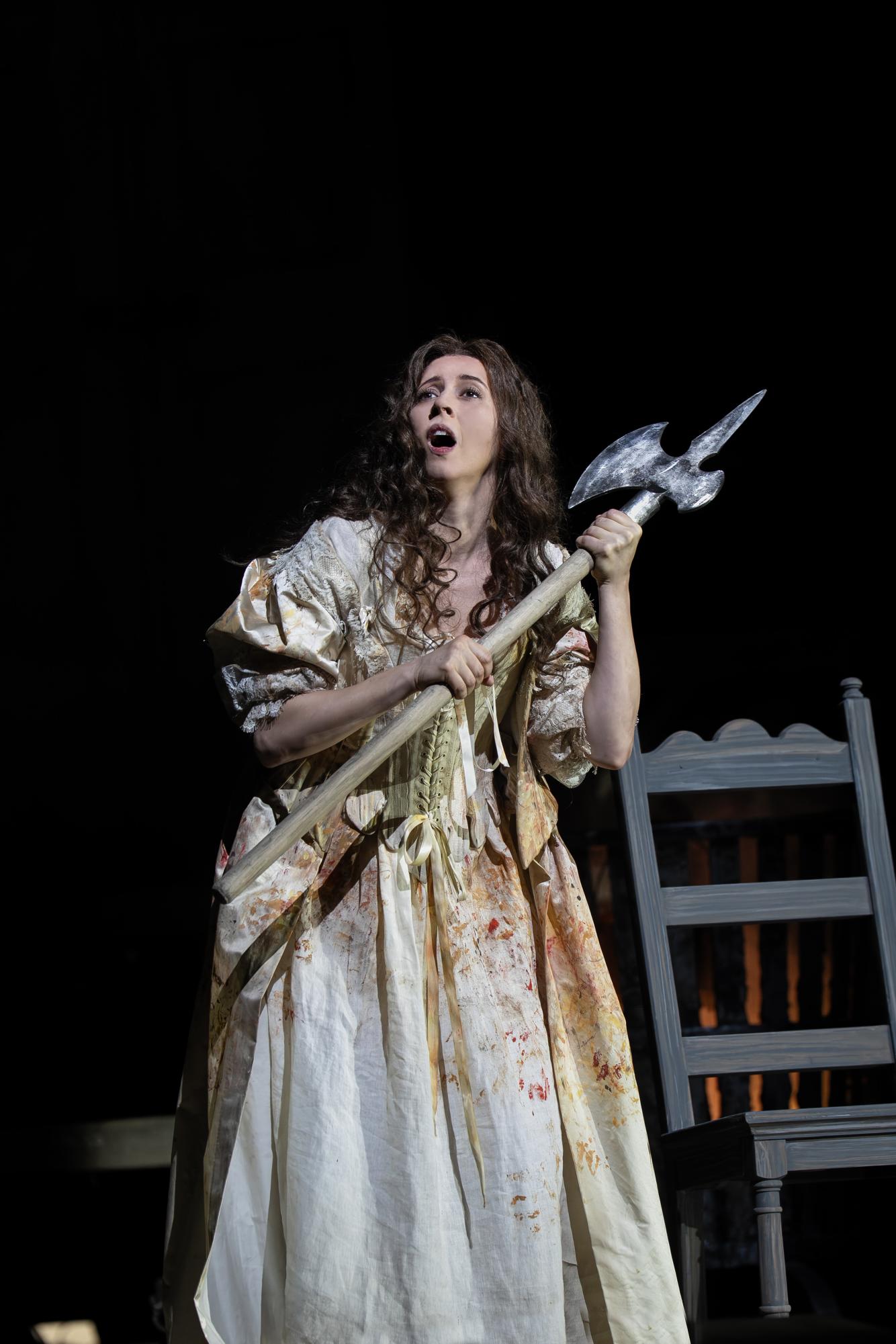
Elvira becomes manic. As the chorus sings of her “having her revenge,” she grabs the axe that Riccardo had wielded in a scene earlier. She swings at Riccardo, who backs off terrified, but suddenly pulls him onto the table on which she had attempted to hang herself. She straddles him provocatively and kisses him passionately. The Puritan chorus around them is outraged. And on the back wall lies a shadow of a Puritan woman, who clutches a Bible. This contemporary scene, likely the prerogative of director Edwards, seems to be Elvira’s breakout of rigid Puritan norms — her crazed grasp at freedom.
Act II
A few months have passed. The stage opens to the Puritan church room once more, yet now it seems more reminiscent of a war base. The lighting is dark and ominous, women weep, and axes are hoisted. A Puritan woman lies on a mattress on the floor, giving birth to a stillborn baby. The air is tense and somber; the Puritans are struggling in wartime, and Elvira is still broken from the loss of her innocent love.
The Puritan women begin to crowd around Giorgio, asking him how Elvira fares. He is solemn in his response. “Sometimes the dear virgin wanders and asks the breeze and the flowers with a sad face, ‘Where did Elvira go? Where did she go? Where did she go?’” The women lament for Elvira. “She will die of love!” Riccardo then reveals: for his crimes of freeing a prisoner and breaking an innocent heart, Arturo — when captured — will be put to death.
Elvira’s voice is heard from offstage: “Oh, give me my hope…oh, let me die!” She begins to descend a staircase with a lone candle, her once-pure wedding dress disheveled and dirty. “Who are you?” she asks Giorgio, who is pained to see his beloved niece in such a state. “Do you not know me?” he asks. She suddenly remembers and lights up with a spark of joy. “Yes — my father: you call me to the temple?” Her true father, distraught, falls upon the mattress on which the stillborn baby had been born moments before. Light wedding music starts again as she falls into her delusions, singing of marriage with Arturo. But, when Giorgio and Riccardo mourn her madness, the music is dark again. Such is the push and pull of Elvira’s emotional turmoil.
The lighting is green again, and a vision of Arturo and the runaway queen enter. Light music accompanies Elvira’s happy riffs; “Come, beloved!” she tells him. Enrichetta leaves Elvira’s delusions, and it is only Elvira and Arturo onstage. Suddenly, in a shocking throwback, we return to the overture scene, with two opposing chairs. He writes, and she draws — a strange, incomprehensible doodle. But this time, as Elvira hands him her creation, he does not caress it as he had previously. The Arturo of her visions rips the paper furiously and runs off, slamming the door behind him. Elvira whisks away to her room, more broken than ever before.
Brass sounds in the orchestra as Giorgio rises, speaking to Riccardo. “You must save your rival,” he tells Riccardo. Giorgio has long suspected Riccardo of helping Arturo and Enrichetta escape. To preserve Elvira and return her sanity, Giorgio implores Riccardo to spare Arturo’s life if the man should return in peace. “You shall make two victims…their shadows will surely follow you. If you see a phantom in the night…it is Elvira!” While they argue, a vision of Elvira appears to Riccardo with a rope around her neck. She eventually lies next to her unmoving father on the mattress, clutching an axe. Riccardo eventually agrees with Giorgio — he will spare Arturo if he returns in peace and surrenders.
Military trumpets pierce the air. The Puritan men take swigs of their drinks as they sing of their battle prowess, vowing to crush their Royalist enemies. Both tear their shirts and begin to paint themselves haphazardly with St. George’s cross. More rowdy painted men enter from the wings wielding weapons, and raise them high in fraternity-esque patriotism.

Act III
It is only a few days later — yet the Puritan church room is now utterly dilapidated. A wall has completely broken down, and destruction is all around. A young ghostly woman in Puritan clothing — a physical manifestation of Elvira in her innocent younger years —paints on a canvas. Backward canvases are lined on top of what used to be pews. Arturo then stumbles into the room; he has been running from Puritan forces, and begins to recount his narrow escape. Then, a voice is heard: from offstage, adult Elvira begins to sing a song of love that was known by both of the ex-lovers. He is quick to respond. “My own fond song of love! Elvira, oh say, where are you…it was this that I sang to you under the shady branches of this grove.”
Drums pound as Puritan forces appear with torches in pursuit of Arturo. Their present savagery is a stark contrast to the rigid prayers and hymns they had once practiced in this very room. Arturo hides from his aggressors, terrified. After they have departed, he only continues to despair of his love.
Finally, the adult Elvira appears onstage. In a haunting metaphorical interaction, the young Elvira — the girl constrained by rigidity and tradition — guides the adult Elvira, who is unconstrained and madly in love, to Arturo by hand, who is overjoyed. Adult Elvira cannot believe her eyes. One by one, she displays the paintings she has made over the three months he has been gone: they are all of Enrichetta. Many of them portray a mouth smeared with red — alluding to the adultery and seduction that Elvira believes Enrichetta used to steal Arturo. But nonetheless, she is happy at his return. “I breathe freely, and resign every murmur, every sorrowing.” Their duet is joyful, peppering, and winding, recalling their plights being apart and their joys now that they are reunited. He reassures her that he did not love Enrichetta and that he is now here to stay. “Come, come to my arms,” Arturo implores her. “You are my life’s sole delight!”

Drums again are heard, and although Arturo fears that he will be captured, he is certain that Elvira will protect him. But to his horror, Elvira begins to sing along with the offstage soldiers. “You would again desert me,” she cries out. “But she shall never call you hers!” She calls to the soldiers: “He wants to flee…help, for pity’s sake!” Soldiers rush in to arrest him. As she wails, she pushes her body through one of her canvas paintings, adorning it around her neck. Elvira’s madness is not conquered yet; she cannot bear the risk of losing him once more.
Arturo is on a pyre, surrounded by the Puritan army and the canvas paintings of Enrichetta that Elvira had drawn in her frenzy. The chorus sings of his fate: death. The Puritan women watch Elvira, noticing her volatility. “What sudden change! Now she’s deathlike—now all fire!” Elvira believes that once he is dead, she will never lose him again. “With my loved one, I’ll share the grave.” Arturo, still gallantly in love, cares more for Elvira than himself. In a slow, passionate aria, he sings sweetly: “Now I challenge fate…if we together calmly may die!”
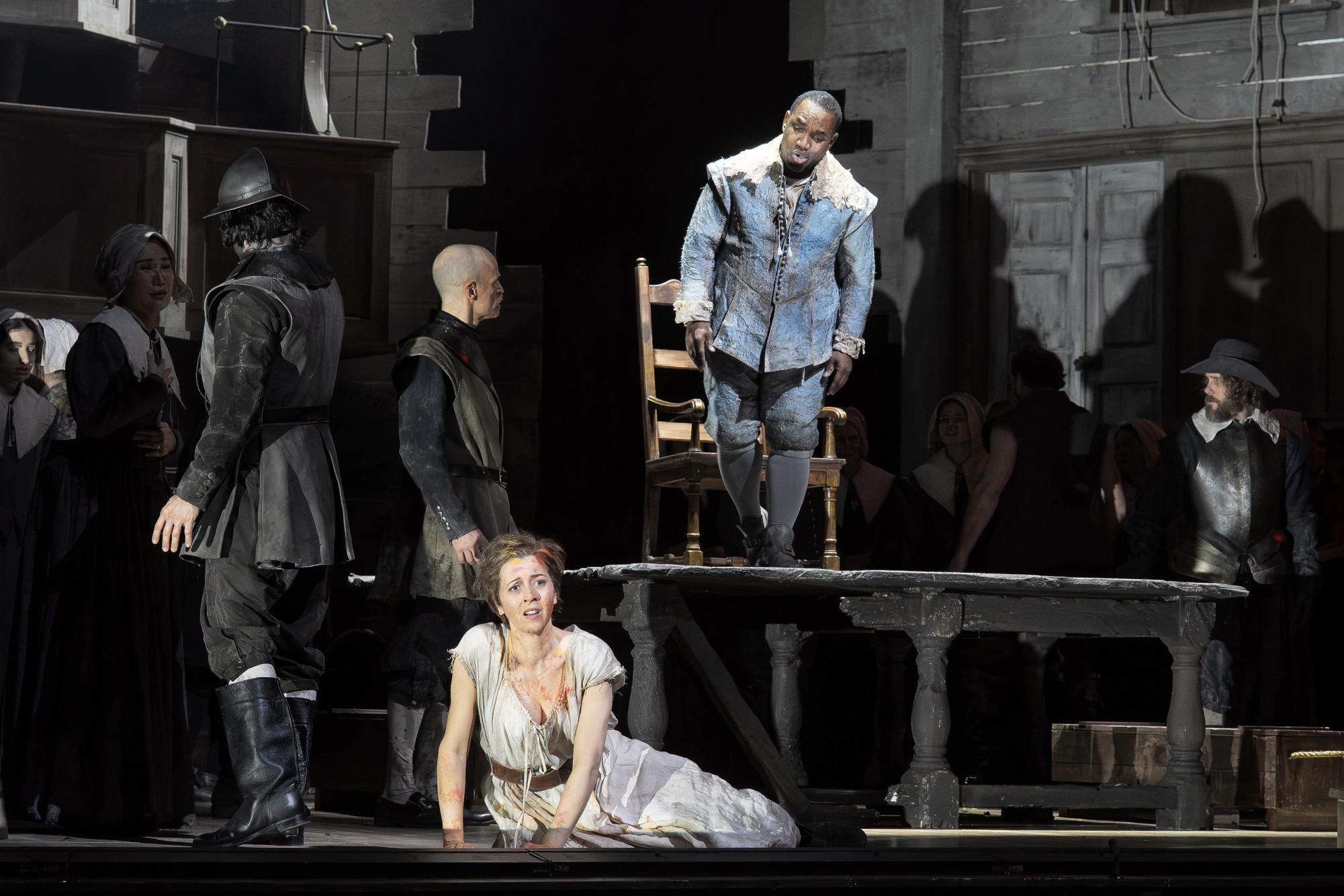
His love seems to calm her crazed thoughts. “Alas, forgive me,” she laments, pacing the stage. “Oh, Arturo dearest, I’ve caused thy death.” As the army calls for Arturo’s trial by fire to begin, he cries to the army to have mercy on Elvira’s fragile soul, as she sinks to the floor and looks away in pain.
Arturo is about to be executed, but suddenly, pamphlets rain down from the rafters. The Puritan commander Cromwell has triumphed over the Royalists, and the English Civil War is won. All offenders are to be granted pardon. The Puritans rejoice, and the lovers can now be together without fear.
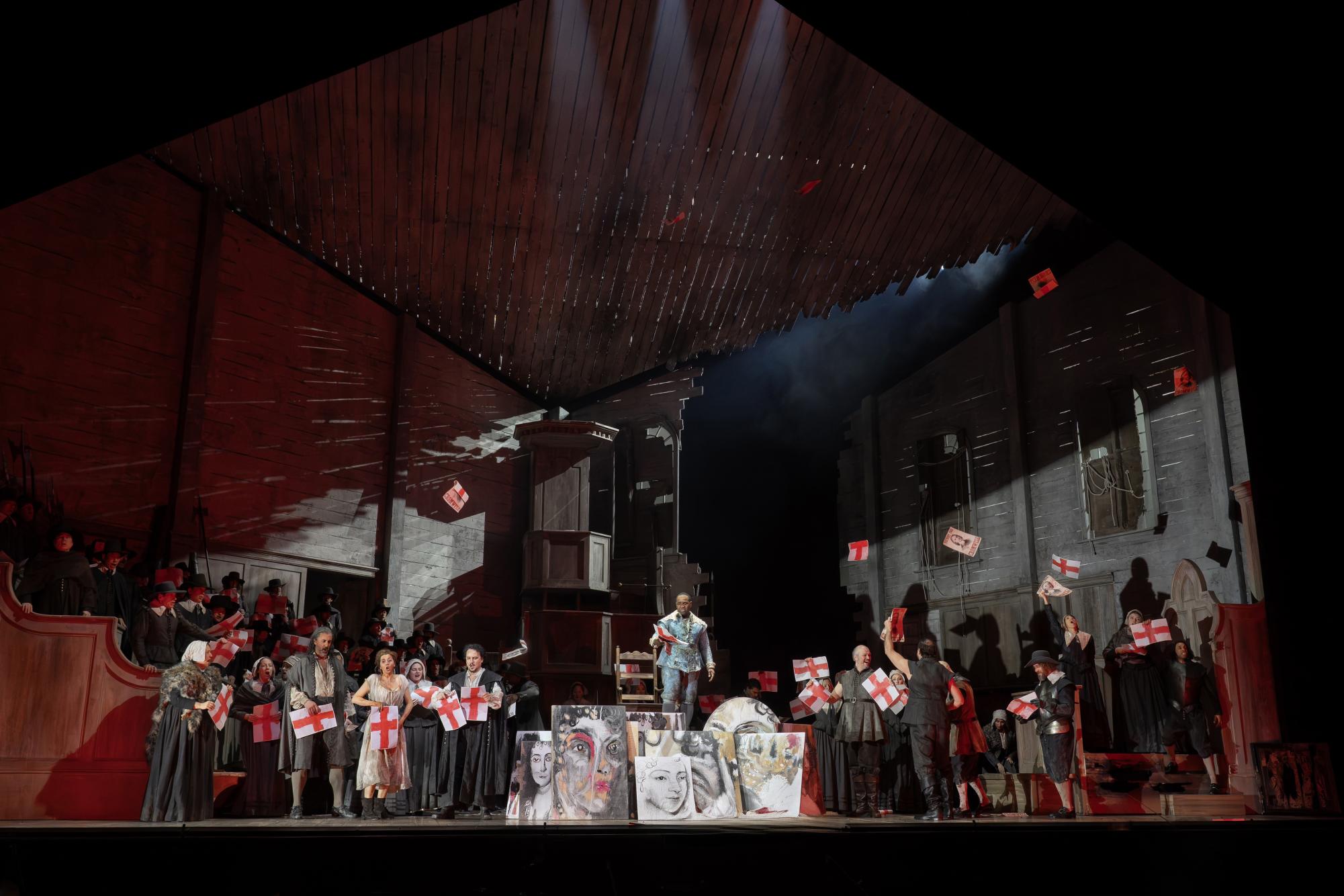
Something, however, seems to be amiss. Arturo tears one of the pamphlets to pieces and runs offstage. And as Elvira sings out her triumphant last note, the set once again fades to the color of her madness. She and the Puritans are bathed in a sickly green as the curtain falls.
End Synopsis
This season, acclaimed soprano Lisette Oropesa starred as Elvira. Her bright high range perfectly fit into Elvira’s birdlike riffs, while her lower tones had a fuller sadness. Oropesa brought beautiful sonic volatility to mirror Elvira’s emotional dynamics. Arturo was played by the magnificent tenor Lawrence Brownlee, who had a desperate, yearning tone to his phrasing — as his character would demand — and rose bravely to the infamous F5 in Bellini’s score, making it look easy. Polish baritone Artur Ruciński took on the role of Riccardo and made every note count; each phrase sung had a powerful quality about it, most notably his twenty-second-long G5 in ‘Bel sogno beato’. Giorgio was sung by bass-baritone Christian Van Horn, whose gruff, edgy tone brought the wise-man characterization needed.
I Puritani is more often than not a production meant to produce a happy ending — lovers are reunited, and once-enemies are now amiable. But at the Metropolitan Opera this season, Edwards has created a unique critique of “puritanical rot,” as music critic Joshua Barone wrote in his review in The New York Times. The Puritans appear rigid and stifling in opening scenes, reciting their hymns and keeping tradition. But they devolve into barbarism and savagery as the war drags on, hoisting torches and smearing themselves with the paint of patriotism. As for the devolution of Elvira? Well, whether she has become mad with grief, madly in love, or simply mad, that sinister green light has once again dawned upon her — as it has all the Puritans. And this time, it won’t go away.
From the very beginning, Bellini wanted his production to be an emotional melting pot, centered around love, betrayal, and maddening passion — so enthralling that it, instead of a raging war, should draw the unwavering attention of the audience. “Draw tears, cause horror, bring death, by means of song,” he told Count Carlo Pepoli, the librettist of the opera.