
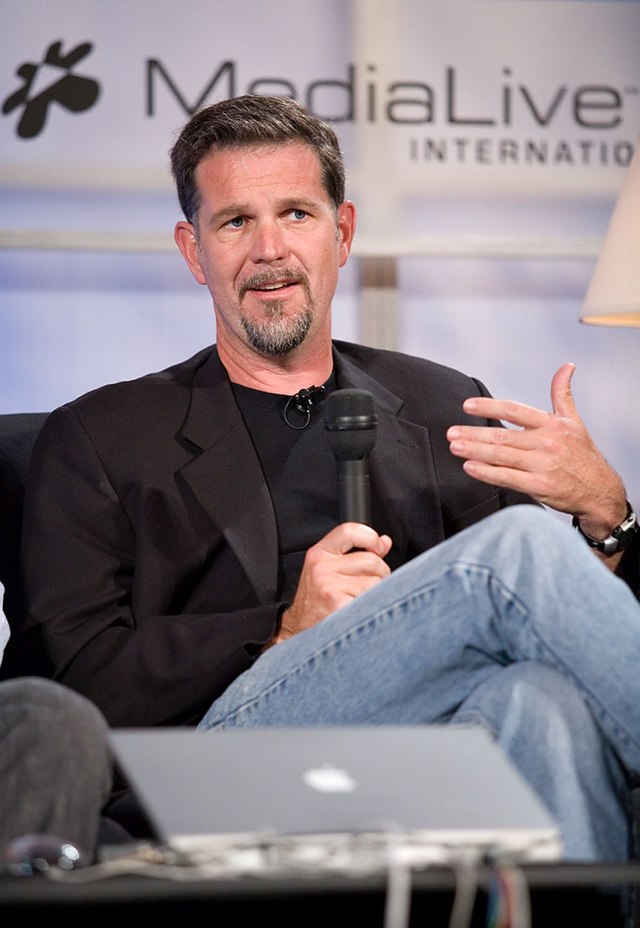
From physical DVDs to digital broadcasting, Reed Hastings took the risk and changed the global perspective on the entertainment industry. In our modern day, art and cinema is an increasingly prevalent part of society, whether for educational purposes or for pure entertainment. Over time, the streaming platform, Netflix, a global TV show and movie streaming service, has become one of the most significant aspects of daily life. Audiences commonly turn to this platform for comfort and amusement without considering the origins of this innovative approach to entertainment.
Netflix was cofounded by Reed Hastings, a businessman who frequently searched for innovative ways to create change and expand consumer freedom. For his extraordinary ideas, he was often considered to be a storyteller and disruptor beyond simply his title of a businessman. Hastings is known for his work, making the world’s first convenient and consumer-oriented streaming service, which reshaped the filmmaking industry. By increasing efficiency and modernizing the platform to keep up with newer technologies, he has kept consumers engaged and also has helped to personalize their streaming experience.
Early Career
Reed Hastings was born in Boston in 1960. He studied mathematics at Bowdoin University before joining the Peace Corps in 1983. There he taught math for two years and gained valuable critical skills and a broader perspective towards handling various scenarios, two abilities he would later use to build his companies. After returning to the United States, he studied computer science at Stanford University and found a passion with studying artificial intelligence.
Hastings started off his software career by founding a company called Pure Software in 1991, working closely with two other engineers, Mark Box and Raymond Beck. The company developed products designed to solve issues with debugging, assisting new software developers. The company grew more quickly than the co-founders would have anticipated, leading to the company to merge with a technology-based corporation, Atria Software, and creating Pure Atria Software after the merger. The result of Pure Atria Software was a decline in the company’s value until 1997, when it was sold to another software company, Rational Software Corporation, for an estimate of $525 million.
Although Pure Software was short-lived, it carved the path to Hastings’ future success. In his first company, he had the technology knowledge to create his business. However, he did not have the business understanding to expand and oversee it. It might have been because of his inexperience that he underestimated the rapid growth of his first company, causing it to fall apart. Although not successful, he gained a solid reputation in the market and learned from the mistakes he made in Pure Software.
Reed Hastings’ motive for creating a platform such as Netflix was the lack of flexibility in the previously existing system, in which viewers had to physically receive and return DVDs. The system was not only inconvenient for users but also carried several consequences for the DVD customers, such as late fees and late receival of DVDs. Such consequences often led to customer dissatisfaction, a trait far from desirable when creating a streaming service. Frustrated with the system’s flaws, Hastings set out to revolutionize it. He partnered with Marc Randolph, a former employee in Pure Software, and together they launched Netflix, transforming the way we enjoy entertainment forever.
When searching for a solution to the entertainment industry, they came across the idea of digital streaming, an idea inspired from Amazon. They wanted something that could be streamed online for convenience. To start up the business, they decided to ship customer’s DVDs when customers would place the order online. This idea succeeded, and he decided to innovate and try streaming films online, something he had always spoken about doing since it involved his enthusiasm towards technology. In 2007, they introduced online streaming of movies. Originally, when Hasting’s announced the change, many people weren’t fond of it since the internet wasn’t widely used at that time, causing Netflix’s stocks to drop. A significant amount of people at this time were used to and trusted the DVDs, so they opposed the idea of paying to have a completely new system. They were uncertain that this new system would be better than what they had been using for multiple years. After a few individuals started to use it, the platform grew and eventually this new and unknown streaming approach became a familiar and standard method used in peoples’ everyday lives.
Competition and Challenges
Due to the emerging growth of the internet industry, Netflix found itself surrounded by competitors, all trying to claim a similar idea. To maintain its originality, Netflix started releasing its own shows. In 2013, Netflix released its first original series, House of Cards. This show gained popularity rapidly and its success inspired Netflix to start heavily investing in creating their own originals instead of solely streaming films and shows from other companies. Netflix later co-produced shows such as Stranger Things, The Crown, and Squid Games, turning the platform into a movie and T.V. studio recognized globally. Overall, it did an outstanding job in differentiating them from their competitors.
Over the years, Netflix faced obstacles regarding public approval and the corporate decisions that they implemented. In 2011, Netflix hit something called their “lost year”, where they faced multiple setbacks. The most well known challenge being the company’s idea to appeal to both existing users and new audiences. They wanted to be able to sell DVDs and stream online, operating Netflix as a dual business. In early 2011, they offered the DVD system and streaming system for ten dollars in one service in which they observed that people preferred the streaming version more. From this result, Netflix wanted to solely emphasize on streaming and created another company, Qwikster, which continued the DVD system. The two companies operated in a way in which the streaming service and DVD service would operate separately. A person could purchase the services separately or together. The benefit of this to Netflixwas that it would allow Netflix to progress into the newer generation while increasing their profit by covering more of an audience. This might have seemed like a favorable change, using methods that were both popular at the time, however, in reality, this increased the prices of Netflix by 60%, leading to a drop in over 800,000 customers while stocks dropped 77%.
Netflix was streaming entertainment from other companies and when Netflix’s stocks and customer base dropped, these companies were also faced with loss and stopped streaming their productions on Netflix. Some major companies including Starz, a popular TV network, which had around 1,000 titles on Netflix previously, reduced its A-list movies including Sony Pictures and Disney. From February to September 2011, Netflix fell into a loss period causing it to shift to an entirely new digital platform strategy from user data. When other companies saw this favorable change, they resumed streaming their films more than a year later.
In the end, Hastings found a more efficient solution to create an online streaming platform that would charge a flat fee for usage and allow for consumer prioritization. Today, we can see the impacts of his decisions as Netflix has grown to be an increasingly popular platform with worldwide users.
Awards
Throughout Hastings’ lifetime, he went through multiple challenges regarding his decision making and his image. His story and achievements in the entertainment industry have received numerous awards in honor to his contributions in AI, business, and entertainment. In 2021 he won the Charles F. Jenkins Lifetime Achievement Award at the 73rd Engineering Emmy Awards. His business leadership was also recognized with the 2017 David Packard Award and the UCLA Anderson John Wooden Global Leadership Award, both being highly prestigious awards. Reed Hastings started his entrepreneurship and engineering journey in the 1990s and won his awards after more than a decade, depicting how every mistake is a step towards a goal.
Reed Hastings went from any other student, traveling and doing what he loved, to making a global impact through generations. He learned that mistakes don’t lead to failure as much as accepting defeat at any point does. From his story, we learn how our failures can shape our future and the people we become, as each mistake, each decision we make teaches us the importance of growth through adversity.
Reed Hastings went from any other student, traveling and doing what he loved, to making a global impact through generations.