
Today, the epitome of urbanization is Times Square. Whether it is the massive billboards, glamorous Broadway shows, or enticing tourist attractions, Times Square is, simply put, the center of the world. Anywhere you go, nearly everyone knows about Times Square, and most dream of one day visiting it. Times Square is the ultimate indicator of “making it” and the utmost display of human achievement.
Yet just over a generation ago, in the late 1960s to early 1970s, the reality and reputation of Times Square were antithetical to those of today. Riddled with crime, drugs, and prostitution and populated by hustlers, traffickers, and other unsavory characters, the Times Square of the era epitomized danger and depravity. The Museum of the City of New York describes the activities as “Prostitution by all genders, open drug trade, alcoholism, and con games, like three-card monte and clio, became commonplace. Inside, crime thrived… By the late 1970s, the Times Square area recorded the most felony and net crime complaints in the city.”
Unsurprisingly, Broadway sales declined during this period. According to Variety Magazine, “Nearly 10 million people took in a Broadway show in 1968. By 1972, that number had fallen to 5 million…” Clearly, if everyday, life-long New Yorkers avoided the area, then even the most intrepid tourists did as well. Not only that, but Broadway venues that had formerly showcased some of the world’s most talented performances now showcased pornography and sex shows. As early as 1960, a New York Times article had this to say about 42nd Street: “It is frequently asserted that the block is the ‘worst’ in town.” And in 1981, Rolling Stone infamously referred to 42nd Street as “the sleaziest block in America.” Evidently, twenty years hadn’t altered the public perception of Times Square much at all.
In 1975, a fiscal crisis swept the nation, and New York City could no longer borrow from the municipal bond market and nearly filed for bankruptcy. This put a hold on any potential chance to “fix” Times Square as people focused on their own financial hardships, including the rising price of the subway fare and extreme layoffs. New York Times political scientist Roy Bahl said, “In the last decade, for every 1 percent increase in personal income, there has been a 1.84% increase in state and local spending in New York.”
Ordinary citizens, sick of the crime and chaos, pressured politicians to turn the city around. Not only were they feeling the harsh economic effects in their personal lives, but the pride that they had in their proclaimed “greatest city in the world” was becoming a metaphor for living in the past.
As the overarching fiscal situation continued to decline, the New Yotk City-based non-profit organization Theater Development Fund (TDF) came to a realization that Times Square could be used to financially benefit the city. The TDF was composed of former actors, theater lovers, and people who had invested in real estate who, therefore, wanted to increase the popularity of theaters and bring tourists back. They believed that if a theater wasn’t sold out, people should have the option to buy unused tickets on the same day for half the price.
In theory, this idea would help in numerous ways, as not only would it sell more tickets, it would draw people to Times Square and in turn increase tourism. After sitting on this idea for a few years as the city’s economic situation remained stagnant, the TDF called in two 30-year-old architects to do the job.
These architects were Robert Mayers and John Schiff. They had both grown up in Manhattan, Mayers on the Upper West Side and Schiff in Washington Heights.

The two had met during their sophomore year at the College of Architecture at Cornell University while working together on a design team.
Post-graduation, Schiff served in the U.S. Army and Mayers attended graduate school at MIT. Immediately following graduate school, Mayers came upon an incredible opportunity to work with a well-known architecture firm designing low-cost housing for various countries in Latin America, including El Salvador, Honduras, Mexico, Colombia, and the Dominican Republic.
Upon his return in 1964, Mayers’ mentor recommended him for an open position in Dhaka (located in Pakistan at the time). Even more fortuitously, Mayers could select an additional architect to accompany him. Mayers clarified how this was an easy choice, “Having worked very well with him at Cornell, John Schiff was my obvious and only choice.”
After returning to New York in 1965 due to the India-Pakistan conflict, Mayers and Schiff rented a small office on East 42nd Street and opened their own architectural firm, aptly named Mayers & Schiff.
The partners obtained the prestigious job of designing the booth through connections at TDF. Mayers described the ecstatic feeling. “We were really thrilled it was the first project that we got that would have a lot of publicity.”
Despite this incredible opportunity, their budget was capped at a measly $5,000. Mayers explained that “$5,000 was not a lot of money to build something. And especially in the middle of Manhattan in Times Square.” He further expanded upon the difference between capital and operating budgets, which afforded them leeway in how they wanted to design it. “There’s two kinds of budgets. So a capital budget is, you spend, you have $5,000, you build a thing for $5,000, and that’s it. That’s all you can do. But they had an operating budget. So the operating budget is something where they rent stuff. You could rent stuff and pay by the month. So our idea was to make the entire building or structure out of rented parts. So they wouldn’t have to buy anything. They could just rent the parts.”
The partners chose to build the entire structure out of rented parts, allowing them to take significant liberties in creating their eventual design. They knew they needed to build something with a unique, commanding presence in order to attract crowds. Each and every decision would prove to be crucial, given the behemoth of a challenge of creating something extraordinary in the already extraordinary Times Square.
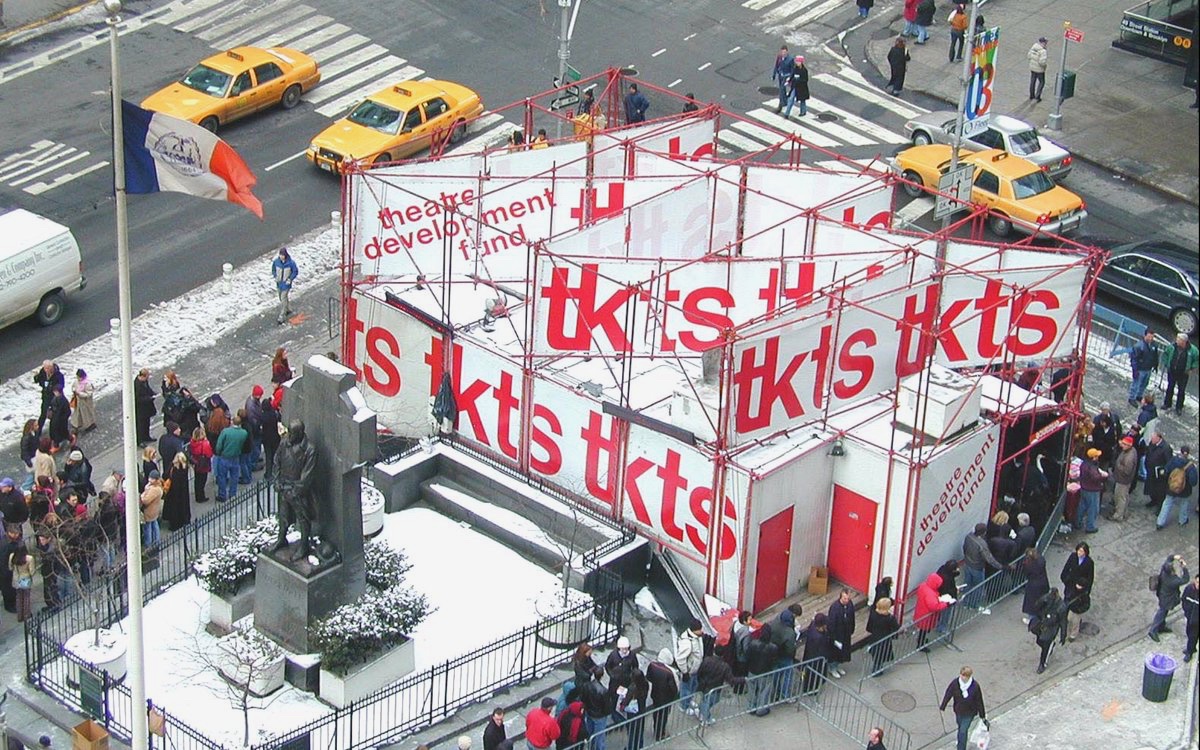
They understood the necessity of a recognizable logo; moreover, a large space would be essential to showcase a truly eye-catching logo. To accomplish this, they rented the type of metal scaffolding pipes used in skyscraper construction. They utilized these to create a giant kite to hold plastic film, which was woven throughout it. On the plastic film would lie the logo: TKTS.
Mayers detailed the process behind the creation of the fabled ‘TKTS’ logo. “And we were looking for a name, and John Schiff, my partner, was looking in, we had at that time, we used a thing called, was it press type things? It was press type, which was all the letters of the alphabet on a film, and you could by rubbing them, you could press the letters onto a piece of paper or something. So we looked in the press type, and we didn’t have every letter. We only had a few left, and we happened to have TKTS in Helvetica type, heavy black, bold Helvetica type. We pasted those letters onto this material, and it was a fantastic graphic. TKTS repeated once after the other. We even designed the T and the K to be a little different from the normal Helvetica T and K.”
To draw pedestrians and drivers to the logo at night, Mayers and Schiff came up with the idea to clip spotlights to the metal poles and have them go on at night and illuminate the plastic film so that the letters would be seen in silhouette. The city liked the idea, but they had concerns regarding the building site, as it was over a subway. Mayers explained the problem to me as such: “It was supposed to be right in the middle of Times Square on 47th Street and Broadway, on an island there, right behind the statue of George M. Cohan, who was a famous actor and performer of the 1920s. But underneath the ground there is a subway. And so the question was, how do you build over a subway? You can’t dig into the ground and put in a foundation because there’s nothing there. It’s hollow.”

Mayers highlighted the issue with an example: “This is like a giant kite. And if there were a hurricane or even a very heavy wind, it would probably blow away like a kite.” Given the fact that during the process of construction, buildings’ foundations are generally made of steel or concrete piles driven deep into the ground and that must weigh more than the building itself, the partners’ solution had to be innovative.
They had to talk it over with the city first though, as they didn’t want to accidentally collapse the ground onto the subway. The city informed them that subway was made of steel and concrete to hold the weight of above-ground vehicles traveling over it.
That meant that it could hold more weight than the test weights, so they were able to get the whole structure tied down. The partners’ solution was to rent four test weights, place them on each corner of the structure, and then hook them to the scaffolding.

The final step of the process was to build a structure that would actually sell the tickets. Mayers recollected their “And how do you build a ticket booth there underneath that huge kite? So we looked around, and we found that, when you see a construction site, you know, that they have an office. They don’t build the office. They rent a trailer. So we went around and we found a trailer that would fit exactly under those scaffolds. And I think that was the only thing we had to buy, and it was not very expensive. It was a used trailer. And we cut openings in the side of it and put in windows, ticket booth windows, and they put chairs inside. And so it could hold three or four ticket sellers and they came in the back and the front of it faced the front of the scaffolding, and there it was!”
The creation of the TKTS booth was monumental. As Mayers recalled, “it was terrific with the crowd coming around, all the way down a couple of blocks, a huge crowd.” On its opening day, Mayers was given the opportunity to take a picture of the TKTS booth for the city, on mayor John Lindsay’s personal request.
Mayers went to a nearby office booth and took the picture. He recalled his encounter at the city hall hilariously, “And I blew it up, and we took it up to City Hall or wherever the reception was going to be. And one one of the mayor’s assistants looked at it, and she said, oh, my God, you can’t use that picture. And we said, “Well, why not?” And there was a homeless person on the sidewalk, right next to the ticket booth, totally out of his mind drunk, surrounded by bottles, and he was looking up at the camera. It was so, I didn’t want to go back and take another picture, so we had an early version of Photoshop to erase him from the picture.”

The TKTS booth had major success; Mayers and Schiff entered it in competitions for graphic design, where it won various awards, including the New York Society of Architects award in 1973, the Albert S. Bard Award for Architecture and Urban Design from the City Club of New York in 1975, the Certificate of Merit for Design Excellence from the New York State Association of Architects, and the award for Excellence in Communications Graphics from the American Institute of Graphic Arts.
Did the TKTS booth immediately revive Broadway, sanitize Times Square, and single-handedly revive the New York City economy? It did not; in fact, a nationwide recession peaked in the 1980s and plagued the early years of the Reagan administration. As for Times Square, it failed to see redemption through the 1980s and into the 1990s. A blog post by the Times Square Alliance restates that “efforts to address the increase in prostitution, especially by juveniles, were derailed by the arrival of crack cocaine to Times Square in the 1980s. As a result, crime rates spiked and continued to increase through 1989…Crack dealers, junkies, and the cardboard encampments of the homeless took over the streets.”
The ultimate resurgence of Times Square is largely credited to former Mayor Rudolph Giuliani and his aggressive, albeit somewhat controversial, methods during the 1990s of utilizing the NYPD to target low-level crime in the area as a means to sanitizing it and restoring it to its former glory.
Nobody could have predicted that from two unknown architects, a used trailer, and months of painstaking labor, an iconic symbol of the greatest city in the world would emerge. Now a must-see stop for all tourists and a mainstay of entertainment for everyday New Yorkers, the TKTS booth is undoubtedly a worldwide attraction, selling over 68.8 million tickets since its inception.
Today, social media is flooded with influencers flaunting themselves beside the huge red logo. After all, if you don’t have a picture at the booth, did you even go to New York City at all? Even the city officials of New York showed their everlasting love for TKTS by having a 50th anniversary celebration of the impact, cultural significance, and genius of the old booth – right on top of the new one.
Nobody could have predicted that from two unknown architects, a used trailer, and months of painstaking labor, an iconic symbol of the greatest city in the world would emerge. Now a must-see stop for all tourists and a mainstay of entertainment for everyday New Yorkers, the TKTS booth is undoubtedly a worldwide attraction, selling over 68.8 million tickets since its inception.