

It’s a gray Tuesday afternoon in April. As you’re waiting for the next bus, the stop grows more crowded by the minute. You catch a quick glimpse of a pigeon out of the corner of your eye, nibbling away at a soggy half-slice of whole wheat bread. It pecks repeatedly at the center, bobbing its head in a clock-like rhythm, determined to tear off the tiniest crumb. After roughly ten more unsuccessful attempts, the pigeon resorts to trying for a piece of the crust, using its sharp beak to pick up the slice by the corner and hoist it into the air. It tilts its head sharply to the left, trying to shake out whatever bit of the crust it can manage to pry off. After an eternity of 30 seconds, the bread falls to the ground, but a tiny flake of crust remains sandwiched in the pigeon’s beak. It swallows the crumb and proudly nods, a sliver of its green and pink neck catching a ray of sunlight through the blanket of clouds.
However, it only has a few seconds before a second pigeon flies over, snatches the bread, and takes a crumb for itself. A third, fourth, and fifth pigeon swoops down from the ledge of a fourth story window, until a swarm of over twenty pigeons tear away at the slice. Within a couple of minutes, it is completely gone. All that is left are pigeons pacing in circles, poking at the sidewalks for remnants of their meal. Once each bird is certain that no food remains, they cluster in a group and take a few steps before forming a flock to find a nearby air conditioner to rest on. By the time you step onto the bus, tap your OMNY card, and rush for the last seat, their calls and sounds of flapping wings are drowned out by the chaos of the passengers, and the flock of birds turn the corner of the block, disappearing from sight.
Whether the echoes of their flapping wings and low-pitched hoots from the top of a nearby air conditioning function as their daily alarm, or the swarm of them gathered around a singular piece of food takes up half the width of a sidewalk, every New Yorker is familiar with pigeons. No matter how much hate they receive, these so-called “rats with wings” have been an iconic symbol of New York City for centuries. But how did they come to dominate New York? And what turned them into a notorious pest?
The domestic pigeon descends from the rock dove, native to the Middle East, as well as parts of Southern Europe, Northern Africa, and Western Asia. Long before their feathers scattered the sidewalks of New York, pigeons and humans have lived alongside each other, these birds being first domesticated over 5,000 years ago as a source of food and a means of communication in Mesopotamia and Egypt. In the seventeenth century, the pigeon was brought to The United States by European settlers, and it began to populate New York City.
Before the domestic pigeon took over New York City, the passenger pigeon was the most common pigeon species in the United States. This bird had a more colorful appearance, its dull blue coat and dusty orange belly resembling that of a barn swallow more than the pigeons one sees today. From the sixteenth to nineteenth century, they were a key source of food, and they were hunted frequently. Passenger Pigeons traveled frequently in large flocks, making it extremely easy for hunters to shoot multiple pigeons within a short period of time. In the 1800s, this practice skyrocketed and the population began to decline. In the next century, the passenger pigeon became extinct and the domestic pigeon came to be the dominant species.
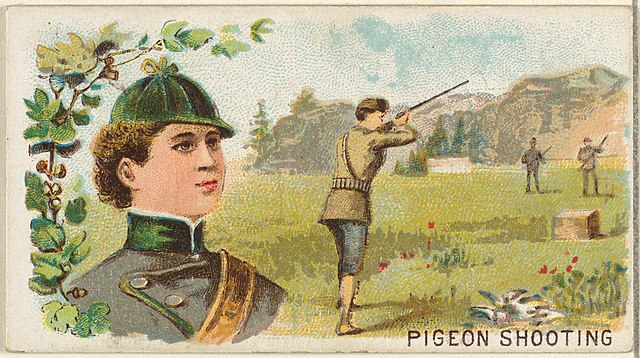
At this time, many people living in New York City cherished and admired these domestic pigeons. Competitive pigeon shooting was a common leisure activity for many, and people would often set out traps hoping to capture flocks of pigeons, gather them into baskets, and release them, shooting as many as they could before they flew away. This practice was incredibly cruel, as these pigeons were usually solely hunted for the purpose of pure entertainment. Most people killed these birds for the joy of the sport and love of being so close to them. This practice is described in a New York Times article dating back to 1858, which depicts pigeons as fascinating animals with beautiful feathered coats, reflective of the love most New Yorkers had for them. It also touches on how many people found this practice inhumane and felt sympathy for the bird. Still, at this time, few people expressed any feelings of fear or disgust towards them.
As the number of domestic pigeons increased, many escaped and found homes in the streets of New York. In a relatively short period of time, the number of feral pigeons multiplied, and they began to take over the city by storm.
Then, in the 1960s, a fungal infection called cryptococcal meningitis emerged. This disease originated from the fungus cryptococcal neoformans. Though incredibly rare, the infection is fatal if it spreads to the brain. After two deaths were reported in 1963, Mycologist Dr. Maxwell Littman directly blamed pigeons for the fatalities, claiming that, on average, “50 percent of pigeon droppings contain cryptococcal neoformans. And there is no question that some people in our city are dying because some people want the pleasure of feeding birds.” This resulted in a widespread fear of pigeons, causing suggestions of pigeon extermination to arise. Many people had conflicting opinions on this, some blaming pigeons for this epidemic, and others defending them. In the end, the pigeons were not exterminated after a treatment was established and the disease faded away. What did linger, however, was the widespread fear people had of them.
With so many feral pigeons and the persistent belief that they carry disease, New Yorkers began to view pigeons as dirty and unwelcome. Even today, pigeons still dominate New York and are known for their intrusiveness, as can be seen when one is trying to enjoy a midday snack or a walk through the park. In densely populated areas of New York City, it is hard to avoid getting approached by a curious pigeon or even surrounded by a whole flock of them.
Though most people stray as far as possible from pigeons, an alarming number of people often feed these birds the remains of their meal or even toss them a handful of birdseed. This leads to a myriad of issues affecting both humans and pigeons, the first being disease risk. Mainly as a result of many of the unsanitary parts of the city that pigeons tend to reside in, these birds carry a large amount of diseases , including viral, bacterial, and parasitic, such as Salmonella, E. Coli, and Ornithosis. In more recent years, bird flu has emerged as a widespread concern among various species. However, the risk of transmission of these diseases between pigeons and humans is incredibly low, and very few cases of disease have been reported.
It is still best to avoid contact with pigeons and refrain from feeding them in order to protect the health of ourselves and pigeons. Pigeons have become dependent on food from humans, which is deficient in nutrients that are vital for their health and survival, and thus extremely unhealthy for them. Additionally, the practice of pigeon feeding causes them to overpopulate and gather in large flocks, leading to an increase in contamination of public spaces. Unfortunately, it is impossible to be as close to pigeons as we were over a century ago, and our transformed view of them is only a result of our actions.
Fascinating? Gross? Adorable? Regardless of how we view them, humans are the root cause of the problems that they bring. We can only blame ourselves for how pigeons have evolved. Pigeons have found a home in New York City, and it is up to us to learn how to live alongside them.
Unfortunately, it is impossible to be as close to pigeons as we were over a century ago, and our transformed view of them is only a result of our actions.