
Every year, on the night of October 31st, pumpkin spice swarms the air, and crunchy autumn leaves adorn each sidewalk. Children run thundering down streets and alleyways, as the faint hoots of owls echo through the moonlit night. A shrill cackle melts into this cacophony, and a haggard old crone takes form in almost every house that one passes.
The Halloween witch has always been recognizable — a cauldron of boiling, green liquid; a long, pointed hat; a black, tattered dress; and a crooked broom that mirrors the distortion of the ‘real’ witches portrayed throughout history. Historical witches happened to be ordinary women, who, through witch trials and witch hunts, were disproportionately targeted by the patriarchal structures and religious dogma that plagued societies across the entire world.
Witch trials were established in the 1450s-1750s, most notably in colonial North America and Europe. About 100,000 to 110,000 people on average were accused of witchcraft in these areas, and around 40,000 to 60,000 people were executed. 75% to 80% of these victims consisted of women, but not many question why that is. However, this gender imbalance is not coincidental. It reflects the longstanding patriarchal values and misogyny that were prevalent in society back then, and continue to plague contemporary times.
Witches were seen as a threat to European society and stability because they were believed to wreak havoc and prey on the innocents of a population. This was believed to have destabilized many societies as many people died, and livestock and supplies within a region were contaminated. This was established through many texts, such as On the Demon-Mania of Witches by Jean Bodin in which he writes: “[Witches also] kill livestock…and crops…causing famine and sterility in an entire region.” Bodin demonized witches by emphasizing their affiliation and association with Satan (the Devil), and humanized witches through describing how they need to eat and recharge themselves, but with blood and human flesh, instead of conventional nourishments.
Misogyny was a significant driving force in the historical witch trials of the 15th to 18th centuries. Women were disproportionately targeted, and patriarchal power structures continuously benefited from these executions, especially in a time when androcentrism ran rampant throughout communities. Patriarchy was a driving force in how religion operated in Early Modern Europe, and witch trials were a blatant epitome of that. Since the patriarchal structures in European society valued men above women, religious structures were established to accommodate that and create a framework that demonized and diminished women.
Religious authorities used religion as a way to justify ostracizing women, as well as punishing them for being outspoken or independent. Anne Hutchinson was a spiritual leader and early dissenter in Colonial Massachusetts who was repudiated for not only her religious views, but also for how she carried herself. First, she frequently held meetings at her home to discuss sermons regarding Christianity and to teach other women the Scripture, which was typically seen as a man’s job. Second, she directly challenged the religious and political authorities of the time and insisted that Christians work on building a closer, intuitive relationship with God, instead of adhering solely to clerical guidance.
A woman questioning religious structure and jurisdiction during this timeframe was seen as blasphemous, and the patriarchy could not — and would not — settle for that. Anne Hutchinson was not accused of witchcraft, but she was later declared a heretic and banned from the Massachusetts Bay Colony. What happened to her served as a forewarning to any woman who dared to defy the domestic sphere or speak with authority figures.
Protestant Reformer Martin Luther, who, although reaffirming women’s spiritual equality, reinforced social subordination to men. He claimed that women should readily subject themselves to their husbands and insinuated that the only thing women could be successful in was managing the household. Stories like “Eve’s Sin” were often used to claim that this was a God-sent punishment for women and to push the narrative that women were servants to their husbands and would never be seen as fully equal.
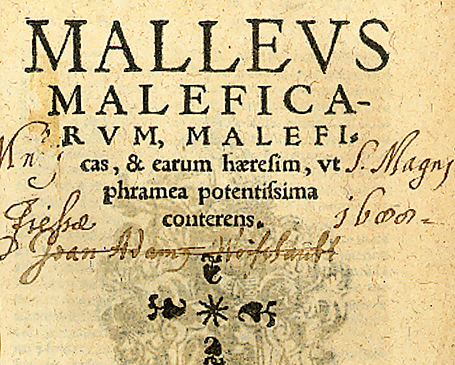
Heinrich Kramer was a German churchman who was described to be superstitious and believed women were intrinsically evil and unholy. He was a catalyst for witch hunts, writing the Malleus Maleficarum (which translates as ‘The Hammer of Witches), a book designed as a manual on how to identify and prosecute witches. In the Malleus Maleficarum, Kramer argued the idea that women are more feeble than men in both the mind and body, therefore making them more likely to make pacts with the Devil. The primary beliefs surrounding women back then revolved around domestic roles; in addition, they were often viewed as second class citizens, their needs or beliefs always becoming mere afterthoughts. For instance, the doctrine of coverture in 17th-century England legally erased a woman’s independent identity after marriage. It also stole many of their rights, such as being able to own property, the ability to contract or sue, which prevented them from taking legal action in the case of any event. This type of system was prevalent among many European legal codes, such as the Athenian Law, where women were restricted from politics, social life, and education. Slowly, women became invisible in the law and humanity.
The depiction of witches has long been a reflection of patriarchal anxieties surrounding women who refused to conform to their domestic roles. Every detail of the witch’s traditional image was crafted to ridicule women. The broomstick, for instance, was not an arbitrary symbol. It was an everyday household object used by women for cleaning, but in the hands of a witch, it became an apparatus of rebellion and fear. The image of women “riding brooms” through the night represented the inversion of femininity, a woman abandoning the home rather than tending to it. The pointed hat exaggerated the presence of women who dared to stand out, and the cauldron distorted the domestic arts into something unholy. Cauldrons, which alluded to real pots used by women to cook, were depicted as one of the instruments witches used to carry out wicked deeds. Even the witch’s crooked nose, warts, and wild hair symbolized the supposed ugliness of female power and aging. Through this imagery, the witch became the ultimate symbol of what happened when women strayed too far from submission.
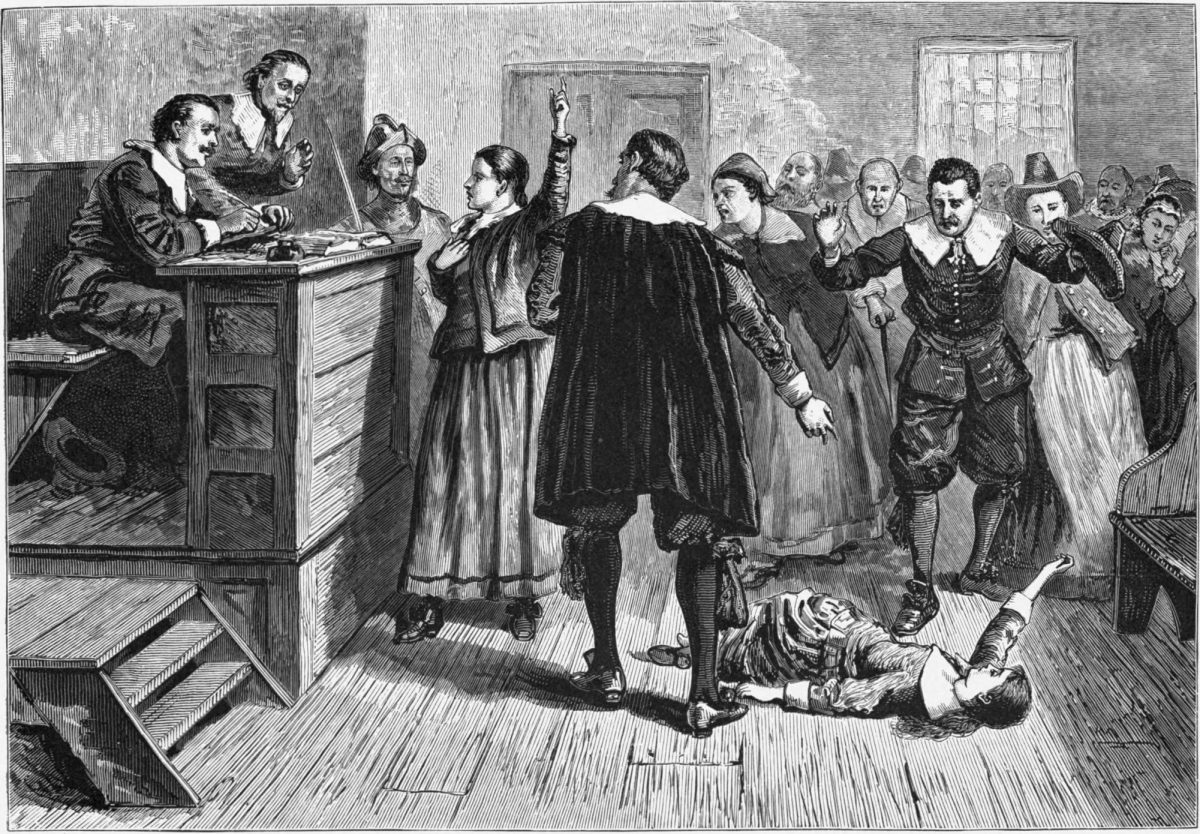
The process of a witch trial was often vicious and pre-determined. Accusations could arise from just about anything: a sick child, failing crops, or even an unconventional personality. Once accused, women were subject to invasive examinations, torture, and public humiliation, all of which was done to extract a confession, even if not true. A common test conducted during witch trials was referred to as the ‘swimming test.’ The accused would be brought before a body of water and thrown in to see whether they would float or sink. It was a common belief that witches rejected the custom of baptism, so this led to the conclusion that if a witch was inside a body of water, the water would reject their body. Therefore, if an accused person floated, they were deemed guilty and a witch. If they sank, they were deemed innocent, but the possibility of drowning was certain.

A notable example of witch trials are The Salem Witch Trials. These witch hunts occurred in colonial Massachusetts from February 1692 to May 1693. Salem was a typical Puritan community, a small, rural farming society that was built on theocratic and patriarchal ideologies considered foundational. Women were viewed as spiritually weak and subordinate to men, giving the perfect excuse for the witch trials that later occurred.
Bridget Bishop was the first person executed during the Salem Witch Trials. The accusations against her were fueled by deep-seated prejudice against women who did not conform to rigid Puritan standards. Like Anne Hutchinson, Bishop was an outspoken woman and had been married three times. She also ran a successful tavern, owned property, and dressed in clothing deemed inappropriate by her Puritan neighbors.
For many, Bishop’s independence was suspect and her personality was deemed unruly for a woman. Because of her perceived transgressions, Bishop had been accused of witchcraft more than a decade before the 1692 trials, though she was acquitted at that time. This earlier history made her an easy and vulnerable target when the new wave of accusations began. Accusations against her included making poppets, a type of doll used for spellcasting, and bewitching pigs. Additionally, during her trial, authorities relied on “spectral evidence,” which involved the accusers claiming to see Bishop’s spirit or “specter” tormenting them. This type of testimony was considered highly reliable by the court, but in reality was based on invisible, exaggerated claims that could not be verified. The persecution of financially independent women, like Bridget Bishop, also served to enforce patriarchal control over property and wealth. In some cases, officials and neighbors stood to gain from the execution of a wealthy or independent woman.
Even children weren’t exempt from the terror of witch hunts. Dorothy Dorcas Good made history as the youngest person to be arrested and jailed due to witchcraft accusations. Sarah Good, Dorothy’s mother, was a beggar in Salem, and instead of helping her, neighbors saw her as a creature of malignancy and enmity. As a result, both were brought in for investigation and were later imprisoned. The witch hunters inflicted pressure and fear on Dorothy that drove her to confession. She falsely claimed her mother had three birds that hurt the people of Salem, and admitted to having a snake that was seen as a witch’s companion. Dorothy was only four at the time, so there was no way she could have possibly known what was causing all the havoc in Salem. Witch hunters leveraged this to their advantage and forced a confession out of Dorothy, later using it as enough evidence to label Sarah Good and Dorothy Good witches. Sarah Good was hanged on July 29th, 1692, and Dorothy was released from prison eight months later, but eventually disappeared from historical records. The system of witch trials was readily built against women, and stripped away any form of compassion and rationality, even for children.
Although the last recognized witch trial was in Salem during 1878, the modern age has revived the witch hunt in new forms. Today, digital screens and social media have become execution grounds for the media to slander successful women who are perceived as challenging the status quo. Taylor Swift is a prime example of this. Throughout her career, Swift has been attacked on numerous occasions for her dating history, some conspiracy theorists even pointing to supposed ‘witch-like’ imagery in Swift’s songs as evidence to call her a witch. Swift has responded to this playfully and sort of embraced the accusation, using it to paint women as so much more. In her song ‘I Did Something Bad,’ Swift sings, “They’re burning all the witches even if you aren’t one,” drawing a direct parallel to the unjust persecution of women. She overthrows the negative stigma surrounding witches and reclaims the idea as a symbol of power and agency.
Even after the last “witch” was executed, we can still trace the legacy of misogyny to our own modern cultures. If the historical record shows that we have long feared and condemned women who defy convention, how can we be certain that our own modern biases are not simply new masks for the same old fears?
Even after the last “witch” was executed, we can still trace the legacy of misogyny to our own modern cultures. If the historical record shows that we have long feared and condemned women who defy convention, how can we be certain that our own modern biases are not simply new masks for the same old fears?