
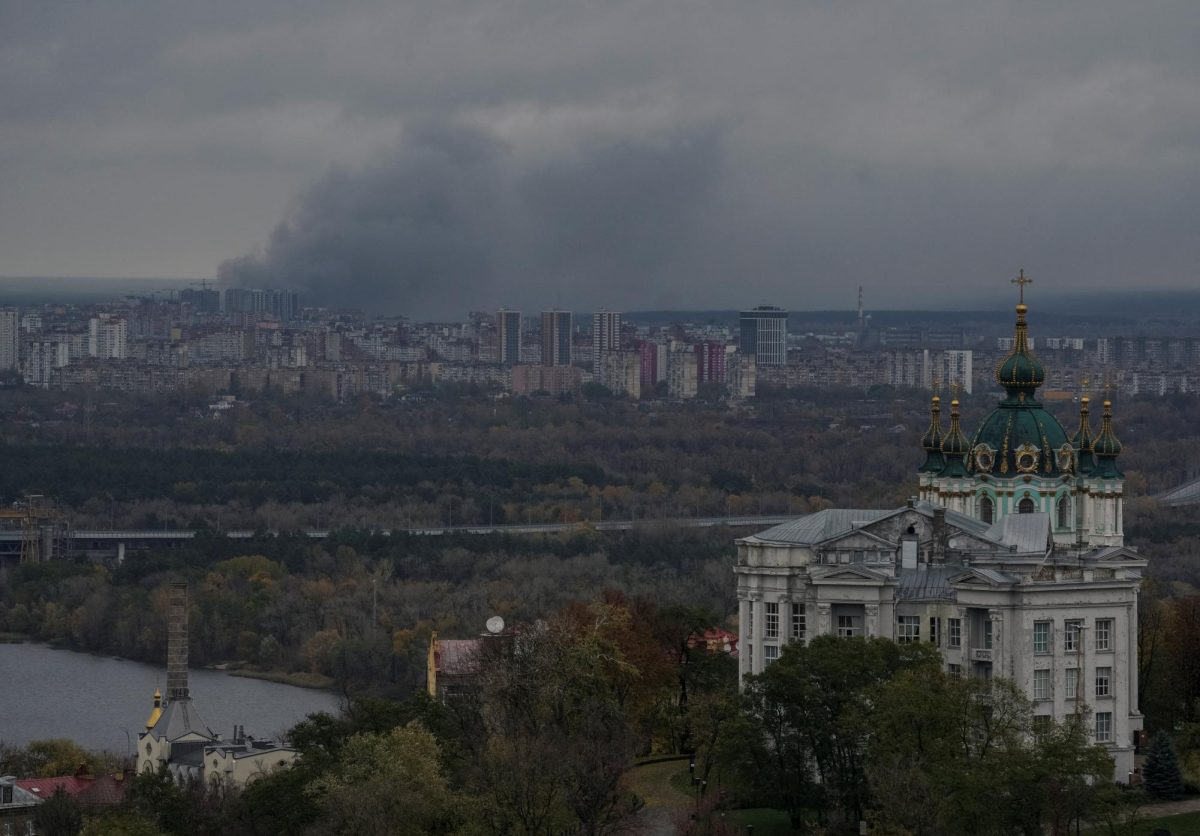
At 5 a.m. on February 22nd, 2022, Vladimir Putin announces that Russia is beginning a “special military operation” in Ukraine. After weeks of buildup and speculation, the unthinkable has finally happened. Minutes later, Ukrainian cities like Kyiv and Kharkiv experience heavy bombings, sending the country into a state of chaos. The largest invasion in Europe since the Second World War was now underway.
Russia and Ukraine share a long history of animosity, dating all the way back to the annexation of the Crimean Khanate by Catherine the Great in the late 18th century. Ukraine was viewed as “the bread basket of Europe,” given its immense grain production. Although Russia and Ukraine shared a history tying all the way back to the “Kievan Rus,” Russia quickly set about destroying Ukraine’s national identity, and replacing it with Russian culture.
Ukraine became a socialist republic after the Russian Revolution, falling behind the “Iron Curtain” of the Soviet Union. During this time, the Ukrainian people were subjected to brutal treatment under Russian and Soviet rulers. Particularly notable was the Holodomor, where Joseph Stalin starved Ukraine into submission, causing the deaths of almost four million Ukrainians.
Ukrainian independence, following the collapse of the Soviet Union in 1991, provided an opportunity for Ukraine to finally step out of Russia’s shadow.
The 2022 invasion was not the first attack that Ukraine has faced in the 21st century. Eight years prior, Russia used the collapse of the Ukrainian government as an opportunity to annex Crimea, a peninsula on the coast of the Black Sea. A referendum was then held by the Russian military that seemed to show overwhelming support for the inclusion of Crimea into Russia. However, the results of this referendum are widely viewed as fraudulent. Vladimir Putin has also long viewed the resource-rich Donbas region as one of his top priorities. Following the annexation of Crimea, Putin supported ethnic Russian separatists in the Donbas, in the hopes of being able to swoop in and take control once Ukraine could no longer resist the separatist movement.
Putin has long shown a desire to expand Russia’s borders. With a background in the Soviet secret police (KGB), it is no surprise that he has interest in restoring Russia’s former power. During his support for separatists in Ukraine, Putin referred to an area of southwestern Ukraine as “Novorossiya,” a term that quite literally means “New Russia.” This terminology predates the Soviet Union and can be traced back to imperial Russia.
Putin used pretenses centered around Ukraine’s growing relationship with NATO and the EU to justify the 2022 invasion. By the start of the invasion, Ukraine was an enhanced opportunity partner of NATO, as close a country can come to joining without actually doing so.
Putin has claimed that Ukraine’s path towards NATO membership represents a betrayal of Western promises not to expand NATO eastward. During talks of German reunification in 1990, former Secretary of State James Baker agreed with Soviet president Mikhail Gorbichev not to expand NATO eastward in order for East Germany to rejoin West Germany.
There was never any formal agreement regarding eastward expansion nor were there any discussions about former Soviet territories joining NATO in the future. These Cold War era “worries” further the idea that Putin is stuck in the past, scrambling to return Russia to its place as a global superpower.
Before the invasion, Russia was still widely considered one of the major global superpowers. In 2020, Russian Defense Minister Sergei Shoigu declared that as much 70% of the armed forces’ vehicles, weaponry, and equipment had been modernized. At the onset of the invasion, Ukraine was seen by both Russia and the West as a pushover. U.S. Intelligence suggested that Kyiv would fall in just 96 hours.
Then the actual invasion came, and everything changed. After their initial gains, Russian soldiers were pushed out of Northern Ukraine by spring of 2022. The following June, Ukraine launched their own counter offensive, succeeding in their goal of breaking through the Russian lines. Despite their supposed superiority over the smaller Ukrainian army, the Russian army has faced a staggering one million casualties since the onset of the war.
So the question arises: why, after what could be classified as a total failure, is Russia still pushing forward with the invasion? The truth is that the Russian people have been disconnected from the reality of the situation. This war isn’t simply decided by soldiers firing guns, but by the flow of information.
For the West, journalists have bravely navigated the conflict in order to provide people with accurate accounts of what is happening. In Russia, however, since the invasion began, the flow of information has become even more tightly regulated by the State than it was beforehand.
In July 2025, the Russian Parliament approved a bill that authorized punishment for online searches labeled as “extremist.”Anastasiia Kruope, an assistant researcher with the Human Rights Watch explores the growing level of press censorship. “Although Russian law already prohibits VPNs from providing access to blocked websites, and hundreds have been banned, individual VPN users have not faced legal consequences until now.” It was already difficult for the Russian people to access information from outside media outlets, but this bill made it worse.
Putin’s ability to use his invasion of Ukraine to somehow consolidate even more power is quite impressive. Russians are now no longer able to share online accounts, making digital surveillance much easier for the Kremlin. With the stream of information from outside of the country drying up, there doesn’t seem to be any way for those in Russia to get an accurate sense of what is really going on just across the border.
Yet, those in the West claim to champion liberty and freedom. So why is it that the largest invasion in Europe since the Second World War has seemingly faded into the background of everyone’s mind? 16-year old Ezra Berger ’27, an 11th grader at the Bronx High School of Science, shares his level of awareness on the war currently. “Obviously I’m aware the war is still going on, and that Ukraine is doing its best to fight Russia, I just don’t really know the specifics or day-to-day things.” He attributes this to a lack in media coverage of the war, especially compared to the early days of the invasion. “Right now, I don’t hear anything about what happens on a day-to-day basis. I only hear what happens when something involves Trump or the U.S. more directly.”
There are obviously those aware of the conflict and who have been following closely since it began. But the average American, like Ezra, is only aware of what is put in front of them on social media or on T.V.
The war still represents a pressing issue for the United States and its European allies, so why does coverage of it seem to have almost disappeared from the public eye? For starters, the war in Gaza certainly detracted attention from Ukraine. A GDELT Project study found that although American television coverage of Ukraine had already been declining, the tidal wave of attention that the conflict between Israel and Palestine received completely drowned out any remaining interest in the European war.
Lack of coverage can certainly not be linked to a lack of journalists on the ground in Ukraine. Thousands of correspondents have visited the frontlines, coming into direct contact with trauma, violence, and death.
Prior to Putin’s invasion Polina Lytvynova was just a regular journalist. That all changed when her home country was attacked, making her a war correspondent. She says, “but I often remember how fragile human life is. When we’re reporting, sometimes I look up contacts and realize I can’t call them because they are dead — killed on the front line or in a missile attack.” Being a war correspondent is anything but easy. Not knowing what each day will hold can create a sense of anxiety and dread.
International Media Support runs a program with over 600 members to maintain the mental health of journalists in Ukraine. The effects of being exposed to violence and trauma on such a wide scale takes a toll on journalists as they come into contact with countless grieving families. The pressure of having to constantly travel the front lines searching for a story further adds to the pressures placed on journalists.
However, the risk to journalists is not just mental. This war has seen some of the heaviest utilization of drone warfare, making the fighting more sporadic and unpredictable. Drones, which can cost just 500 dollars to make, provide both armies with a cheap, quick way to attack isolated targets. Drone usage has made it much more dangerous for individuals on the battlefield, as a drone attack could come at any time.

It was this very kind of attack that claimed the life of Antoni Lallican, a French Journalist working with France’s Hans Lucas photo agency in the town of Druzhkivka just a few weeks ago. Lallican, an award winning photographer, was the first to be killed by a drone attack, and one of 17 journalists killed according to the European Federation of Journalists (EFJ) since the beginning of the war.
It is also important to understand that the lack of coverage by the West has allowed Putin to pump out propaganda and false narratives to make NATO and Ukraine look weak and corrupt. He has labeled the Ukrainian government as far-right nationalists and neo-nazis, aiming to weaken public support for Ukraine in the West.
Not only does the current lack of awareness in the West enable his propaganda machine, but it also masks the horror the Ukrainian people endure. The Russian army has systematically driven Ukrainians from their homes throughout the army’s advance.
Whether it was through their own flight, murder, or deportation, nearly 4 million Ukrainians have been displaced by the war. Russian soldiers deliberately target civilians, attempting to rid Ukraine of its identity, as if it were the 18th century all over again.
It is extremely important to understand the role that information has played in this war and the role it will continue to play. Ukraine has made it clear that they intend to defend their country from its wrongful invaders. As citizens of a country that champions freedom and liberty on the world stage, we have to understand why it is that the United States must play a role in enabling Ukraine to continue resisting. The foundation of that lies in the American people being educated and aware.
“Truth isn’t always beauty, but the hunger for it is.” — Nadine Gordimer
It is extremely important to understand the role that information has played in this war and the role it will continue to play. Ukraine has made it clear that they intend to defend their country from its wrongful invaders. As citizens of a country that champions freedom and liberty on the world stage, we have to understand why it is that the United States must play a role in enabling Ukraine to continue resisting. The foundation of that lies in the American people being educated and aware.