
When Donald Trump took the oath of office for the second time on January 20th, 2025, many American citizens knew that things were about to change. From his views on same-sex marriage, climate change, and immigration, to his ambitions in tax changes and tariffs, no one doubted that our government was about to flip our country upside down. What we might not have expected was that his policies would also send other countries through enormous changes.
In the past twelve months of Trump’s second presidential term, he has acted on many elements of his initial campaign. On his first day in office, he signed 26 executive orders (a White House record), which collectively targeted many “hot topics” in American politics such as climate change, LGBTQ+ rights, gun control, immigration law, the military, and healthcare.
The priorities and plans he articulated in these extensive documents have quickly culminated into tangible manifestations around the United States, especially with the signing of the ‘Big Beautiful Bill.’ Included in these manifestations were significant funding cuts to the Supplemental Nutrition Assistance Program (SNAP) and Medicaid, and funding increases towards border security and detention facilities, as well as the Department of Defense (DoD).
It is already difficult to keep up with Trump’s changes to domestic policy. Information is coming out daily about the National Guard, ICE, and the Department of Agriculture, and it’s easy for the changes in foreign policy to get overshadowed. Besides tariffs and the various international agreements that the U.S. has now been pulled out of, there is something else to think about: war.
As of today, the U.S. is directly or tangentially involved in multiple foreign conflicts. Direct involvement — in the form of military combat operations, drone strikes, and intelligence missions — are mostly found in the Middle-East and in Africa, in countries such as Somalia, Iraq, and Yemen. Indirect contributions, which are limited to providing aid and military training, are actively being offered to (and accepted by) countries like Israel, various Eastern European countries, and, most notably, Ukraine.
The Russia-Ukraine War is one of the deadliest wars since World War Ⅱ. The conflict is a continuation of a century-long affair within Eastern Europe, where Russia has repeatedly attempted to consolidate the various ethnic groups of the region under its control. It succeeded in 1922, effectively creating the USSR (Union of Soviet Socialist Republics) between Russia, Ukraine, Uzbekistan, Belarus, and 11 other modern countries. Though the USSR has since been dissolved, Russia has been clear about its intentions to reassert its influence.
Under Vladimir Putin, Russia has been consistently working towards reaching its goal in the past twenty years. Putin has maintained control in the region through economic agreements with Belarus, powerful military bases in Armenia, Kyrgyzstan, and Tajikistan, and energy dependence (where Russia leverages its natural gasses and oil supplies) over essentially the entire area. Putin has also spearheaded military interventions in Georgia (2008), Belarus (2020-present), and Moldova (1992- present), which have been devastating to each of these populations. Yet, there is an undeniable difference in scale between all of these conflicts and Russia’s current war with Ukraine.
Since Russia’s full-scale invasion of Ukraine in 2022, over ten thousand Ukrainian civilians have died and more than 30,000 have been injured. Putin’s choice to specifically target Ukraine was driven by his desire to prevent the country from acquiring NATO membership. Such a commitment would defend Ukraine from future Russian aggression, as a fundamental aspect of the NATO agreement is the collective defense clause (an attack on one member is an attack on all members). If Ukraine were to join NATO, it would mean that Russia could not invade the country without subjecting itself to war with other, more powerful countries like the United States, the United Kingdom, France, and Germany.
When Joe Biden was president of the United States, there was almost a universal certainty that the U.S. would never question its support of Ukraine. Indeed, it was Biden who decided in 2022 to significantly increase the financial, military, and humanitarian assistance provided to Ukraine in light of the escalation of the war. This aid remained both versatile and substantial for the remainder of Biden’s presidency (it actually increased rather significantly near the end of 2024, right before Biden’s term would end).
Now, in 2026, this aid guarantee is being questioned. Prior to his presidency, Trump has not hidden his relationship with Putin. The two met multiple times in person during Trump’s first presidency, at various international summits. It is also rumored that Trump and Putin have had numerous conversations over the phone, but many of these discussions are not confirmed.
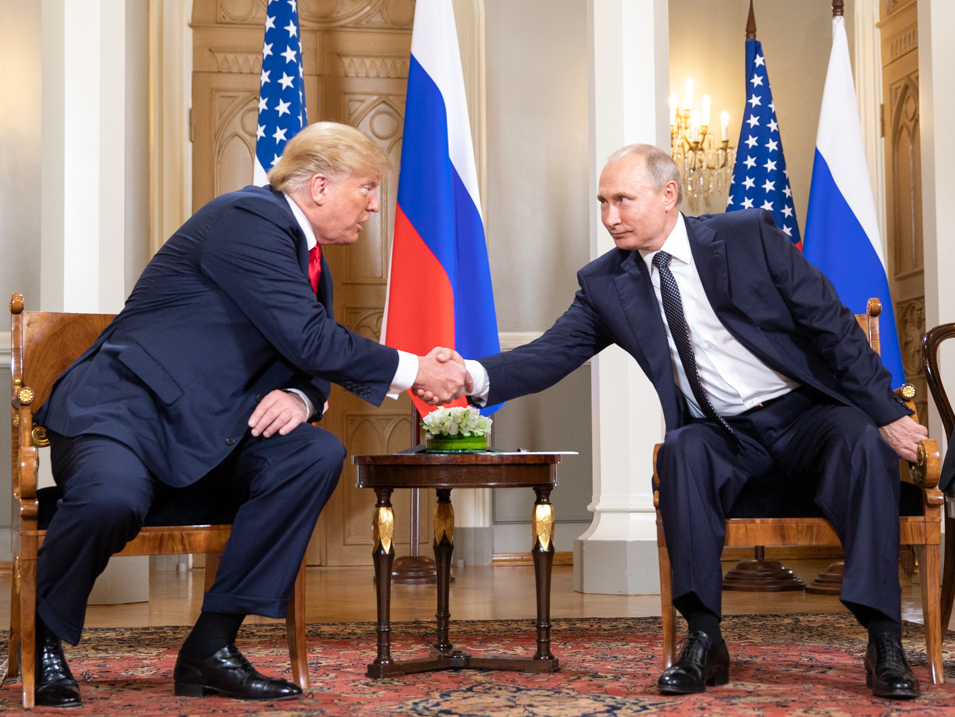
One of the most well-known meetings between these two representatives was in 2018 when they met at the Russia-United States Summit in Helsinki, Finland, to discuss relations between their two countries. They reached informal agreements about arms control and counter-terrorism in Syria that signaled a noteworthy level of diplomacy. Still, the meeting was not popular amongst the general public.
Though the Russia-Ukraine War started in 2014, the conflict was not highly publicized until 2022. This suggests that at the time of this first summit, the criticism from the American people towards the meeting was not based on their opinions about the war, but on entirely separate issues with Russia. What this signifies, as part of the greater whole, is that American citizens had prior reservations about Russia-U.S. relations. The current public opinion of Russia is not just a result of the war with Ukraine (though the war has highly intensified this sentiment), it’s also the general attitude that the U.S. has held for decades now.
Since the summit in 2018, the two countries have met in multiple in-person, diplomatic meetings. They have continued to discuss the 2018 topics, but have also expanded their conversations to specific countries that are currently suffering from corruption and/or war. They’ve brainstormed ways to intervene in these nations – primarily Syria – so as to slowly help them rebuild.
In his current presidency, Trump has decided to continue pursuing collaboration with Russia. When Trump was inaugurated back in January 2025, he made it abundantly clear that he had two primary goals related to these connections, both of which he would achieve through negotiation: creating a lucrative trade relationship with Russia, and ending the Russia-Ukraine War.
Despite his insistence that he would have the war over “shortly after” he won the 2024 election, Trump’s progress is slow. He continues to have public meetings with both Putin and Ukraine’s current president, Volodymyr Oleksandrovych Zelenskyy (Zelensky), which, if anything, showcases how stagnant the conflict has become.
One of the most relevant meetings between Trump and Putin is the Russia-United States Summit in Anchorage, Alaska back in August 2025. This meeting was directly centered around the conflict in Ukraine, with Trump’s supposed goal being to motivate a ceasefire deal. No such agreement was reached, as Putin continued to emphasize the “fundamental causes” of the conflict, including Ukraine’s potential NATO membership. Without having certainty that Ukraine will not follow through with its intentions to join NATO, Putin will not stand down.

At the same time, Trump has been having meetings with Zelensky that have been just as fruitless. On February 28th, 2025, the White House televised a meeting between the two leaders in the Oval Office. J.D. Vance, Trump’s vice president, was also present. The recording of the interaction instantly went viral the second it hit the internet. People quickly extracted some of the more intense moments of the meeting, posting them to social media commenting on the rhetoric being used by Trump.
Indeed, there were many instances where Trump or Vance directly disrespected Zelensky, criticizing him for not thanking the U.S. enough for their help, or accusing him of “gambling with World War Ⅲ.”
The entire ordeal was extremely messy and gave a bad impression of U.S. leadership worldwide. The aggression with which Trump and Vance approached Zelensky was uncalled for and inconsistent with the help that the U.S. has been providing him under the previous administration. This meeting signified a shocking shift in Ukraine-U.S. relations, where the U.S. was holding its political and economic power over Zelensky’s head rather than using it to support him and his people.
Since the meeting, the relationship between Zelensky and Trump has only worsened. They recently met with each other on October 17th, 2025, at the White House, where they had a tense discussion about the development of the war and how they should go about terminating it. Trump suggested that Zelensky should accept Russia’s terms for ending the war, which included the handing over of the eastern Ukrainian territory of Donbas. Trump himself has spoken on this specific matter, telling Air Force 1 that “They should stop right now at the battle lines. … Go home, stop killing people and be done.” When Zelensky refused this demand, it was clear that the meeting wasn’t going anywhere.
Another highlight from their discussion was Trump mentioning a phone call he had with Putin the previous Thursday. According to Trump, he and Putin agreed during this conversation to meet in Budapest, Hungary, in the near future and devise a definite plan for ending the conflict. Trump also mentioned that Putin threatened to “destroy” Ukraine if they did not agree to the agreement about Donbas.
The meeting ended in an intense screaming match, displaying a shocking lack of diplomacy between these two leaders. This outcome is extremely concerning in regards to the future of Ukraine. For the past three years, our country has been at the forefront of the movement for supporting this nation, contributing the most (financially) to their success. Even prior to 2022, the U.S. was providing substantial aid to Ukraine as the war was beginning to take root (this began under Obama in 2014).
What also came to light during this discussion was Trump’s ambiguity towards whose side he’s on. Based on the information accessible to the public, it seems as though his relationship with Zelensky is getting worse and worse, whereas his relationship with Putin is progressing. Between their in-person meetings (both those already occurred and those anticipated), and their supposedly frequent phone calls, there is a growing fear that Trump is aligning himself with Putin. It is almost as if Trump is worsening his relations with Ukraine’s leadership on purpose, giving himself more reasons to pursue connections with Russia.

As of now, however, the U.S. is still a part of NATO, and is therefore expected to support Ukraine’s own efforts to join the organization. While many Americans have speculated that Trump would attempt to leave NATO when he took office this year, he is legally prevented from doing this under the 2024 National Defense Authorization Act, which states that such a pull-out would require congressional approval (despite a Republican majority in the legislative branch, it is extremely unlikely that congress would agree to such a controversial decision).
Still, with Ukraine not being an official member of NATO, the U.S. is technically fully within its right not to provide aid to the country; Trump has no obligation to support Ukraine.
What we have seen in the past 10 months is that Trump is extremely aware of this reality, and has been taking advantage of it. In summer of 2025, European military aid from the U.S. as a whole received a significant funding reduction, cutting military aid to Ukraine by 57%, and general aid to Ukraine by 43% monthly (even with the decrease, however, the U.S. is still Ukraine’s biggest financial and military aid provider). This sharp decline has not been accounted for by other nations, though countries like Canada have increased their aid to attempt to lessen the blow. It would be extremely challenging for other nations to make up for the changes in U.S. funding, as these numbers were significantly larger than those of other countries.
Ukraine will not be able to survive without the support of the U.S. The war is continuing to escalate, with Russian military attacks increasing in intensity every day. In September, Putin launched the biggest aerial-assault against Ukraine yet, which included 800 attack drones. This aggression persisted into October 2025, which also saw extremely violent military confrontation, specifically in the form of missiles. Just in the past couple of the months, Russia has succeeded in completely overwhelming the Ukrainian air force.
Big cities in Ukraine – like Kyiv, Donetsk, and Kharkiv – have already been victim to an extreme magnitude of attacks. Across the entire country, Ukrainian infrastructure has sustained over 170 billion USD worth of damage. Included in this statistic is damage done to the water system, transportation, and energy – public services that every citizen depends on. Housing has also been impacted, causing many Ukrainian citizens to seek refuge in other European countries. Not only would reparations take decades, but they would also require over half a trillion dollars, which Ukraine is far from being able to afford.
With all of the conflict that has emerged in the past couple of years, it has become harder to remind ourselves of what is happening in Ukraine. The war is not regarded with as much urgency as it was in 2022, and many people do not understand that the war is ongoing – and getting worse.
As American citizens, it is our job to understand the role that we can play in the Russia-Ukraine war. We are citizens of one of the most powerful nations of the modern world; we have the ability to protect Ukraine from the terror it is enduring.
It is when we are informed that we speak out. It is when we speak out that we can reorder our nations priorities. Do not forget Ukraine.
As American citizens, it is our job to understand the role that we can play in the Russia-Ukraine war. We are citizens of one of the most powerful nations of the modern world; we have the ability to protect Ukraine from the terror it is enduring.