
11:30 PM, October 18th, 2025.
I boarded the ferry that went straight from the Battery Maritime Building in Manhattan to Governors Island. There were more passengers than usual, perhaps because it was a Saturday or because of the special event that was happening today.
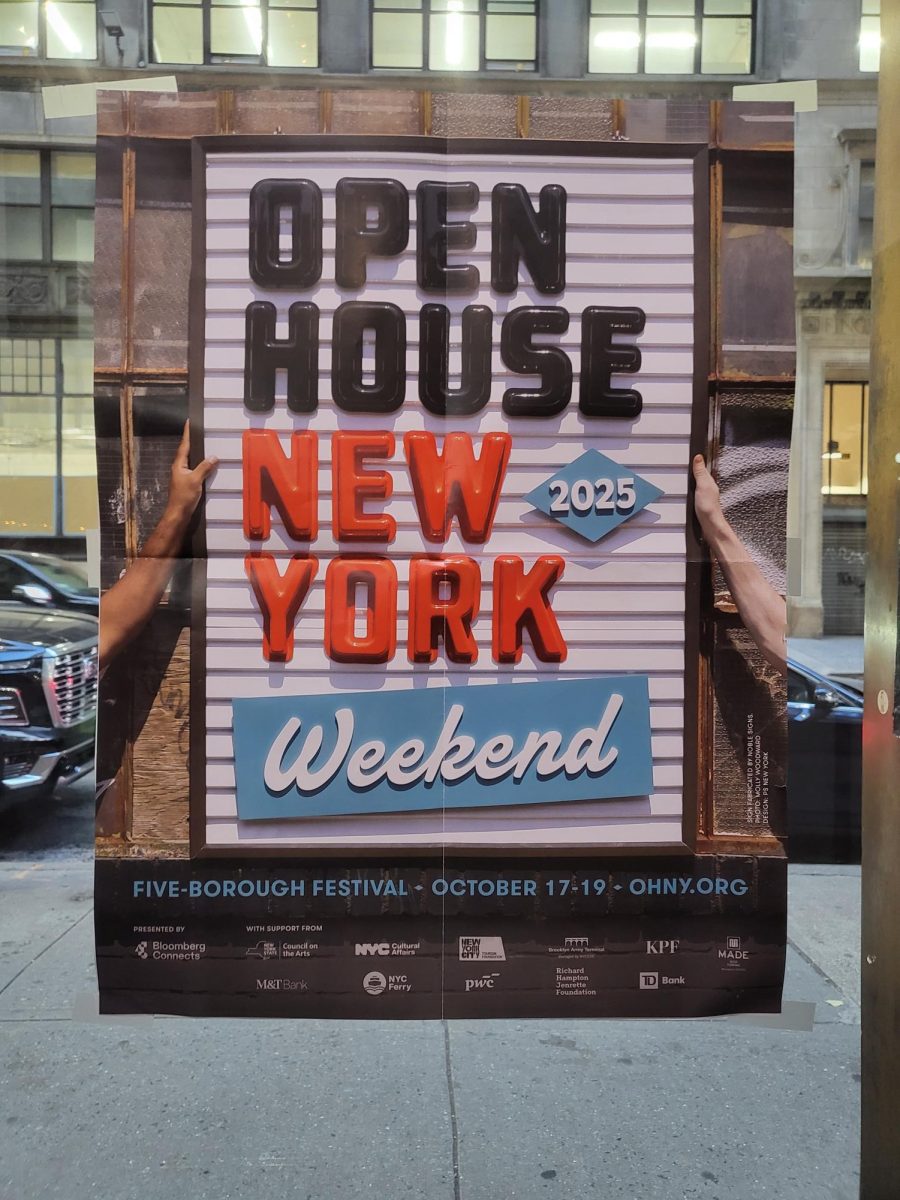
After arriving on the island, I turned left, walking past the welcome center. I followed the soft dirt path into Nolan Park, a long stretch of greenery that is bordered by two rows of quaint homes. On my right, a cozy yellow house had a small poster pasted in front of the porch. The poster matched what was printed on my red t-shirt, with the text:
“Open House New York Weekend.”
Open House New York Weekend (also known as OHNY Weekend) is a three-day festival, hosted by the non-profit organization Open House New York (OHNY). It is an annual event that happens every mid-October. Most recently, it took place between October 17th and 19th, 2025. There are over 300 locations available, in all five boroughs, for visitors to explore; some of which are typically not open to the public.
Besides having locations all throughout New York City, the times are also accessible, fit for “the city that never sleeps.” Some of these destinations start as early as Friday midnight, like the tour on the process of protecting water supply in New York; some end as late as Sunday night, like the stargazing in Inwood.
This idea of having open access for all New Yorkers has been the organization’s mission ever since it was founded in 2001.
Scott Lauer founded Open House New York with the goal of opening parts of the city back up. OHNY is part of Open House Worldwide, which is made up of a network of organizations that share the same goal. Following London, New York is the second city to have this movement. The first Weekend started in 2003, two years after the foundation of the organization, but it was only part of Architecture Week. The first festival started off with 84 sites and 300 volunteers.
Now, over sixty cities participate in the Open House Worldwide, from Athens to Zurich. As for the Weekend, this year’s festival reached 327 sites.
Today, a small team of six continues this mission of keeping sites open for visitors.
But the team is not the only one contributing to the festival. This year, over 1,400 volunteers, made up of regular New Yorkers, helped out in these sites. New Yorkers, of different backgrounds and ages, all gathered together, sporting the same bright red colored shirt. Some had more than twenty years of experience, while others had just started their volunteering journey.
I was one of the volunteers who started volunteering for the Weekend this year. I was assigned to volunteer at the Billion Oyster Project on October 18th, 2025, located on Governors Island. Their goal is to restore one billion oysters to the New York Harbor. They also teach people about the history of oysters and how to restore them.

11:50 PM, October 18th, 2025.
I stood in front of the small yellow house and looked at the 19th-century homes on both sides. Many of these buildings are repurposed for offices or cultural centers, the Billion Oysters Project being one of them.
I met Prophet and Hassan, who work at the non-profit. They both graduated from the New York Harbor School, also located on Governors Island. As I set up for the event with them, they gave me a short introduction on the organization and oysters.
They explained how oysters are important to the environment. One reason is that they create reefs that encourage biodiversity in bodies of water across the world. Oysters can also filter up to 50 gallons a day. Last but not least, oyster reefs help soften the blow of large waves, greatly reducing flooding and erosion.
So how does this connect to New York?
Oysters used to be abundant in the harbor, but pollution and overharvesting created a decrease in population. The Billion Oyster Project works in different harbors around New York, placing oysters and oyster shells in the water to encourage growth. At the same time, they educate New Yorkers, working with volunteers and students.
And no, they said, you cannot eat the oysters.
All of this information was new to me. I had not known how oysters benefited the environment, let alone the fact that oysters were originally plentiful in New York. I was also introduced to the processes for placing the oysters in the harbor, all in a few hours of volunteering.
After learning about oysters, the organization, and their connection to the city, I began wondering: how are the destinations chosen for the Open House Weekend?
To answer this question, I interviewed Riley McShane, who is the Program and Production Associate at OHNY.
McShane explains that the question they address when choosing sites is, “Does this place tell a unique and interesting story about New York City?”
As a result, many places can fit this criteria: “Factories, boats, parks, skyscrapers, tiny museums, places of worship, workshops, artist studios, for example,” McShane said.
“Something else we look for is a ‘wow’ factor that often comes from the fact that a location that is not normally open to the public, like this past year’s Bronx General Post Office or Brooklyn Army Terminal,”McShane continued.
As for the sites that are normally open to the public, OHNY asks its “partners to offer some kind of ‘behind the scenes’ access or a special program that visitors would not normally get to see on just any other day,” McShane said. An example is the Brooklyn Banks at Gotham Park, which is a public space and skate park that is open to anyone and at any time. During the Weekend, they offered a more exclusive tour on “the site’s history as a New York City skateboarding destination and counter-cultural landmark.”
Now that the festival has concluded, McShane shares his reflection on the 2025 Weekend:
“This year’s OHNY Weekend was our biggest ever!” he said. “We saw 49,649 visits, and festival participants came from 89% of the city’s zip codes, which tells us that the reach of OHNY Weekend is continuing to grow.”
For next year’s Weekend in 2026, Open House New York is excited to celebrate its 25th anniversary. They are hoping to explore the theme of zoning and land-use, and how it shapes people’s lives in the city.

Although the dates for the 2025 Weekend have already passed, it does not mean you have to stop exploring the city. Outside of the Open House Weekend, they have other events that are equally popular.
McShane said, “We have an event coming up on December 3rd, 2025, which will discuss how New York City tackles climate change and how it’s planning for the future with an Environmental Justice Plan.”
Another special event is a monthly boat tour that is centered around a certain theme. I had the opportunity to go to two of these boat tours.
The first one I went to was the Port Infrastructure Boat Tour, their most popular and highly requested tour. It showed passengers the loading docks and cargo in New York and New Jersey. The second one was the Coastal Resiliency, which discussed the flood prevention measures created in New York City since Hurricane Sandy in 2012. Both tours took place in the evening, so passengers were able to learn more about these topics while seeing the famous skyline at night.
3:00 PM, October 18th, 2025.
Towards the end of my volunteer shift, I noticed the familiar red shirt in the distance. Two volunteers walked by, a mother and a daughter.
They also volunteered on the island that day, at the KlimaKover: Urban Heat Shelter, a pavilion that can regulate its temperature. They stopped by and briefly chatted with me. I learned that they have been volunteering together for a few years, but the mother has been volunteering for almost a decade. They left shortly after, as they were going to explore the rest of the island.
4:00 PM, October 18th, 2025
After my shift ended, I boarded the ferry back home. As I watched as Governors Island slowly faded into the distance, I reflected on my long, but exciting day.
This volunteering opportunity opened my eyes to important topics the city encounters, such as the environment and biodiversity. But there was also a sense of community between me and the people whom I encountered. It didn’t matter whether we were volunteers or visitors (or perhaps even both). It didn’t matter how long we had participated in the festival, whether that was a decade or just one year. At the end of the day, we were all New Yorkers, who feel the same strong attachment to our city. We all have the same goal of exploring and learning more about New York City.
And this community and exploration is what Open House New York offers.
Riley McShane, the Program and Production Associate at OHNY, explains that the question they address when choosing sites is: “Does this place tell a unique and interesting story about New York City?”