
I cannot remember the last time that I, or any of my peers, committed plagiarism. Attempting to submit someone else’s work would be absurd, given the array of alternative options available to us for finishing an assignment in a few minutes, should we want to do so. Claude, Gemini, ChatGPT, Deepseek, and Copilot are just a few of the ever-growing list of (mostly) free generative artificial intelligence tools created by companies like OpenAI and Anthropic and funded by Big Tech conglomerates like Microsoft and Google. Why commit an act of intellectual property theft and pass an expert’s or a classmate’s work as our own when, instead, we can take the in-style, less guilt-inducing path: generate a brand new document with language mimicking those experts and classmates, and millions of others like them?
One answer — the amorphous threat hanging over the heads of AI users everywhere — is that generating text instead of writing will one day destroy our “critical thinking.” There is a plethora of concrete discourse, both in academic and social spaces, about the value of human intelligence within the AI-centered ecosystem.
The Value of an Idea
As a society, we have assigned a hefty value to the part of the human brain that controls the creation of ideas. It’s the reason why straight-up, old-fashioned plagiarism leaves a bad taste in our mouths. Throughout the Western canon, the genius individuals with the most world-shaking ideas are celebrated with the highest praise. In 2026, the mission statements of universities such as Duke and Emory, and the hiring criteria for important sectors of the job market, from finance to technology, highlight “critical thinking” as one of the most important qualities in a person.
Despite the buzz around this term, scientists and field experts struggle to define what critical thinking actually means. Education researcher Stephen P. Norris writes in his book ‘Teaching Critical Thinking,’ “There is no scientific legitimacy to [the] claim that critical-thinking ability involves ability to control for content and complexity, ability to interpret and apply, and ability to use sound principles of thinking. If anything, scientific evidence suggests that human mental abilities are content and context-bound, and highly influenced by the complexity of the problems being addressed.”
Norris found that while gaining expertise in a specific field was correlated with positive results in that field, there was no significant underlying skill that correlated to positive results in all fields simultaneously. “Critical thinking,” as we like to call it, seems to describe only the ability to apply knowledge from a specific area of study to that same area of study — as opposed to some important brain function cultivated in universities and destroyed a little bit every time we use AI. Rather than trying to preserve some nebulous creative skill while continuing to employ AI for all of our difficult tasks, we must understand that doing those tasks — analyzing the data that an algorithm would otherwise sort through — is exactly what develops the skill we seek to maintain.
The feeling of unsettlement in the aftermath of taking modern shortcuts is still a valid and, perhaps, a vital reaction. Although critical thinking does not exist empirically in the way that we might expect, something human is definitely lost in AI-generated writing. Reading a polished version, a final draft, without any insight into the process by which it was written, is off-putting for a reason: first drafts are often the most difficult and laborious stages of writing.
In John McPhee’s ‘Draft No. 4,’ the great journalist explains his process for beginning to write. “You finish that first awful blurting, and then you put the thing aside. You get in your car and drive home. On the way, your mind is still knitting at the words. You think of a better way to say something, a good phrase to correct a certain problem. Without the drafted version — if it did not exist — you obviously would not be thinking of things that would improve it. In short, you may be actually writing only two or three hours a day, but your mind, in one way or another, is working on it twenty-four hours a day — yes, while you sleep — but only if some sort of draft or earlier version already exists. Until it exists, writing has not really begun.”
McPhee attributes his growth and development as a writer — his “critical thinking,” a resumé reviewer might say — to the uncertainty of putting a pen to blank paper. He acknowledges how difficult it is to think of new sentences when each affects the one before and the one after. “To feel such doubt,” he explains, “is a part of the picture — important and inescapable.”
Words Matter
Generative AI writes without thinking, embellishes without imagining, and uses new language without creating. Subtly, in the first few months of AI’s global proliferation, a cleavage formed: words are no longer attached to their meanings. It is not necessary for people to “brainstorm” or write first drafts, because the very ideas we create in those genesic stages have been untethered from our final products, which can be generated by machinery.
Authors have warned us for centuries about the danger of detaching language from thought in this way. In her 1993 Nobel Prize acceptance speech, American novelist Toni Morrison spoke about a fictional wise woman warning two children about their use of language. “[The wise woman] is convinced that when language dies, out of carelessness, disuse, indifference and absence of esteem, or killed by fiat, not only she herself, but all users and makers are accountable for its demise. In her country children have bitten their tongues off and use bullets instead to iterate the voice of speechlessness, of disabled and disabling language, of language adults have abandoned altogether as a device for grappling with meaning, providing guidance, or expressing love.”
If we study a GPT-prompted writing sample carefully, we are often left disappointed with the lack of truth or creativity or complexity. It is precisely this acceptance of spineless writing that promotes the killing of our language. One of the most powerful tools we possess as individuals and students is the ability to express ourselves in writing; when we normalize producing writing that is detached from our beliefs and ideas, we devalue the very words that remain in our vocabularies.
Morrison continues, “Language can never ‘pin down’ slavery, genocide, war. Nor should it yearn for the arrogance to be able to do so. Its force, its felicity is in its reach toward the ineffable.” She explores the concept that individual words represent far more than their face value, each a meager image of the multitudes of emotion and thought that they stand for. Just like how McPhee preaches the importance of draft-writing, Morrison tells us there is value in the search for every single word that we use, even if depicting our ideas adequately is impossible.
In his critically acclaimed science fiction novel 1984, George Orwell writes about a futuristic society under strict authoritarian control, in which a government-issued dictionary (called “Newspeak”) is shrunk every year, limiting the amount of words in use. Orwell writes, “Don’t you see that the whole aim of Newspeak is to narrow the range of thought? In the end we shall make thoughtcrime literally impossible, because there will be no words in which to express it.” He claims that our individual thoughts, and thus our overall perspective and belief system, are formed and limited by the language available to us. In the novel, the government seeks to control its population by culling so severely that words previously representing layers of ideas, historical context (“democracy,” for example) no longer exist, reverse-causally making citizens’ minds narrower.
By skipping the draft-writing process — the process of searching for the best diction to describe our thoughts — we neglect the diction itself, using words as mere data points in a machine’s output, rather than the very vessels of human expression. We turn from the path that Morrison’s wise woman guides us towards, and attempt to assign meaning to words that, by virtue of their creation, have none.
A Technological Timeline
An important distinction needs to be made between the dawn of AI and the past 3,000 centuries of human invention. With every great invention — electricity, the railroad, steamships — came waves of conservative backlash and protests against change. Groups like the English Luddites of the 19th century destroyed textile manufacturing equipment to protest the Industrial Revolution and the changes it brought to social and economic norms. High school students in Brooklyn decided to go completely analog during the COVID-19 pandemic and reject the mobile technology that had become ubiquitous in their lives.
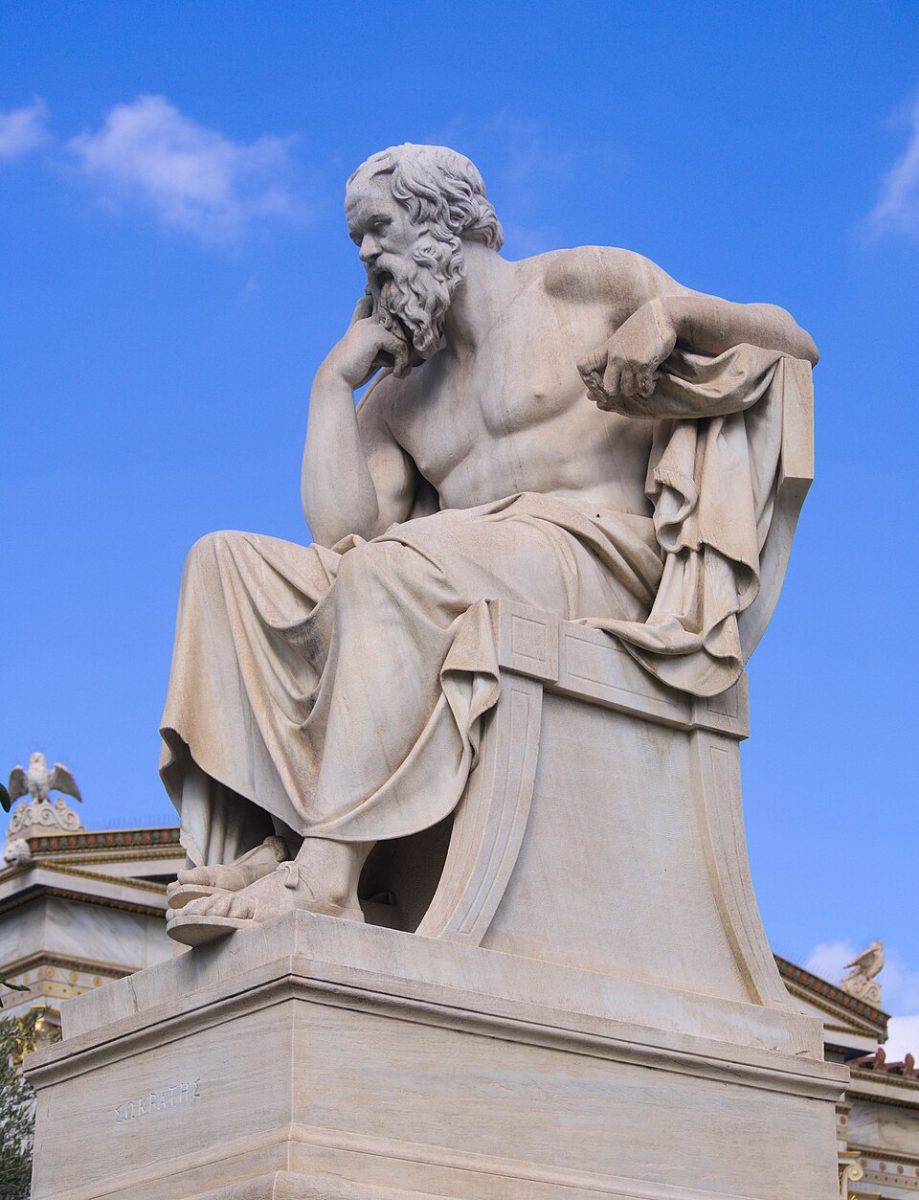
In the year 370 B.C.E., a wise man took a stance that even the Luddites would consider radical: Socrates rejected the technology of writing, refusing to write a single word in his lifetime. In the Phaedrus, written circa 370 B.C.E., Plato, a student of Socrates, recorded Socrates’s justification. “[Writing] has this strange quality, and is very like painting; for the creatures of painting stand like living beings, but if one asks them a question, they preserve a solemn silence. And so it is with written words; you might think they spoke as if they had intelligence, but if you question them, wishing to know about their sayings, they always say only one and the same thing.” The philosopher argued that writing was irreparably inadequate for conveying ideas, and the minds of those who tried to inscribe their thoughts onto paper would be strangled to the point of ruin.
Socrates further posited that value only existed in “the living and breathing word of him who knows, of which the written word may justly be called the image.” If someone were to show Socrates a writing sample generated by AI, he would assign it no value whatsoever: not only does that writing fail miserably at representing the thoughts of a wise person — its writer — it fails to even attempt to do so, having no writer at all.
This is not to say that Socrates was necessarily correct in his lifelong protest; hundreds of thousands of philosophers, researchers, and educators have argued that writing enhances, rather than obstructs, the brain’s functionality and clarifies, rather than stifles, thinking processes. Although our thoughts are certainly more complex than the words we use to describe them, that is not grounds to reject the attempt at immortalizing thoughts altogether.
After millions of technological breakthroughs and the eagerness of millions of people to blame those breakthroughs for a changing status quo, it is easy to label AI as the next logical dot on our timeline — another victim of conservative radicalism that everyone will eventually forgive and embrace. This assumption doesn’t hold, however, against the tool’s key difference: every prior technological innovation has expedited things like hard labor, mechanical processes, or merchandise production, but when AI writes, it replaces the creative spark that is uniquely human. I could enter a prompt as vague as “write an essay about the sky,” and AI would generate a thesis based on millions of similar public essays and defend it for hundreds of words with manufactured evidence. That’s not streamlining workplaces, that’s bending our own ideas to a machine’s direction, and sacrificing our unique humanity for the sake of productivity.
Every few years, the Catholic Pope releases a social encyclical, a letter addressed to bishops and the public articulating the Church doctrine in light of modern issues. Pope Leo XIV released his first encyclical titled ‘Magnifica Humanitas’ or “Magnificent Humanity,” after what he describes as “the grandeur of humanity in light of the promises of AI.” The document enshrines the social doctrine of the Church in the face of new social norms born alongside AI’s integration into our daily lives.
The Pope writes about the story of Babel, in which God’s people attempt to build a tower tall enough to reach Heaven, and He recognizes their hubris and excessive ambition and curses them each to speak a different language. Unable to understand each other, the people can no longer build as one and instead scatter to the corners of the earth. Pope Leo writes that “Babel reveals the limits of any effort that, however grandiose, arises from self-affirmation, sacrifices human dignity for efficiency, and aspires to reach heaven without God’s blessing.” The limit that AI has crossed is precisely this: it places efficiency on a higher pedestal than human dignity, causing us to lose ourselves.
“We must, then, avoid the ‘Babel syndrome,’” Leo continues, “namely the idolatry of profit that sacrifices the weak, a uniformity that neutralizes differences, and the pretense that a single language — even a digital one — can translate everything, including the mystery of the person, into data and performance. The risk of dehumanization — of building a future that excludes God and reduces the other to a means — is an ancient and ever-new temptation that today takes on a technical guise.” Whether the God in your life is the all-powerful, all-knowledgeable receiver of religious worship or faith in an individualized moral compass, Leo’s message holds true: no worship of a new technology should supersede what you believe in.

The Pope is not of the Luddite class, either. He concedes, “Technology should not be considered, in itself, as a force antagonistic to humanity. On the contrary, it has formed part of our history since the beginning as ‘a profoundly human reality, linked to the autonomy and freedom of man.’ […] Today, however, we find ourselves facing a new situation. The power and prevalence of emerging technologies are interwoven into the fabric of daily life, shaping decision-making processes and deeply affecting the collective imagination: ‘Never has humanity had such power over itself.’”
The line between AI positively shaping the next few decades of growth and a 21st-century repeat of the Tower of Babel is thin, but noticeable. We just have to each pay careful attention instead of letting corporations and algorithms subconsciously influence our passive decisions.
What is Truth?
Until now, I have been discussing the idealized version of AI — one that produces what it is asked to produce, embellishing here and there but generally adhering to facts. In reality, this version has yet to exist. The AI models that are available to students and thrifty freelancers often fail to distinguish between facts and falsities among the data available to them and “hallucinate,” or generate absurd lies up to 30% of the time.
When people neglect to train our “critical thinking” (truly, it should be called data analysis) skills, we slowly lose the ability — or often, the motivation — to check the verity of our writing with alternative sources. Conversations with AI often assume an authoritative, friendly tone, persuading us to believe that the machine is knowledgeable and wouldn’t “lie.” This facade is, of course, entirely superficial, but it lulls us into complying with the social systems that thrive on our confusion.
As the philosopher Hannah Arendt writes in ‘The Origins of Totalitarianism,’ the perfect subjects of a totalitarian regime are not, as one might expect, the most zealous believers, but instead “the people for whom the distinction between fact and fiction (i.e., the reality of experience) and the distinction between true and false (i.e., the standards of thought) no longer exist.” The conglomerates with billionaire CEOs and the corporate-sponsored politicians who are interested in complacency among their constituents thus have no real incentive to fix the bugs that plague AI. The more text we generate that is sprinkled with undetectable lies, the more paranoid we become, questioning the information we receive even from trustworthy sources.
This distrust makes the collective imagination fragile: we struggle to distinguish between good and bad or right and wrong when the truths that should be the basis of those ethics no longer exist. The Pope warns, “When words are simulated, they do not build genuine relationships, but only their appearance.” Falling into the habit of communicating with AI — composing emails or writing public documents — kills the genuine relationships that otherwise work to build a spiritually healthy society.
So my thesis is this: Is AI completely wrong, and something we should reject unconditionally? No, of course not — that would undermine entire sectors of the economy and swaths of powerful research in medicine and clean energy. But we should reframe the debate about government or corporate policies regulating the technology into a debate about personal philosophy. We should be thinking critically about our own boundaries — the lines we draw — and refusing to let laziness or the chase of efficiency blur those lines. And maybe plagiarism is not the worst offense after all; recognizing that an act is wrong and doing it anyway can, in some cases, be less harmful than convincing ourselves we are taking a shortcut without consequences, while slowly, steadily, eroding our free will.
Generative AI writes without thinking, embellishes without imagining, and uses new language without creating. Subtly, in the first few months of AI’s global proliferation, a cleavage formed: words are no longer attached to their meanings. It is not necessary for people to “brainstorm” or write first drafts, because the very ideas we create in those genesic stages have been untethered from our final products, which can be generated by machinery.