
“When Homer says a god ‘breathes might’ into some of the heroes, this is really Love’s gift to every lover,” (179B) writes Plato in The Symposium, first written between 385 – 370 B.C.E.
We all love someone or something. Love is everywhere we go: in tearjerking endings of our favorite comfort movies, in serenading music that professes devotion in pure declaration, in crowded streets where smiling lovers intertwine hands, in the corners of our wishful imagination, and in the depths of our hearts. Love drove Romeo to die for Juliet, and, as the ancient Greek Phaedrus claimed, drove invincible armies of men who were so bound by love that they would rather “die a thousand deaths” than surrender in the face of his lover. For us, love may be a feeling, a desire, a weakness, or a strength. But for Plato, love is a sort of indescribable divine transcendence that leads the soul to an abstract climb towards truth and beauty.
Today, love has never been easier to find — or to lose. We swipe right, fall fast, and fall out even faster. Words like “love-bombing,” “ghosting,” “three-month rule,” “situationship,” and “the ick” define our generation’s vocabulary of affection, all reflecting the transactional nature of today’s love. Whether we call it friendship, passion, or obsession, it’s possible we simply chase short-term comfort, seek attention for our own validation, love out of loneliness rather than devotion, and fall in love with the idea of being loved.
“Now, people choose what or who they love out of convenience to protect themselves and maintain comfort. Love can come from just being around someone all the time,” said Bronx Science student Aya Boulghobra ’26. “It comes out of nowhere and can redefine you as a person and your life, sometimes for the worse.”
With a statement akin to Boulghobra’s, her classmate Beatrice Sireci ’26 takes a more hopeful view: “Love can certainly change people’s course of events. I believe that love sustains itself as the root of happiness.”
Their words reflect the undisputedly transformative, yet perplexing and contentious, nature of love. It’s a timeless truth that love has always been beautiful, painful, confusing, and all very human. This raises the question: Can a thin, 2,400-year-old book tell us anything about what love really is and what it is that we seek when we fall for someone?
In The Symposium, Plato tells of a drunken Athenian banquet where a circle of philosophers, poets, and politicians take turns giving speeches attesting the power of Eros, the god of love. Plato, a classical Greek philosopher from Athens, remains one of the most influential figures in Western thought. As the student of Socrates and teacher of Aristotle, Plato is known for his dialogues where Socrates is used as the main character in order to explore complex philosophical questions through dialectic, even after Socrates’ death. Each speech builds on the last, creating a ladder of understanding to reveal love’s evolution from myth to morality to metaphysics.

ARISTOPHANES
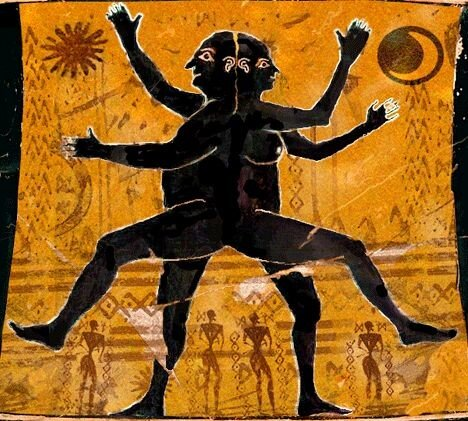
The comic playwright Aristophanes tells about a time of our origin. Picture fumbling, round creatures with two bodies fused into one, bound together by the head and rear, traveling by somersaulting. Each possessed two faces, four arms, and four legs. They were true soulmates, destined to be together for eternity. Fearing their power, however, Zeus split them apart. Each half is condemned to wander the earth, searching for the other in desire to reunite, as eternal torture. This, Aristophanes says, is love: the innate yearning to be made whole again — even though it’s physically impossible.
“Its obvious that the soul of every lover longs for something else; his soul cannot say what it is, but like an oracle it has a sense of what it wants, and like an oracle it hides behind a riddle” (192D).
This story still shapes our idea of “soulmates” today. We dream of finding “the one” who will complete us, believing that we are tethered by an invisible red string and destined to meet the one who is “meant to be.” It’s a comforting idea — that love repairs what’s broken — but it also reveals our human flaws: our tendency to seek fulfillment outside ourselves, in some cases, for our own reassurance.
We continue to chase this wholeness today. We look for people who fill our gaps, soothe our insecurities, or make us feel seen. Yet Plato continues to ask: Can another person really make us whole, or does that wholeness have to come from within?
AGATHON
Next comes Agathon, a young poet who praises love as the “youngest of the gods” and romanticizes love as eternal youth, beauty, and goodness. His speech is poetic, but deliberately shallow.
Agathon’s idealization of love is familiar to anyone scrolling through Instagram: filtered affection, aesthetic romance, glossy love. We chase the feeling of being in love when it’s shiny and new, but struggle to commit and put in the work when flaws arise.
Plato uses Agathon’s speech to show how easily we confuse infatuation with genuine love. True love begins when the illusion of the “honeymoon” phase fades: when the perfection we projected onto another eventually gives way to the reality of their imperfections, yet we choose to keep loving them not for how they make us feel, but for who they truly are.
SOCRATES AND DIOTIMA
Everything dramatically changes when Socrates delivers his profound speech. He recalls what he once learned about love from a wise woman, Diotima. Her view redefines everything the others have said. Eros, she says, is not a purely good or bad god, but a spirit between gods and humans. Love is the desire for what we lack, and, through it, we strive for what is good and beautiful.
“One goes always upwards for the sake of this Beauty, starting out from beautiful things and using them like rising stairs… and from these lessons he arrives in the end at this lesson, which is learning of this very Beauty, so that in the end he comes to know just what it is to be beautiful” (211C).
Love isn’t about attraction or chemistry, but about a climb toward this abstract perfection. Love begins with desire for a beautiful body but should evolve into love for beautiful minds, beautiful ideas, and ultimately, Beauty itself as a kind of truth beyond human reach. The truest love is a ladder:
Stage 1: One is in love with a particular beautiful body — physical attraction.
Stage 2: Now, one recognizes that beauty is not confined to one body but is shared among all. Physical attraction begins to lose its hold.
Stage 3: Then, one comes to see that the beauty of souls is more honorable than that of the body. They turn toward loving all souls and characters, seeking to bring forth goodness and wisdom in others.
Stage 4: Love expands further to include beauty in practices, customs, and laws — the harmony found in virtuous living. Beauty in the body now seems inconsequential.
Stage 5: From there, one is drawn to the beauty of knowledge itself (epistêmai), finding joy in the life of the mind, and is now freed from finding beauty in just one particular person.
Stage 6: Finally, the lover has singular knowledge of a specific fineness — the Form of Beauty: the source from which all other beauty flows.
“[Love] is always one in form and all the other beautiful things share in that, in such a way that when those others come to be or pass away, this does not become the least bit smaller or greater nor suffer any change” (211B).
Imagine a kind of beauty that never fades, never changes. This is the Form of Beauty: an ideal, eternal essence that exists independently of the physical world and beyond all people and objects. It remains unpolluted by human flesh or mortality, as all beautiful things simply participate in it.
The Form of Beauty lies at the heart of Platonic metaphysics. In his Theory of Forms, Plato argued that our physical world is merely an imperfect reflection of a more divine realm of perfect, unchanging Forms. Each abstract concept has its own corresponding Form. The Form of Beauty, specifically, is an ideal, unchanging archetype for all beautiful things in the physical world.
The ascendence to the Form of Beauty allows the individual to escape an excessive fixation and detach beauty from a singular, mortal being. Instead, one is able to recognize a common Form of Beauty that “is always one in form” (211B) and achieve divinity. In that ascent, love becomes less about possession and more about transformation. It’s a means of self-betterment, a spiritual journey that elevates the soul.
“The love of the gods belongs to anyone who has given birth to true virtue and nourished it, and if any human being could become immortal, it would be he” (212A).
Human beings, Plato writes, desire that the good always be theirs; This longing is a desire for immortality and is the reason we love (206A). Since immortality is beyond our grasp, the only way to attain it is by procreation — though not restricted in standard biological sense. For Plato, reproduction chiefly means leaving behind something new that is similar to the old (208B). Immortality, then, isn’t achieved by living forever, but by creating, teaching, or loving in ways that outlast our mortal lifetime. Through love, we give birth to virtue, art, or wisdom that transcend our physical lifetime. Examples of this “immortality” abound: people strive for fame, making sacrifices with knowledge that their names and deeds will be remembered for some time beyond their life. Or one could be “pregnant in the soul” and cultivate virtue and wisdom in other souls. Some may argue that this spiritual and intellectual creation is better than biological procreation. Only through love are humans able to give birth to true virtue. The lover becomes a philosopher and gains immortality through wisdom of the soul as he turns from illusion and towards truth.
ALCIBIADES
After Socrates’ speech, Alcibiades bursts into the room in a drunk and noisy entrance. He professes his earthly obsession for Socrates on the spot, offering Socrates his beauty and favors in return for Socrates’ wisdom. Socrates, however, sees through Alcibiades’ shallow love and rejects him in shame. As we can see with Alcibiades’s unreciprocated and tragic profession of love to Socrates, love that does not ascend is trapped, transient, and unsatisfying. This rejection represents triumph of philosophical virtue over superficial worldly obsession. Socrates demonstrates that love and knowledge can not be bought nor traded and must instead be pursued for their own sake.
LIMITS AND LESSONS
But is this view of love perfect? If we love others as a means of self-actualization, when do we care for others for their own sake? Happiness, not love, is the true ultimate end for all human beings, as it is not desired for the sake of anything further. Above all, is the ascent of the ladder of love too abstract? Is attaining the Form of Beauty feasible for humans? Is something as perfect and godlike as true virtue and objective beauty even fathomable?
Olivia Gawehnidi Porter, a Philosophy M.A. student at Stanford University, believes so — to an extent. “I think the Form of Beauty is attainable but only for a select few,” Porter explained. “Plato’s divided line explains that concepts exist in both a physical world of senses and an invisible world of reason. The majority of people are only able to understand concepts in the physical world, which include physical objects, images, beliefs, and imaginings. As you transcend the divided line, you reach mathematical objects and thinking. Lastly, you can grasp forms and knowledge. Understanding Forms is mostly inaccessible to the average human mind, so, while I think it is possible to understand the Form of Beauty, I think proper understanding is uncommon.”
Even if the transcendence to the Form of Beauty seems vastly out of reach, the act of striving towards that ideal still gives meaning to our relationships. As Porter noted, “reflecting on the concept of it can provide insight into how an individual may want to change the love they are seeking, receiving, and providing.”
Rather than mistaking attraction and desire for love, Diotima tells us to use that initial spark to climb the ladder toward a deeper appreciation of goodness and beauty in itself. Plato would likely encourage us to seek a partner who empowers us to reach our full potential and grow into our best selves, building a relationship based on deep friendship and mutual respect.
Something as valuable as love can not be so easily found with a swipe, nor so easily lost overnight. Love, in this view, is a sacred pursuit that demands patience and courage to create something lasting beyond your generation. Perhaps, what we forget most easily is that love worth having is never meant to be easy, but transformative.
A MODERN TAKE
Once a purely theoretical exploration of love and beauty, Plato’s Symposium has now become the subject of explicit political debate in Texas. In January 2026, reporter Alan Blinder with The New York Times published an article, reporting that Texas A&M University warned a philosophy professor to remove lessons on Plato’s Symposium, including Diotima’s Ladder of Love and Aristophanes’ myth, in order to comply with new curricular restrictions that courses may not “advocate race or gender ideology, or topics related to sexual orientation or gender identity.” This reflects the broader Trump administration’s argument that universities were engaging in “liberal proselytizing” and “radical left indoctrination.”
Plato remains an unequivocal cornerstone of philosophy — the foundation of Western thought — despite his works being millennia old. If The Symposium were truly obsolete, it wouldn’t require censoring. Its continued controversy in today’s world reveals that Plato still provokes and demands reflection in deeply uncomfortable, yet deeply necessary, ways.
Plato’s ancient dialogue challenges us to rethink what we’re really looking for and whether our culture of convenience has stripped love of its depth. Plato’s view forces a timeless question back into focus: Is love about finding “the one,” or about becoming someone better?
These three visions of love reflect the stages of love we still experience today: We first desire another person to “complete us.” Then, we fall in love with the idea of love itself: the comfort of having a special someone, the reassurance of being liked by another. Essentially, this is the “honeymoon” period: the initial excitement with idealized views and high levels of feel-good neurochemicals. If we’re lucky, we finally move beyond both, learning to love in a way that transforms ourselves into better people, rather than being consumed.
But that climb isn’t easy. Many contemporary relationships stall somewhere on the lower rungs. We settle for attention instead of connection, or we seek love as a cure for loneliness rather than a path to growth. Love becomes transactional, something to fill a void instead of to elevate the soul. After the “honeymoon” period fades, many people soon seek another to feel that spark again which, in many cases, is never permanent.
For Porter, Plato’s take on love still holds true today, precisely because it decenters individual relationships as the sole focus of affection. “We have much more to gain from loving all bodies, minds, and ideas and appreciating beauty in its universal form,” she said. “Plato’s Symposium did not drastically change my view on love, but it did increase and reaffirm my belief that a person’s values and morals should be understood and applied as universals. Concentric circles of relationships show that there are different levels of closeness within different types of relationships, entailing varying degrees of love, but I think the attitudes we approach people with should remain the same.”
Plato reminds us that love’s true power isn’t in finding “the one.” It’s in becoming someone who can love deeply, selflessly, and wisely. To love in the Platonic sense is to care, not about what we gain but the simple act of caring as a human. Achieving the Form of Beauty is to recognize beauty not only in others, but in the world, in thought, and in all elements.
If we want love that lasts, we need to learn from Plato’s ladder: stop searching for completion in others, stop idolizing the perfection of love itself, and instead, climb toward a love that creates something good, something immortal, within us.
Imagine a kind of beauty that never fades, never changes. This is the Form of Beauty: an ideal, eternal essence that exists independently of the physical world and beyond all people and objects.