
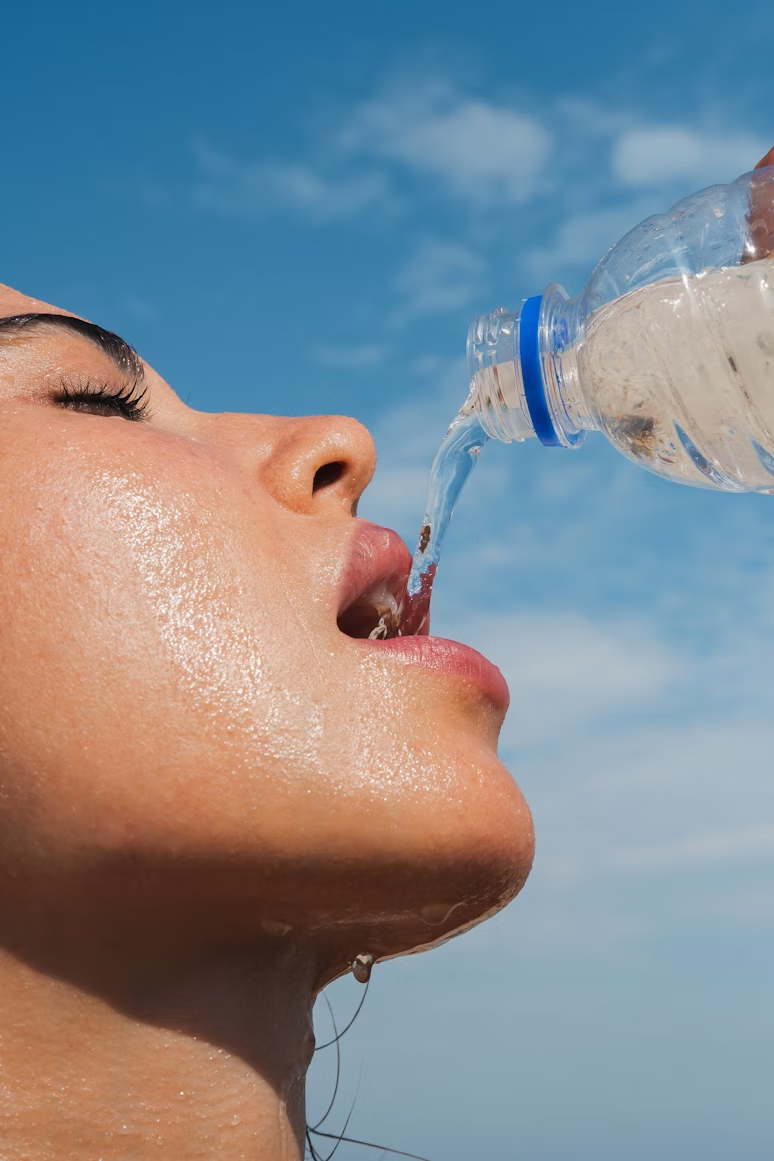
There are debates that have defined generations, whether that is pineapple on pizza, the Oxford comma versus grammatical chaos, or cats versus dogs. But a discussion has risen especially prominent in our generation: the conflict between “Waterfall” versus “Airsip.”
Both describe the same act: tilting your water bottle above your lips, and letting a stream of water gracefully into your mouth without touching the rim. But only one term carries linguistic integrity, social coherence, and the poetic truth of hydration itself.
To break it down for my fellow “airsippers,” if you’re “airsipping,” you’re not sipping water or air, you’re sipping delusions.
Let’s picture this.
You’re at gym class, and you’re dying of thirst. Your friend generously offers their water bottle, but warns, “Don’t put your mouth on it.” What do you do? Obviously, you tilt the bottle above your face and let a stream of water fall into your mouth. Within those delicate seconds, you’ve experienced hydration and satisfaction, but you’ve also demonstrated coordination, respect, and physics. You’ve quenched your thirst while maintaining balance and grace in one fluid act.
That, my fellow peers and readers, is called a waterfall.
Yet, recently, a disturbing number of people have begun to rebrand this sacred act as “airsip.” This absurd term has spread like wildfire, or more accurately, like dehydration.
But words matter. Renaming waterfall as “airsip” is like calling the Mona Lisa a doodle. It’s an offense to art, physics, and taste.
Now, let us approach this with academic rigor, the right amount of emotional investment, and the passion of those who know they are right.
“Waterfall” is a word of beauty, power, and motion. It conjures imagery you can feel and even taste. A waterfall is natural, inevitable, and majestic. The term honors the flow, the movement, and the delicate moment of trust between the bottle and the drinker.
“Airsip,” on the other hand, sounds like something you’re ordering from the children’s menu at Applebee’s.
The prefix air suggests absence and emptiness. Sip implies minimal effort–a tiny, inconsequential slurp. Together, “airsip” paints a picture of someone pretending to hydrate themself. There is no air in this act, and there is no sipping. But there is water falling. A waterfall is not a suggestion; it’s a commitment.
“Airsip” is linguistic inflation, an attempt to rebrand something revered for novelty’s sake. But no rebranding can defeat the laws of nature. Water falls; it does not lift itself delicately through the air.
A proper waterfall requires coordination, courage, and respect for gravity. You tilt the bottle just so, estimating distance and angle with the precision of a NASA engineer. One miscalculation and suddenly you’re baptizing your chin in Dasani or Poland Spring. But when it works? It’s magic. Poetry. Engineering. It’s hydration choreography.
Meanwhile, “airsippers” refuse to acknowledge the truth. They deny the artistry of the act by pretending it’s gentler, subtler, “just a sip.” But waterfalling isn’t sipping, it’s soaring.
To see where Bronx Science students stand, I conducted an in person survey of 105 students. 55% of them agreed that waterfall is the correct term, while the other 45% sided with airsip. While many respondents remained anonymous regarding this matter, I’ve come across many students that were quite passionate about their preference. Aruba Hossain ’27 declared, “Truthfully those who say airsip are honestly delusional. Like why are you sipping air? It’s a waterfall because it looks like one.”
These comments, while humorous, reveal a deeper truth. Supporters of “waterfall” cite its natural logic, its flow, its beauty. Meanwhile, “airsippers” cling to modernity, claiming it “sounds cooler,” a phrase that ironically reflects their desperate thirst.
Language isn’t exactly about sounding cool; rather, it’s about accuracy, history, and the poetry of truth. Rebranding our precious, righteous terms strips the act of its cultural heritage and its connection to the eternal element that sustains life itself: water. Drinking water is an act rooted in centuries of rituals and meaning, whether that is shared cups at family tables or tea ceremonies rooted deeply in Chinese culture. To drink is to participate in something ancient and universal, a reminder of both survival and gratitude. When we reduce this act to shallow rebranding, we forget the reverence and collective memory that surround such a simple, yet essential act.
But this is more than a vocabulary mishap. It’s a tear in culture and generations of history. We live in a world obsessed with renaming, repackaging, and rebranding. We give old things new names and pretend we invented them. All of a sudden, meditation becomes “mindfulness,” thrifting becomes “vintage exploring,” and South Asian dupattas become “Scandinavian scarves.” To the Scandinavian scarves and airsips, they’re all equivalent to avocado toast, familiar, yet marketed as innovation.
History shows that societies have been conscious of the power of naming. From Aristotle’s meticulous terminology to the precise classification of modern science and art, human beings have understood that words carry consequences. In the case of “waterfall,” the term honors the laws of physics, the experience of the drinker, and the communal understanding of the act. “Airsip,” however, trivializes these elements, replacing substance with style. This reflects a larger cultural pattern: the obsession of rebranding and renaming classic novelties, disregarding culture, history, and tradition. The rebranding of waterfall exemplifies this phenomenon, authenticity with aesthetics.
Moreover, the mischaracterization inherent in “airsip” undermines social cohesion. Consider group settings such as sports practices, gyms, outdoor activities, where water is shared both practically and symbolically. Naming the act correctly as waterfall signals mutual understanding of the rules and the artistry of execution. Mislabeling introduces confusion and erodes the subtle social etiquette embedded in the practice. Shared languages enable a shared reality.
From a rhetorical perspective, “waterfall” carries beauty and resonance. The word conjures motion, flow, and inevitability, echoing in both nature and human experience. It embodies a marriage of elegance and function, descriptive yet understanding. Conversely, “airsip” offers an awkward alternative, with poor structure and implications that undermine the precision of the act itself. Prioritizing “airsip” over “waterfall” privileges novelty over truth.
In a world where people are obsessed with repackaging and novelty, preserving precise meaningful vocabulary is a moral and cultural necessity. Contemporary society repeatedly renames the familiar, disrupting innovation with invention.
This debate is more than just hydration. It’s about our relationship with language, culture, and honesty. Waterfalls respect physics and celebrate the beauty of motion. It captures the essence of what it describes. “Airsip” denies it.
If words are architecture and building blocks of thoughts, airsip is a destruction, collapsing under dishonesty. Defending waterfall is not ridiculous, it is preservation. We cannot allow classic terms to be repackaged into oblivion. “Airsip” is merely one example of a larger issue: the erosion of linguistic authenticity in the pursuit of trendiness or what’s the next big thing. As with all things that fall, water, civilizations, our government–neglecting laws of gravity leads to collapse.
To sum it up, we should all call things by their rightful names. Let the water fall. Let physics govern. But above all, let the language of hydration remain poetic and precise.
The next time you’re in the gym asking your friend for water, you participate in an ancient ritual that honors coordination, courage, and linguistic integrity. Humans have been offering and drinking water since the dawn of civilization, a practice essential to survival. Water has been honored throughout cultures, but has always remained as a symbol of life, purity, and survival.
You are not “airsipping,” you are waterfalling.
And even then, whether you call it waterfall or “airsip,” the real question remains: which one actually quenches the thirst for truth?
“Truthfully those who say airsip are honestly delusional. Like why are you sipping air? It’s a waterfall because it looks like one.”