

It is six in the morning, when the screeching of your alarm clock rouses you from a hard-earned slumber. As usual, you’ve spent most of the prior evening studying for tests, or if you’re a senior at this time of year, completing supplemental college essays you’ve spent far too long procrastinating upon before finishing them. Outside, the city hums with life: cars honk throughout the street and buses hiss periodically as dawn shines its friendly face upon another busy day in the city that never sleeps. Drowsily, you emerge from the warm cocoon of your bed and begin the daunting process of getting ready.
Six hours and an ocean away, a student much like you awakens from their own tranquil hibernation to a chorus of birds harmonizing in a nearby tree. As a resident in the city of dreams, known geographically as Vienna, Austria, their mornings are soundtracked by the gentle clatter of trams only a short distance away, and the occasional whir of cars passing through streets unhurriedly.
While you battle subway delays and the tyranny of time, Viennese students, like my cousin Nicole Ijieh, begin their mornings with a reserved order. No rushing through crowded platforms or panicked sprints to class, just a calm start to the day.
Nicole attends the Albertus Magnus Gymnasium, and during an in-depth interview, she opened my eyes to an alternate academic world that was structured not by inequity, but by quiet consistency.
The Structure Behind Vienna’s Education System
In Vienna, education follows a tiered system that begins defining a student’s academic path early on. Nicole explained that from ages six to ten students must attend primary school — a foundational stage, similar to the elementary schools here in New York, that prepare them for more specialized paths to follow. After this core level is when the journey of individual Viennese students begins to diverge.
Students who perform well during primary school receive an AHS recommendation at the end of primary school, essentially a ticket to apply to the more academically rigorous and prestigious Allgemeinbildende Höhere Schule (AHS). Those who don’t earn this recommendation are required to continue on to a Mittelschule — the AHS’s less glamorous younger sibling.
AHS schools are lauded for their rigor and comprehensiveness. Students spend their first four years in what’s called lower secondary school, a partial equivalent to American middle school, before advancing to upper secondary school for another four years. In the Austrian system, these correspond to grades one through eight within the Gymnasium itself, though in the U.S., they align with grades five through twelve.
In contrast, Mittelschulen only encompass the lower secondary portion of a full Gymnasium, grades one through four, making them a more direct equal to the middle schools here in America. After the completion of a Mittleschule, students are mandated to take at least one year of upper secondary education.
At this point, they may opt to transfer to an AHS, where they can complete the upper level or instead go to a Berufsbildende Höhere Schule (BHS) — what we would call a vocational school — which don’t offer any levels of lower secondary education.
Vienna’s education system helps level the playing field between students in Mittelschulen and those in the lower secondary portion of a Gymnasium, by enforcing a standardized curriculum across all schools at each grade level within lower secondary. This ensures that when Mittelschule students transfer to a Gymnasium, they can more easily keep pace with their classmates, having already covered the same foundational material. As Ijieh put it, in a Mittelschule, “Everything is done a bit slower, a bit more on their level, so when the time comes to go to upper secondary, everyone is on the same level and fully understands the material.”
There are three main types of Gymnasiums which primary students may attend or Mittelschule graduates may transfer to: the standard Gymnasium (AHS), Realgymnasium, and Wirtschaftskundliches Realgymnasium. The AHS offers a bit of everything, but focuses primarily on humanities. In these schools, the mastery of two foreign languages is mandated. In the Albertus Magnus Gymnasium, which Ijieh attends, these are Latin and English, as all instruction in school is done in German. Conversely, the Realgymnasium have a greater emphasis on natural sciences. Finally, the Wirtschaftskundliches Realgymnasium focus heavily on economics.
Despite the national standard every school has to comply with during the years of lower secondary education, many Gymnasium will begin to offer distinct courses that align with the specific category of the school. “In my school,” Ijieh explained, “[At the end of second grade] You can choose between three, let’s say branches: Latin, French, or the Science Branch.” In the French and Latin branches, you have an additional class of either language. “Everybody from 5th grade has to have Latin, so you can either choose to have Latin in third grade or from fifth grade – whatever you like.”
Similarly, in a Realgymnasium, students will have additional science courses on top of the standard curriculum after the second year, and those in a Wirtschaftskundliches Realgymnasium will have more economic classes. However, these specialized courses are completely distinct from BHS schools whose sole purpose is to integrate students’ education with the practical knowledge of a specific career, rather than simply provide additional courses.
As students approach the upper secondary level of Gymnasium, things become even more varied across the different schools, and schools adopt more distinct practices. However, there remains a clear goal — passing the Matura. This requires the three essential courses of English, Math, and German.
Regardless of your Gymnasium’s specifications and unique classes, you are all still adequately prepared for the Matura and take this set of foundational courses. That’s why Ijieh remarked, “Whether you’re in the most gross public school on earth, or the most prestigious private school in Austria, you’re basically learning the same thing.”
How Inequality integrates itself into NYC’s Education System
The academic harmony that Vienna synchronizes using a standard curriculum is an unfamiliar tune in New York. On paper, there are statewide criteria known as the P-12 standards which dictate what students should have mastered in different subjects by the end of individual grade levels. Yet, these standards are only broad guidelines, not a unified curriculum, and how closely they’re met in New York City depends heavily on a student’s zip code.
It’s left to local districts and schools to figure out how to get their students to meet these benchmarks, and for those in underserved areas, this might be a herculean task. Although schools in high poverty districts receive more funding, it’s not always enough to address critical issues like outdated materials and higher teacher turnover. In these environments, students are more likely to be taught by less experienced or uncertified teachers, which widens the achievement gap even further.
Poverty proves itself to be an inherent barrier to education for many students throughout the city. It determines which schools have access to opportunity and which are left to make do with less, setting students from low-income areas at a disadvantage both when they begin applying to prestigious high schools during middle school, and when striving for top universities during high school.
But even this stormy cloud shows a glimmer of light. In recent years, New York City schools have begun inching toward a more unified academic foundation. During the 2023–2024 school year, a standardized reading curriculum called NYC Reads was gradually introduced across all elementary schools. The following year, a companion initiative named NYC Solves began its roll out in select districts for middle and high schools. Under this program, middle schools were required to choose from a list of city-approved curricula, while Algebra I courses (normally taken in high school) across participating schools adopted a single, standardized approach. Former Mayor Eric Adams even announced plans to expand these programs citywide by 2027.
Still, these changes are unfolding within a system where districts remain underfunded and burdened by longstanding challenges. Only time will tell whether these initiatives can truly bridge the city’s educational divide.
In high schools specifically, one of these challenges lie in the courses available to students. All schools are required to offer certain classes to prepare students for the Regents exams — tests that every New York student must pass to graduate. Beyond these requirements, however, access to advanced coursework varies widely.
In many schools, juniors and seniors can choose from a range of higher-level classes: Advanced Placement (AP), honors, or college-credit courses, which strengthen transcripts and broaden students’ knowledge. But for schools in underfunded or underserved neighborhoods, such opportunities are far more limited. This ends up being another way students in these schools are denied the same academic opportunities available to their wealthier counterparts.
The Duality of Schedules in New York Versus Vienna’s Uniformity
Schedules for high school students vary so much because different schools offer distinct things. After speaking to students across the city, they confirmed the notion that your course rigor is almost entirely dependent on whether or not you take advanced courses.
Jaylynn Castro of St. Raymond Academy for Girls explained that honors students at her school analyze classical literature and tackle higher-level math and science, while non-honors classes operate on “a noticeably lower standard.” During her ninth grade year when she took all regular classes, she said the work felt so easy that she rarely needed to study.
In schools that offer a wide range of advanced courses, students can often find a balance between challenge and manageability. Oluwatise Onanuga, a student at Columbia Grammar and Preparatory School, described her experience: “Most of my AP and honors classes are difficult, especially the research program and math. But I think that for me, most of my [other regular] classes are easy, though I still have a lot of work.”
Similarly, Bronx Science offers its students a plethora of courses in every area one can think of — from A.P. Music Theory to Introduction to Neuroscience. A source of joy among students is the wide range of choices they have to explore during their time here. In Bronx Science, students may take some Advanced Placement classes as early as sophomore year, with the most popular choices at this stage being: A.P. Biology, A.P. European History, and A.P. World History. This is in addition to any regular regents classes one may take or elective courses like Journalism or Orchestra.
But the variance schools have across the city ensures that different schools have their own systems. Jaylynn describes the opposite of balance in her school. “When a student is in an honors class, they are required to take all other subjects as honors. This is often a dilemma for students who are strong in one subject yet falter in another.”
In New York schools, each student follows their own unique schedule according to their school, migrating from class to class while teachers stay put. For many, like Oluwatise, simply getting to the next period can feel like a workout. “I always have A.P. Biology after Japanese, and those are in two completely different buildings,” she said. “So I have to sprint from the west building to the north one, climb five flights of stairs, and shove through crowds in the hallway, just to still end up late and exhausted.
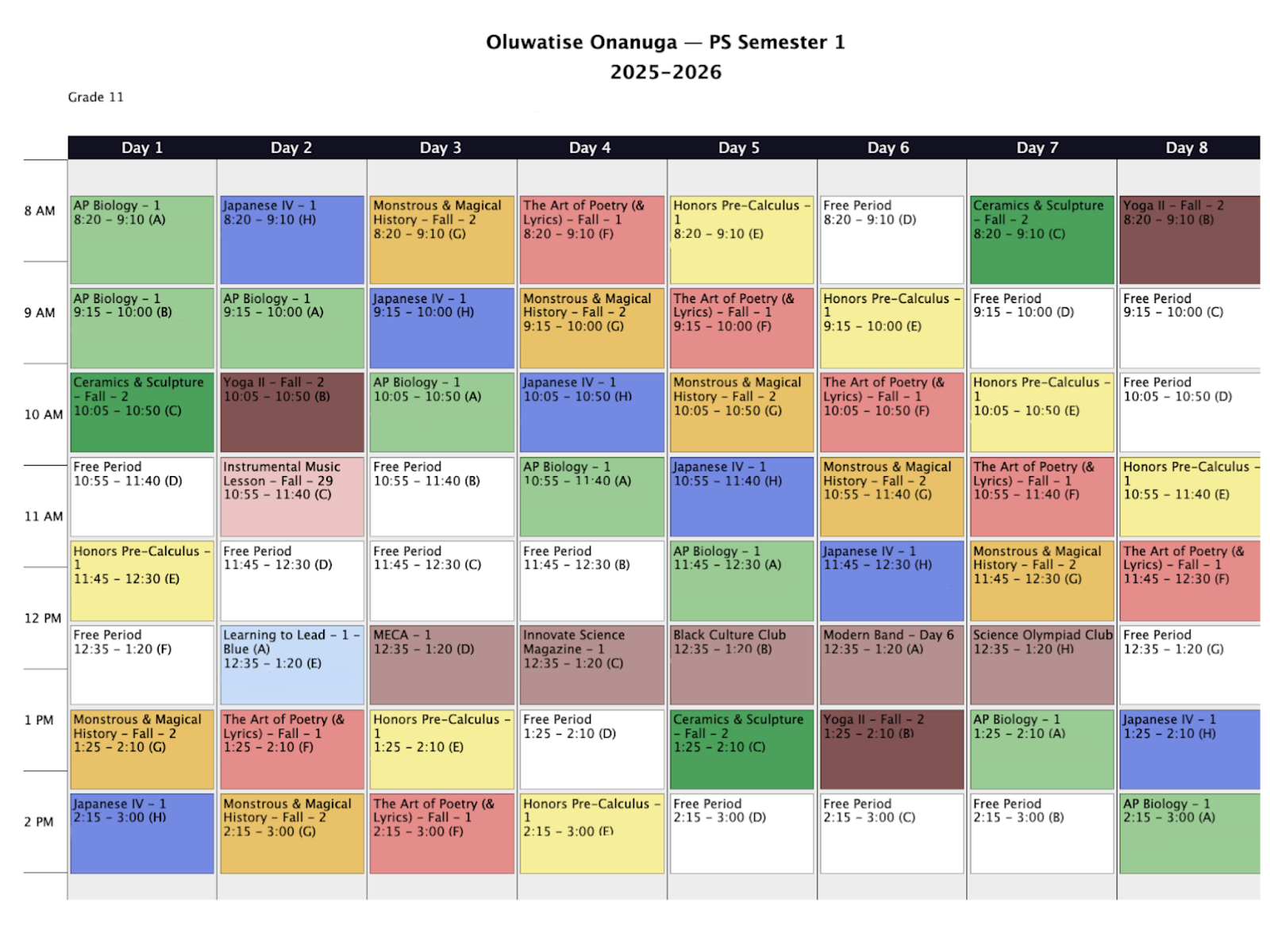
(Image Credit: Oluwatise Onanuga; used by permission)
While New York students zoom past hallway mobs to catch up to their next class, Viennese students experience a transition period embedded with serenity. The reason why isn’t a mystery at all: they don’t move, rather, teachers do. Instead of students rushing from one room to another, teachers make their way to a single classroom where the same group of students remains throughout the day.
As Nicole explained, this system works because after the second year of lower secondary, students choose a “branch” — a concentration like Latin, French, or science — that determines their academic focus for the rest of high school. From that point on, they’re placed in a permanent class alongside others who chose the same branch. For the next six years, they share the same schedule, the same classmates, and largely the same teachers.
While this setup might vary slightly across schools, it’s a widespread practice throughout much of Europe for teachers to travel to the same group of students, not the other way around, with some exceptions for non-standard subjects such as gym and art. This means students can focus on what the time in between classes is supposed to be: a break.
This system allows for another hidden benefit: uniform testing schedules.
Tests are Terrible Regardless of Which Country You Reside in
Since teachers in Vienna instruct the same group of students throughout the year, coordination comes far more naturally. At Ijieh’s school, this synchronism allows teachers to plan together with more precision. At the start of each school year, every class receives a testing schedule collaboratively designed by their teachers. It’s essentially a master calendar listing every exam date for the school year in advance.
Assessments fall into two main categories: tests and Schularbeiten. A “test” is closer to what we’d call a quiz — a brief fifteen-minute check of understanding. However, because teachers coordinate across subjects, these shorter tests blend material from multiple subjects. The Schularbeiten, on the other hand, are more comprehensive one-hour exams that primarily assess English, German, and Math, all in preparation for the major assessment awaiting students at the end of 8th grade.
The stress-filled atmosphere that so often defines testing periods like midterms and finals in New York Schools simply doesn’t exist in Vienna. As Ijieh put it, “We [her class] complain to teachers every time we’re scheduled to have more than one assessment in a week.”
Instead, as mentioned earlier, Viennese students are plagued by a different kind of horror: the Matura.
The Matura are a set of about six standardized tests that are dreaded by every secondary student in Vienna. They consist of three mandatory written exams of German, Math, a foreign language (usually English), and three oral exams on a subject of the student’s choosing. Each exam is four to five hours long and extremely comprehensive as it tests students on the material they have learned throughout the entirety of their eight years in secondary education. As such, most of 8th grade is devoted to preparing for it using Schularbeiten as practice.
The only respite for students is that they can mix and match the other three exams they are tested on. For example, a student may choose to take a written exam in French and have four written exams and two oral ones. Regardless of configuration, passing the Matura is nonnegotiable because it’s necessary for both graduation and university eligibility.
While the Matura marks the culmination of Viennese secondary education, New York students face their own forms of academic gatekeeping much earlier — beginning with the state-mandated Regents exams, which typically last around three hours each. As mentioned earlier, high schools are required to offer the subjects these exams cover since passing them is a graduation requirement, making them somewhat comparable to the Matura. However, the Regents are far less rigorous and lack the Matura’s depth and comprehensiveness.
In terms of difficulty, the SAT and ACT may serve as closer parallels, though even these assessments only test material most students complete by the end of 10th grade, rather than encompassing the entirety of high school. Additionally, these exams primarily function as enhancers for college applications, but their importance has somewhat waned in recent years as many institutions have adopted test-optional admissions policies following the COVID-19 pandemic
It’s evident that students fret over tests no matter which side of the globe they reside in, but when that last bell rings, and students are liberated from their academic shackles, what comes next?
What Happens After the Last Bell Rings?
For both Viennese and New York students, the work does not truly stop, albeit for different reasons.
In Vienna this is due to another component of the Matura, a comprehensive research paper called the Vorwissenschaftliche Arbeit, or VWA. At the end of the 7th grade, students may choose any topic that their heart desires and create a defensible thesis. Then, they may spend the following summer entering 8th grade, and the duration of 8th grade itself, developing their thesis and conducting research in order to construct a full paper on their chosen topic.
In Ijieh’s school, students must submit their paper by February and present it in front of a board of administrators — including the principal and some of the student’s teachers — from April to May. Since this paper is a component of the mandatory Matura, you can not graduate without completing it.
In contrast, research in New York is a suggestion rather than a mandate. Because there’s so much variance in how schools are organized, not every school offers a research class or program. Although students are encouraged to do some research in order to stand out during the college application process.
Research papers are especially valuable since students can submit them to national competitions like Regeneron and gain widespread recognition. At Bronx Science, students attending our research classes must reach out to external institutions or professionals to conduct research over the summer. Or, if they fail to acquire an external mentor, they can work at the recently constructed Manne Institute during the summer.
If research doesn’t align with a student’s interest, many schools throughout the city provide non-academic extracurriculars they may devote their time to after hours. The most popular options students turn to are clubs and sports.
Bronx Science, for example, offers over a hundred different clubs, and forty-three different sports students can try out for, although the competition is usually fierce since the school is so large.
Jaylynn griped that her school, St. Raymond Academy for Girls, doesn’t offer “a large variety of clubs,” explaining further that they only have teams for “volleyball, basketball, softball, and track.” Even with these modest offerings in comparison to other city schools, Jaylynn’s school still outpaces many Viennese institutions when it comes to extracurricular life.
At Ijieh’s school in Vienna, only two main clubs exist — peer mediation and skiing. Clubs simply aren’t a major part of school culture there. “Everyone is just there to do their schoolwork and go,” she told me matter-of-factly.
Sports don’t play a central role either. “The spirit or the community is just not there — we don’t have that, like, football team that everybody knows,” she lamented. Instead, students who want athletic involvement often turn to private organizations. “Everybody would rather go to a private company [for sports] where they would get more out of it,” she explained.
Ijieh reflected on the deeper difference between how sports fit into school life in Vienna compared to places like New York. “There’s being a student athlete, then there’s being a student who does athletic things,” she said. The distinction may sound subtle, but it captures an entire cultural divide. In the U.S., sports are often intertwined with school spirit, pride, and college aspirations. Being a “student-athlete” can mean carrying the colors of your school, and representing something larger than yourself.
In Vienna, however, athletic participation is viewed more as an individual pursuit than a community one. Without the fanfare of Friday night games, students who play sports often do so quietly, outside of the academic sphere.
For Ijiehv, that separation makes it harder to feel like sports are a defining part of her school experience. She loves track, but in Vienna, that passion lives beyond the classroom walls, disconnected from her identity as a student.
While the differences in classrooms, schedules, and student life in high school are telling, the most revealing contrast lies in pursuing what comes next: college — a higher educational level that’s both harder and pricier.
Except, not really.
The Climb to College
In Vienna, at least, the diploma students earn after passing the Matura gives them access to public universities for free. For many, higher education is simply a natural continuation of their academic journey. There’s no need to mortgage one’s future for the promise of a degree, and no looming shadow of student debt hovering over students after college graduation..
This reality is worlds away from what awaits students in New York, and across much of the United States, where the transition from high school to college often feels less like another step forward and more like a leap of faith.
American students navigate puzzling financial aid forms, impossible acceptance odds which are fostered through brutal competition amongst students, and worst of all, figuring out how to afford the price of learning — a cost that can easily skyrocket into the tens or hundreds of thousands. What should be an opportunity instead becomes a privilege.
Another worry that looms large for New York students is feelings of inadequacy. Dashawn Jr., a student at Bishop Lincoln Washington High School, shared that his greatest concern is “that I won’t be good enough for them. As I live, I’ve learned to accept rejection as a part of life. But that doesn’t mean I don’t dread it.”
His words echo a sentiment more common than most are willing to admit in New York. It’s easy to slip into a cycle of self-comparison and to feel like everyone around you is somehow more accomplished, taking five A.P. classes, running three clubs, casually curing cancer over summer break, all while maintaining straight A’s.
Vienna’s standardization cultivates a learning environment that’s far less cutthroat than New York’s. Everyone studies the same material for the Matura, everyone completes research, and everyone faces the same expectations, and the result is a heightened sense of academic equality.
Competition still exists for colleges, particularly in prestigious fields like medicine, but Vienna’s policies dull its sharper edges. In contrast, New York’s system, fragmented and uneven, often turns the pursuit of higher education into a race where the starting lines are miles apart.
In the end, the difference between Vienna and New York isn’t just about structure, curriculum, commutes, or future costs. The bigger picture lies in what each system values: Vienna’s model prizes consistency, whereas individuality takes center stage within New York’s educational approach. Yet, neither is without its faults: Vienna’s consistency in education erases aspects of the school community, while New York’s individuality breeds hazardous levels of competition and deepens inequality.
Perhaps the best path forward lies somewhere in between: adopting Vienna’s commitment to fairness while preserving the culture that defines New York’s spirit.
In the end, the difference between Vienna and New York isn’t just about structure, curriculum, commutes, or future costs. The bigger picture lies in what each system values: Vienna’s model prizes consistency, whereas individuality takes center stage within New York’s educational approach. Yet, neither is without its faults: Vienna’s consistency in education erases aspects of the school community, while New York’s individuality breeds hazardous levels of competition and deepens inequality.