

“Whatever you do, at the crossroads, don’t turn left.”
Those were the words that drew a new generation into a one hundred and thirty one year-old collection of short stories. On October 24th, 2025, Searching For a World That Doesn’t Exist was released on Youtube by a creator named Wifies, a former Harvard student who had been making Minecraft videos for the past seven years. The video blew up overnight, garnering millions of views and rocketing Wifies’ subscriber count by a million. The video seemed to draw in everybody who watched it, leaving thousands speculating about the mystery that it presented.
While the video itself is an amazing piece of storytelling, it is rooted in something much deeper, a collection of short stories that has served as the inspiration for many horror and fiction writers ever since it was first released in 1895, Robert W. Chambers’ The King In Yellow.
The first four stories in The King in Yellow are linked by the device of a play of the same name that burdens all who read it with knowledge that makes them insane. The book as a whole consists of nine short stories and a collection of poems. The short stories follow victims of the book, some being loosely connected but still mostly self-contained. Words from the actual play are never given to the reader. Instead the reader is given snippets of a plot that is difficult to piece together, although it is very clear that the play is about the actual king in yellow.
While this article will not walk you through every story, it will give a small idea of the first four stories of the collection, which are widely considered to be the most successful.
‘The Repairer of Reputations’
“Ne raillons pas les fous; leur folie dure plus longtemps que la nôtre… Voilà toute la différence.” “Let us not mock the insane; their madness lasts longer than ours…That’s the only difference,” wrote 19th-century French author Adolphe d’Houdetot in his book Dix Épines Pour Une Fleur: Petites Pensées D’un Chasseur a L’affût. Chambers begins The King in Yellow with this quote as the opening epigraph.
The first story in the book is ‘The Repairer of Reputations,’ which follows a character named Hildred Castaigne in an imagined version of early 20th century New York. Castaigne, having recently read the play The King In Yellow during his stay at an asylum, has been overcome with ambitions of becoming the king of the world.
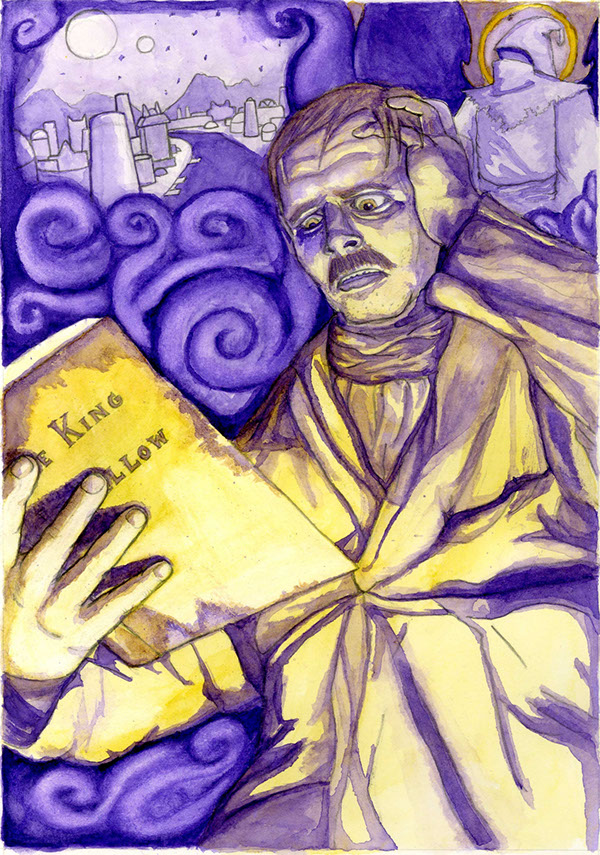
During this first story, we begin to see a major theme that persists throughout the collection, which is the untrustworthiness of the narrators. After all, each narrator is depicted by Chambers as mentally ill, twisted in their delusions. The reader can only guess at what is real and what is not. Castaigne discusses the ways in which he was awakened after reading the book, noting that he used to be lacking in ambition but that now he has found motivation. These statements are then contrasted by comments from other characters, who note how Castaigne has gone from a young man filled with energy to someone who spends all his time listening to the ravings of a madman.
‘The Mask’
Camilla: “You, sir, should unmask.” Stranger: “Indeed?” Cassilda: “Indeed, it’s time. We all have laid aside disguise but you.” Stranger: “I wear no mask.” Camilla: (Terrified, aside to Cassilda.) “No mask? No mask!” — The King in Yellow: Act I—Scene 2d.
The second story in the collection, ‘The Mask,’ is immediately different from ‘The Repairer of Reputations’ in a few distinct ways, the first of which being that our the person who we see the story through, Alec, has not yet read the play The King in Yellow. We are introduced to the three main characters, Alec, Boris, and Genevieve, who have known each other for years. Boris and Genevieve are married and, although they all know that Alec used to have feelings for her, they are close friends who basically do everything together. What Boris does not know is that Alec still has a small crush on Genevieve. This emotion is what the play The King in Yellow will use to break them apart.
The play The King in Yellow in this story is a disrupting force used to depict the destruction of an established norm, rather than an exploration of someone already broken.
‘In the Court of the Dragon’
“Oh Thou who burn’st in heart for those who burn In Hell, whose fires thyself shall feed in turn; How long be crying,—‘Mercy on them, God! Why, who art thou to teach and He to learn?”
The third story in the collection, ‘In the Court of the Dragon,’ follows a man who seeks solace in the church after having read the play The King in Yellow the previous night. Immediately, he notices that something is wrong in the church. The organ, which he describes as usually calming, is instead now sinister and ominous. The organ player is off too; he looks at the narrator with unadulterated hate. The narrator’s focus on the organ player combined with his declining mental state drowns out the preaching in the church, blocking out the very advice that he went there to receive. He leaves, claiming that the church was a waste of time, not knowing that it was the last place he would ever be safe.
In this story, the play The King in Yellow is represented as another disrupting force; it is in control of the organ player and manipulates the narrator into leaving the church. Although ‘In the Court of the Dragon’ is often interpreted as standing in opposition to the church and to religion, the role of the church in this story is as a safe haven where the narrator could have been safe had he stayed and listened to the sermon; it is reflective of Chambers’s views towards Catholicism.
‘The Yellow Sign’
“Let the red dawn surmise What we shall do, When this blue starlight dies And all is through.”
The fourth short story in the collection, ‘The Yellow Sign,’ focuses on Mr. Scott, a French painter living in New York at around the same time as Hildred Castaigne. While working with a model, Tessie, Scott becomes disturbed by the nightwatchman of the church across the street from him. This disturbance coming before he reads the play The King in Yellow and this is the only time in any of the stories when the malign influence of The King In Yellow starts its process before the book is actually read. Tessie claims to have had a dream, which is of the watchman driving a hearse with Mr. Scott in the coffin.
The story goes on for a while with no mention of the play The King In Yellow; Mr. Scott learns more about the watchman while going about his life, until he finds himself walking past the man at night. Listening, he hears the man mutter, again and again, “Have you found the yellow sign, have you found the yellow sign?” Mr. Scott keeps moving, not entertaining him and not doing any research into what this yellow sign may represent. Despite this, the next day Scott finds that Tessie has brought him something, “a clasp of black onyx, on which was inlaid a curious symbol or letter in gold.” This is the yellow sign. More damningly, Tessie says that she had found it on the same day that she had the dream. The next day, Scott finds the play The King In Yellow on his bookshelf while looking for something to read, and everything goes downhill in the same fashion as it had in the other stories.
The yellow sign is notably unique in all the stories. Not only does the play The King in Yellow begin to influence the characters in ‘The Yellow Sign’ before the play is read, but the story focuses on Mr. Scott’s life, building a beautiful picture before suddenly tearing it down, with only the last third of this short story showing the malign influence of the play on its characters.
Influence
Over the years, the concepts brought up in Robert W. Chambers’ The King in Yellow have seeped into many forms of media, most notably influencing H.P. Lovecraft’s exploration into cosmic horror in The Cthulhu Mythos and some of his other works, along with HBO’s True Detective.
When asked about the main draw of the book’s stories, Tommy Giaccone ’26 said that it was Chambers’ influence on Lovecraft and Giaccone’s own interest in gothic literature that brought The King in Yellow to his attention. “My favorite story is ‘In The Court of the Dragon’ because I felt like it portrayed the declining sanity of the organist really well. The short story had a lot of unnerving parts to it.”
Giaccone also had an interesting take on what the play The King in Yellow was meant to represent within the book’s world: the influence that mistakes can have upon a person’s mental state. “If a mistake is made and only you know about it, it can haunt you in a way that some things can’t… I think that that madness is what Chambers was aiming to materialize throughout the book,” Giaccone said.
What allows The King in Yellow to continue being adapted today is its overall insight on human nature and the different interpretations of that nature that it portrays. We will always be driven by knowledge, no matter how dangerous we know that knowledge to be. The characters in The King in Yellow read the play The King in Yellow, even when they are aware of the destruction that it causes; they doom themselves through their curiosity.
Looking at some of the more popular adaptations since the original book, many evolve Chambers’ concepts into new forms that allow for further exploration into the themes of the stories and their ideas of human nature.
Signalis is an indie survival horror video game developed by rose-engine and published by Humble Games. The games’ greatest influence is from The King In Yellow, with the play being a vital item within the game, along with its clear influence on the themes presented in the story of the video game.
The video game begins with no information; you wake up in a pod as Elster, the main character of the story, and you are left to search the wreck of a spaceship you find yourself in. The controls and story are explained through books you find as you explore, directing you, while you gain insight into what brought you to wake up where you did.
You continue on like this, finding the way out of the ship and into the cold world outside. At this point, you feel as if you are at the end of the hand-holding; the title credits begin, and you make your way through a seemingly endless landscape of snow.
You walk, you have nothing else to do. Trudging through the harsh environment, you eventually find a gate, past which is a hole lined with a descending spiral staircase. It feels completely out of place in the otherwise barren world.
It is at this point where the game shifts into something stranger; you go down, and there’s another hole. This time, the hole is not large enough to hold stairs. Instead, the hole is simply a black spot in a wall just big enough to crawl through, with no guarantee that you will be able to get out. Yet again, there is nowhere else to go, so yet again, you go deeper.
You emerge into a room that seems to be a small bedroom, with a bookshelf above the desk, and a seemingly broken radio and computer. But what draws your attention is the book on the desk that seems a bit brighter.
“An ancient-looking tome is lying on the table. It feels like it is calling to me…”
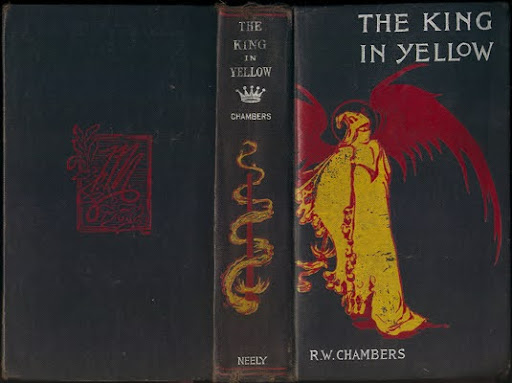
You pick up the book and read what is printed on the cover: The King in Yellow. The book has six seals on it, but the simple action of picking it up triggers a cutscene that brings you to the real start of the game.
Signalis is a story about reality tearing at the seams and the decision not to turn back; you come across items bringing you to another world if you touch them, only to come to with something straight out of what you thought was a hallucination.
While the video game Signalis takes inspiration from many different works of media, the overall story of the game is driven by the same idea that Chambers’ The King In Yellow is driven by: the desire to go deeper. This is represented in the way you progress through the video game by literally going deeper through a series of holes, or through the way that every time you come across The King in Yellow in the video game, more seals are broken, which brings you closer and closer to madness.
Malevolent is a horror/mystery podcast telling the story of Arthur Lester, an investigator who finds himself with a disembodied voice in his head after opening a mysterious book. While this on its own is strange enough, his situation is made dire by the voice having stolen his sight. Immediately, the parallels to Chambers’ The King in Yellow are made clear: Arthur and the voice, which is later named Jon, are forced to work together to find out what happened to them and try to separate themselves.
On their journey, they hear about The King in Yellow, in this story being portrayed as a being from another plane of reality, known as the Dreamlands, where he rules over the kingdom of Carcosa. Throughout the story, Jon (the voice) is talked about with reverence as a creature with the power to drive people mad and control them through their broken state.
As Arthur goes further into a world he has no understanding of, his mental state begins to decline, with carefully built-up walls crumbling, as his situation becomes worse. While Malevolent directly borrows some of the ideas and names from Chambers’ The King in Yellow, it does this to represent the same themes that the original story develops. Each step taken forward is a step where you should have turned back, followed by the realization that you do not have a choice anymore.
Searching For a World That Doesn’t Exist
I found the video Searching For a World That Doesn’t Exist, like many people did, without having heard anything about it before. Later on, I would start to hear people calling it the best YouTube video of all time, and I watched it spark a resurgence of interest in Robert W. Chambers’ The King in Yellow.
In the YouTube video, the story starts out innocently enough; Wifies explains that a Minecraft Youtuber found a book with something interesting inside in his world, an odd occurrence because he didn’t put it there. In Minecraft, unless you are in multiplayer, you are the only one who can build anything that is not automatically generated. Avery, our main character at this point, mentions that it might have been made by the last owner of the computer, but he doesn’t dwell on it, opening the book and reading a cryptic message.
It’s gibberish, warnings coupled with a code that Avery does not even attempt to solve; he ends his video, but Wifies doesn’t leave it at that. After solving the code, Avery finds another video hidden in a google drive that switches us to our true main character, a player who will later be revealed to be named D3rlord3. Unlike Avery, D3rlord3 isn’t the type to run away from a challenge. He begins in the same room as Avery, but without the book, mining into a cave that leads to a strange passage. Alas, deeper they go.
There is something captivating about the ways in which Wifies tells the story of D3rlord3 in the video, what could easily be interpreted as a guy messing around in Minecraft somehow shifted into a genuinely enticing and at times frightening exploration into an ever stranger world. He makes his way further into what is clearly not something naturally generated by the game. There are riddles behind each turn, and nothing is promised at the end of this path, nothing except the satisfaction of having solved this massive puzzle. D3rlord3 gets through it almost effortlessly, before reaching the end, his grand prize…and it’s not anything that he would have wanted.
I won’t spoil the end of the story, but the video is amazing, the journey that it takes you on cannot be explained easily. The most important part of all this is the question of ‘why?’ Why did this video entice people as it did, and what made it so special? Aside from the algorithm and its coverage by big creators, I think the reason that this story moved so many people can be found in the original The King In Yellow.
Conclusion
The stories in Robert W. Chambers’ The King in Yellow followed by those stories adapted from it, all tell us nothing. We are never told what the people are reading. The book is sealed shut for Elster until the end of the video game Signalis, and although the Malevolent podcast recently concluded, its creator Harlan Guthrie has already said that the story will go on following something else.
We want to know what’s inside the play The King in Yellow, even if we do not want to read it ourselves. We want to know what it was that broke these people. Searching For a World That Doesn’t Exist captures that feeling in a time where media often feels the need to explain itself, and it does it so unapologetically. So people will theorize, connecting dots that may or may not paint a picture, but there will never be any confirmation of their ideas.
The people consuming this media become the readers of The King In Yellow, and we are lucky enough to have whatever causes the breaking point hidden from sight.
If you are now inspired to read Robert W. Chambers’ The King in Yellow, the best modern paperback edition of the book is available from Lanternfish Press.
The first four stories in The King in Yellow are linked by the device of a play of the same name that burdens all who read it with knowledge that makes them insane. The book as a whole consists of nine short stories and a collection of poems. The short stories follow victims of the book, some being loosely connected but still mostly self-contained. Words from the actual play are never given to the reader. Instead the reader is given snippets of a plot that is difficult to piece together, although it is very clear that the play is about the actual king in yellow.