

“Many think that Cubism is an art of transition, an experiment which is to bring ulterior results. Those who think that way have not understood it. Cubism is not either a seed or a fetus, but an art dealing primarily with forms, and when a form is realized it is there to live its own life.” – Pablo Picasso (1923)
For centuries, traditional Western paintings were illusions – three-dimensional objects and scenes rendered in paint on a flat surface. Typical paintings were grounded in realism. The rules of realism were so ingrained into artists’ brains that works of art had centered on accuracy rather than on creating a unique art form. Objects were depicted from only one viewpoint, following strict rules of depth, proportion, and perspective, in order to create the most realistic looking image possible.
In 1907, that all changed with one radical art movement that completely shifted the course of modern art: Cubism.
Cubism was revolutionary for the art world – it encouraged artists to forgo the traditional methods of perspective and realism. Cubist artists alternatively depicted subjects from multiple angles at once, creating fragmented and geometric works of art. Cubism introduced a completely new way of portraying perspective to artists and their viewers.
Cubism first emerged in early 20th-century France, largely influenced by the works of Paul Cézanne, a French Post-Impressionist painter, followed by the artistic partnership between Pablo Picasso and George Braque. Shifting from Impressionism to Post-Impressionism, Cézanne depicts multiple different viewpoints in one painting, foreshadowing the beginnings of Cubism.
Cézanne believed that nature could be broken down into simple geometric forms, such as cylinders, cones, and spheres. In his famous paintings of Mont Sainte-Victoire, a mountain located in the Provence-Alpes-Côte d’Azur region of southern France, Cézanne strays away from realism, simplifying the mountain into solid blocks of color and shape, focusing on the structure rather than on the details. Cézanne created paintings of this scenery dozens of times, painting from slightly different viewpoints every time. In many of these versions, the mountains and trees have been reduced into geometric planes rather than depicted in detailed realism. While he did not directly create Cubism, by showing how these scenes could be interpreted rather than merely copied realistically, Cézanne created a concept that would later become the inspiration for Cubism.
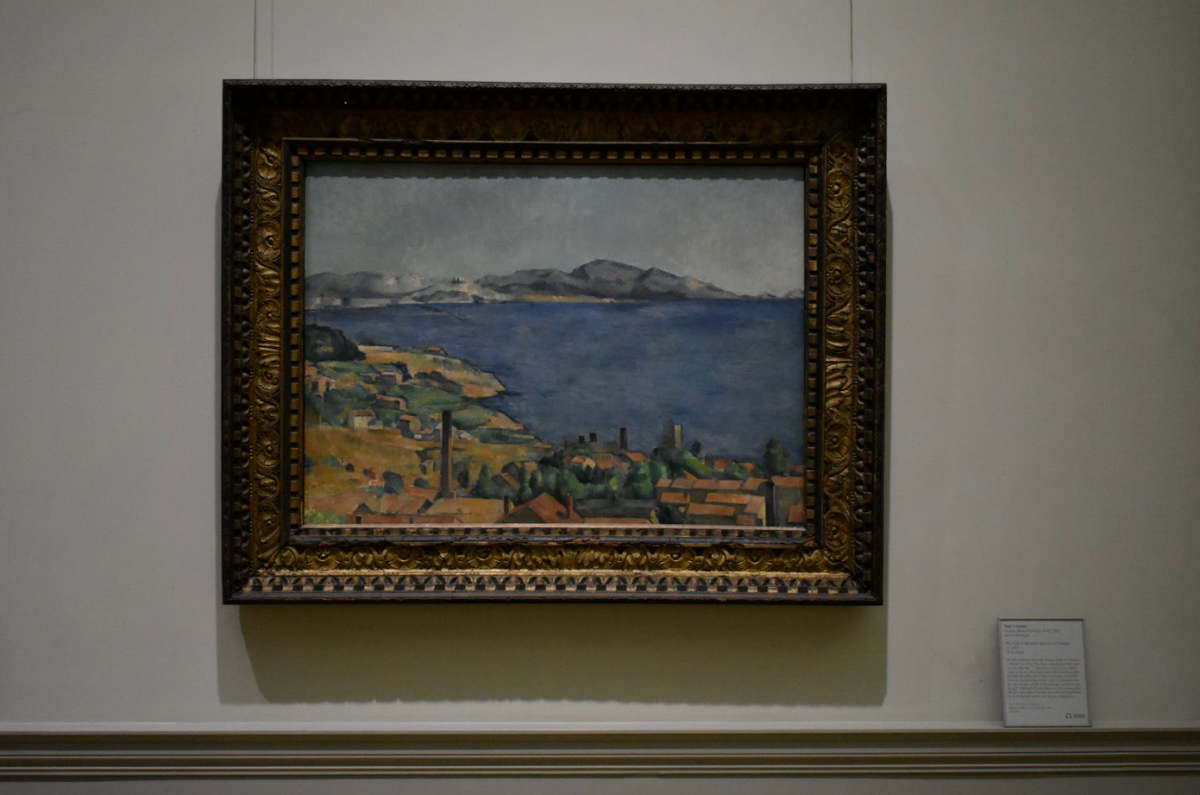
Cézanne’s approach is exactly why Pablo Picasso later famously praised him: “Cézanne is my one and only master…He was like the father of us all.” This influence was evident in Picasso’s work, especially when Picasso started to go beyond Cézanne’s structural simplifications. This shift became one of the defining characteristics of Cubism. Objects were no longer treated as one solid form. They were instead shown as complex structures, taken apart, and reconstructed piece-by-piece. Cézanne’s approach laid the groundwork, but Picasso and George Braque took it further, creating an entirely new art movement that would forever change the course of Western art.
Pablo Picasso was a Spanish artist, widely known as one of the most influential artists of the 20th century. Born in Málaga, Spain, in 1881, Picasso showed artistic talent at a young age: his first word being “piz,” a shortened version of lápiz, which is the Spanish word for pencil. Picasso’s father was a painter and art professor who trained Picasso at a young age. At just the age of 13, Picasso was so talented that his father felt his son had surpassed him artistically – and so retired. Picasso soon after began receiving formal artistic training. He attended the School of Fine Arts and the Royal Academy of San Fernando, art schools in Barcelona and Madrid, where he quickly gained attention for his ability to paint realistic portraits and detailed figures. But Picasso was never satisfied with following traditional techniques, and as he grew older, he became more interested in experimentation and using art as expression rather than just accuracy of depiction. While Picasso is best known for co-founding Cubism, he also experimented with many different styles such as those paintings of his Rose Period and Blue Period.
In the early 1900s, Picasso moved to Paris, which at the time was the center of the art world. There, he began to develop and explore his own artistic identity. His work went through several major stages: the Blue Period (1901-1904 C.E.), during which he painted gloomy and emotional scenes using mostly blue tones, and the Rose Period (1904-1906 C.E.),, during which he painted more playful scenes with warmer colors.
In 1907, Picasso created Les Demoiselles d’Avignon, portraying five nude women in a brothel. Inspired by African art and masks, Picasso distorted the figures into sharp, angular forms. This painting left the art world shocked, as Picasso had abandoned realism to move toward a more abstract approach. and is now considered one of the most important to the creation of Cubism. This creation marked a major turning point in art as Picasso had abandoned realism to move towards a new, more abstract, and fragmented approach to art.
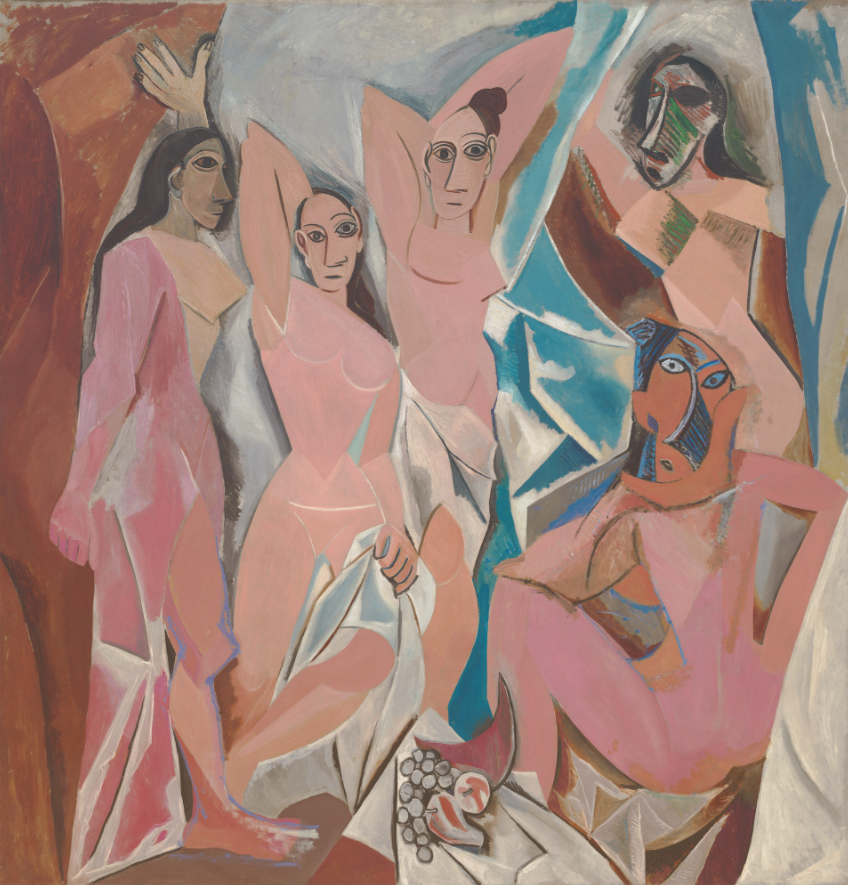
Along the way, Picasso formed a close artistic partnership with French painter George Braque. Together, the pair developed Cubism, an art movement that would completely change the direction of modern art.
Born in 1882 in Argenteuil, France, George Braque trained as a painter and later became a prominent figure in the Parisian art scene. Originally influenced by Impressionism and Fauvism early in his career, Braque dramatically changed his artistic style after seeing the work of Cézanne. Braque then began experimenting with simplifying objects into geometric shapes, and in 1907, he met Pablo Picasso. From there, the two challenged traditional Western art and laid the foundation for Cubism. In fact, Braque’s 1908 painting Houses in Estaque is how the name “Cubism” came to be: French art critic Louis Vauxcelles described his painting as “cubist oddities” due to its geometric and fragmented structure.
Following the breakthrough with Les Demoiselles d’Avignon, Picasso and Braque entered a new phase of Cubism – Analytical Cubism. Analytical Cubism (1908-1912) featured painted objects as broken subtle, interlocking planes, with muted tones of browns and greys. This period emphasized structure over color, with the goal not being to depict multiple perspectives. The aim was to break down and reassemble the object in how the mind perceives it, rather than how the eye sees it. The muted palette of Analytical Cubism allowed for viewers to focus entirely on the form and structure of the paintings.
Leonard Lauder (1933-2025) was an American businessman, philanthropist, and an alumnus of the Bronx High School of Science, Class of 1950. He was the son of Estée Lauder, the founder of Estée Lauder Companies. While he helped expand his mother’s company into a global brand, Leonard Lauder was a respected art philanthropist and collector, with a deep passion for Cubism.
In 2013, he donated his collection of Cubist pieces to the Metropolitan Museum of Art, with the gift being valued at over one billion dollars. The collection included works by major Cubist artists, such as Pablo Picasso, George Braque, Juan Gris, and Fernand Léger.
To honor Leonard Lauder’s legacy and his landmark gift of Cubist masterpieces, curators at the Metropolitan Museum of Art have made a three-room installation in the Modern Art galleries, which highlight almost 40 works by Georges Braque, Juan Gris, Fernand Léger, and Pablo Picasso.
Displayed in The Leonard A. Lauder Cubist Collection at The Metropolitan Museum of Art, ‘Nude in an Armchair’ and ‘Woman with a Book,’ both by Picasso, embody the essence of Analytical Cubism. In these works, the human figure is dissected into angular forms with the limbs, body, and focal features completely reduced to geometric shapes. The forms overlap and intersect with each other, creating a sense of depth. The colors are dull, in order to emphasize interlocking planes that catch the light and shadow differently at each angle. The viewer must actively engage with each painting and piece together the shapes, in order to reconstruct the figure in their mind.
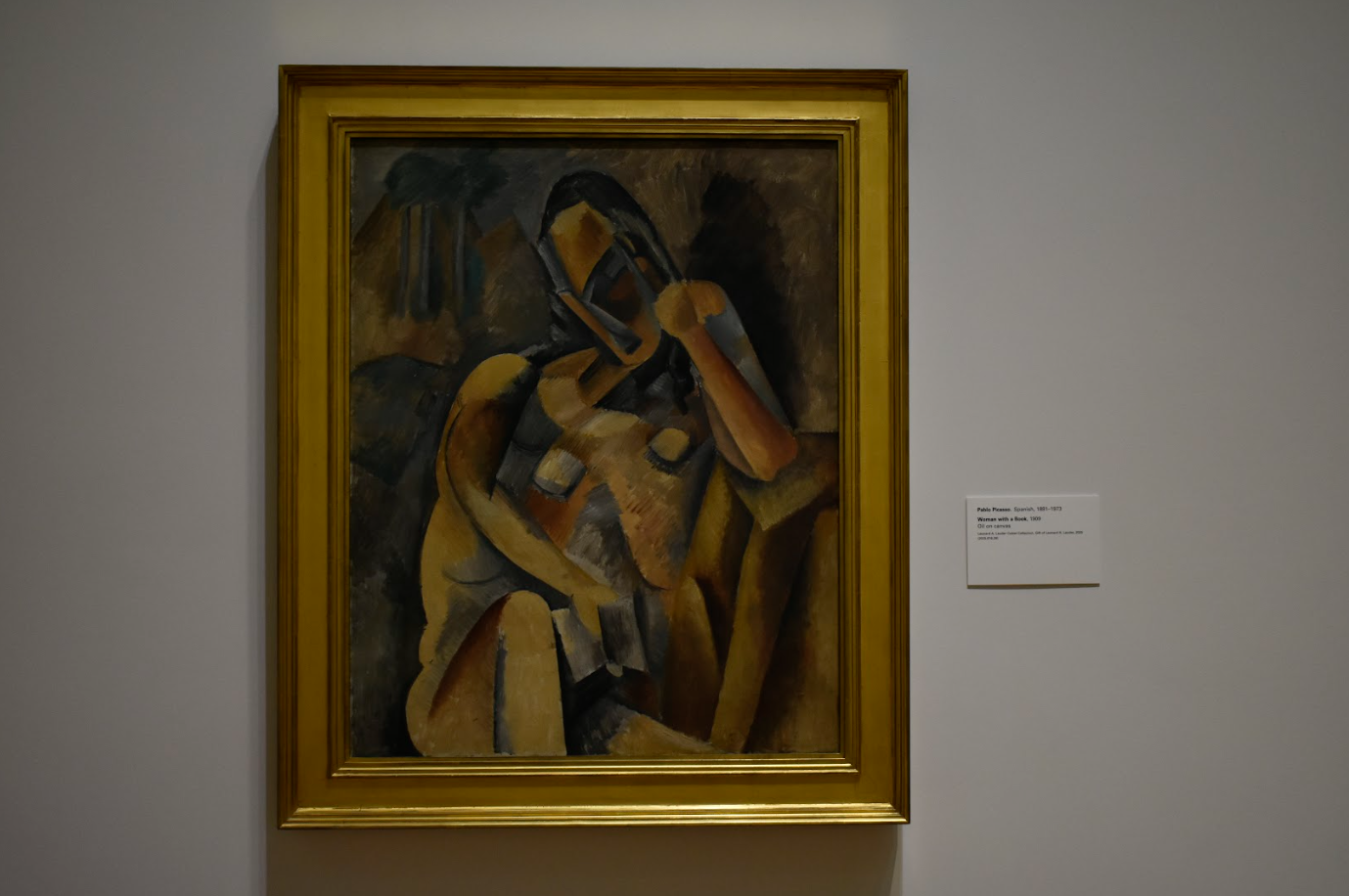
(Namira Malek )
Similarly, Braque’s ‘Trees at L’Estaque’ and ‘The Terrace at the Hotel Histral’ take apart landscapes, minimizing them to a lattice of planes and angles. Every branch, every roof, every mountain slope is a structural element, explaining the geometry of the scene rather than just its appearance. The earthy tones of the landscapes are accentuated by the muted tones and sharp angles of the rooftops and branches. The careful arrangement of the colors and angles guides the viewer’s eyes through the entire composition, creating a sense of harmony amidst abstraction. The paintings perfectly reflect Cézanne’s concept that nature can be understood through structure, rather than mere imitation.

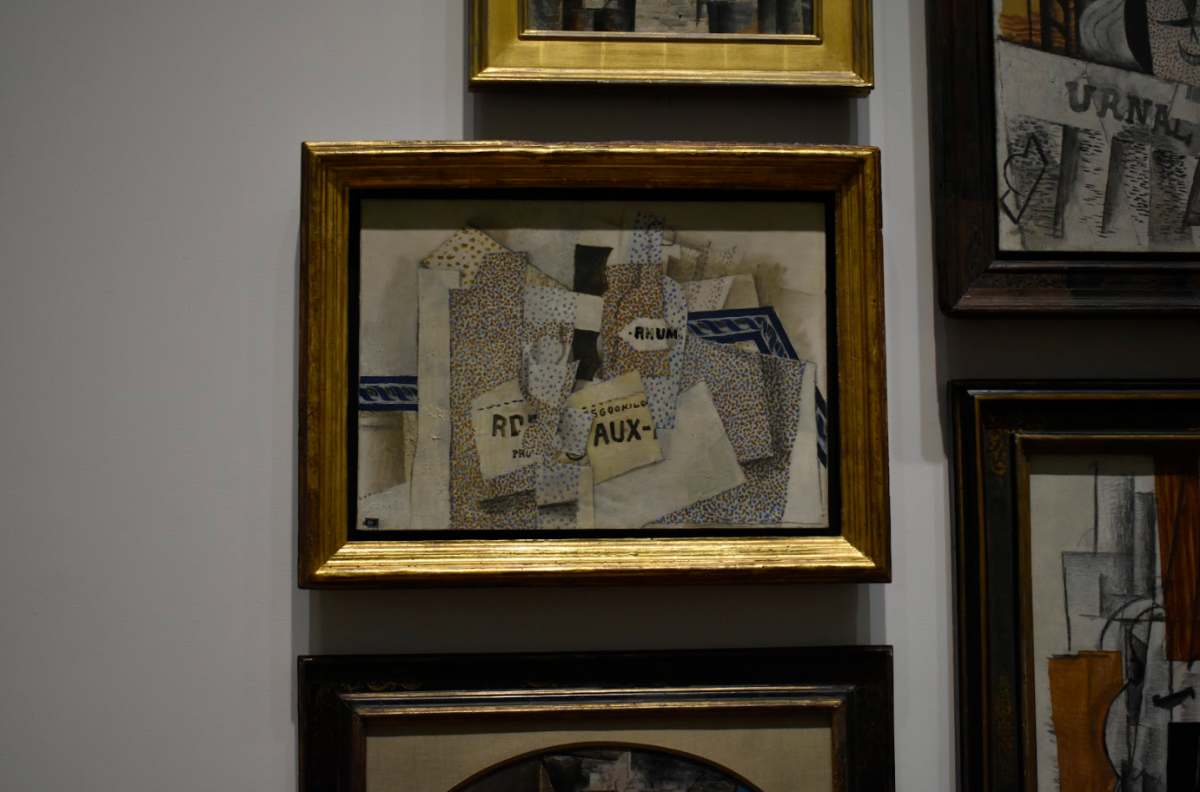
Nearing the end of 1912, Picasso and Braque moved beyond Analytical Cubism to Synthetic Cubism (1912-1919 C.E.). This phase was almost the opposite of Analytical Cubism: the goal of Analytical Cubists was to break down an object by different viewpoints, whereas the goal of Synthetic Cubists aimed to completely flatten the images and make them two-dimensional in order to build up subjects with different items and parts. Objects were simplified into bolder shapes and brighter colors, and many Cubists started to incorporate physical elements like newspaper clippings, cloth, and sheet music.
In Braque’s ‘Bottle of Rum,’ the shadows, the texture of the paper, and the ragged edges show the distinct outline of the bottle. The outline contrasts with the shapes and subtle paper textures of the scattered labels. The piece feels both familiar and unusual, as everyday objects are made into a distinct visual puzzle.
Juan Gris’ ‘Still Life with Checked Tablecloth (1915)’ highlights the infatuation with pattern and structure during the Synthetic Cubism period. The sharp edges of the checkered tablecloth cut through the seemingly flattened fruit and glasses. Meanwhile, Gris’ use of brighter colors juxtaposes with the darker, muted background in order to construct a checkered pattern with a cohesive visual rhythm. Sharp shapes and angles merge harmoniously with the rounder shapes and wavy angles.
The integration of newspaper clippings and sheet music was more than decorative. These inclusions directly incorporated contemporary culture into the art. In Braque’s ‘The Musician’s Table,’ fragments of sheet music are carefully laid alongside geometric shapes meant to represent musical instruments and everyday objects. These collaged elements invite the viewer to interact with the work and to take note of both the visual composition and cultural references woven into the piece.
While Cubism began to lose its momentum after World War I, its influence never truly disappeared in the art world. What started as a radical art movement transformed into a foundation and an inspiration for modern art. Even today, elements of Cubism can be seen in contemporary art, graphic design, architecture, and digital media. Cubism changed the way people think about and view art, as it proved that art does not have to imitate perfectly in order to be meaningful. Cubism did more than just shift artistic technique; it permanently changed the direction of modern art and continues to shape new pieces today.
To honor Leonard Lauder’s legacy and his landmark gift of Cubist masterpieces, curators at the Metropolitan Museum of Art have made a three-room installation in the Modern Art galleries, which highlight almost 40 works by Georges Braque, Juan Gris, Fernand Léger, and Pablo Picasso.