

There is an essay buried in the pages of Camera Work, No. 36 that contains, to me, one of the most simple yet compelling descriptions of New York City ever written. “Now, to me,” Alvin Langdon Coburn, a pioneer photographer in his own right, wrote, “New York is a vision that rises out of the sea as I come up the Harbor on my Atlantic liner, and which glimmers for a while in the sun for the first of my stay amidst its pinnacles, but which vanishes, but for fragmentary glimpses, as I become one of the grey creatures that crawl about like ants at the bottom of its gloomy caverns.” Coburn saw the city as something alive and perpetually changing, only able to be captured if you’re quick enough to pull out your camera and photograph it.
That passage gives its name to the Robert Mann Gallery’s current exhibition, Fragmentary Glimpses: Alfred Stieglitz and David Vestal in New York, on view through Saturday, April 11th, 2026. Tucked inside a large building at 508 West 26th Street, between 10th and 11th Avenues, in Suite 9F in the Chelsea Art District of Manhattan, don’t feel discouraged by the unconventional entrance to the Robert Mann Gallery. At the outside of the exhibit, expect to be greeted by an antique manual elevator, an array of rentable studios, and finally, a small, warm-tone room lined with no more than 30 photos. The show pairs a rare, near-complete collection of photographs from Stieglitz’s own Camera Work No. 36 — the landmark October 1911 issue of Alfred Stieglitz’s quarterly photography magazine — with a selection of post World War II street photographs by David Vestal, a lesser-known but still impactful figure in photography. The result is one of the more unassuming yet thoughtful exhibitions currently on view in the city.
“We knew we wanted to focus on this work,” said Daniel Menzo, a gallery curator and Art History & Criticism PhD holder with whom I had the pleasure of meeting. “It’s a very rare collection from the original Camera Work publication. His work has been getting some recent resurgence and attention from other institutions in the city, and we wanted to be part of that conversation.” The question then became one of balance — who could speak alongside Stieglitz without being drowned out by him? The answer, he explained, was Vestal. “Formally, in terms of light and shadow and composition, his work seemed to really echo Stieglitz’s well. They have a similar sensibility. These images capture moments of the city in a way that some other photographers might focus more on crowds or strictly architecture without the surrounding environment.” That sensibility — atmospheric, contemplative, resistant to the overtly political — is what ties these two photographers together across a half-century’s distance.
The Stieglitz section features Camera Work No. 36, an issue part of the magazine Camera Work produced from 1903 to 1917. The publication typically featured the work of other photographers and, occasionally, reproductions of modern paintings — such as Picasso drawings and Rodin sketches — alongside lengthy critical essays and exhibition reviews. This issue was the rare occasion when Stieglitz turned the lens entirely on himself. The gallery pulled the photographs from the original pages and displayed them in the order that they would have originally appeared in the magazine — interspersed with text, turning from page to page, exactly as Stieglitz intended.
‘The Terminal (1892)’ is perhaps the most historically weighted image in the show. It depicts a New York street scene of horse-drawn trolley cars in winter, with steam rising from the horses’ flanks, and the old storefronts of Harlem visible in the background. Menzo noted that this was photographed at a pivotal moment for the city— the Blizzard of 1888 had effectively paralyzed the city’s horse-drawn transit system and forced the city to push through the building of the now iconic New York City subway. “Once you know that,” Menzo remarked, “everything surrounding that moment and that time period — wow, that’s such a cool image. It means a lot more when you know it.” What looks like a simple street scene becomes a photograph of a city on the cusp of an industrial revolution.
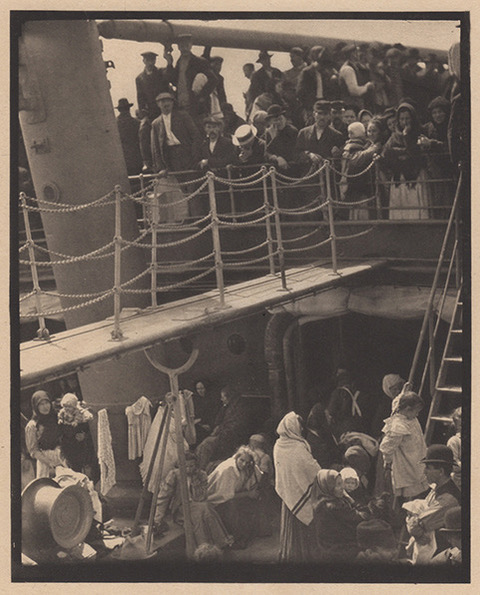
‘Spring Showers (1900)’ and ‘The Steerage (1907)’ are equally rich. The former — all mist, bare trees, and slick pavement — feels like it could have been taken yesterday in Riverside Park. The curator pointed to this persistence as one of the show’s themes: “Even in this very real picture, a few guys the other week stopped by and said, ‘I feel like I see that today, like when I ride the ferry. It has that similar feel.’ A few of them even recognized the streets.” The Steerage, meanwhile, remains as audacious as ever, its composition dividing the frame into near-abstract planes of humanity and steel.
One of the show’s revelations is a photograph that the gallery’s curators believe is historically significant, an early image of an airplane flying in the New York area, taken around 1910. “We’re pretty convinced that this might be a pretty important historical flight,” Menzo said. “At the time, there would have only been a handful of flights in the area.” The Wright Brothers had made their first flight just seven years earlier, and the skies over New York were still largely uncharted. Looking at the image, knowing that this photo depicts one of the first moments of human flight, it becomes truly mind-boggling.
Stieglitz was famously interested in the atmospheric and the ethereal. His later series of cloud photographs, which he called ‘Equivalents,’ would pursue this obsession to its logical conclusion. That sensibility is already visible in these earlier New York photographs, in the ways in which steam, smoke, and winter light blur the city’s edges into something almost painterly. He was equally drawn to the contrast between old and new: one image in the exhibit captures a row of 19th-century mansions along what was then Park Avenue, with the new Vanderbilt Hotel — still standing today — rising like a colossus in the background. “He was really interested in this sort of juxtaposition,” the curator noted, wondering aloud what Stieglitz might photograph were he alive today. “All those supertall buildings at the south end of Central Park — they literally reach into the clouds. I think that would have absolutely interested him. And Hudson Yards, too — that sort of new shine, the movable mechanical building.”

The David Vestal portion of the exhibit is quieter. Vestal’s photographs pose subtle differences in style and mood. The Stieglitz and Vestal pieces are differentiated by their frames — the Stieglitz works are ensconced in an orangish-gold frame with red undertones, matching the yellow hue of the photographs. Vestal’s photographs appear more slick in a solid black frame, underlining the black and white contrast that Vestal used in his photos.
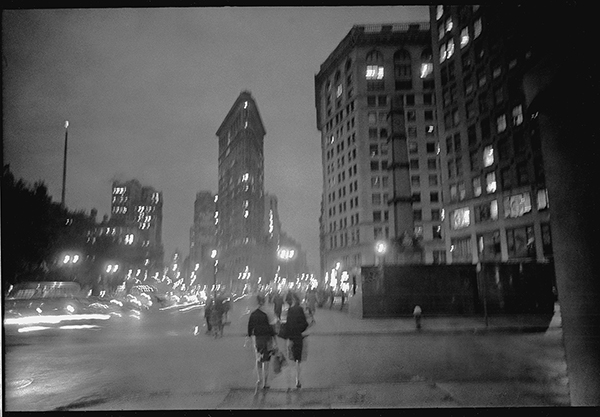
David Vestal arrived in New York in the late 1940s and trained as a painter. He found his way into photography through the Photo League — the celebrated collective known for its socially engaged documentary work. But Vestal, as the curator was careful to note, did not intend his work to be political. “He was part of the Photo League, which was more known for photographing minority groups,” Menzo said. “But he didn’t really do that. He was focused on form and composition.” Where many of his League contemporaries were producing photographic essays with explicit social arguments, Vestal preferred to let the city speak for itself. His photographs are not neutral — no photograph is — but they are images that, as the curator put it, “take in the scene for what it is and allow the viewer to arrive at it in their own way.”
What they arrive at is a New York of wet streets, fire escapes, uneven pavement, and figures caught mid-motion in the dark. Vestal shot at night, in rain, in snow, and on foot — with some degree of camera shake that lends the images an unsettling quality, estranging them from how we typically perceive the world. One photograph of fireworks — the curator’s personal favorite in the show — is almost paradoxical. Though capturing an explosion of light and sound, it feels utterly still. “It’s simultaneously so quiet,” Menzo said, “and just this perfect capture of a burst of energy. When you go to watch fireworks, you know how loud it can be. And it feels so quiet and peaceful here. I just love this image.”
The exhibit is installed in order to celebrate two prominent photographers along with the city that they, and we, love. By looking at Stieglitz’s developing turn of the twentieth century city and Vestal’s postwar city, you can catch fragmentary glimpses of moments pulled from the flux before they vanished. I hope you can recognize that their city and ours are one and the same — this is the show’s argument and its triumph. The photographic prints from Camera Work No. 36 on display are invaluable, and they cannot be understood in a digital format. Each printed photograph is worth more than a first glance, and I urge anyone who visits the exhibit to later do some research on the context behind each photograph.
In my walk-through the exhibit with Daniel Menzo, he showed me the gallery’s copy of the original Camera Work No. 36 magazine. It is in remarkable condition for something more than a century old — a thin, beautiful object that once arrived in subscribers’ mailboxes as something radical and new, containing within it photographs that were then arguing, urgently, that the camera was an art form that could produce photographs that were equal to those produced by the painter’s brush.
Alfred Stieglitz won that debate about photography, creating a new path in the art world. As I walk around the city in March 2026 after seeing the exhibit, I cannot help but see the city with new eyes. Though I am no artist, I too hope to catch the city before it disappears.
“Now, to me,” Alvin Langdon Coburn, a pioneer photographer in his own right, wrote, “New York is a vision that rises out of the sea as I come up the Harbor on my Atlantic liner, and which glimmers for a while in the sun for the first of my stay amidst its pinnacles, but which vanishes, but for fragmentary glimpses, as I become one of the grey creatures that crawl about like ants at the bottom of its gloomy caverns.”