

The first time that I went to the circus was on my fourteenth birthday. The famous Cirque du Soleil had a show nearby that promised to bring the audience on a “surreal escape to an imaginary Mexico.” Even at the age of fourteen, the circus seemed silly and childish to me, and I was sure that I would be bored within minutes.
But then the lights dimmed, a hush fell over the audience, and a set of drums began playing, filling the cavernous space of the circus as the first performers emerged, their bright costumes coming to life as they somersaulted through the air.
Alexander “Sandy” Calder (1898-1976), the American sculptor best known for his mobiles, loved the circus. As a young man, he was employed as an illustrator for the National Police Gazette and was dispatched to cover the Ringling Bros. and Barnum & Bailey Circus at New York’s Madison Square Garden. The Ringling Bros. and Barnum & Bailey Circus, which exists to this day, is an American traveling circus company that advertises themselves as ‘The Greatest Show on Earth.’ Calder went on to spend two years with this circus as it performed in Sarasota, Florida.
“I love the space of the circus,” he said in 1964. “I made some drawings of nothing but the tent. The whole thing – the vast space – I’ve always loved it.” The acrobats, the theatrics, the light and motion, and even the rigging was infinitely fascinating to him, and fueled his imagination.
Calder had grown up around art. Born in 1898, he was the second child of artist parents, His father was a sculptor and his mother was a painter. His father, Alexander Stirling Calder, received public commissions, which allowed the family to traverse the country throughout Calder’s childhood. His parents encouraged him to create, and from the age of 8, Alexander Calder had a dedicated workshop. He presented his first sculptures on Christmas of 1909 – a small dog and duck cut from a brass sheet and bent into formation. Even at this age, his ability to dexterously handle materials was apparent.
After high school, Calder first enrolled at the Stevens Institute of Technology, and in 1923 he enrolled in classes at the Art Students League in New York. It was shortly thereafter that Calder committed to becoming an artist, and around the time when he took his first job related to the circus at the National Police Gazette.
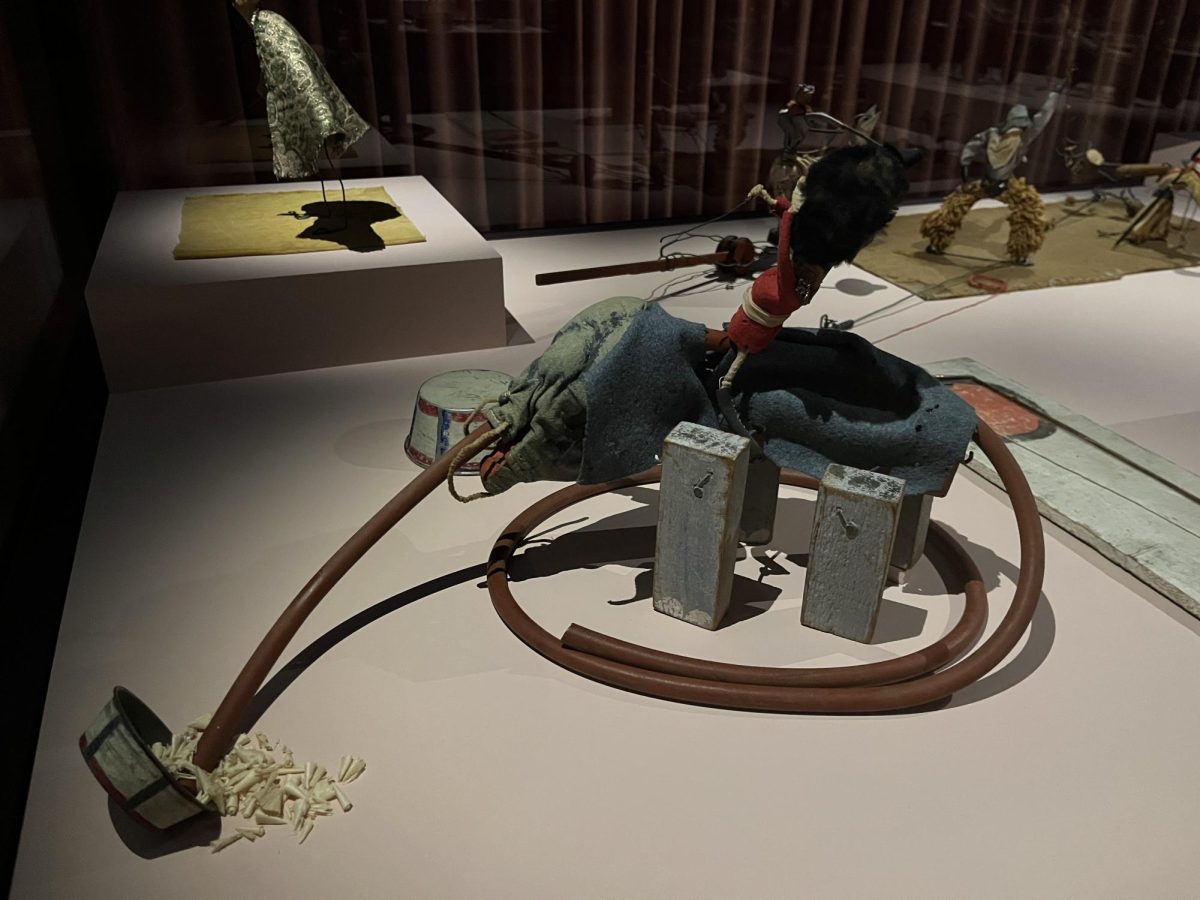
The circus became a lifelong interest of Calder’s, and after moving to Paris in 1926, he began creating his own. The Cirque Calder, or Calder’s Circus, was like any other circus in that its assemblage included performers, animals, and props. Over the years that he spent building it, Calder would expand the troupe, including horses and chariots, belly dancers and sword swallowers, aerialists and contortionists, a thick-maned lion, and a ringmaster. However, unlike other circuses, his sculptures were created with wire, cork, wood, fabric, and other miscellaneous materials. And unlike other works of art during this time, the Cirque Calder was unique in that it predated performance art by forty years, and thus garnered both attention and an audience very quickly.
Calder’s Circus is now 100 years old, and in order to celebrate this centennial anniversary, the Whitney Museum of American Art in lower Manhattan has mounted an exhibition, High Wire: Calder’s Circus at 100, currently on view through Monday March 9th, 2026. The exhibition is co-curated by Jennie Goldstein, Marion Boulton “Kippy” Stroud Curator of the Collection, and Roxanne Smith, Jennifer Rubio Assistant Curator of the Collection. Calder’s Circus was purchased by the Whitney in 1983, after a successful fundraising campaign. Originally, it had been lent as a long-term loan from the artist himself to the Whitney in 1970. After Calder’s death in 1976, the executors of his estate had to sell the Circus in order to settle taxes owed by the estate.
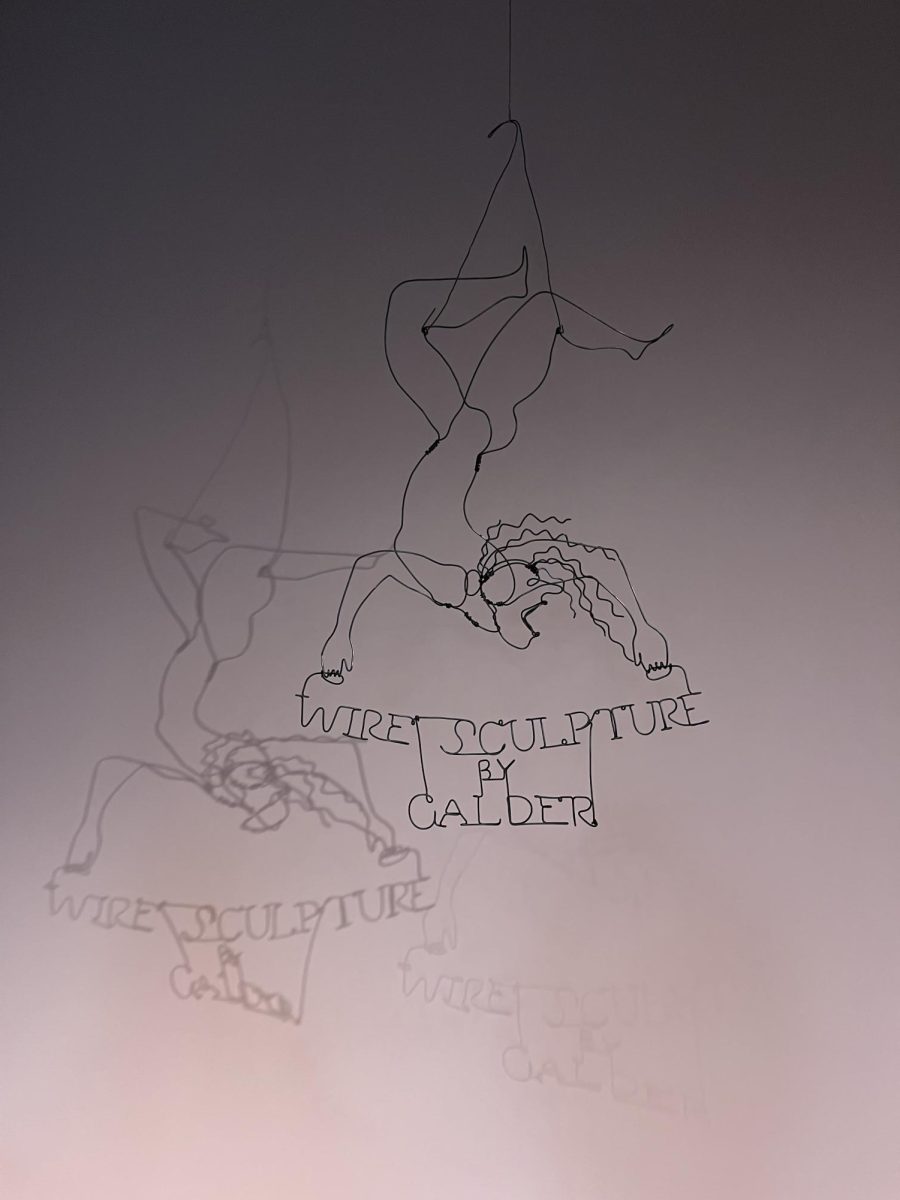
In 1928, Calder was given his first solo gallery show at the Weyhe Gallery in New York. Before this, he would pack his circus into large trunks and perform at small gatherings in art spaces and even at people’s homes, which he would advertise in advance with flyers and invitations of his own design. These events were impromptu and informal – visitors sometimes had to bring their own seating, while Calder occasionally served peanuts. He followed no strict script, and behind him, his wife Louisa was in charge of the musical soundtrack, playing records on a Victrola. There were only around a few dozen people in the audience for his first shows that were hosted at his studio, a hotel room on the Rue Daguerre in the 14th arrondissement of Paris, France.
Five years into the project, Calder’s creations were enough to fill five large suitcases. As he traveled and performed, his audience grew, with acclaimed and experimental artists such as Piet Mondrian, Marcel Duchamp, Joan Miró, Jean Arp, and Isamu Noguchi attending his two-hour performances.
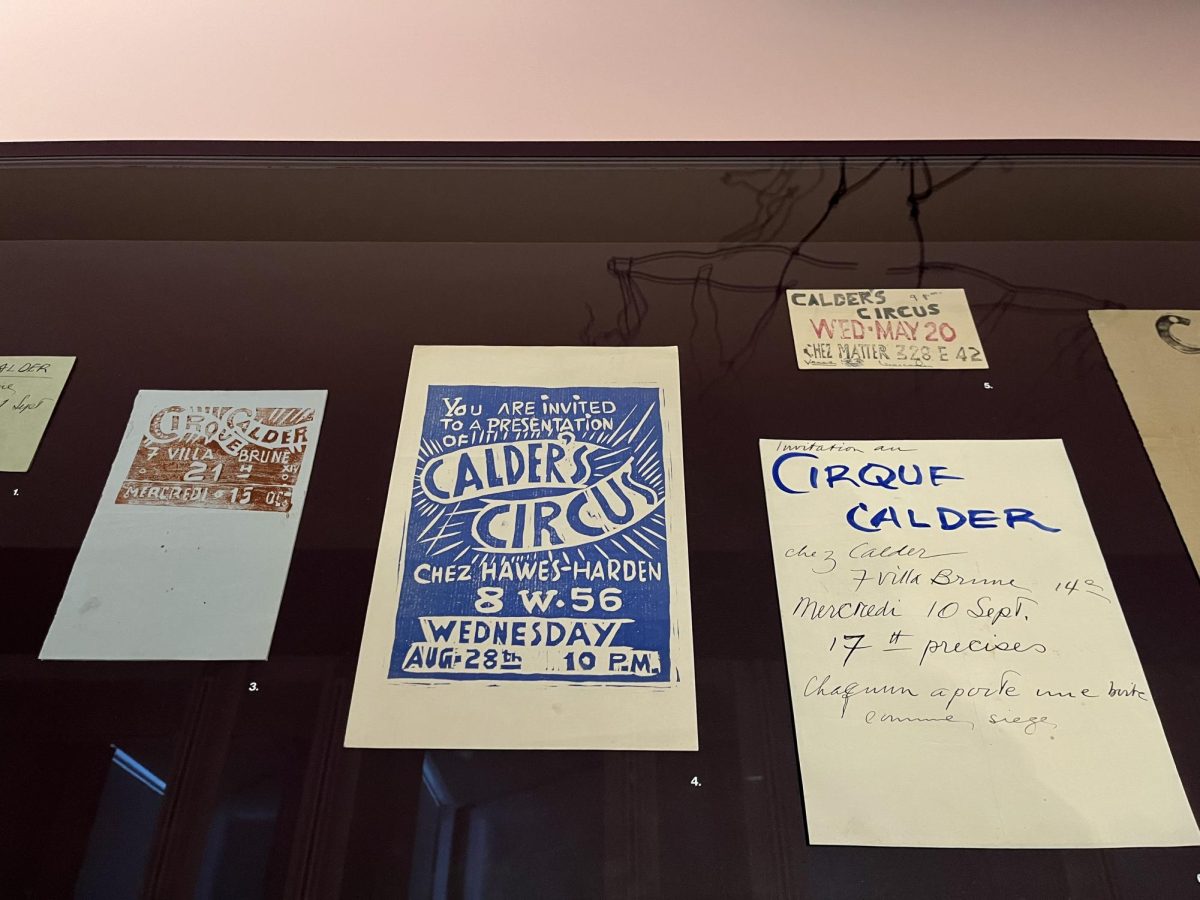
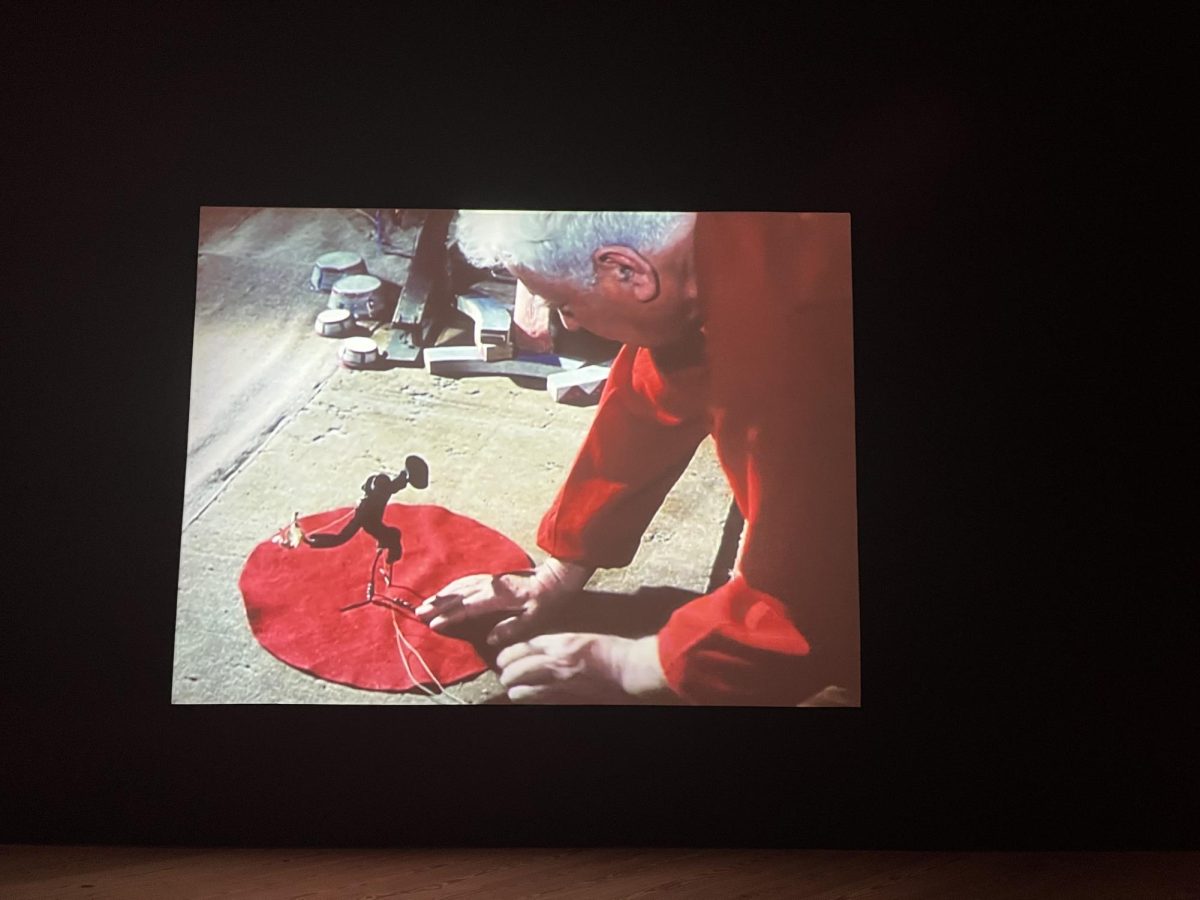
Some film footage of Calder performing these shows survives, although none survives from his early period. One documentary, filmed by Franco-Portuguese director Carlos Vilardebó, captures the artist’s final Circus activation in 1961, and it is included in the Whitney’s High Wire: Calder’s Circus at 100 exhibit. Projected on a wall, the viewer sees an older Calder maneuvering his acts on a stone floor for a small audience.
This was my favorite part of the exhibit. Behind the display vitrines at the Whitney, all of the circus animals seemed lonely and cold, sitting lifeless on display, when they in fact should be moving and dancing on stage. They were beautiful and delicate, but I yearned to see them in motion, and to see them come to life. The video did exactly that. It was the last part of the exhibit, and a handful of museum-goers had settled into the benches around the projection screen to watch it, with rapt attention.
It is the video that brings the whole exhibit together and breathes life into it. The first time that I watched it, I was overwhelmed by the novelty of it all – the sculptures that I had seen in the vitrines were more complex than I had originally thought, and they moved in ways that I didn’t think were possible. Calder acts as the ringmaster, his lively voice resounding through the room as he announces each act. I frantically took notes as I was watching for this article, trying to remember every trick that Calder performed. There was the cowboy on his horse that with every gallop took his hat off his head; a balloon blower that could blow up a red balloon; a man dressed in yellow who did somersaults; a ballerina who is shaking her hands with pompoms; a kangaroo that can jump; a woman in a bikini who can dance and lift one leg while also spinning; the ‘strongest man in the world’ who can lift a bar up over his head; two tightrope walkers; a figure that can smoke a cigarette; a person lifting another person over his head; an elephant that stands up and blows air into a bowl of wood shavings; a dog walking on two legs; and Dr. Iron Gut, the sword-swallower.
As the credits rolled at the end of the video, after the first viewing concluded, I decided to stay to watch it again. Closing time for the museum was soon, but I wanted to watch the video once more, this time in order to leave my pen and notebook aside and to truly enjoy the show instead. Calder’s chubby and blistered hands delicately picked up the pieces and, with a tug of a string or a twist of a wire, animated them. Behind me, I heard two Whitney Museum employees discussing the beautiful sunset that was unfolding over the Hudson River, with orange and yellow streaks of light piercing through the Meatpacking District. Other people rose from their seats to see the sunset; I remained enraptured by the show in front of me.
After a particularly impressive or humorous trick, the audience in the video “oohed” and “aahed” and laughed; simultaneously, 100 years later, the audience in the museum chuckled alongside. The camera would sometimes pan over to Calder’s face, and he too had a huge grin stretching across his face. There was something intimate about the performance, the way that Calder invited us to eavesdrop on his creation of pint-sized men, women, and animals with movable parts, which he maneuvered with childish joy, while remaining precise and in control.
Thomas Wolfe (1900-1938), an American novelist and short story writer, famous in his day and now read less frequently, had a different opinion about Calder’s circus. In his novel You Can’t Go Home Again (1940), Wolfe follows the journey of writer George Webber as he grapples with fame, disillusionment, and the changing American landscape in pre-war Europe. In Chapter 18 of the novel, entitled ‘The Party at Jack’s,’ Wolfe introduces the character of Piggy Logan, an eccentric artist who performs a detailed, whimsical circus using small wire figures for a group of wealthy, sophisticated New York socialites. Piggy Logan represents Calder, and Wolfe is extremely critical of them both. He portrayed Piggy Logan as a big, blubbering man with the attitude of an overgrown child. He describes the audience as being ignorant, simply a group of elites and self-proclaimed avant-garde artists who wanted to indulge in the newest form of experimental art. They “were not always sure what each act meant,” so when they were able to identify something, “a pleasant little laugh of recognition would sweep the crowd and they would clap their hands to show they had got it.” He describes Piggy Logan messing up one of the tricks to the point where “it became painful” and people “looked embarrassed.” Nevertheless, he continued to repeat his attempts until “he looked up at his audience and giggled cheerfully, to be greeted after a puzzled pause by perfunctory applause.” The grand climax of the show in this chapter is the sword-swallowing act, which he describes as “rather horrible.”
Wolfe sharply contrasts Calder’s performance with the underlying social tensions and impending tragedy of the scene, critiquing the fact that, while fascism was rising worldwide, elites were focused on this insipid form of art. “It was astounding to see so many intelligent men and women – people who had had every high and rare advantage of travel, reading, music, and aesthetic cultivation, and who were usually so impatient of the dull, the boring, and the trivial – patiently assembled here to give their respectful attention to Mr. Piggy Logan’s exhibition,” Wolfe writes.
But bohemian Paris was itself one big circus. In his Calder: The Conquest of Time: The Early Years: 1898-1940 (2017), American art critic Jed Perl provides a comprehensive biography of Calder that places him within a wider context of evolving culture. As Perl describes in his biography, “everybody was a performer of one sort or another, although opinions certainly differed as to whether their farcical or fantastical behavior was frank, true, and sincere.” Perl writes that many Parisian artists and writers preferred “to see caricature and laughter as freed from fixed judgments – as an immersion in the delicious, spectacular absurdities of life, a circus in which anybody could be both artist and audience. There was a new sense of caricature as a joyous democratic experiment, with everybody, like children, laughing at everything.”
Although Wolfe’s perspective is more pessimistic, that was just one opinion at the time. The truth was, nobody in Paris knew how to grapple with the changing world order and culture, and simply indulging in an unorthodox circus performance was something that people could all agree was enjoyable. Within the context of Wolfe’s novel – a young man’s desire to escape his small-town life – it makes sense why he would feel bothered by Calder’s circus or see it as a mere distraction. However, art in this time period was characterized by experimentation, whether it was Marcel Duchamp’s Dada sculptures or Pablo Picasso’s Cubist paintings. In this sense, Calder’s art was simply one beautiful branch growing off a tree of modernist experimentation and radical reimagination that flourished in pre-World War II Paris.
In the Vilardebó documentary that I could not look away from, Calder animated his final acts – a lion tamer that sticks his head in the lion’s mouth; two horse-drawn chariots that race each other; acrobats that swing on trapeze bars; and a cowboy lassoing a horse. Above me, in the almost imperceptible breeze, swayed one of Calder’s mobiles, a type of kinetic sculpture that he invented. The almost 10-foot long sculpture, Big Red, swims through the air, its many red scales balancing it. By the time the video finished, I was the last person remaining in the exhibit, and before leaving the circus, I admired the sunset from the eighth floor of the Whitney. It far surpassed what I expected.
It is the video that brings the whole exhibit together and breathes life into it. The first time that I watched it, I was overwhelmed by the novelty of it all – the sculptures that I had seen in the vitrines were more complex than I had originally thought, and they moved in ways that I didn’t think were possible. Calder acts as the ringmaster, his lively voice resounding through the room as he announces each act.