
![Paul Klee's 'Protected Children' (1939) voices Klee’s worry for the youth as the piece presents confused children in an unmanageable storm with a Red Cross that is not an sufficient answer. [Image Credit: Paul Klee, Protected Children (geschützteKinder), 1939, 345. Watercolor on burlap, 29 5/8 x 39 1/2 in. (75.2 x 100.3 cm). Private collection. © 2026 Artists Rights Society (ARS), New York; used by permission]](https://thesciencesurvey.com/wp-content/uploads/2026/06/Children_Klee_Credit-1200x823.jpg)
In the subtly ornate halls of the Jewish Museum on the Upper East Side lies an exhibition that asks its audience to reconsider an artist they believe they already know. Paul Klee: Other Possible Worlds, currently on view through Sunday, July 26th, 2026, traces a through line of political resistance running beneath Klee’s celebrated abstractions — one that has gone largely undiscussed in the canon.
The shift is unmistakable as you move through the galleries. The luminous, chromatic works of Klee’s Bauhaus years — where he taught first in Weimar, then Dessau, becoming one of the school’s most revered figures — give way to something darker and more urgent. As Adolf Hitler rose to power and the National Socialists branded Klee’s work subversive, dismissing him from his post at the Düsseldorf Academy, the palette and the purpose changed. Klee, who was not Jewish, was nevertheless labeled a “Galician Jew” by the regime, a fabricated racial designation deployed to discredit and exile him. Forced to return to Switzerland, the country of his birth, as a stateless immigrant, Klee abandoned the decorative lyricism that had made him famous. What replaced it was art as reckoning.
Klee, referred to by some as the father of abstract art, was claimed by various early twentieth-century avant-garde movements such as the French Surrealists, the Zurich Dadaists, and the German Expressionists. His works are foundational to Surrealism and Abstract Expressionism. Yet any attempt to categorize Klee is not just an intellectual misclassification but also a misunderstanding of Klee as a figure in art, history, and time.
The curators of the exhibition understand this notion. In reference to his work being the subject of these claims, the curators’ initial exhibition statement cites a quote of Klee’s: “I am my own style.”
As fascism enveloped Klee’s world, central to Klee’s political resistance was the refusal to be defined. Fascism explicitly rejects individualism, and demanding that citizens surrender their personal liberties and autonomy to the collective goals of the nation. Conformity is the objective, and this was painstakingly clear during the rise of the Nazi party in Germany. The Nazi regime enshrined this demand for conformity in the Aryan ideal: a racial and cultural archetype that all German citizens were expected to embody or at minimum serve. Artists, architects, and musicians were conscripted into this project, their work evaluated not on its merit but on its loyalty to the Volk. In 1937, the Nazi regime staged the Entartete Kunst (Degenerate Art) exhibition in Munich, a deliberate public shaming of modernist work deemed racially impure, intellectually corrosive, and incompatible with the German spirit. Klee was featured 17 times.
As the exhibition begins to delve into the unmistakably political works of Klee this emphasis on individualism is vital; central to Klee’s political resistance was the refusal to be defined. After all, even the Nazis failed.
Toward a Higher Point of View
The first gallery in the exhibit is titled ‘Towards a Higher Point of View,’ a fitting title to introduce Klee’s earlier works as this ethereal sentiment is artfully representative of the metaphysical manner in which Klee viewed art. The gallery’s primary wall text states, “For Klee art was a progressive project of resisting limitations and constraints of any kind, a pursuit of complete freedom.” It was Klee himself who wrote in his Creative Credo (Schöpferische Konfession), “Art does not reproduce the visible; rather, it makes visible.”
It is with this in mind that the exhibit causes one to puzzle why Klee’s artistic canon is nearly apolitical. This ideal inherently lends itself to the political; it is in the belief in art to transcend physical oppression that allows Klee to imagine the “Other Possible Worlds” on display in the exhibit.
The gallery opens with works from Klee’s first significant body of independent work, Inventions (1902-5), a group of early etchings that prove the political was always present in his art.
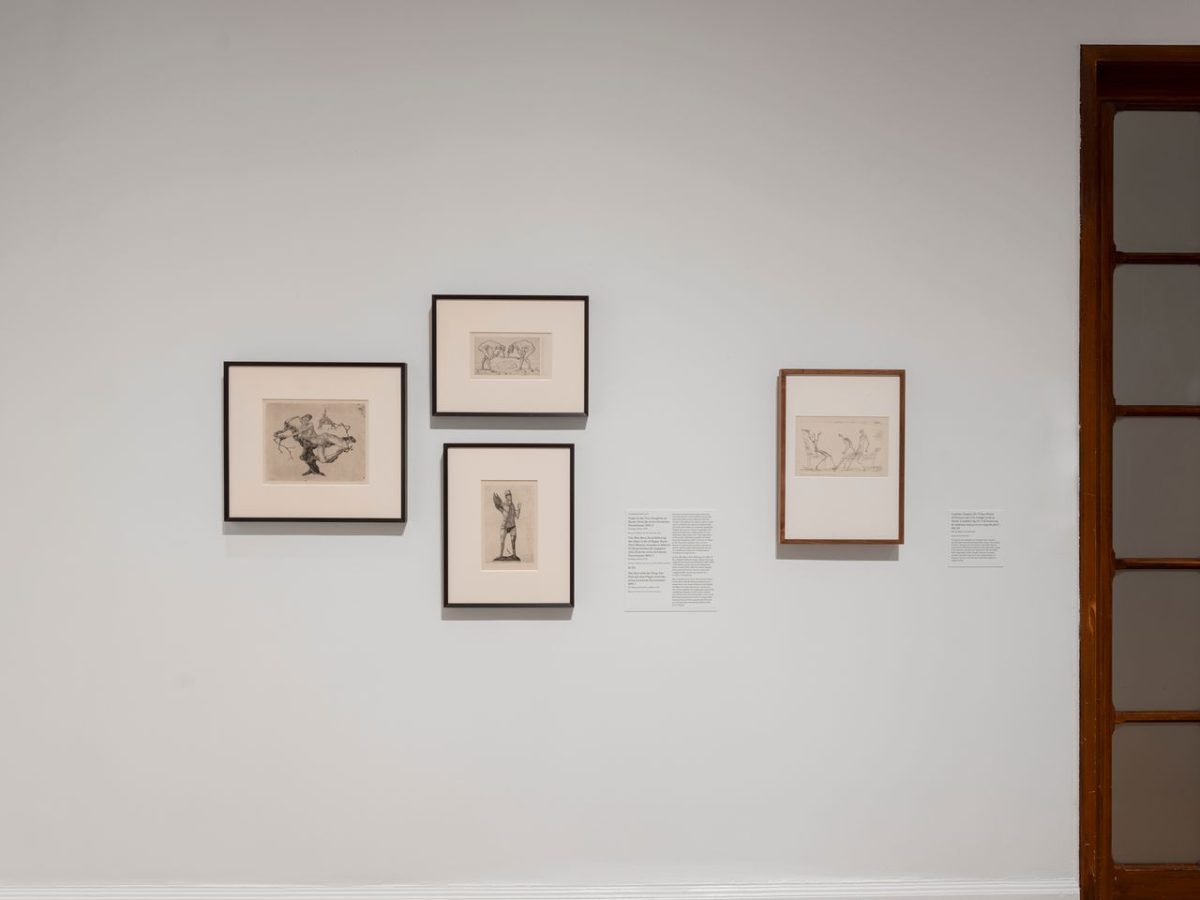
In Two Men Meet, Each Believing the Other to Be of Higher Rank (1903), Klee depicts the contemporary monarch Wilhelm II of Germany and the militaristic Franz Joseph of Austria bowing grotesquely toward one another — a mockery of monarchy and a demonstration that, from the very beginning, Klee understood the fundamental futility of power. Both figures are portrayed naked, and stripped of uniforms, clothing, or accessories that might otherwise signal social rank. Exposed, these figures are un-evolved, a commentary of the primitive nature of despotism in a time of purported industrial advancement.
Directly below, The Hero with the Wing (1905) introduces a one-winged hero who firmly believes in his destiny for flight but lacks the means to achieve it. The artist amplifies the tragicomic element by conflating this hopeless reality with a stately pose. Rooted into the ground like a tree trunk, the hero’s broken leg furthers his impossible situation but, per Klee’s commentary, “does not prevent him from remaining faithful to his idea of flying.” The piece is a fitting emblem for the exhibition itself, one persisting in the face of a setting that has rejected him.
As one moves beyond the Inventions series and walks the perimeter of the gallery, a timeline of Klee’s academic journey comes into view, a journey which is inextricable from the emerging political state of Germany.

Harlequin on the Bridge (1920) is among the most significant works in this gallery, and perhaps in the entire exhibition. The harlequin, originally an Italian comedic servant, serves as a symbolic self-portrait that conflates the entertainer’s outsider status with the role of the modern artist, someone who questions cultural norms and imagines alternative worlds. Straddling a bridge, the harlequin occupies the precarious position of a creator existing between different worlds, between reality and imagination, at a transitional period of history.
Paramount in the painting is the Star of David. Cited as the inspiration for the piece, when Klee was nominated as a professor at the Stuttgart Art Academy, he was denounced as a left-wing artist by faculty, students, and the daily press, where a journalist referred to him by an antisemitic slur, “Paul Zion Klee!” The Star of David and the figure of the harlequin together function to conflate the artist and the Jew as outside agitators. United in resistance, the harlequin, the Jew, and on further reflection, Klee himself, become one. This is, as the wall text notes, the birth of an alter ego, and the only articulation of “other possible worlds” in the wall text of a specific piece.
In 1921, Klee began teaching at the Bauhaus school of art. It was in 1924, at the opening of an exhibition, as the wall text states, “Klee presciently voiced a concern that art would not remain independent from politics. He feared that the freedom and individualism on which the Bauhaus had been founded was being replaced by a focus on technology and mass production.”
This anxiety is rendered concrete in Klee’s late Bauhaus works. Castle Hill (1929) was painted shortly after Bauhaus founder Walter Gropius selected Hannes Meyer as Klee’s replacement, signaling the school’s drift toward functionalism. As seen in the dreary red and blue hues, at this point, Klee’s concern for art had become something closer to grief. Perched near the peak of a geometric hill, representing the increasingly rigid functionalist style of the Bauhaus, is a solitary blue flag — its color symbolizing the highest point of the abstractionist Blue Rider movement. In the bottom corner, hanging on to the edge of the painting stands a lone figure, most likely Klee; the mechanization of art physically leaving him on the edge of popular existence.
“In 1931 Klee resigned from his professorship at the school, which the Nazis permanently closed in 1933,” the wall text notes.
Angelus Novus, or the Angel of History
In the next gallery, one small, 12.5 in × 9.5 in, monoprint hangs alone — centered against a deep red backdrop. The piece was titled Angelus Novus, in latin meaning “New Angel,” by Klee. Yet this crude angel, designated its own gallery, is better known as the “Angel of History.”

Klee made Angelus Novus in 1920 using his signature oil-transfer technique: after coating a sheet of paper with black oil paint, he used an etching needle to transfer the dry paint onto a second sheet, creating a drawing he then painted over with watercolor. The following spring, the German Jewish philosopher and cultural critic Walter Benjamin purchased the work for 1,000 marks and hung it above his writing desk in Berlin, frequently referring to it as his most treasured possession. The two men’s lives would run in haunting parallel. When the Third Reich rose to power in 1933, Benjamin fled to France and Klee to Switzerland, the country of his birth. In 1940, Benjamin killed himself when he faced deportation in Spain, three months after Klee had died from complications of scleroderma.
Before his death, Benjamin wrote a passage in his Theses on the Philosophy of History, immortalizing this modest drawing as one of the most consequential images in modern intellectual history:
“Looking as though he is about to move away from something he is fixedly contemplating. His eyes are staring, his mouth is open, his wings are spread. This is how one pictures the Angel of History. His face is turned toward the past. Where we perceive a chain of events, he sees one single catastrophe that keeps piling wreckage upon wreckage and hurls it in front of his feet. The angel would like to stay, awaken the dead, and make whole what has been smashed. But a storm is blowing from Paradise; it has got caught in his wings with such violence that the angel can no longer close them. The storm irresistibly propels him into the future to which his back is turned, while the pile of debris before him grows skyward. This storm is what we call progress.”
Placing Angelus Novus at this precise juncture in Other Possible Worlds is an act of curatorial genius. The exhibition is organized chronologically — this is the exception. The work dates to 1920, belonging properly to the earlier galleries. But the curators have pulled it forward, the Angel of History transcending time to stand at the threshold between Klee’s Bauhaus period and the political darkness that follows. The viewer, like the angel, is propelled from a vanishing past into the catastrophe ahead.
The painting’s journey to that wall is itself emblematic of its meaning. For this exhibition, it was on loan from the Israel Museum, but the war with Iran disrupted international flights, delaying its arrival weeks after the show had already opened. For that stretch of time, the deep red gallery held only a notice in its place — a blank where the angel should have been. There is something almost unbearably fitting about that: the Angel of History, held up by the storm of “progress,” once again.
Idyll in the Light
Leaving Dessau behind, the next gallery features Klee’s time, starting in 1931, at Düsseldorf to teach at the Academy of Fine Arts. Unshackled from the Bauhaus and its increasingly prescriptive demands, he painted with a new looseness and developed a distinctive variant of pointillism. But history would not hold still. The July 1932 federal elections handed the National Socialist German Workers’ Party its first Reichstag majority, and the death of the Weimar Republic became a matter of when, not if. The gallery is bisected by the entryways at its ends: on one side hangs Klee’s idyllic abstract pointillism, the other his first pieces on display explicitly critiquing the newly-elected Nazi party.

Monument in Progress (1929) depicts a satirical portrait of Benito Mussolini and his infatuation with Classical Rome, rendered not with the heroic monumentality fascism, specifically Italian fascism, demanded of its art but with Klee’s characteristic wit; the monument perpetually unfinished, literally “in progress,” its grandiosity is undermined by its own incompletion.
What makes this gallery remarkable is not just the fear it documents but the form that the resistance takes. As conformity tightened its grip across Germany, Klee moved in precisely the opposite direction. His new pointillism was not the orderly, scientific dot-work of Seurat but something defiantly individual — built from squares of color that retained their own identity even as they composed a larger whole. In a Germany demanding the surrender of the self to the collective, Klee was making art out of individualism at the smallest level.
In Athlete’s Head (1932), Klee combines the two artistic themes, turning a distorted face into an act of dissent. The portrait’s abstraction and disfigurement satirizes the Nazis’ superficial glorification of the heroic athlete, painted in the same year the regime mandated five hours of athletics daily in schools.
When Adolf Hitler ascended to power in early 1933, it confirmed what his paintings had already begun to say.
Is Europe Limping or Am I?
“So now the great Klee makes his entrance, already famous as a teacher at the Bauhaus. He tells everybody he has pure Arabian blood in his veins, but he is actually a typical Galician Jew. He paints in a crazier and crazier way, he bluffs and baffles, his students goggle and gape, as a new, unheard-of art makes its appearance in the Rhineland.”
Just days after Hitler’s appointment as the chancellor of Germany, this quote was published in the Nazi periodical Die Rote Erde (The Red Earth). A sobering reflection of the cultural conformity fascism prescribed, this quote is prominent in this gallery’s wall text to exhibit the darker turn of upheaval that Klee and his family experienced which is reflected in his work.
A month later, his house was maliciously searched by the Gestapo, his personal property seized. A month after that, he was dismissed from his professorship at the Düsseldorf Academy. Labeled “degenerate,” his paintings were cast out of every museum in Germany; he and his family were forced into exile in Switzerland.
Klee was diagnosed with the scleroderma, a degenerative disease, in 1935. In his pocket calendar at the time, Klee jotted down: “Is Europe limping or am I?’’ The wall text concludes; the viewer is left with the morbid namesake of this equally morbid gallery.
Behind many of the pieces in this gallery stands an accent wall painted a deep, unbroken red. The choice is not incidental. Where the previous galleries gave Klee’s abstractions room to breathe, here the color closes in — a seemingly chromatic declaration of the dread that now saturates his work.

One of the gallery’s most significant pieces is Struck from the List (1933), and its placement as a centerpiece feels deliberately confessional. Following the Gestapo’s raid on his Dessau home and his dismissal from the Düsseldorf Academy, Klee made this painting as a self-elegy. The palette is muted, the face caught mid-grief, its hardness calling to mind the kind of ritual object meant to hold the memory of the dead. The black X through the portrait is unambiguous: the erasure, the exile, the administrative violence of a line drawn through a name. The infamous Entartete Kunst exhibition of 1937, in which seventeen of Klee’s works were displayed as evidence of “degeneracy” rather than celebrated as art, is brought to light in the accompanying description. By partially anchoring this gallery around an act of self-portraiture, the curators root the section not in abstracted political commentary but in Klee’s lived experience.
Europa (1933) is hung nearby, and the pairing with Struck from the List is pointed. Where the latter turns inward, Europa turns outward — a diagnosis of Europe’s limp rather than his own. Drawing on the myth of Europa’s abduction by Zeus, Klee repurposes the etiological myth of Europe, the continent’s beginning, to represent its end.
The figure of Europa stands in the composition looking almost unbothered, one leg crossed casually over the other, which only makes the painting’s other signals more unnerving: the blood on the hem of her dress, a dangling exclamation point, and Europe visibly coming apart in the background. A grotesque composite face assembles from the wreckage. This is not Europe being carried off. It is one that has already begun to break at the hands of the casual indifference of its people.
Klee’s contempt for Nazi racial ideology finds its most precise expression in Your Ancestor? (1933), a work that targets the regime’s eugenics program at its most foundational premise. The figure — apelike, grinning — collapses the boundary between human and animal that the Nazis had so carefully constructed as the basis of Aryan superiority. The question mark in the title is intentional: Klee is not making a statement so much as posing an uncomfortable question to the ideology itself.
The gallery closes with its latest piece, Revolution of the Viaduct (1937), and the curators have selected it for last deliberately. The human-footed arches have broken formation, each striding independently in reds, oranges, and pinks — colors in direct contrast to the gray-greens and blacks of Nazi uniforms. It is a direct mockery of Hitler’s parades, those spectacles of synchronized power and collective submission. But as a closing image for this gallery, it functions as something more than satire. After the grief of Struck from the List and Europa, the darkness of Your Ancestor?, and the dread of the red wall, Revolution of the Viaduct offers a different register: defiance that embraces the disorder of individual human nature in opposition to rigid fascism.
National Socialist Revolution Drawings
In a time when his modern style was criminal, Klee turned to art at its most form: drawings. Started in 1933, the year of Hitler’s election, and continued until Klee’s death, the National Socialist Revolution Drawings are collections of works in direct response to Nazism, dispense with the lyrical abstractions and oblique metaphors that had defined his earlier political commentary.
But the curators have not given these drawings a room of their own. Instead, the drawings appear chronologically on easels scattered across the exhibition’s final two galleries, surfacing between the oils and watercolors like interruptions. There is no clean separation between Klee’s work and life, between his political and “apolitical” works. They occupy the same space.

Accusation in the Street (1933) depicts a brazenly etched scene of a figure performing the Nazi salute, most likely accusing one of disloyalty to the Third Reich. The surrounding figures all seem to be staring at the accused off-page, bystanders to the sociological damage of fascism Upon closer look, the figures, particularly the bystanders, bear animal faces as well as their own. Klee is not dehumanizing his subjects; he is documenting what dehumanization looks like from the inside, rendered in the faces of those doing the accusing. The figure to the far right has the clearest face, one that is canine rather than human, dormantly vicious in the face of society’s degradation.
Violence (1933) is much more explicit. An erratic tangle of lines, the piece communicates assault more as force than as event. The abstraction is not evasion; it is the most honest formal response available to an artist trying to depict something that exceeds the capacity of a figure on a page. The violence of Nazi Germany goes deeper than the physical state, it reaches the soul in a way realism cannot quite depict and modernism can only attempt.
And then there is Crawling Man (1933). This crude figure has been reduced to a single act: prostration. There is no face to read, no gesture of defiance, and no irony to soften the image. Just a body that has been brought to the ground. Where the rest of the Revolution Drawings indict the regime — its ideology, its cruelty, its absurdity — Crawling Man records what the regime produces. It is the human cost rendered in chalk, in the simplest lines that Klee could manage. That simplicity is not a limitation. It is the point.
Leap Year
By the late 1930s, Klee was aware he was dying. Scleroderma had begun its slow erasure of his body, gradually stripping the dexterity from his hands, the disease progressing with a cruelty that felt almost allegorical given everything else that had been taken from him. And yet 1939, the last full year of his life, was the most productive year of his life; the gallery statement notes that Klee produced 1,253 works in those twelve months.
The man whom the Nazis had tried to erase, whose name they had struck from lists and whose paintings they had pulled from museum walls, was making more art than ever.
Angels had appeared in Klee’s work as early as the end of World War I, but in these final years, they proliferated. Their appeal to Klee makes sense on multiple levels. Theologically, angels occupy a liminal space: neither fully human nor divine, neither bound to the earth nor entirely free of it. For an artist in exile, cut off from his adopted country, his profession, and gradually his own body, that in-between state was not metaphor but lived condition. The angels also carried the weight of history — none more so than Angelus Novus, which by this point in the exhibition the viewer has already encountered. In the final gallery, the angel cycle returns, but the tone has shifted. These are not angels of history. They are angels of the everyday: Angel Applicant, Angel, Still Female, Angel, Still Ugly, and many other pieces depict figures wrestling with their own incompleteness, a mirror of the human condition that Klee shared with them in his final months.
The theme of children runs alongside the angels through these last works, and the wall text frames it precisely through a quote from Klee: “I want to be as though newborn, to know nothing,…nothing at all. Ignorant of poetry, wholly uninspired.” This was not resignation due to artistic difficulties, it was Klee’s belief that the unlearned mark, the child’s unmediated line, was closer to something true than anything his formal training could produce. In isolation in Switzerland, he wrote, he had achieved a state of childlike freedom and wonderment.
Protected Children (1939) is where that philosophy becomes political. The figures clutch umbrellas against a blustery storm, their walkways confused and branching, the Red Cross appearing amid the chaos like an insufficient answer. Klee was acutely sensitive to what Nazi ideology was doing to German children — the militarization of their education, and the conscription of their imaginations into the service of the state. It can be seen in their eyes, the deep blue conveying a desperation rare of youth. Children, for Klee, were not sentimental symbols. They were the future, and the future was in danger. To paint them struggling to hold their umbrellas against a storm they did not choose is to understand that the damage being done was generational.
Nothing in the exhibition makes this more clear than Untitled (Last Still Life) (1940), the painting that was on Klee’s easel when he died. At the bottom of the canvas is Angel, Still Ugly — robed and bewildered, a cross on his chest that carries the weight of death. His hands are clasped, his expression hovering between a grimace and an embarrassed grin, as if he has arrived at the threshold of death and found himself uncertain whether he is up to the task. Beside him, a small figurine waves goodbye. Stick figures drift at the upper edge of the canvas. And above it all, an infinite black void opens, a full moon suspended within it. But this void is not darkness as absence but darkness as continuum, a space-time that connects everything, that floats upward past the boundaries of the frame.

As the Angel of History sweeps Klee up at its feet, the storm of progress rages on, the children prominent in its wind. Soon the Nazis will be swept into this pile as well, yet Klee does not know this yet. But Klee’s works — his defiant lines, his indecipherable symbols, his raw individualism — hang paramount in the sky of history like the angels that he continuously depicts.
The words on his tombstone at Schosshaldenfriedhof (Schosshalden Cemetery) in Bern, Switzerland, and reprinted on the wall of the exhibition, which is also Klee’s credo, state, “I cannot be grasped in the here and now, for my dwelling place is as much among the dead as the yet unborn. Slightly closer to the heart of creation than usual, but still not close enough.”
The exhibit is titled Other Possible Worlds because it demonstrates the worlds that Klee dared to imagine — this exhibit simply cycles through the one in which he lived.
As the Angel of History sweeps Klee up at its feet, the storm of progress rages on, the children prominent in its wind. Soon the Nazis will be swept into this pile as well, yet Klee does not know this yet. But Klee’s works — his defiant lines, his indecipherable symbols, his raw individualism — hang paramount in the sky of history, like the angels he continuously depicts.