

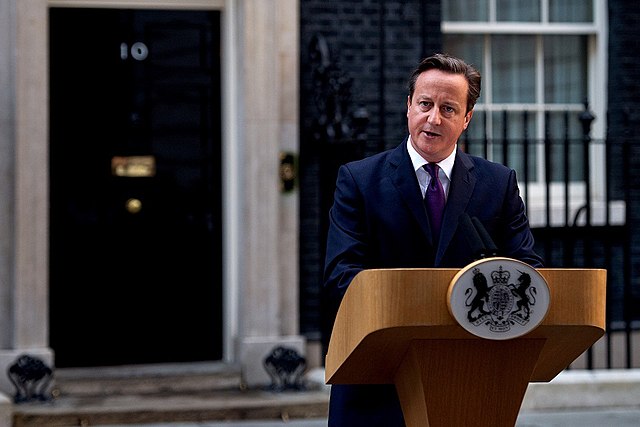
“Across the world, people have been watching the choice that Britain has made.” David Cameron walked out of Number 10 Downing Street with a somber look on his face, aware of the gravity of the speech he was about to deliver. Just an hour earlier, the results of the Brexit referendum had been announced, shocking the world with the success of the campaign to Leave the European Union, an outcome that, to many, seemed previously unimaginable. While David Cameron prepared to resign as Prime Minister following the failure of his campaign to stay in the European Union, a very different scene was unfolding in central London, where Leave supporters had gathered to celebrate.
“Let 23 June go down in our history as our independence day.” The declaration of victory was no surprise for Nigel Farage. He had built his political career as a Euro-skeptic, someone who wanted the United Kingdom to leave the European Union. After spending decades railing against what he saw as an unaccountable Brussels elite, he now savored his ultimate triumph and vindication.
The referendum served as a flashpoint for a global order in flux. Seven years earlier, the Great Recession of 2008 had caused people across Europe to face austerity measures from their governments, just as the economy was on the verge of collapse. At its height, unemployment reached 10.3% in the Eurozone. In places like Greece, household income per capita fell by 37% between 2008 and 2012, and thanks to austerity, many people were unable to afford basic medical care. This combination left electorates angry and betrayed, convinced that the system had been designed to protect financial institutions while leaving ordinary citizens to pay the price; they were ready for a populist insurgency to upset the status quo as establishment parties subscribed to the unpopular austerity measures.
This populist insurgency started out more impromptu and non-electoral, like Occupy Wall Street in the United States, the Indignados movement in Spain, anti-austerity protests in Greece and the English Defence League’s street marches. These movements were not necessarily right wing or left wing, merely a rejection of political elites and established institutions. Eventually, however, this populist sentiment began to formalize, adopting more electoral strategies like the Tea Party movement and Bernie Sanders campaign for president in the United States. In Europe, political parties like Podemos and Vox in Spain, the Five Star Movement in Italy, and Fidesz in Hungary sought to translate this populist anger into real electoral success.
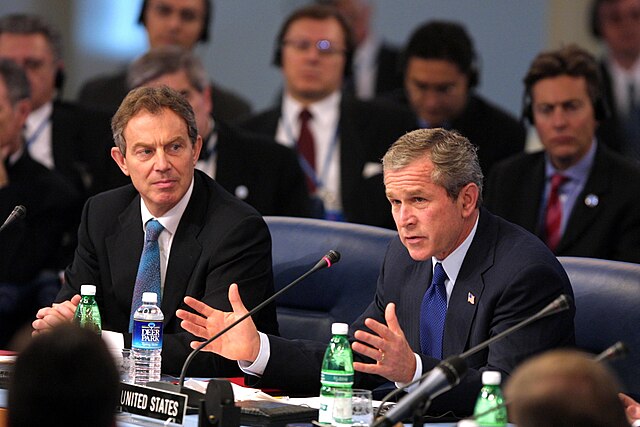
In the United Kingdom specifically, things were ripe for a right wing populist turn. After the New Labour revolution of 1997, when then Labour leader Tony Blair “moderated” the Labour party towards a deregulatory, pro-market ideology, the Labour party maintained a comfortable grip on power during the 2000s. It aligned itself more with the European Union, opening up its labor market to immigrants in 2004.
Blair also aligned himself with the United States during the invasion of Iraq, damaging his credibility both with voters and within his own party as the war became increasingly unpopular. Eventually, he was replaced by Gordon Brown in 2007, though he failed to recover Labour’s popularity before the financial crash.
During this time, the Conservative Party was in crisis. In contrast to the youthful Labour party, they seemed antiquated and elitist. The party also struggled to define its position on Europe, with one wing of the party favoring further integration and another wing of the party being much more nationalist, skeptical of immigration, and “Brussels elites.” This resulted in constant leadership instability, which soon became a theme of the Conservative Party, and subsequently led to their lack of political influence during the 2000s.
Enter David Cameron. After becoming leader of the Conservatives in 2005, he sought to moderate the party by moving towards social liberalism, pro-European integration, and a compassionate conservatism aligned with George Bush’s Republican party across the Atlantic. While this did manage to make the Tories more popular, it alienated the more right wing elements of the party who felt as though the country was losing both its identity and its independence.
Enter Nigel Farage. A former commodities trader who became politically active in the 1990s as a member of the Conservative Party, he grew disillusioned with its pro-European attitude under then-leader John Major. In response to this, he started the United Kingdom Independence Party in 1993. In its early years, the party was considered nothing more than a fringe movement, only containing a few hundred members.
However, over the next few years, it would begin to gain traction on a voting bloc that would become increasingly familiar to right-wing populist movements: disaffected Conservative voters. These voters tended to be older, rural, and were those who felt left behind by globalization, as factories closed and companies increased their profit margins in favor of cheaper, non-unionized labor in the global South. This helped them to gain seats in elections that most people were not engaged in: European parliamentary elections, with them gaining 16%of the vote in 2004.
While these elections had low turnout and were filled with protest votes, they still demonstrated a growing movement. At the time, both parties treated it as a sideshow, a small protest that did not reflect the wider mood. This began to change in 2004, when Tony Blair’s government made the aforementioned decision to open up the United Kingdom’s labor market to immigrants from Europe as eight poorer post‑communist countries joined the European Union. This stood in contrast to other Western European countries, most of which imposed temporary restrictions on worker migration.
Large populations of young working age men from Eastern European countries began to enter the United Kingdom, at a rate that was far greater than what the Labour government had predicted, with the number being in the hundreds of thousands. While this did cause a backlash, it was only after the financial crash that the issue really came into the mainstream.
This was thanks to a combination of recession‑induced factors, including increased competition at the bottom of the labor market, where Eastern European migrants willing to work for lower wages now competed with newly disadvantaged British workers. In normal times, this pool of migrant workers would not be so unusual, but thanks to the recession, it felt like a threat in deindustrialized towns already hit by globalization.
David Cameron’s win in 2010 did not help anything. Forming a coalition government with the smaller Liberal Democrats following Labour’s collapse, Cameron joined his European counterparts in responding to the crash with austerity measures, further exasperating the crisis for the working classes. You now have longer wait times at hospitals, more crowded schools with an 8% decrease in per-pupil spending, more pressure on housing development thanks to cuts at local authority housing budgets, and a general newfound scarcity of resources thanks to 110 billion pounds worth of cuts from 2010 to 2015.
By this point, it was clear to the British public that something had gone wrong. But whose fault was it? One option might be the bankers, whose drive for higher profits can reasonably be blamed for the financial crash. However, for many voters, there was a much easier and more immediate target: migrants, who were visible in everyday life in a way that financial institutions were not.
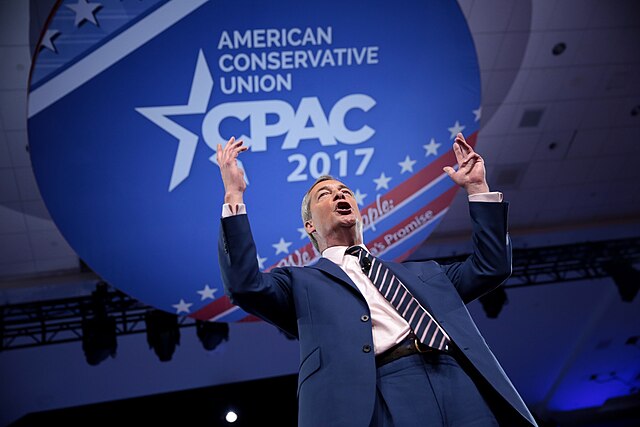
Re-enter Nigel Farage. Harnessing this public anger and dissatisfaction, he made four main pitches to the British public: immigration is out of control, the EU is forcing it on Britain, the political elite refuses to listen, and I, the political outsider, can rectify this. This did not go unnoticed to David Cameron, who made one of the great political miscalculations of the 21st century.
In 2013, David Cameron made the promise to hold a referendum on British membership to the EU by 2017. He did this for two main reasons: first, the more Euro-skeptic branch of the Conservative Party was feeling unhappy and disaffected with the moderate bent of Cameron’s leadership. Cameron feared defections to Farage, who was leveraging his argument about immigration to appeal to older and rural voters that Conservatives had relied on. So Cameron announced the referendum, assuming he would never have to follow through on this promise, after all, the Conservatives were in a coalition with the Liberal Democrats, who did not support the referendum, and this coalition was not expected to fare much better at the 2015 elections.
Now the 2015 election rolls around, and much to everyone’s surprise (including Cameron’s), the Conservatives had an outright majority in parliament. All of a sudden, any obstacle to the referendum was now removed from Cameron’s path; it was now fully in his power to do so. And so it was set: to honor his commitment, Cameron set the referendum for June 2016. The UK would settle its place in Europe once and for all.
Cameron got to work as the public face of the remain campaign. His argument was fairly simple: leaving the EU would be terrible for the economy, and any of the concerns that voters had with the nation’s place in the EU could be fixed through renegotiation without leaving. Cameron had much of the domestic and international establishment on his side with the leadership of Labour and the Liberal Democrats and many corporations. Then, President Obama gave a speech warning the British public that they would be at the end of the queue for any deals with the United States if they left the EU. Overall, the remain campaign oozed establishment, technocratic energy.
This was in stark contrast to the Leave campaign, which was much more emotionally charged and less organized. The campaign was made up of two main groups, Vote Leave which was made up of more mainstream conservative politicians like Boris Johnson, Michael Gove, and Gisela Stuart. Their message focused on “Taking Back Control” from an EU they saw as overly bureaucratic and unaccountable. Nigel Farage and Leave EU, on the other hand, were seen as more populist and out of the mainstream, with a heavier focus on a loss of national identity, specifically due to immigration.
With these two strategies, the Leave campaign covered a lot of ground, addressing both middle‑class concerns about sovereignty and working‑class concerns about immigration and cultural change. As with many populist movements, the Leave campaign captured a part of the public imagination that the more abstract and technocratic Remain campaign did not.
Cameron, however, was confident that Remain would win. Undecided voters would break for the status quo, and the economic warnings from establishment figures would get through. Telephone polls showed Remain ahead, though online polls were closer. It was only in June that the true possibility of a Leave win began to materialize, with multiple polls showing the race to be a toss up with the more emotional immigration message starting to connect with voters. Cameron was also concerned about the lack of excitement among young voters, who were seen as more likely to break for Remain. Despite all this Cameron remained confident that the status quo effect would keep Leave from winning, assuring everyone that he would stay on no matter what and that “wouldn’t be a verdict on me.”
Election night arrives. Early on, the pound surged to its highest point in months as if Remain had already won. Midnight rolls around, and Sunderland, a heavily Leave‑sympathetic area, reports its result with the Leave margin being far larger than expected. No need to panic yet. The night rolls on, and Midlands and the North show Leave outperforming expectations across the board, while Remain heavy areas like London and Scotland don’t have the margins necessary to compensate. By four in the morning, it was clear Leave had won.
In the days, months, and years that followed, the United Kingdom underwent a profound political upheaval. The country cycled through multiple Prime Ministers as it navigated the complex and unprecedented process of leaving the European Union. Theresa May, Cameron’s successor, struggled to deliver a withdrawal agreement that satisfied either Parliament or the public, and her premiership collapsed under the weight of repeated defeats. She was eventually replaced by Boris Johnson, who positioned himself as a harder‑line leader and promised to deliver a “clean” or “hard” Brexit after years of political deadlock.
Finally, in 2020, the Brexit process was finished, Nigel Farage’s life’s work was complete. Throughout the Brexit process, Farage had been busy. At first, he stepped away from direct leadership of his Independence Party UKIP, focusing on appearances on television, radio, and pressuring the Conservative government for a “hard” Brexit. He distanced himself from his old party, as it devolved into a vision more extreme than what Farage was comfortable endorsing.
Eventually, he formed a new party, the Brexit Party, winning the 2019 European Parliament elections on a platform of punishing political elites for failing to deliver Brexit. However, once Brexit was finally completed under Boris Johnson, he had to rebrand. The Brexit Party was now Reform UK with a message that was familiar to Farage: immigration is ruining this nation. In 2024, Reform UK gained 14.3% of the vote and secured seven seats in the House of Parliament. Following a year of collapse in the polls by the two big parties of Labour and the Conservatives, Nigel Farage is at the peak of his influence, with Reform UK polling at around 30%, far and away the most popular party in the nation. If this can hold until the next elections, Farage would be the presumed Prime Minister in waiting.
In a way, the United Kingdom (and the world) remains in Brexit mode, with the same story that made Brexit possible repeating itself. Economic crises like the Great Financial Crisis and the pandemic squeeze the cost of living for voters, while moderates struggle to offer convincing solutions. Into that vacuum right-wing parties manage to shape the national conversation by linking economic anxiety to immigration. Their rising popularity has influenced policy from the outside, much as UKIP once did. Today, Prime Minister Keir Starmer is pursuing a tougher immigration stance in response to Reform UK’s surge in support, echoing the way David Cameron felt compelled to promise a referendum under pressure from UKIP a decade earlier.

Is there any way out of this toxic cycle for the United Kingdom and the world? One way could be using the powers at the government’s disposal to address the cost of a living crisis that has defined our times. Cameron’s austerity in response to the Great Financial Crisis exacerbated people’s struggles, leading to the appeal of Farage’s explanation of immigration as the source of the issue. The current Labour government ran on a message of ending austerity, but has since doubled down. It remains to be seen if they can recover their poll numbers in time for the next election, or risk falling to the same fate Cameron did, succumbing to a wave of right wing populism.
But whose fault was it? One option might be the bankers, whose drive for higher profits can reasonably be blamed for the financial crash. However, for many voters, there was a much easier and more immediate target: migrants, who were visible in everyday life in a way that financial institutions were not.