
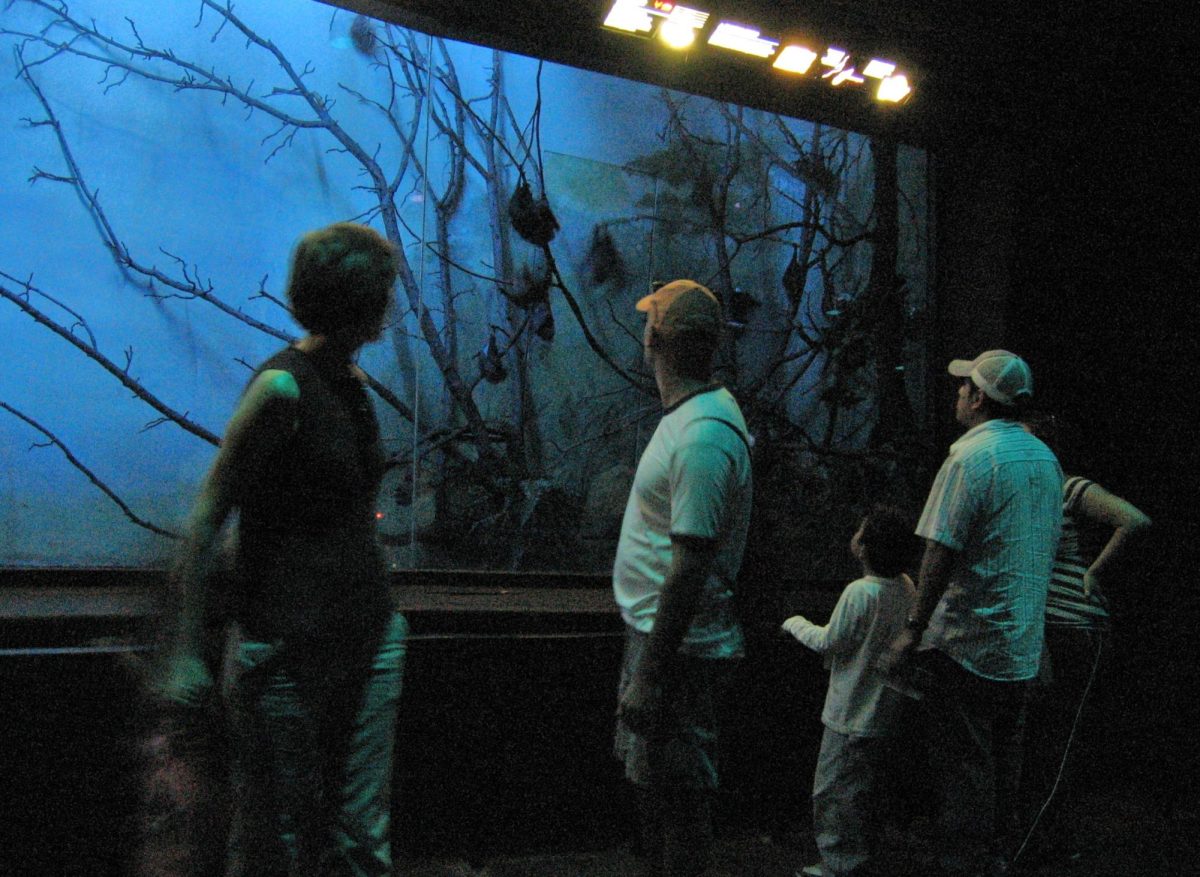
As you enter the Bronx Zoo’s new exhibit, World of Darkness, you are slowly consumed by emptiness as the door closes behind you, until your eyes adjust and the faint, colorful glow of rectangular, glass mirrors give you a glimpse into the reclusive lives of nocturnal animals.
The World of Darkness
The World of Darkness, a newly renovated exhibit of The Bronx Zoo, reopened in its new iteration on July 2025 after a sixteen year hiatus. It features nocturnal animals in human-made habitats designed to mimic their natural environments. It is one of the zoo’s most unique exhibits.
This exhibit first opened on June 12th, 1969, years after the Bronx Zoo’s debut as one of the first major zoo exhibits to use a reverse light cycle. The reverse light cycle is the opposite of the standard light-dark schedule, resulting in darkness inside the exhibit during the day and light at night. Through this technique, the exhibit is able to help artificially create the conditions that species prefer.
However, due to budget cuts caused by the 2008 global recession, it closed in 2009. The 2008 global recession resulted in lower funding for New York City and a general decline in donations to the zoo. To adjust to the zoo’s new budget cuts, less-popular exhibits were closed and hundreds of animals were relocated to other accredited zoos around the country.
Sixteen years have passed since the exhibit’s closure in 2009. However, the exhibit’s revival has given the new version of the World of Darkness a remarkable surge in popularity. The exhibit’s popularity stems in part from the presence of uncommon species that are rarely seen in zoos, such as fat-tailed lemurs and elusive mouse lemurs, as well as nostalgia from people who saw the exhibit prior to its closing. Furthermore, a reserve light cycle allows visitors — many of whom may have never viewed such an exhibit before — to observe the animals during their active period.
The World of Darkness is placed near the Asia Gate right across from the Gelada Reserve, a famous large habitat designed to mimic the habitat for Gelada monkeys and other biologically related animals.
As visitors walk through the Geleda Reverse, they are able to see a large windowless C-shaped building. When they get closer to the exhibit, guests must either travel via ramp or climb a set of stairs, which alters the perspective and places them in front of an out of place wide, dark charcoal colored building that sets the mood for the exhibit. Right outside, there are large promotional signs for the exhibit that visitors cannot miss, bringing in people from all around the city. One of the most notable features near the exhibit is the Rocking Stone, a massive forty-ton ice age glacier boulder composed of pink granite which has been in the zoo for years.
As patrons enter through the exhibit’s doors, they take time to adjust to the change of light before arriving into a whole new world with species all around. The 13,000 square feet exhibit holds 21 habitats for the 25 unique species being displayed.
The visitors have a variety of habitats that they can visit, all from different continents around the world. Throughout the different habitats, the Bronx Zoo has small interactive signs with fun facts about the species which help keep the visitors engaged, and also discusses how specific animals are threatened.
History of the Bronx Zoo
In 1898 C.E., the city of New York allocated 250 acres of Bronx Park for the preservation of native animals and the promotion of zoology. In addition, the Bronx Zoo seeks to connect visitors with wildlife and get them to join their conservation efforts to save different species around the world.
The zoo officially opened in 1899 and has remained one of the largest wildlife conservation parks in the United States, housing more than 700 species. Since its opening, the park has gained fifteen more acres of land. Furthermore, the zoo has dedicated significant efforts to care for a wide variety of animals with over 2 million visitors each year. Since its founding, the Bronx Zoo has come to be known for its iconic, immersive exhibits like the Congo Gorilla Forest, Madagascar, JungleWorld, and many others.
These exhibits are the result of all the research and time dedicated to learning about so many different species from around the world. As each one is specifically crafted, taking into account the unique habitat and aesthetics of the continent of the animals featured within them.
The World of Darkness includes multiple species from several regions across the globe. Some of the most popular ones are Egyptian Fruit Bats and Sand Cats, both from Northern Africa, with habitats that mimic African environments that they come from.
Opinions of the Exhibit
The World of Darkness truly caught my eye as it differed from other exhibits at the Bronx Zoo, and it drew me in through its unique concept. The experience gave me a better understanding of how nocturnal animals act in their natural habitats and a first-hand view into their habits, which I would not have known if it had not been for this exhibit.
The Egyptian Fruit Bats specifically were seen zipping and navigating throughout their environment. They were fast and hard to spot even with the red lighting in their habitat. They would move from side to side but would never crash into the windows. The relentless back and forth motion was hypnotic, causing observers to stay in place watching them.
While observing the animals, visitors also have the opportunity to participate in fun activities which are displayed next to the label of each of the animals.
The World of Darkness is impressive especially because of its thoughtful design, demonstrating an attention to fine details. Signs around the building are designed to be large enough to include both English and Spanish translations. Thanks to this, visitors who speak English or Spanish are able to guide themselves throughout the exhibit. Furthermore, ramps are placed next to each enclosure promoting accessibility for strollers and people in wheelchairs.
As guests navigate the exhibit, they feel as though they have entered another dimension. People crowd the windows of the different habitats, trying to spot different species and scout out any hidden ones. For people who have never seen an exhibit like this before, it’s an all-around unique experience.
Praise Uhunmwangho ’27 was a first-time visitor of the exhibition. She noted how it was a “very good recreation of nature,” as the animals seem perfectly content in their habitats. It did not feel like an interruption to their daily life but more of an assimilation combining human life and nature. Uhunmwangho went on to highlight the importance of exhibits like these that help to showcase hidden aspects of the natural world that we typically do not see.
Uhunmwangho expressed surprise at the range and diversity of the animals on display during the visit. We discussed everything from initial reactions to her favorite animals in the exhibit. She mentioned how informative the exhibit was and how helpful it is for individuals who are unfamiliar with species, particularly nocturnal ones.
Overall, the World of Darkness exhibit offers a compelling educational and interactive experience, with guests often collaborating to help one another spot animals that are difficult to see. People have the opportunity of not only getting introduced to different species, but also the opportunity to observe them in their natural environments.
The World of Darkness, a newly renovated exhibit of The Bronx Zoo, reopened in its new iteration on July 2025 after a sixteen year hiatus. It features nocturnal animals in human-made habitats designed to mimic their natural environments. It is one of the zoo’s most unique exhibits.