

In 194 years, commuter rails have transformed from horse-drawn rail cars to locomotive-hauled trains with self-propelled cars. In 194 years, innovation in the technological sector has exponentially transformed manual systems into automated transit systems that can reach up to 80 miles per hour and carry around 1,000 passengers per train. Yet, in 194 years, there is one role that has remained remarkably human: the job of a conductor.
For a role that has been persistent since its implementation, the inner workings of the job are relatively unknown. Commuters see a small glimpse of the work — the brief, ever-repeating dialogue of “Ticket please?” as the conductors move their way through the bustle of passengers. After the fleeting exchange, many people return to their personal activities: reading a book or using their phone — and the rest of the trip is blurred out. But for the conductor, their job has only just begun.
As a frequent long-distance commuter, these trips gave me time to think, whereupon I stumble across the same questions: What is the role of a train conductor? How do they know who is a newcomer and whose ticket has already been checked? And what is the slip of paper that the conductor’s hole punched and put in the seat in front of the passenger?
On a recent weekday morning at the Grand Central Terminal, I met train conductor Eddie Jempty who was working a commuter rail at Gate 37. At this time, Jempty was preparing for his train’s departure that was three minutes away, ensuring that all passengers got on safely. Amid the clatter of rolling luggage and faint announcements, I asked him about what his job entails beyond the little that the public sees.
He disappeared inside the train for a moment before reemerging with three slips of paper, all colored a deep turquoise. “This,” he explained to me, “is called a seat check.” The seat check is a small paper, divided into sections numbered 0 through 9 to represent the stops that the customers can get off at. “8, for example, is for Poughkeepsie,” he said. Distributing seat checks is the train conductor’s way of knowing which customers they have checked-in, and where the customers are getting off at. To get through this process more efficiently, there is often a contraction for the stop written on the ticket itself, for instance ‘POKIPSE,’ for ‘Poughkeepsie.’ Jempty would quickly read this abbreviation, punch in the numbers on the seat check associated with their destination, and put the small paper in the holder located in the seat in front of the customer.
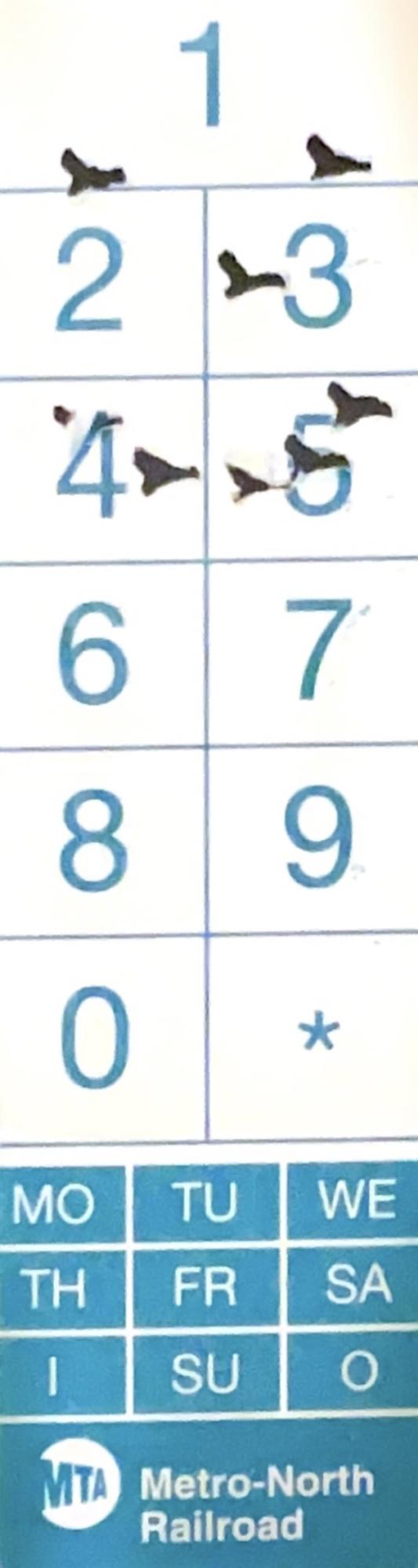
If a seat check details that a person’s last stop is Beacon or New Hamburg, and the individual is on the train after this point, then the conductor knows to charge them extra. “If they’re going to transfer,” Jempty adds, “I have to punch the seat check once.” Then, after the individual transfers, the conductor in the next train would punch a seat check once. “That would cancel that one ride.”
It is like a quiet code: a reliance on visual cues, hole punches and memory. Observation is at the center of this job. “It is my job to notice everything that is going on this train,” Jempty said. Fare-evaders serve as a critical example — there are always one or two per train. Some serve up believable stories, and reference their child or family member. Others bank on the common phrase: “I have to use the bathroom.” The train conductors are specially trained to detect and monitor all suspicious activities surrounding this. “Every train has somebody who will hide in the bathroom,” Jempty says. “It’s a safety issue.”
As part of their role, train conductors walk through the cars regularly, whether this is to observe, monitor, or to check tickets. These are the people helping to ensure customer and crew safety on board. Still, many ask “Does the train conductor drive the train?” Jempty chuckles as he tells this story. “I am not driving the train. I could not be driving the train.” The role of the train conductor is to supervise and handle administrative tasks. “We are constantly walking through,” he tells me. On a train, there is an engineer, a conductor, and an assistant conductor. The engineer is in the front of the train — this is the person driving the train. The assistant conductor helps the conductor. The conductor, though, “the conductor is in charge of the train” and everybody reports back to them.
As he finishes his explanation, the air horn from the train engine rings, marking the end of the three minutes before departure. Eddie Jempty steps foot onto the train and it rolls away to its next destination.
On my next trip aboard a Metro-North train, I start to see the journey through the conductor’s eyes. I sit down in a two-seater, the ideal seat for an individual passenger. I hear the familiar hum or electricity and chatter around me, and I am filled with an overwhelmed sense of sonder. Instead of delving into my long-commute ritual, completing work on my laptop, I observe the happening around me — like a conductor.
I hear the woman soothing her baby, the quiet person in the corner of the car, the person sprinting through — was that suspicious?
Like clockwork, the conductor comes through to check the tickets. “Ticket please?” He turns to me. “Ticket?” I handed him my ticket, on it written the contraction for my stop. With merely a glance, the conductor internalizes the information and punches the number into the seat check.
His work followed a rhythm, almost like he was walking with a musical cadence. It was the type of rhythm only years of experience could build, each movement so practiced that the pattern became almost invisible to customers. The posed questions, the quick glance, the hole punch, and repeat. There was beauty in the apparent simplicity, knowing that the actual complexity of the job required constant alertness and a trained eye.
As the conductor made his way through the train car I was seated in, some passengers offered a “Good morning” or a “How are you” as their ticket was checked. These little moments offered the train conductor a glimpse into another person’s life. On a typical workday, MTA commuter rails have seen 681,800 people. One of the amazing parts of being a conductor is witnessing so many events, being a part of so many interactions, and seeing this human connection.
In an increasingly automated world, the role of a train conductor is enduring — and it remains distinctly human. Technology can replace many things, but it cannot replace human eye and observation. The conductor’s cadence is a reminder that digitization cannot take over the power of human connection and interaction, or wit and intuition. It is the sequence of these practiced movements that keeps the commuter-rail system moving.
“A lot of times they ask me, do you drive in the train? I am not driving the train. I could not be driving the train,” said train conductor Eddie Jempty.