

A steady rush of commuters dash through the 14th Street and 8th Avenue subway station in Manhattan every day, being attentive to train times and set on their destination. What many do not notice, however, is what makes this particular station so special. By taking a moment to detach from the bustling city, one steadily becomes aware of what can be found emerging from the sewer, maneuvering a support beam, or ducking under the gates just next to the turnstiles: one-hundred thirty plus small bronze sculptures scattered across 14th Street’s station.
Tom Otterness, the sculptor behind the public artwork, has been a part of New York City’s culture since he was eighteen, when he came from his hometown, Wichita, Kansas, in order to study at the Art Students League. From there, his artistic career has been catapulted through his extensive work on public art installations, which includes spaces such as parks, plazas, libraries, courthouses, museums, hospitals, and, most relevantly, subway stations, the most notable one being the Fourteenth Street and Eighth Avenue A-C-E and L train station in Manhattan.
There, Otterness showcases his distinct artistic and sculptural style of whimsical, satirical, and cartoonish displays of animals and people. As one of his three-dozen-plus public commissions, Otterness’ public piece, entitled Life Underground, was officially completed in 2004 and has remained a significant cultural component of this particular MTA train station.
Otterness was one out of 800 other professional artists who applied to lead and conceptualize the public art installation back in the early 1990s (with the goal of officially implementing the showcase in 1998 — this project was commissioned to coincide with the station’s renovation). Staying within the framework of a $200,000 budget, the application involved supplying the New York Metropolitan Transportation Authority (MTA)’s Arts for Transit Program with a rough sketch or general design of the ideas for the station.
Ultimately, Otterness was the obvious choice. His art style — which had been established since the seventies — matched the ambience and character of the station, and his intentions and inspirations for the project were relevant and creative.
He described his inspiration as being partially from the original construction of the station, which took place just about a century prior during the 1890s. He sourced the essence of this aesthetic through observing old photographs and documents of the time, which showed workers holding big, heavy tools; this was subsequently represented in his bronze, cartoonish characters around the station.
Otterness also drew major inspiration for the project from historical political cartoonist Thomas Nast, who was established in New York City and mainly used his work to negatively comment on the corrupt Tammany Hall, which was led and directed by “Boss” William M. Tweed.
Boss Tweed was one of old New York’s most corrupt businessmen, having been found guilty for mass embezzlement and leading the fraudulent political organization known as Tammany Hall. Tammany Hall was a democratic political machine that used patronage, bribery, and fraud to maintain monopoly. The hall was, essentially, the only political force in New York for almost 180 years.
In total, Tweed embezzled an estimated $25 to $200 million in tax dollars from New York City’s residents in the 1860s. In an attempt to call out this corruption, German-born illustrator and muckraker Thomas Nast began publishing various political cartoons exposing the fraudulent behaviors to Harper’s Weekly, an illustrated political magazine.
Nast’s cartoons used visual satire in order to reach illiterate audiences and voters, notably calling out Tweed’s greed and arrogance through influential and figurative symbols. The artist’s immigrant background fueled his passion for muckraking the corruption, too; his own experience drove him to advocate for his basic belief in fairness and just governance.
These published cartoons, naturally, angered Tweed. His alleged outburst was, verbatim, “Stop them damn pictures!” The businessman – through his association with Tammany Hall – attempted to bribe the magazine publishing Nast’s work, offering $500,000 in public funds and inflated contracts. This was a failure. The editors at Harper’s Weekly backed Nast and continued to publish his works despite these threats from Tweed and his allies.
Otterness, in describing his motivation for the project in a brief video interview for the Whitney Museum of American Art, claims to have devoted much time to reflecting the class and/or capitalistic struggle in terms of the economy in the small bronze figures. He wanted to target the commuter class; the goal was to represent the class struggles that occur above ground and underground — along with the thousands of subway riders.
As well as applying this initial inspiration, Otterness also took more explicit artistic influence when tangibly creating his figures, such that he looked to old New York City — particularly during its glorious (yet widely economically divided) Gilded Age. Otterness took from the reports and criticisms made by Thomas Nast about Tammany Hall, taking main inspiration from Nast’s most popular political cartoon: ‘The Brains.’
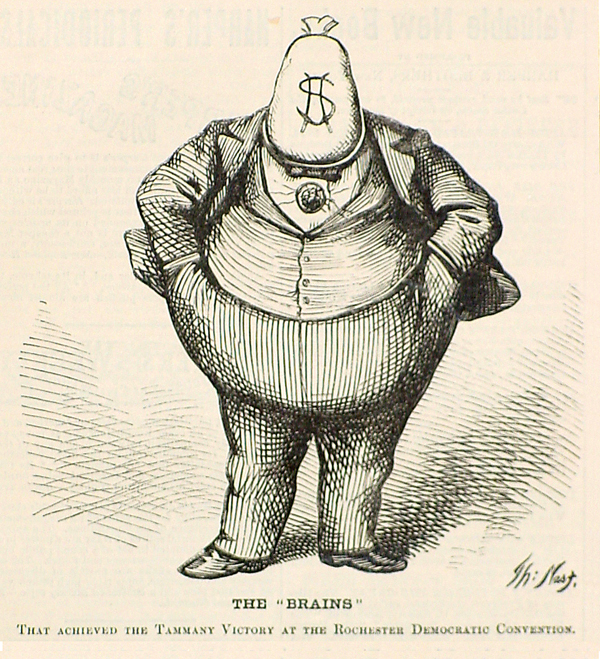
This figure — representing a corrupt businessman with a moneybag for a head — was essentially recreated verbatim into a small bronze statue by Otterness and implemented as part of Life Underground. Today, it is an ‘underground’ habit for New Yorkers to touch the figurine’s moneybag head as they make their way down the subway platform — which is described by Otterness as the commuters “playing the numbers.” In other words, this particular statue not only pays homage to the influential work of Nast in calling out and muckraking corruption, but it also serves, rather beautifully, as a ‘good-luck charm’ for subway riders of all classes.
Otterness wanted his installation to not just represent the upper classes of New York, however. He also put significant effort into representing the other side of that double-edged sword: the working class. In executing his intention to represent all the different walks of life that can occur within a New York City subway system, Otterness made sure to install alternative kinds of statues; in almost a scavenger hunt across the station, one can find various statues representing families holding oversized coins, commuters waiting for the train with (another) moneybag in hand, law enforcement, criminals, and any other type of person that could be found lingering across the subway system.
Not only did Otterness seek to represent a diverse array of classes, but he also wanted their inclusion to feel natural, or, as he puts it, “as visitors — like we are.” He wanted the figures to become a part of the ‘commuter flow,’ as a seamless and almost unrecognizable integration into the New York City subway space. In this sense, statues can be seen simply sitting down, waiting for the train, or walking down the station for a transfer.
When Otterness first began his work for this project, it was a slight struggle, for the 14th Street/Chelsea area was quite desolate; there wasn’t much need for young people — or any people, for that matter — to be getting off at the particular train station, making the western boundary between Lower and Midtown Manhattan frankly uninteresting and boring.
As construction began and was coming to a close on this project, however, Otterness claims the area began to take on a new life; “the art world started coming in,” as he puts it. New installations and projects began to grow around the area, particularly the Whitney Museum, which soon made this particular train stop a destination for young, striving artists and older art appreciators alike. The sculptor also makes note of the fact that the L train line became more of a necessity for young New Yorkers who were pushed out to Brooklyn following Manhattan’s increase in the price of living — which ultimately made for the 14th Street train station to be that much more of a destination for the many.
Today, at seventy-three years old, Otterness is still broadcasting and selling his works to galleries and independent buyers alike. Locally, Otterness’ 1983 sculptural narrative Battle of the Sexes is being shown at the Craig Starr Gallery through June 2026, located on the Upper East Side. This installation depicts the story of “a fierce combat between men and women for power and domination,” as described in the gallery’s profile.
The two-room show is made up of a variety of wall sculptures (with the company of one small depiction in the center of the main room) that are covered in white plaster and can still be seen to represent Otterness’ rather cartoonish style.
Life Underground is a piece that tends to fall behind the cracks of the New York Subway scene; in the scramble of the fast-paced and attentive MTA, it can be hard to detach from the frenzied world of a train station. But by the subtle, miniature characters that scatter the platform, one may, subconsciously, feel more positive and relaxed about their commute.
By taking a moment to detach from the bustling city, one steadily becomes aware of what can be found emerging from the sewer, maneuvering a support beam, or ducking under the gates just next to the turnstiles: one-hundred thirty plus small bronze sculptures scattered across 14th Street’s station.