

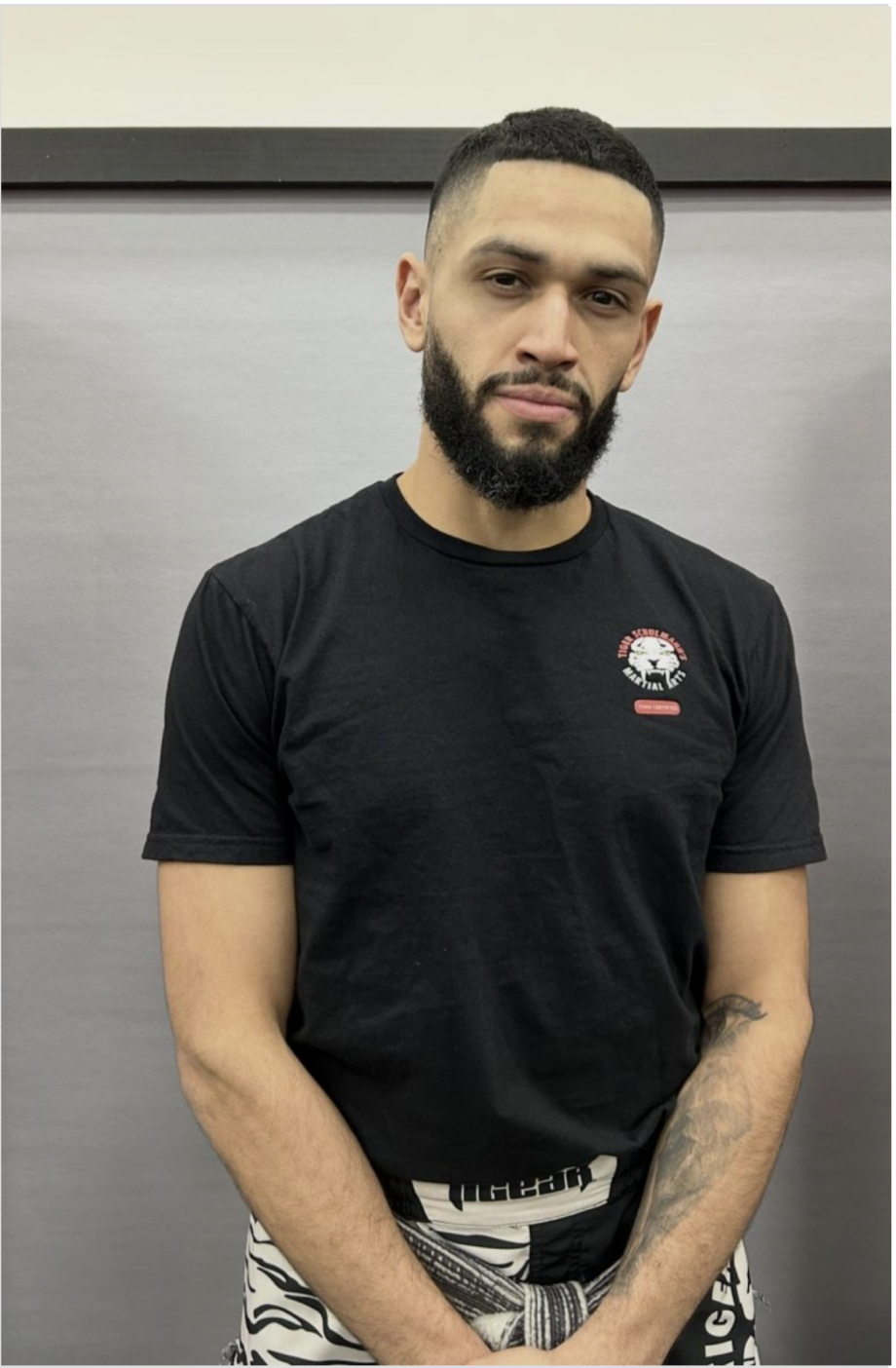
Two weeks before his 18th birthday, Juan Vides attended his first kickboxing class. Having just graduated high school, Vides felt irresolute about the direction he wanted to take his career. He went into the class with the intention to try it out and see what happens – an experiment. He was a beginner and recalls being largely uncoordinated. “I was probably one of the worst people in the class,” he said, adding, “although I wanted to be the hardest worker there.” This resolution from the get-go propelled him to continue his training. Although Vides was also juggling his job as a waiter and his studies in college – he was pursuing a career as a physical therapist – kickboxing became a passion. “I wanted to learn how to heal the body, especially from strenuous exercise. But every time I was in school, I couldn’t sit still – I just thought about training.”
Juan Vides’ growing passion for Martial Arts didn’t align with the professional career that he was pursuing, yet his love for the sport only grew. Dropping out of college was a difficult decision. It created a divide between Vides and his family, and forced him to support himself independently. He knew that he had to bet on himself, and the only option was for that bet to pay off. This mindset reframed his motivation and prepared Juan Vides to be a strong fighter. Vides quickly learned that discipline means self-regulation. He said, “What’s the best thing about homework? It teaches you to do something that you don’t want to do. Choosing to focus is willpower,” said Vides. “Are you willing to pay attention to that? When you choose to pay attention to everything, even the things that you don’t like, that’s when you become more successful.”
This mindset was tested a few years into his training. When Juan Vides was training at Tiger Schulmann’s Martial Arts in Chelsea, he heard that a coach there had a serious accident. A new coach was needed immediately; Vides took the opportunity and stepped up for the role. “I can do it.”
New to teaching, he winged it with his first class. It took a while for him to get his bearings. “I would blow my voice out in one class. I would talk so loudly that after one class, I couldn’t speak any more. I was wheezing the entire time.” Yet Vides continued to practice and refine his approach.
Juan Vides was inspired by his first coach and incorporated his teachings into his work. “I think that people that you hang out with have such a big influence on you, and he was definitely the biggest one.” He would listen to the coach speak for hours, drilling the class on certain skills, and teaching his students how to pay attention.
Over time, as his nerves went away, Vides began to add his personal touch to teaching, the most notable being the stories that he tells to his students. People said to him, “You have got to tell a story; tell a story about something.” He considered motivational stories about famous people, but he felt that this wasn’t something that people could relate to. So, he told stories about himself. “I’m just an average person. I’ve done some good things. I’ve done some bad things. I’ve made mistakes. So, the best way for me to end the class is to try to get people to not make the mistakes that I’ve made. Teaching kids, teenagers, adults, we all live the same lives – it’s just different settings. And this might help them out.”
“When I see people’s faces when I’m telling these stories, everyone’s nodding – people are finding it relatable.”
Over time, Vides learned a few fundamental lessons.
To have anger. “Anger is one of the best emotions you can have. I’m not talking about the anger where you want to break things. I’m talking about anger where people are doubting you, so you have a purpose to prove them wrong. It’s an anger that gets you to do things. It’s an anger that gets you to just start moving and figure something out.”
The best revenge is to be successful. “ A wise person is going to actually look for a way to better themselves, because the best revenge is to be successful. And I did do that – it’s a beautiful position.”
Be too stubborn to quit. “If your will is not strong enough, it’ll break you. If your will is strong enough, it’ll motivate you. It’ll make you mad, and it’ll get you to do something. That’s the one thing that’s always been in me — just too stubborn to quit, and too stubborn to not work hard.”
Juan Vides’ career began to pick up as he continued his teaching. At 20 years old, he fought in his first competition. It was a huge moment for Vides; he was so excited to fight. His girlfriend at the time and her father had come to watch him. When Vides’s competitor came into the ring — a muscular, 32 year old man — doubts settled in the mind of the audience. His girlfriend’s dad, who ridiculed him about committing his life to Martial Arts, grew worried. He is going to get hurt, he thought.
Juan Vides proved himself that day. In the first fight, he defeated his opponent decisively. After that day, he was not ridiculed again. People began to support Vides in his endeavors. “When’s the next fight?” his girlfriend’s dad would say.
Vides kept winning. But the more he won, the more he became afraid to lose. “I didn’t know how to lose,” he said.
Then, he lost. And he lost again.
Losing a fight is a critical learning stage for young fighters. Learning to pick oneself up again after a loss can be incredibly difficult in sport and in life. At that point in his career, Vides wasn’t sure how to be proud of a loss and continue training; he was devastated. His losses spurred a period of stalemate in his fighting career. For two years, Vides believed he was done with fighting. He continued his training, but faced self-doubt about competing.
“What’s the point of your training?” his friend asked bluntly one day. “The whole point of training is to fight.” Vides considered the statement. He wasn’t sure.
“Sometimes, people are placed in your life or conversations are had just for you to snap out of it.”
Vides signed up for a fight. The decision wasn’t easy; there was a period of struggle. “But just like anything else, once you experience it enough, you overcome it.”
Overcoming his self-doubt taught Juan Vides how to handle negativity. “When you’re very successful, people talk poorly about you all the time. If I don’t teach a class at [Tiger Schulmann’s], people talk poorly about me. “Oh, he’s getting lazy,” they would say. “Negativity is everywhere, and it can be hurtful if one doesn’t make the conscious choice to ignore it. A person could be loved unconditionally by many, but still be hated on by others. “Ultimately,” Vides said, “it’s what you think. Let them talk.”
“When you’re full of purpose, and there’s no time to even talk poorly about somebody.”
Vides trained hard and competed in kickboxing, jiu-jitsu and amateur MMA, which is a stepping stone into the world of professional fighting. It combines nine styles of Martial Arts and it prepares fighter for the next level. Professional MMA is a hand-to-hand full-contact sport that involves a blend of Martial Arts styles: Boxing, Jiu Jitsu, Brazilian Jiu-Jitsu, Judo, Karate, Kickboxing, Kung Fu, Taekwondo, and Wrestling. Fighters can win by Submission (SUB) – tapping out, Knockout (KO) – knocking a fighter unconscious, Technical Knockout (TKO) – fighters are stopped by the referee, or Judges’ Decision – the judges final call.
Going professional is extremely difficult. It is a full-time commitment, requiring around 2-4 hours of intensive training a day, 5-6 days a week. To go from a complete beginner to going pro means committing to the sport which can take 5-7 years of intensive training, at the minimum.
Ron Schulmann, a head coach at Tiger Schulmann’s, makes the final call on which fighter progresses to the professional level. It’s a high honor to go professional because you’re representing the whole team. Tiger Schulmann’s has highly decorated professionals who have competed in the UFC and other major fighting organizations.
Schulmann saw the potential in Vides and asked if he wanted to go into professional fighting. This was an incredible moment for Vides, who had trained so much to get to this stage. He is now one of the few fighters who have made it to that level. “ It’s fun to say that I’m a professional athlete. When people ask, ‘What do you do for a living?’ I have a choice. I can say, ‘I teach martial arts’ or that ‘I am fighting professionally.’”
Martial arts is a special sport where you can be a slow learner, or the least coordinated, and still be able to make it to the top. It isn’t talent in this sport that sets you apart the most; it is discipline. Juan Vides had discipline. “I actually like when things get tough,” Vides said. “I knew right away that that was the only time I could ever beat someone with talent, was when they gave up. And a lot of the time, that’s exactly what happened. Though, eventually, when you do something for so long, you get as good as anybody with talent.”
Vides compares this experience to the “Tortoise and the Hare” by Aesop, an Ancient Greek storyteller. The tortoise is a slow animal, and the hare is fast, and in this story, arrogant and over-confident. The two animals agree to a race, whereupon the tortoise wins because the hare tired-out. The moral of the story is that slow and steady wins the race.
That’s one story that Vides loves telling his students at the end of a class. When one of his students feels defeated, or feels like quitting, he tells them “go slow. Even if it takes you 10, 12, 15 years to get a black belt, you could still get one — you just have to be consistent.”
On September 19th, 2025, he had his professional debut. It was a very exciting fight for him because he was competing against someone that he had previously lost to. In the first round of his debut, Vides lost. His opponent had ended up getting him into the same position that he had beat him in when they were amateurs. In this moment, Vides had a choice — to let self-doubt over take him, or to ground himself. For a split second, he thought about the what-ifs. Then, he grounded himself. “This is self-betrayal,” he said.
Bruce Lee once said, “Don’t speak negatively about yourself, even as a joke. Your body doesn’t know the difference. Words are energy and they cast spells, that’s why it’s called spelling. Change the way you speak about yourself, and you can change your life.”
Juan Vides carries this motto with him. What he says about himself can be a manifestation of who he becomes. The second that you say you’re not good at something, you’re not going to be good at it. “I used to always say, I’m not good at remembering things — I forget everything.” And he did. “Now I don’t forget anything, because I stop saying that I’m forgetful. I stopped it. I stopped saying that. And now people are extremely impressed when I remember little things.”
In the second and third rounds of the fight, he beat his opponent cleanly and won the match. Vides reflected on this and said, “You could be successful, but the second that you feel self-sabotaged, it needs to be knit immediately. Because otherwise you will sabotage yourself.”
As a coach and a fighter, Vides takes all of his experiences and forms them into the lessons, which he tells and the stories everyone loves at the end of each class. Vides is so successful because he loves what he does, and he is committed to it. When he comes to class, he doesn’t feel like he’s working. “I’m just have fun,” he said. It wasn’t like this from the get-go, however. There were a series of challenges, both personal and external, where Vides could have made the choice to stop what he was doing. Instead, he continued.
Now, he is able to pass on his confidence and teach people the skills he learned over so many years of intense training.
Everyone comes into his Upper East Side Tiger Schulmann’s for a reason. Some want to learn self-defense, others want to build confidence. Some, he says, come here for no reason. Then, they find a purpose.
“Class is tough for a reason,” Vides explained. “I like making it tough. When it’s tough, that’s when you find yourself. You find yourself in struggle. Never in comfort. Struggle brings it out of you. It makes you uncomfortable. It shows you what you’re made out of.”
Focus is one of the most important aspects of what Vides teaches in his classes. In his advanced kickboxing classes, there are often 2-5 minute sparring rounds. Many students have trouble focusing for this duration of time, or they will procrastinate starting the exercise. Maybe they need to fix their gloves, get a drink of water, or ask their partner a question. Martial Arts teaches a person to notice this and fix it. It teaches a person to get better through struggle, persistence, and focus.
For Juan Vides, his career has never been solely about winning. It has been about betting on himself and continuing martial arts even when easier alternatives were available. In Martial Arts, the only way to rise to the top is to want to and to choose these options every single day. Vides’s success reflects his wholehearted commitment and passion to pursue MMA and coaching. This is what makes him the incredible fighter and coach that he is today.
This class is now dismissed. Osu!
“Choosing to focus is willpower – are you willing to pay attention to that? When you choose to pay attention to everything, even the things that you don’t like, that’s when you become more successful.”