

Five, Four, Three, Two, One, BRAAAAAAAP. Do You Believe in Miracles… Yes!
Each second felt like an hour, as an entire nation tuned in. Millions of Americans anxiously watched what commentator AL Michaels referred to as “the rarest of sporting events.” The United States and the Soviet Union were facing off for the right to play for the gold medal in the 1990 Winter Olympic Games in Lake Placid, New York.
One word can be used to define the Soviet Union Processional Hockey Team from 1963 to 1988: insurmountable.
During this stretch of time, the Soviets Won 7 of 9 Gold Medals in the Winter Olympic Games and won almost every IIHF (International Ice Hockey Federation) World Championship during the 1960s and 1970s. If you were to ask anyone with remote hockey knowledge, they would tell you that the soviets were the team to beat. It was nice to fantasize about, but actually beating hem felt frankly impossible. In 1972, Harry Sinden, the Head Coach of Team Canada said, “They don’t make mistakes. They’re tremendously skilled and tremendously disciplined.” Former NHL star Bobby Hull said, “They’re the best team in the world. There’s no question about that.” He was not alone on that opinion.
The American team, on the other hand, was quite the opposite, and it was clear that they needed a change. That is exactly what happened in 1979 when they hired Herbert Brooks from The University of Minnesota to be the Head Coach of the team for the Olympics. While of course he had a variety of eccentric outfits, and questionable coaching style, he quickly left a mark on the team. Colloquially referred to as “Herb,” he put together a roster with an average age of 22 years, making them one of the youngest teams in the tournament. Many of the players had never even played in a NHL game, and they were quite literally fresh out of college.
Initially, many of the players held each other in contempt. Coming from rival undergraduate hockey programs, many of them still had recent grievances from their college athletics career. The end of this mindset on the team is perfectly dramatized in an epic scene from the 2004 movie Miracle. Directed by Gavin O’Connor and starring Kurt Russell as coach Herb Brooks, it chronicles the journey of the team of underdogs and misfits. The scene begins with the team exhausted from drills after a poor 3-3 tie against Norway.
Between whistles, Russell’s character demands, “Who do you play for?” One by one, the players respond with their names and their colleges:
“Mike Eruzione, Boston University.”
“Jack O’Callahan, Boston University.”
“Rob McClanahan, Minnesota.”
Finally, exhausted, captain Mike Eruzione declares, “Mike Eruzione… United States of America.”
At that moment, the team stopped being divided by college rivalries and became one united national team.
Now, a team of young, effervescent, and most importantly, bonded team of Americans, they felt like they could win it all. They were objectively not even close to the most talented team in the Olympics, and one might think they were being naive if they thought they had a chance of winning. Yet, they did! It has since been known as ‘The Miracle on Ice.’
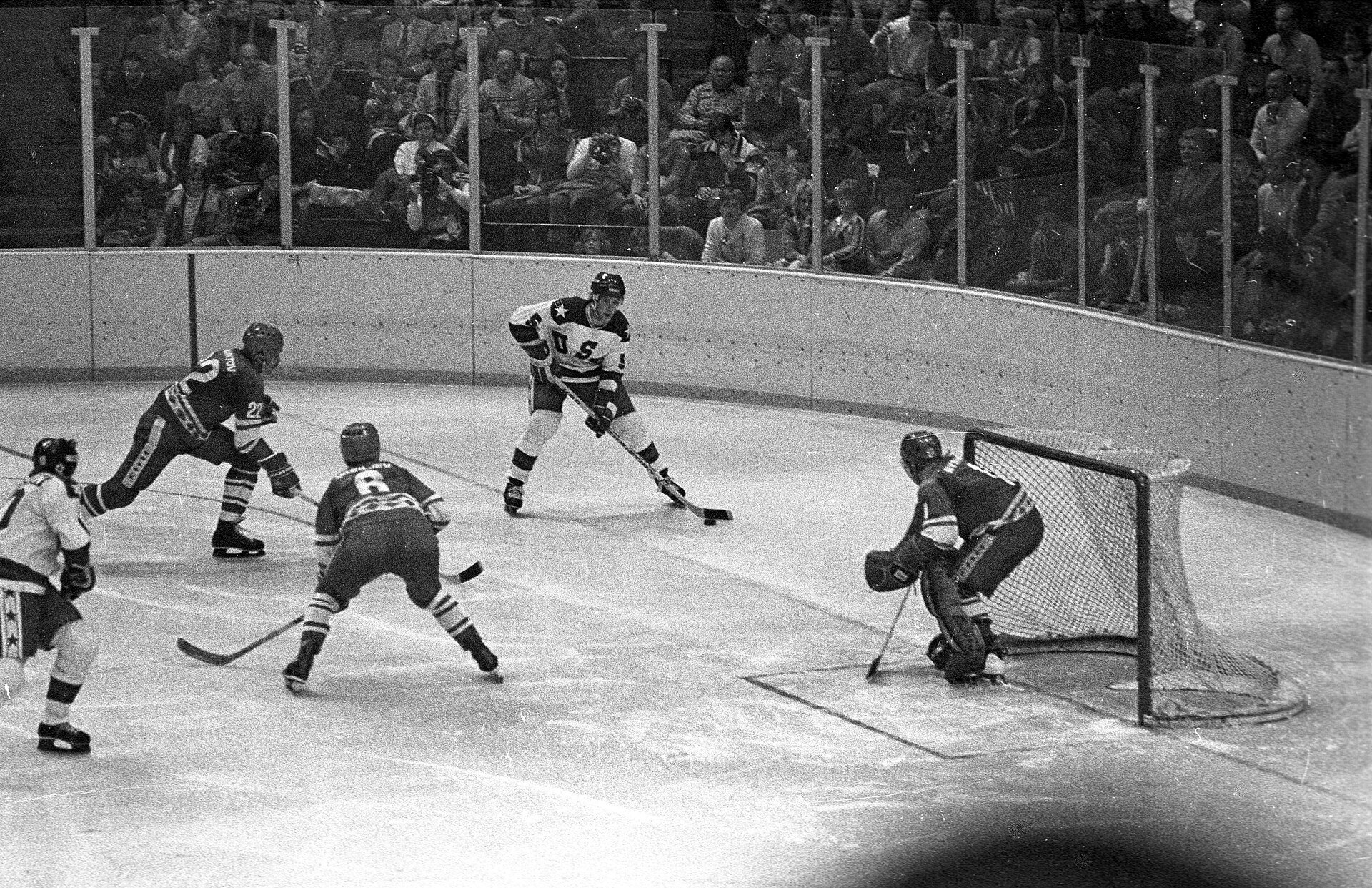
While Sports fans such as myself love lamenting over famous moments such as these, by far the most important part of the game, the part that Commentator Al Michaels said millions of people were turning into, was not that. It was the social, cultural, and geopolitical implications of the game.
To say the least, the 1970s was not a decade of much success for the U.S. With the Soviets ramping up military spending like never before, things seemed be spiraling further and further out of control. Domestically, stagflation had trapped millions in poverty; President Carter’s acknowledgment of his inability to end the crisis in his infamous “Crisis of Confidence” speech further entrenched in the minds of millions of Americans the poor trajectory their country was on. Internationally, the United States was facing a series of setbacks that further diminished its international standing. The United States’ inability to recover its hostages in Iran showcased severe vulnerability, and weakness.
While the game was of course symbolic and did not solve the pressing issues facing the country, these young Americans, many of them still in college, embodied a spirit of optimism, resilience, and community that deeply resonated with the public. In this sense, the game was never just about hockey — it was about identity, values, and the power of belief to overcome even the most daunting obstacles. In the midst of the Cold War, the Soviet Union represented a global superpower whose dominance extended beyond politics into global cultural influence. Every Soviet victory, no matter how mundane it could have been, felt like a blow to the American Spirit. For Americans, watching a group of young, largely college-aged players take on the seemingly invincible Soviets was about more than just hockey, it was about roaring national price in the midst of difficult times for everyone. As the crowd chanted, “U.S.A., U.S.A., U.S.A.,” each pass, shot, and save turned a ordinary hockey match into much more.
The Cold War did not end in 1980, nor did relations between the United States and the Soviet Union really change as a result of a hockey game. The issues that sparked the cold war in the first place, remained largely intact. However, as Kurt Russell (Starring as Coach Herb Brooks) put it, “it gave both those who watched it, and played it the ability not only to imagine, but to believe.”
Now as we fast forward by 46 years, for the first time in over four decades, the United Sates has just won the Gold Metal in Olympic Hockey defeating Canada 2-1. Of course, there is much that sets this completely apart from the miracle in 1980. During the Cold War, the vast majority of Americans felt that it was justified and permissible to attempt to “win” the cold war against the evil socialist USSR. However, it is incredibly difficult to ignore the insulting rhetoric of President Trump such as calling Canada the 51st state. Thus, it makes it difficult to view the U.S Winning the Gold Metal patriotically, as it feels that in many ways we have become even more of what we have been so desperately trying to avoid. Additionally, shortly after the victory in 1980, the United States started using professional athletes in the Olympic Games. This means that the team that just won the Gold Metal in Italy a couple weeks ago is entirely comprised of superstars from various NHL teams that do not resemble the original team in 1980.
Additionally, the Male Hockey team has severe criticism on social media and beyond for derogatory comments made, and encouraged, towards women, and female hockey in general. Specifically, President Trump was found through a leaked video saying to the men’s team that he “had to invite the women’s team” and that he “would be impeached” if he had not invited the women’s team (who has also won the gold medal). Following those comments, many of them were invited to, and attended the president’s chaotic, divisive state of the union speech to congress and distinguished guests.
Nevertheless, winning Gold is always historic, and given that this was the first time for the U.S.A> since the ‘Miracle on Ice,’ it deserves attention. Connor Hellebuyck’s incredible performance earned him the tournament best goaltender honors, along with the Presidential Medal of Freedom, as the team was able to enjoy the glory of winning the nation’s first hockey Gold Medal in 46 years.
Though we are no longer in the same world as when the original ‘Miracle on Ice’ happened, it appears that in the ever-changing world we live in, American hockey is still alive and well.
At that moment, the team stops being divided by college rivals and becomes one united national team.