

Your fingers cling to the edge of a hold. Your muscles shake, and the floor feels impossibly far below. Yet, instead of fear, there’s focus, and a strange kind of joy. Rock climbing is a sport that looks intimidating, but in reality, welcomes anyone, from complete beginners to world champions.
Walk into a rock-climbing gym, and you’ll notice something surprising–strangers cheering for each other like old friends. Chalk dust floats in the air, laughter echoes across the padded floor, and climbers trade tips about which “beta” (sequence of moves) will get them to the top. For a sport that looks so solitary, rock climbing has one of the most social and supportive communities out there.
While climbing gyms and brightly colored plastic holds might feel like a modern invention, the roots of climbing go back centuries. Early records of people scaling cliffs date back into the late 1800s in Europe, when mountaineers in the Alps began tackling rock faces as part of their expeditions. What started as a way to reach summits soon became its own pursuit. Climbers started to focus less on the mountains themselves and more on the technical challenge of climbing. By the mid-20th century, climbing was spreading worldwide.
Indoor rock-climbing gyms became popularized in the 1980s and 1990s, making the sport accessible to significantly more people. Instead of mountains or remote cliffs, climbers could practice their skills year-round on concrete walls, attached polyurethane holds that mimicked outdoor rock, and a secured crash pad in case of falls. These innovations not only boosted safety but also created spaces for the climbing community to thrive. Today, climbing exists in many forms, with bouldering, sport climbing, and traditional climbing among them. This evolution has since carried the sport from small local gyms to the world stage, where international competitions and even an Olympic debut in Tokyo 2020 now mark its presence.
What hasn’t changed, however, is climbing’s unique mix of physical challenge and problem-solving. Climbing definitely demands strength, but not just in the way people typically expect; it’s less about brute power and more about balance, control, precision, and positioning your body in the most efficient way possible. Every move requires coordination between mind and body. In a way, climbing feels similar to a vertical dance, where each meticulous movement must be intentional.
Many people think of climbing and assume that your arms are doing the bulk of the work. This, however, is a misconception. Pulling your entire body upward with your hands and back will quickly lead to exhaustion. As a result, simultaneously depending on your lower body for strength and balance is necessary. Climbing, in this fascinating way, heavily relies on manipulating physics to your advantage. Techniques such as flagging, where you stretch one leg out to the side to balance your weight, or smearing, when you press your shoe directly against the wall for grip, allow your body weight to be redistributed in support of your next movement along the wall. These strategies allow one’s hips and shoulders to turn to one side more, hence providing the climber with a boosted reach to the next hold.
Even while climbing, one has to be extremely aware of each and every limb’s position and stability. If you’re scaling up holds spaced far from one another, moving your leg up before your arm could create problems easily avoided with a different order of the same movements. Falling, for example, is inevitable if your center of mass is too far from the wall due to your legs moving first and being too close to your arms: your backside would stick out, creating a force of torque that’s incredibly difficult to overcome. Even the smallest adjustment can turn a climb that once felt impossible into one that feels achievable.
With all the physical intricacies overlapping in one’s mind as they climb, it’s not easy to “flash” (finish on the first try) a challenging climb. Part of the reason climbing’s culture is so special, however, is how supportive others are if they notice you struggling on a climb. Whether it’s breaking down a climb like a puzzle and giving advice on how to fit the final piece necessary to finish a hard route, or small fist-bumps from strangers after finally finishing the same problem, strangers quickly turn into friends within a climbing gym.
I notice this every day at my gym. Climbers hang from steep overhangs (horizontal climbs where you’re hanging upside down, almost like a bat) with only fingertips, hooking their toes on holds and clenching their core as they slowly make their way up walls. Others carefully work their way up starter routes marked by bright, chunky holds. Regardless of your level, if you’re on a beginner V0 (the easiest climb on a scale of V0-V17) or on a harder V11, all climbers inevitably fall; there’s no stigma around it since everyone’s experienced it, which helps in creating such a supportive environment. There’s a comfortable, yet exciting rhythm to it all: climb, observe, support, and try again.
Having climbed for over a decade, Alina Hurtado has scaled her fair share of walls. She agrees with this sentiment, describing how “in climbing, people will often cheer each other on, so I definitely think it’s a supportive community.”
While most climbers practice for the fun and challenge of it, the professional side of the sport pushes these skills to incredible levels. Watching elite climbers perform can feel unreal; they seem to defy gravity. Few athletes capture this sense of awe better than Janja Garnbret, a Slovenian climber who has become one of the most dominant and inspiring figures in the climbing world.
Her story captures the essence of what makes climbing so captivating. Born in Slovenia, she began climbing when she was only six years old, scaling walls with confidence and precision far beyond her years. By her teenage years, she was already dominating international competitions, known for her flawless technique and calm focus. In 2020, she made history by becoming the first woman to win an Olympic gold medal in sport climbing, solidifying her place as one of the greatest climbers in the world.
What makes Garnbret so remarkable isn’t just her physical ability: it’s her mindset. She treats every climb like a puzzle to be solved, describing climbing as being “in a dialogue with the roughness and edges of the wall.” When she falls, she studies what went wrong, then tries again with sheer determination. Her approach highlights one of climbing’s most universal truths: success is built on patience and persistence. Janja herself emphasizes that “99 percent of my training is falling.” It’s evident that even the best climbers fall constantly; what’s important is maintaining resilience and the invaluable ability to respond to the challenge.
Garnbret’s impact extends far beyond the competitions she wins. She’s become a role model for young athletes, especially women, showing that power and grace can coexist. Many climbers at local gyms cite her as the reason they first picked up chalk: proof of how one person’s passion can ripple through the entire community.
Her style is characterized by aggression and facing obstacles head-on. Instead of being static or taking a balance-focused, stable approach, she’s adopted her own dynamic method of committing to big moves with confidence. One of the best examples came at the 2023 Briançon World Cup, where she unexpectedly slipped early in qualifiers: an uncharacteristic fall that almost cost her a spot in the next round. But, instead of letting the mistake shake her, she regrouped, stepped back onto the wall, and climbed with explosive precision through semis and finals, ultimately winning the entire competition. Watching her swing from one hold to another during that comeback felt like witnessing art in motion; every reach and foothold seemed deliberate, fluid, and impossibly controlled.
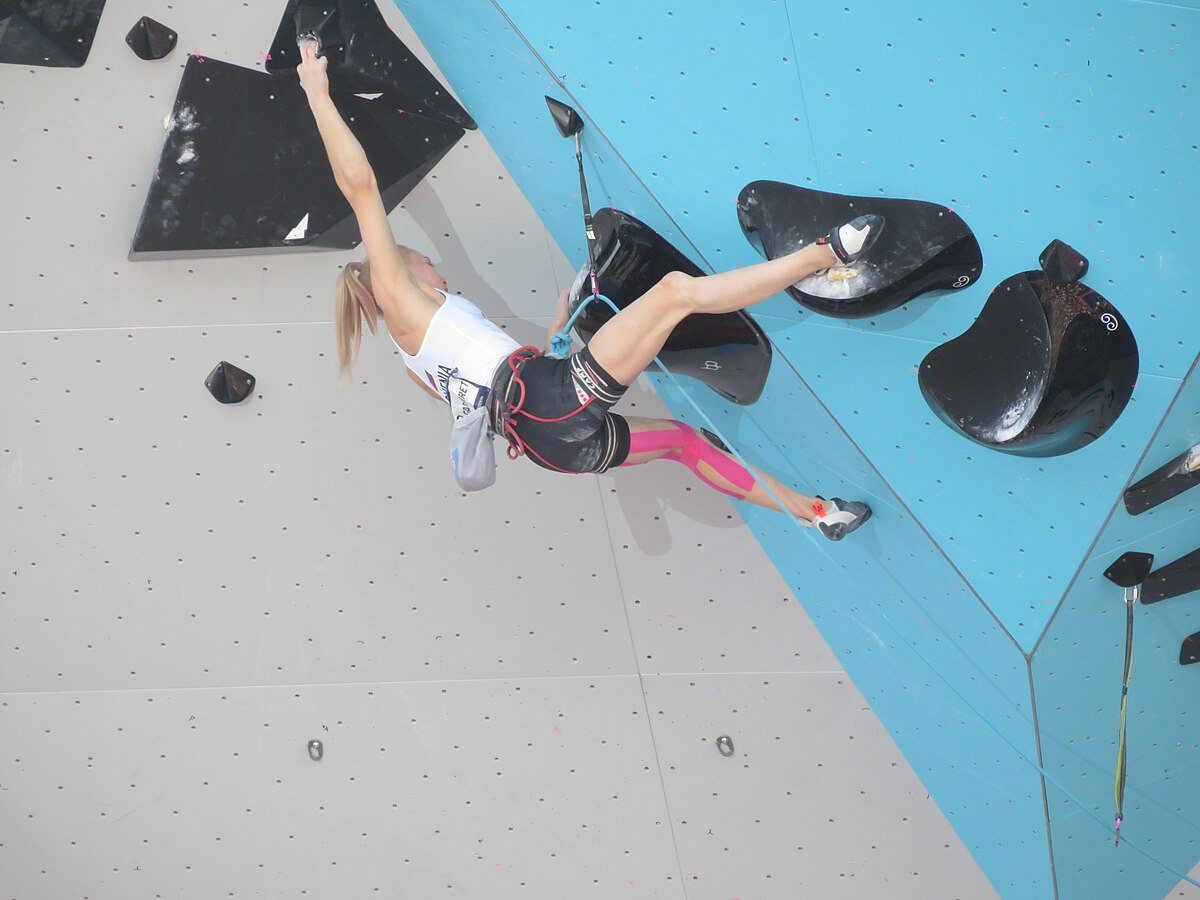
For many climbers, appreciating the beauty of the climb itself is a philosophy that extends far beyond the gym or the crag. Every route teaches something new, not only about technique, but about perseverance and mindset. Falling repeatedly on the same move forces humility, patience, and a willingness to learn. Each failure becomes a lesson, a piece of a larger problem to solve. Over time, climbing transforms from a simple athletic challenge into a meditation on growth and resilience.
“I think it makes you more resilient because you have to keep coming back to a problem and try to find other solutions to it,” said Hurtado. “It’s humbling. But you have to keep moving back to the climb if you really want to finish it, and that builds a unique mindset.”
The mental benefits are just as powerful as the physical ones. Studies have shown that climbing can reduce stress and improve focus, partly due to the fact that it demands complete presence. When you’re suspended on a wall, nothing else matters: not your phone, not your to-do list, not the noise of everyday life. Your mind quiets: your world narrows down on the next hold, the feel of the rock, and the focus of keeping the rhythm of your breath stable. Many climbers describe this as moving mindfulness, a space where thought and motion merge seamlessly.
“It’s 100% a getaway to stay sane and put the rest of life to the side,” Hurtado emphasizes. “Especially since it forces you to occupy your brain, so you can’t really be thinking about other things while you’re climbing.”
Ultimately, climbing is about connection: to your body, to your community, and to something larger than yourself. It teaches that progress doesn’t come from strength alone but from resilience, creativity, and the courage to keep reaching, no matter how far the next hold seems.
Ultimately, climbing is about connection: to your body, to your community, and to something larger than yourself. It teaches that progress doesn’t come from strength alone but from curiosity, creativity, and the courage to keep reaching, no matter how far the next hold seems.