
Across the United States, high school sports are commonly viewed as an activity in which hard work, dedication, and commitment matter more than money. Unfortunately, money lies at the heart of everything (including high school sports). These sports, which students love, can quickly become unaffordable between the cost of equipment and travel fees. And although joining a high school sports team tends to be free, hidden fees quickly accumulate, creating an issue of accessibility.
To further understand these challenges, I interviewed two Bronx Science Varsity captains.
In an interview with Lucas Flynn ’27, the captain of the Boys’ Varsity Basketball team, he states that “the team works better and harder together when everyone works together.” This emphasizes the key belief that unity within a community will only benefit the faction. He also claims that “as a team, we look to each other as brothers” which further emphasizes the extent of how close the team is. “When a member of the team is facing something difficult, we all try to help without adding pressure to the situation. A key part of being a teammate is understanding and respecting boundaries people place, and therefore, being able to successfully communicate and respond to others issues. We all come from different backgrounds, but once we’re on the court, that doesn’t matter. We’re one team.” These quotes are particularly powerful because they show that there are no limitations and negative connotations placed on student athletes based on their financial position. Whether they are struggling or not, it is important that the team is able to support each other in any way, shape or form.
The basketball team is open to people from all backgrounds and once you are a part of the team, you are a part of the team. There are no groups within groups-only a unified community.
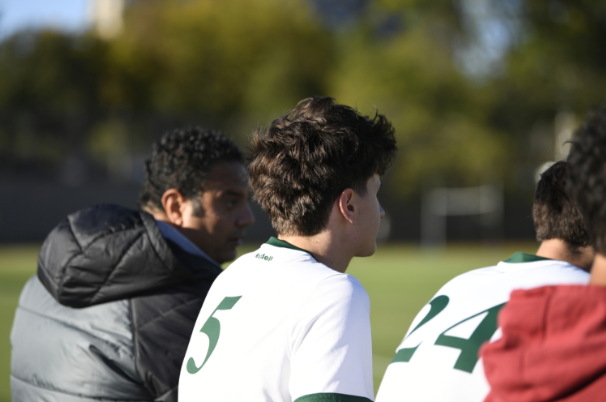
Next, I spoke with Matthew Winograd ’26 who is a two year captain of the Boys’ Varsity Soccer team. He had a similar belief to Lucas in terms of the community of the team and how everyone works together to create a more inclusive environment. Winograd said, “the most important off the field quality we look for in our players is maturity, because if you are not able to handle serious situations with people on the team in a mature manner this team is not for you.” This very strongly reiterates the importance of understanding one another on a team, especially if people are struggling.
In their earlier years, high school students often seek community when first trying to make friends. A quick solution to that is to join a sports team. School sports teams also teach students valuable skills such as discipline, collaboration, and unity. The skills learned when playing a sport competitively can be transferred into multiple fields of interest. With both in mind, one key question comes to mind: “How accessible are our sports teams?” The answer is that it varies.
At The Bronx High School of Science, some sports teams are extremely competitive and selective, whereas others are much more flexible to a wide range of skill levels. However, there are many other factors that help determine one’s decision to join a sports team. An important factor to consider for any form of team is the financial accessibility, and consequently what team is right for you.
Joining a sports team means committing yourself to the success of the team as a whole. To do so, you must be an active participant in a majority of the practices, take games seriously, and be a leader on the team. These qualities all work together to create a determined and successful team. To be able to do these things, you must consistently be prepared with proper equipment, attitude, and mindset.
The cost of being prepared and ready to be an active member typically varies by the sport, but it can accumulate quickly if you are not paying close attention. Sports like soccer and basketball only mandate uniforms and athletic shoes, which usually isn’t a huge expense issue. However, other sports like tennis or lacrosse are much more gear-heavy, and can be extremely expensive. For example, in lacrosse, having a stick, pads, gloves, and cleats are all absolute bare minimums, making it impossible to get around the cost of equipment. While not all of these essentials are individually expensive, the prices can pile up to around $400 (minimum).
Equipment brings a big question mark in the world of school sports since most schools barely provide the proper attire (jerseys, shorts), let alone the equipment needed to be an active member on the team. Schools are under no obligation to do so, placing a responsibility on their students to acquire the necessary equipment, which can be both expensive and hard to find. According to a GAO report, only about 75% of public high schools reported receiving public funding (state or local) for athletics. Most of their funding came from state or local sources, not directly from the New York City Department of Education.
These hidden fees are present in a lot of sports and can be a deal breaker for a lot of low-income students. This makes it unfair for kids who want to reap the benefits of being on a sports team, but simply aren’t able to because of their financial situation.
A common solution for this in many schools tends to be alumni funding. Although this can be extremely effective, it doesn’t necessarily attack the problem at its root, since not all schools have expensive alumni funds. This solution is solely a short term one because over time donations become less consistent and less sustainable to the students because donations are never guaranteed; therefore, teams can’t expect to receive them at all times.
Another issue with this solution is that it rarely accounts for a diverse set of sports. For example, an alumnus may want to donate money to fund the basketball team that they played on when they went to high school, but not the soccer team because they had no personal connection to it. Although this is still very helpful to the funding of the school as a whole, it isn’t a sustainable measure of financing for sports teams.
The issue present in most schools is the lack of a sports team union, and donation variability which can therefore lead to a poor spread of funding. At Bronx Science, there is athletics department representation in the budget, but it doesn’t directly translate to the goals that need to be met for many sports teams. Relative to other schools, Bronx Science is very fortunate to have an active Alumni Foundation that can help with resources and opportunities such as facilities and staff. However, a lot of other schools across the Bronx or in Queens don’t have this luxury. Some can barely afford to maintain fields or replace uniforms, creating a negative view of the sports communities. Although these schools are putting in the effort to maximize their sports availability, it has become increasingly difficult to meet team necessities with a lack of proper funding.
A lot of the problem comes down to effort. If a team can work together and organize fundraisers, it’ll provide a stronger sense of community and unity within the team. Being able to understand each other to a greater depth will bring the team closer as a whole. This allows for a more functioning, friendly, and welcoming environment for everyone.
Fundraisers and donations (although useful and impactful) can only act as short term solutions. A true long term solution revolves around the structure of athletics departments nationwide. Sports are everywhere, and therefore, everyone must lend a helping hand in the success of these high school teams. Schools in certain districts could share an athletic fund to help the less fortunate schools with funding, and in turn create an equitable and fair distribution of funding. However, it is important to understand that certain schools need more funding than others due to both the team size and the amount of teams at a school. Therefore, to successfully implement this solution there would need to be a system in place that can calculate how much each school needs and provide justification for all the schools to work together.
High school sports can easily be the life of school culture by uniting students to participate, watch, or help with games. However, when participation heavily relies on financial privilege, these values built on community and unity lose their meaning. Athletics truly aren’t always about winning. They are about winning together. And you can’t win together all alone.
High school sports can easily be the life of school culture by uniting students to participate, watch, or help with games. However, when participation heavily relies on financial privilege, these values built on community and unity lose their meaning.