
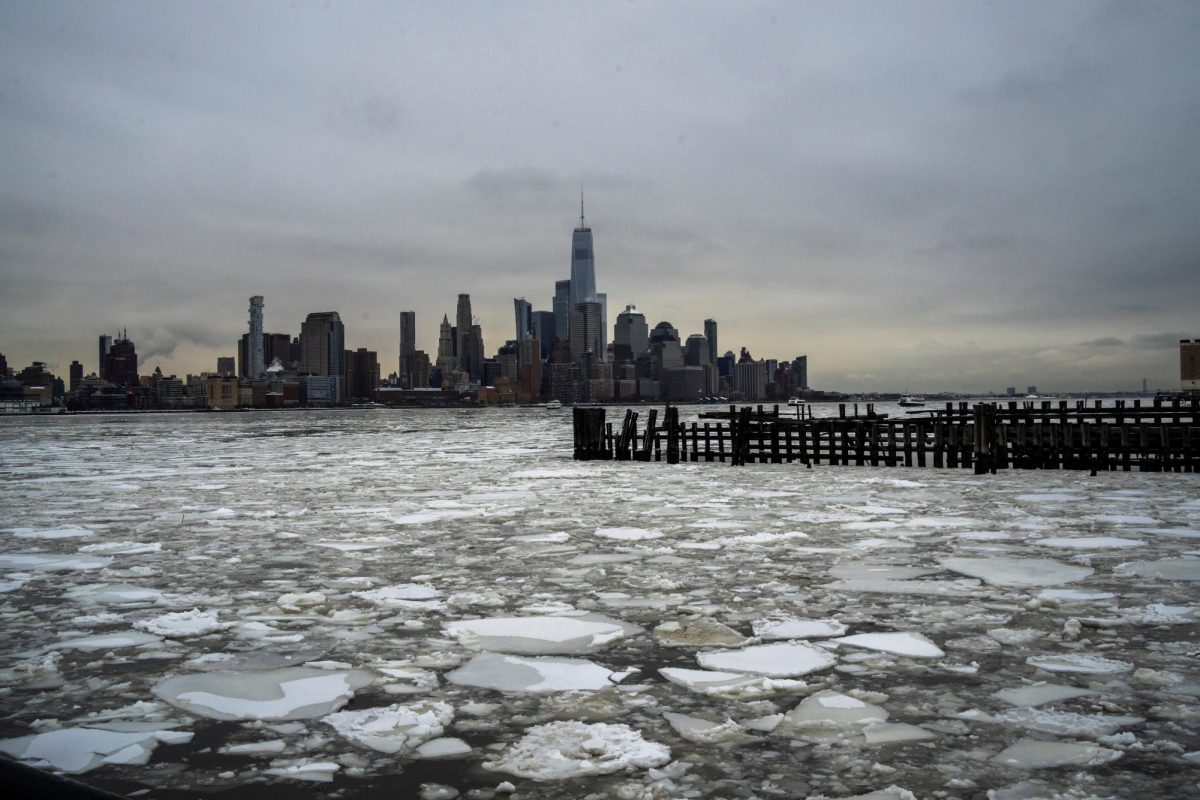
Have you ever heard of the 100 year flood? The term might sound like a post-apocalyptic book or movie title. You might also think of the various narratives throughout time of the world-destroying floods: the Greek myth of Zeus flooding the world, the Sumerian creation myth, or Noah and the Great Flood in the Book of Genesis. Scientists use this term to describe a major flood that statistically has a 1% chance of happening every year. However, this statistic will change as global warming causes sea levels to rise, temperatures to change, and flooding to increase.
During Hurricane Sandy, the 2009 superstorm that hit New York City, the storm pushed the ocean ashore causing fatal flooding. New York is expected to face more severe storms with greater frequency as climate change worsens. Urban planner and climate researcher John Shapiro reports that, “the biggest threat to New York isn’t storm water and flash flooding as one would expect, but sea rise.” Sea levels in New York City could rise by 6 feet by 2100. Imagine Lower Manhattan underwater, facing torrential downpours and grey skies. Shapiro confirms that by 2100, “two-thirds of the city’s sewer system could fail.” It doesn’t help that New York Cityis not permeable land, meaning water cannot pass through easily. According to Robin Sanchez, Director of Education of the Department of Environmental Protection (DEP), “Ss New York City developed over the last few centuries, much of the vegetation and wetlands that made up our natural environment were removed for streets, sidewalks, and buildings. Impervious surfaces replaced our green landscape and today cover about 70% of the city.”
2100 might seem far-off and unimportant. However, the inflection point for many areas of New York City will be earlier, around 2080. Shapiro explains, “People think 2100 means it is an issue for their great grandkids. It seems far away, but 2080, on the other hand, is just 50 years. High schoolers today will experience it upfront.” By 2080, coastal communities including Rockaway and Red Hook will be flooded; by 2100 they will most likely be uninhabitable.
Such flooding has devastating social and economic impacts. Members of coastal communities will be devastated, with those of lower income households facing severely limited options and high costs. In addition to displacement, the city’s energy infrastructure will be at stake. Shapiro states that, “Two-thirds of our energy infrastructure is on the water.” What happens when the infrastructure that powers New York City is underwater? What happens when people have to scramble to find housing in an already unaffordable city?
Shapiro warns, “Far Rockaway will be gone. Red Hook will be gone, Flushing Meadows will be gone.” These areas are what have been dubbed by the city as ‘priority areas.’ Hundreds of thousands of people live in these areas and according to Shapiro there are over 20,000 public housing residences in such locations. The city could face an even worse affordability crisis by 2080.
Shapiro explains that if the city waits too long to tackle the looming energy and infrastructure crises then there will be ramifications. “It won’t cut back on the police or the fire department. It will cut back on affordable housing and all the things that New York City does that other cities don’t normally do.” This is a major issue as the burden of flood damages has already fallen to low income households.
Flood insurance is very expensive. After major flooding in Kentucky in 2022 that killed 44 people, only five percent of the homes affected had flood insurance. Of the households affected, 60% were low-income. Economic barriers prevent residents from moving to higher ground, and we will see this issue worsen in New York City as rent prices hike and sea levels rise.
The Trump administration has revoked federal flood protections, leaving the responsibility to states which do not have the resources necessary. Shapiro explains that taxes will be raised on a state by state basis. He hopes that, “it will be a mansion tax and tax on the top 10% who benefit the most from our current economy that pollutes the environment.” However, it is inevitable that the burden will be placed on low-income coastal communities to some extent.
The issue is not one only faced by New York. Increased flooding risk has spread across the country and the world. Shapiro claims that “as one of the richest countries in the world we should be able to handle this. To put it into perspective, by NYC’s inflection point of 2080, half of Bangladesh and Mumbai will be gone. Combined, that is over 80 million people. For us it is only 20,000.”
The international community has begun to take action. Shapiro reports that London is rebuilding the barrier of the River Thames. Tokyo has created a giant cistern under the city and has begun building barrier islands. Unfortunately, the United States is behind. President Trump has completely reversed, or more accurately abandoned, U.S. climate policy. The EPA is even set to revoke its own funding and authority to regulate various greenhouse gases. Shapiro states that, “Trump has changed 20 years of gradual build up of laws and incentives, bringing climate progress back down to before Nixon in 1968. When you bring it back 50 years, you can’t just wake up the next morning and say everything that was destroyed just goes back to where it was. We lose the 4 years of him in office and then another 5 minimum, if not 10-15, of just getting back to where we were, which by then isn’t enough.”
Disasters serve as “focusing events” named so because they cause society to focus on preventing future disaster. Studies have found that the public is more likely to mobilize and policymakers are more likely to make substantial change after multiple focusing events. The accumulated knowledge from several events results in more action. Accordingly, lessons learned from focusing events decay as time goes on without another disaster. Shapiro confirms, “If there had been another Sandy level storm 4 years after, it would have resulted in voter demand that could make real change. However you talk to people today and Sandy is just a memory.” It shouldn’t take a disaster to rally people to action and unless we start making changes, another disaster will eventually occur.
Immediate action is necessary. However, politicians care about votes and do not wish to raise taxes to solve an issue society conceives as being one for future generations. Leaders would rather put their efforts towards more immediate problems. Shapiro adds, “You can’t blame them because they look at an immediate crisis, and present demands will always take precedence over a problem that is 50 years away.”
That is not to say the city isn’t taking action. The department in charge of managing storm water, the Department of Environmental Protection, has made progress in implementing green infrastructure and increasing sewer capacity among other endeavors. Shapiro explains that there are three main responses to climate change: mitigation, which focuses on reducing greenhouse gas emissions; adaptation, which focuses on altering how we live and work to adjust to changes in climate change like sea rise; and resilience, which focuses on improving the ability of communities to deal with disasters. The city has already implemented sand dunes and sea gates in high risk areas and has introduced projects including Rainproof NYC and the Lower Manhattan Coastal Resilience Project.
Furthermore, the city has created various green infrastructure projects to help minimize flooding damages. According to the current Department of Environmental Protection Director Lauren Sanchez, “gGreen infrastructure uses or mimics natural systems to collect stormwater runoff before it can enter the sewer system or cause local flooding.” This has included the creation of infiltration basins, green roofs and streets, rain gardens, permeable pavements, subsurface detention systems, and more. Thousands of these projects have been implemented across the five boroughs, primarily in Brooklyn, Queens and the Bronx. The DEP also provides financial incentives for installing green infrastructure on private property. In addition to this, the Bluebelt Program – engineered wetlands, ponds, and streams – has been implemented throughout Staten Island and parts of Queens and the Bronx. Sanchez reports that, “ impervious surfaces, like streets and rooftops, increase the rate, velocity, and volume of stormwater runoff. Bluebelts act as flood control measures by temporarily storing stormwater and protecting nearby homes from flood damage.”
The DEP is also designing cloudburst projects in Queens to handle sudden intense storms. These projects combine green infrastructure with grey infrastructure. Grey infrastructure is man made non-nature solutions including sewer pipes, permeable pavement, and underground water storage tanks. According to the DEP, cloudburst hubs are “hydraulically connected areas based on the sewer network.” Sanchez writes that, “more cloudburst projects are coming to Corona and Kissena in Queens, Morris Park in the Bronx, and East New York and Brownsville in Brooklyn.”
Progress is being made but at what cost? According to the DEP 2024 Stormwater Analysis, “In total, roughly $30 billion would be needed to address flooding in the 80+ Priority Areas (in current dollars). Roughly 60% of the total cost is associated with increasing sewer capacity and 40% for nature-based stormwater management solutions.” At a more holistic level, the DEP reports that it “has not yet estimated the costs for higher levels of protection in detail, but it is likely to be greater than $250 billion and in some locations there is simply not enough space underground to implement a solution.”
How do we raise hundreds of billions of dollars when so many politicians procrastinate taking action? Shapiro suggests that zoning and market incentives are a start but at the end of the day the city will have to raise taxes to prepare to displace coastal communities. Sanchez notes that the “DEP is investing tens of billions of dollars to improve water quality and support climate resilience to increased flooding risks.”
Every citizen and student must take action too. Sanchez also outlined seven things you can do to help.
- Throw out trash and recycling in the proper receptacles to reduce street litter.
- Use a reusable bag and water bottle to reduce reliance on single-use plastic (that often ends up as street litter and can flow to New York Harbor!).
- Dispose of grease properly to eliminate “fatbergs” from clogging up sewer pipes
- Take care of plants, trees, and rain gardens in your community that help absorb stormwater runoff.
- Conserve water – shortening your shower by just 5 minutes could save close to 10 gallons of water! Reducing water use during wet weather also puts less pressure on our combined sewers.
- Only flush the 4 Ps to help keep sewers and wastewater treatment facilities clear and flowing.
- Clear catch basins in your neighborhood before storms to reduce flooding or call 311 if they’re too clogged so the DEP can assist.
Shapiro said, “It is only a dystopian future if we don’t act now.” He recommends writing letters to local government officials because if the electoral demands change, then it will spread up the chain of command and action will be taken.
Urban planner and climate researcher John Shapiro said, “it is only a dystopian future if we don’t act now.”