

Knowledge has been carved into stone, painted on ceramics, and passed down through generations via artifacts long before the existence of textbooks and classrooms. Education has influenced the development of societies, from the academies of ancient Greece to the academic traditions of China and the Great South American civilizations. This tradition is still carried on today in museums, which are institutions that conserve artifacts of human history and turn them into educational resources for the general public. Museums continue to be more than just peaceful structures housing artifacts; they are active stewards of collective memory and pillars of society’s dedication to education, despite ongoing discussions about funding and cultural priorities.
In the United States, museums have played a key role in the country’s history. With over 35,000 active museums, America boasts far more than any other country in the world. Although this is a significantly large amount, a problem with funding has recently arisen. Museums in the United States simply lack adequate government funding, an issue growing worse since the beginning of 2025. These changes continue to develop as a direct result of the new Trump administration and its specific budget changes.
In the United States, museums’ reliance on government funding has decreased by up to almost 20% in the last 30 years, a major shift that has revolutionized the way these institutions receive funding. While museums across the country continue to receive less government funding, they are forced to turn to private donations and other forms of income. A comparison with European museums underscores the vast differences in public funding and government support. European collections receive significantly more funding per capita compared to the United States, with many European countries allocating 1% of government expenditure on museums. Though this might not seem like a large quantity, it is disproportionately greater than the 0.0046% of government spending that the United States directs towards its museums. Furthermore, European countries spend up to 200 times more per capita on this aspect of lifestyle.
Not only is there a major difference between the proportion of spending between American and European museums, but there is also an extreme difference in the reliance on government funding. In Europe, museums are subsidized by up to 95% from the government. This major difference between the two systems has shown that the U.S. government clearly falls short of keeping museums a priority. Thirty years ago, what was once a 40% reliance on income from government grants has since dropped to under 24%.
Unsurprisingly, European countries have shown their lasting commitment to supporting museums. This financial burden in American museums compared to European museums can be easily explained: Separated by different cultures, societal norms, and economic structures, these differences highlight the root cause of the financial dissimilarity that museums between the two societies face.
Europe is often referred to as a mix of both worlds. Countries across the continent are predominantly capitalist but contain strong socialist principles, including free health care, subsidized schooling costs, and even stronger workers’ rights protections. At the forefront of what might only seem like great policies are major trade-offs, the largest being that Europeans often face some of the highest tax rates in the world. Additionally, one difference in this shift of priority can be explained by the contrasting American perspective that often views art as a form of entertainment or accessory. In contrast, European values emphasize art as a necessary component of education. By viewing art in different ways, America has created an emphasis on privatizing the art sector, leaving the government to become less involved in its funding. Though Europe, on the other hand, continues to view art as a public benefit accessible to all. But is this lessening support from the current administration in America a direct result of the government falling short, or is it a change in perspective on what is to be prioritized?
The Trump administration is taking what seems to be a different approach to its views towards museums. The United States, which holds the highest national debt in the world at nearly 38 trillion dollars, has long faced concerns over fiscal stability. During his 2016 campaign, President Donald Trump pledged to address this issue, explicitly stating that he would eliminate the then 19 trillion dollar national debt within eight years. However, after being elected in 2024 for a second term, Donald Trump and his administration have since added 7.2 trillion dollars to the deficit, not only backfiring on his extreme promise but also making the issue worse.
Since this drastic promise, the stance of the administration has seemed to change, with a focus on encouraging economic growth to manage the deficit as opposed to his former idea of eliminating the debt as a whole. Part of the steps taken to “manage” this deficit have been changing the national budget. Since the beginning of last year, Trump has successfully increased spending on military and border security, all while making significant cuts to taxes, environmental programs, housing, Medicaid, SNAP benefits, DEI programs, scientific research, and education. These are just some of the major changes the Trump administration has made to help manage this deficit. Many of these changes were the effect of the “Big Beautiful Bill,” a congressional act signed into law on July 4th, 2025.
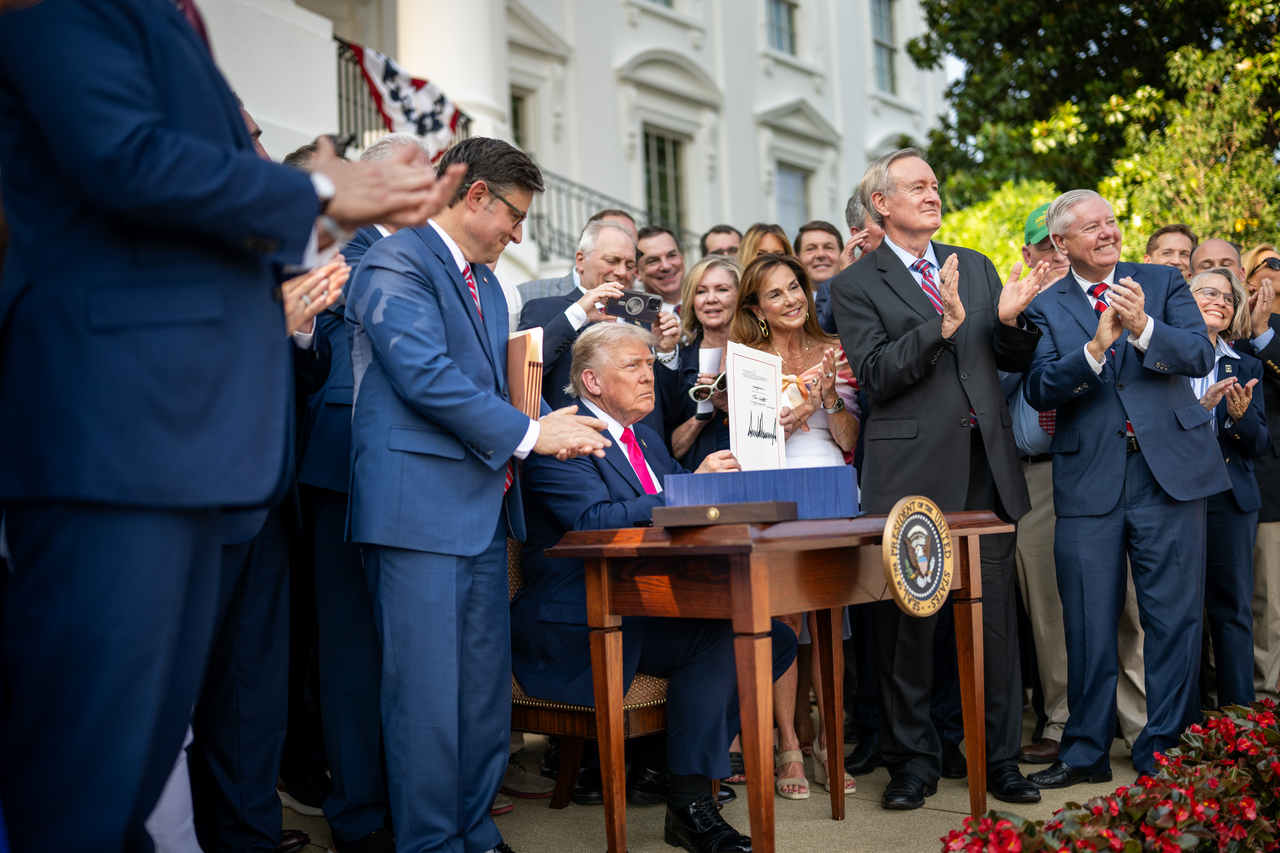
The Trump administration’s current aim has faced serious backlash from many politicians on the left, who have openly criticized these federal cuts. Opposition leaders have highlighted the growing change in direction of the goals this new administration wants to pursue.
One of the major changes to the federal budget has been education, which undisputedly is one of the most important aspects of a growing society, as it is what creates the backbone of a nation. Schools, institutions, and museums are ensured to be properly funded to create a strong centralized government, but recently, many actions have been taken against some of the country’s most important institutions, which is viewed as a direct attack on America’s literacy. Reporter Julia Halperin with The New York Times writes that “one-third of American museums have lost government grants or contracts since President Trump took office.” Museums are viewed by the Trump administration as one of the best ways to cut down on the national debt. To them, budget cuts towards museums do not affect American constituents and are a great way to make up for this major deficit. But in reality, these cuts reduced spending on culture and community-based programs rather than generating significant revenue for the government.
Across the nation, federal grants for museums continue to be canceled. Of those grants, the Institute of Museum and Library Services (IMLS) has seen immediate changes and cuts. Although this grant has a long application process and is earned by museums, contracts are still terminated. The resulting explanations from the administration often vary. From cutting costs to ending DEI programs, the administration has exercised its power to cut these federal grants. This comes as a major surprise, as the IMLS is widely regarded as one of the most crucial grant programs for both museums and libraries across the nation.
Many of these changes were ones I witnessed firsthand while working as an intern at the Museum of Art and Design on 59th Street (MAD). During my time there in the summer of 2025, I saw how cuts to grants directly affected the museum’s ability to support educational programming, staffing, and public events. Although I was given opportunities to meet staff members, give tours, and help coordinate events, these experiences also revealed how much the museum relies on grant funding to sustain hands-on learning opportunities. The skills I gained at MAD extend far beyond the classroom, yet these are the exact kinds of opportunities now being threatened by the new administration’s ideology to scale back educational and arts funding.
In an exclusive interview with Elana Hart, the senior grants manager at MAD, I was able to obtain a large amount of information about the specific federal grants that had been removed from the museum and what their effects have been. Hart said that all three of the major federal grants that she had worked to earn were terminated; these included the IMLS, NEH, and NEA. This forced the museum to redo a cost-benefit analysis for multiple exhibits during a time when the museum had already been struggling to gain back its visitor numbers and income since COVID-19. When discussing the future for museums like MAD, Hart said, “It’s important to know the state of museums, along with the loss and shift of federal funding, as funding in the coming year does not look promising.”
Later in the interview, Hart also explained the trickling effects that these changes will have on museums of all different sizes. Not only do museums receive income from federal funding, but state funding also plays a crucial role in museum subsidies. These state grants have almost become reserved for smaller museums that are struggling the most from these federal budget cuts. As a result, the museums in the middle suffer the most as there is a shortage of support from all funding sources.
Although some of these grants have been reestablished, the future of government funding is questionable. The federal government has exercised its power to terminate grants whenever they choose to, making it a major priority that is considered and accounted for by museums across the country to ensure they don’t face such haphazard losses. Museums continue to fight against what has been described as “devastating” and “frustrating” challenges. Notably, museums have reinstated numerous lost grant programs by challenging these terminations in court. But the Trump administration continues to put pressure on our established grant organizations. On March 14th, 2025, Trump even issued an executive order to eliminate the IMLS as a whole.
What began in 2016 as a vague promise to eliminate the budget deficit has since spiraled into one of the largest crises that museums and education in the United States continue to face in the 21st century. These budget cuts are reported to have barely made a dent in the Trump administration’s financial goals, but for museums, it’s the opposite. The cancellations of these grants have been critical and have the possibility of determining the survival of many museums across the country.
What began in 2016 as a vague promise to eliminate the budget deficit has since spiraled into one of the largest crises that museums and education in the United States continue to face in the 21st century. These budget cuts are reported to have barely made a dent in the Trump administration’s financial goals, but for museums, it’s the opposite. The cancellations of these grants have been critical and have the possibility of determining the survival of many museums across the country.