
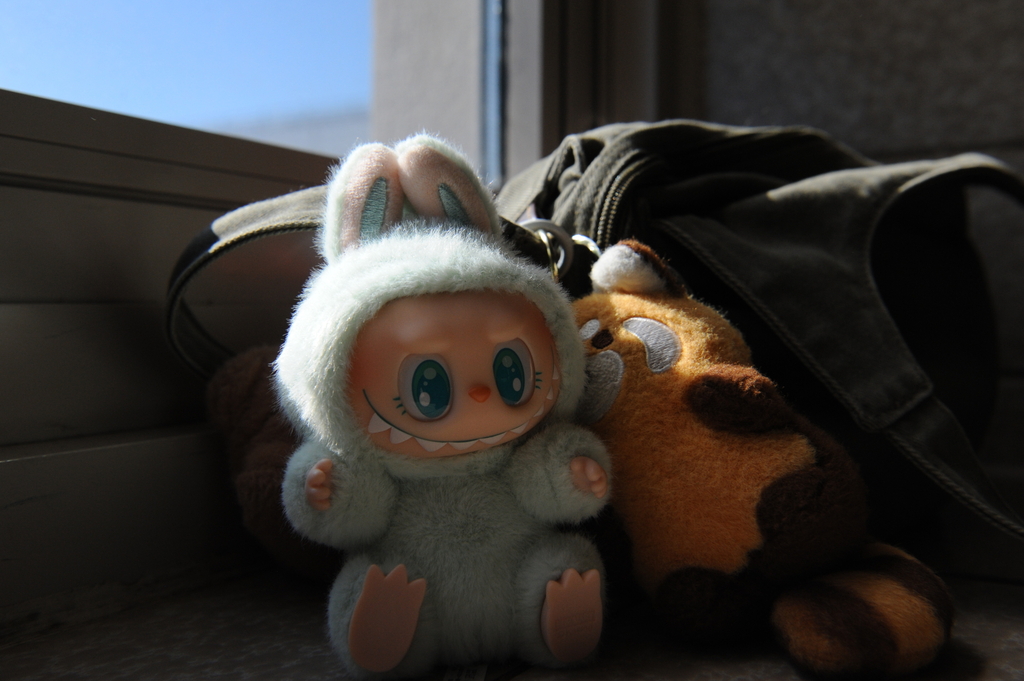
What do you feel when you open up a mystery box?
“I felt anticipation and excitement to see which Labubu would be in the blind box. When we opened the last blind box, my whole family held our breath and felt a lot of anticipation because we wanted to see if we got the special Labubu,” said Juliette Zhang ’28 when describing her experience opening a Labubu blind box set with her family.
In the summer of 2025, Labubus invaded people’s homes, news feeds, and appeared seemingly in every waking moment of their lives. This thirty-dollar doll, created by Kasing Lung, seemed to have taken the hearts of the people, as massive unboxing videos of these dolls spread across the internet. Nowadays, Labubus are popping up on people’s bags, jeans, and everywhere else as a sign of trendiness.
As this trend continues, many people have raised the environmental and economic concerns that Labubus bring. Massive unboxing videos of collectables waste extensive amounts of plastic. Many people call out the environmental damages that these videos bring as they feel that people are engaging in unnecessary overconsumption. With more people on the internet discussing the problem of overconsumption in today’s generation, Labubus are getting caught in the crossfire.
The Lipstick Effect, first coined by Estee Lauder CEO Leonard Lauder in 2001, is a phenomenon that describes where consumers will purchase smaller luxury objects, like lipstick, in times of economic uncertainty. As economists and psychologists explain, this phenomenon happens because people are more hesitant to buy luxury goods, go on vacations, or invest in these times. Lauder noticed this trend after he saw an increase in lipstick sales after the 9/11 terrorist attack. However, this phenomenon goes back to 1999, when Juliet Schorin described the effect in her book, The Overspent American: Why We Want What We Don’t Need. The Lipstick Effect isn’t necessarily a new phenomenon, but rather a reoccurring event that may or may not exhibit signs of a recession.
With fashion trend after fashion trend and new “must-have” accessories every week it seems that the Lipstick Effect is in full swing. The Labubu craze, and the rising popularity of decorating one’s items with small accessories all point to the Lipstick effect. Many influencers on social media are bringing light to the problematic normalization of overconsumption, especially since the recent popularity of the Labubu. However, is this just an innocuous correlation between Labubus and a recession, or should Americans be preparing for one in the following months?
In the past few months, Americans have been through many new changes – both economically and socially. With president Trump declaring a new 10% baseline of reciprocal tariffs on more than 180 countries in April of this year, many economists theorized that another recession may hit America once again. While tariffs are regular taxes on imported goods, reciprocal tariffs are different as they match the foreign country’s tariff on their goods. As a result, countries scrambled to make new trade deals with Trump before the August 30 deadline before the reciprocal tariffs would be in full effect. As the deadline crept closer, Trump closed off new trade deals with Japan, South Korea, Cambodia, and many more countries. When the administration released details about these trade deals, economists were again left wondering how this would ultimately affect the U.S. economy – both in the long and short term.
The last official recession was during the pandemic in 2020 and was one of the shortest recession America ever had, only lasting two months, as declared by The National Bureau of Economic Research (NBER), a private, nonprofit organization that conducts unbiased economic research. Although short, the COVID-19 recession led to a sharp decrease in social, economic, and political instability throughout the globe. The unemployment rate in 2020 surged as layoffs continued, income losses only grew globally. “The consensus among many macro forecasters is that risks of recession or growth stagnation have meaningfully increased, with tariffs as a central stress point in the outlook,” according to Isabelle M. Delalax, an adjunct professor Economics Department Dyson School at Pace University. The Trump administration’s tariff policies and its macro policies forecast a drag on growth. Although data shows that the American economy had a significant resurgence of approximately 3.8% growth in the second quarter, according to the Bureau of Economic Analysis, many economists theorize that the risk of a possible recession has increased due to tariffs adding more stress to the economy. However, the tariffs alone are not the only factors for a possible recession. When Trump first announced the reciprocal tariffs in early April of this year, the world was in shock. Today, the American economy relies heavily on foreign trade and investors, and now there is an investment hesitancy due to the policy unpredictability of the tariffs.
Prices may have gone up this year, but we are yet to see the full effects of the tariffs.
As a result, when the tariffs were first announced, many companies bought stock, without the tariff increase, from foreign countries. Now, as their stocks dwindle with each month, corporations are forced to buy stock with the additional tax. This not only attributes to the increase of market volatility and investment hesitancy, but shows that America has not seen the full effects of the tariffs. For this reason, the International Monetary Fund (IMF), and other major forecasters like the World Bank Group, have warned that economic growth will face drag from the tariffs, policy uncertainty, and inflation in the future. Not only does this affect your favorite trends, but can stop the current influx of micro trends as a whole.
Now if there really is going to be a recession, it would spell disaster for millions of people across the globe – not just American citizens. Domestically, millions of Americans would be put out of jobs, have increased financial debt, and be thrown into an economic disaster. Yet we are also living in a highly modernized-interconnected world. A recession in the U.S. would disrupt global trade, and trigger a wider global economic crisis such as the one in 2020 and 2008. The U.S. dollar is the dominant currency in both international trade and the financial market. A sharp decrease in the value of the dollar would send economies crashing down, and stop already fragile economies from developing.
So, how does this connect to the Lipstick Effect and Labubus? Although we are in a period of economic uncertainty, it may be wiser to look at other economic factors other than the sales of Labubus. Professor Delalex and many other economists claim that the influx of smaller luxury sales may be because of marketing strategies and the broader general consumer interest, not because of actual recession indicators. Additionally, it is not as strong of a macro indicator as gross domestic product (GDP), unemployment rate, and number of exports. Although an interesting psychological phenomenon, it shouldn’t be accepted as the central sign of a recession.
Instead, we should look toward the factors that make up GDP. These include the sum of personal consumption, total company profits, net exports, and total government spending. The tariff increase is the most likely to risk a recession, along with “… citing inflationary effects, supply chain disruptions, retaliation, and policy spillovers,” said Delalex. The increase of prices, in addition to the Federal Reserve’s reluctance to cut rates inhibit companies and consumer margins, meaning the profitability of each individual. What’s more, less consumer spending and consumption in unessential goods dictates a drag in economic growth as it indicates that the lower to middle class are under stress. If these factors started to go down, it would send a stronger signal for a recession.
Today, many of the prominent economic organizations forecast that the probability of a U.S recession is around only 35-40% for the next twelve months. So, don’t feel bad about buying a Labubu – it’s probably not contributing to a recession anytime soon.
With fashion trend after fashion trend and new “must-have” accessories every week it seems that the Lipstick Effect is in full swing. The Labubu craze, and the rising popularity of decorating one’s items with small accessories all point to the Lipstick effect.