

As I look down, I can see 3,000 feet below me. I view the vast plains of grass with small, slight specks, which are cows, horses, and lambs freely grazing. I see the bright blue sky in front of me, as a slight gust of wind grazes my face. A chill runs down my spine, but not because of the frigid temperature on top of the mountain, but because of the scenery that I am viewing in front of my eyes; it seems all too surreal.
Over the past couple of summers, I have spent weeks traveling across Iceland. Considered a Nordic nation, this country has been rising in tourist popularity, both for its scenic views and for its adventurous activities. For most of my life, my vacations consisted of warm sunshine on sandy beaches, and I had been originally hesitant about spending my summer in the brisk 50℉ (around 10℃) climate. Most of the weather around the middle of August to early September consisted of the occasional sunshine, with very frequent cloudy skies and downpour. A raincoat and waterproof shoes are a must! However, my trip to Iceland has altered my viewpoints on enjoyment and relaxation.
Iceland
I stayed a total of ten days in Iceland, which at the beginning felt too long to me, as a person who enjoys shorter trips. Despite my preference for shorter trips, I left wanting to remain for even longer; Iceland frequently has this effect on travelers. We followed a very common itinerary amongst tourists, which consisted of renting a car at the airport and driving in a loop around the entire country in order to cover all of its landmark destinations.
My family and I landed at Keflavík International Airport in Iceland, which is around 50 kilometers outside of the Reykjavik city center, after a red-eye flight, early in the afternoon, so that we would have the whole day ahead of us. Reykjavik is the capital city of Iceland, as well as one of the country’s only major cities, and it’s where 64% of its population resides. There, you will find a selection of tourist shops, hiking gear, and shopping malls.
After roaming and window-shopping, it was time for a meal. Signature Icelandic dishes include lamb, freshly caught fish, rúgbrauð (rye bread), skyr (a thick yogurt-like dairy product), and soups. Plysur (Icelandic hot dogs), lamb stew, the national dish hákarl (fermented shark), dried fish (harðfiskur), and kjötsúpa (lamb soup) are also signature dishes.To cater to tourists, many restaurants also served Icelandic pizza, fish and chips, and burgers. Some places even served puffin, which both surprised and intrigued me, but I came to find out that it was not a usual dish, and was mainly created for tourist consumption.
Near and in the city center of Reykjavik, the two most popular attractions are the Blue Lagoon and the Hallgrímskirkja. The Hallgrímskirkja was even grander in person, with its looming and striking architectural design. It remains an Evangelical-Lutheran church, and it dominates the skyline in the heart of Reykjavik. Likewise, the Blue Lagoon is a natural sauna that is popular for the appeal of its light, pale blue milky water, caused by the silica found in the water that reflects the wavelengths of sunlight. As these landmarks are usually packed, we opted to visit them later at night in order to have smaller crowds. The experience is highly sought after and spoken highly about, as the lagoon’s warm waters are deeply soothing and relaxing.
For the next stop, we drove to Thingvellir National Park, Gullfoss, and Haukadalur Geothermal Field in Selfoss. Thingvellir (in Icelandic: Þingvellir) offered a gentle introduction to our trip, with a small loop-around walk, with many small waterfalls, lakes, and rocky edges. At the top of the walk, you will see small ponds and lakes with flat land stretching across the horizon, with the addition of small, faint mountains in the distance. It was a rare day of bright sunshine with clear skies. The hiking paths were busy, but not packed. Taking the long route, we eventually lost most of the other visitors and passed by the small Þingvellir Church and some other old stone shelters. Unknowingly, until the end of our trail, we had discovered that Thingvellir was famous not only for its scenic route, but also because it is the only place in the world where you can stand and walk between two continental tectonic plates. It is featured in a rift valley, where the plates move and change the scenery each year. For my experience, the rift was jagged and rocky, with moss and other greenery growing on top it. The Almannagjá gorge is featured in the National Park as that meeting place, a narrow valley where both the North American and Eurasian plates remain.
Moving Southwest, in the canyon of the Hvítá river is Gullfoss. Made of two waterfalls of different sizes, the lower one with a drop of 21 meters and the upper one with a drop of 11 meters. This location is incredibly popular. The day continued to be sunny with little to no clouds; the abundance of falling water created a myriad of overlapping rainbows coming from every direction. The special thing about Iceland is that, regardless of season, the views remain equally breathtaking. In the winter, the waterfalls freeze over in order to create icy white caps with hues of blue ice. The summer views showcase vibrant green grass and vegetation growing all around the edges of the falls.
A majority of traveling in Iceland is driving on narrow roads that stretch over grassy plains for kilometers, as far as the eye can see. But out in the middle of these pure green fields, the monumental Seljalandsfoss waterfall is a natural beauty. By the time we arrived, it was near sunset, and the orange and yellow hues in the sky that slowly overtook the light blue had illuminated the waterfall. Like many waterfalls in Iceland, visitors have the opportunity to walk behind or directly underneath the waterfall. Clashing with the sunshine, the rushing streams of water atop the cliff had created a bright, cascading rainbow. At the foot of the fall, big rushes of water would hit you, and after, it would look like everyone had endured a downpour.
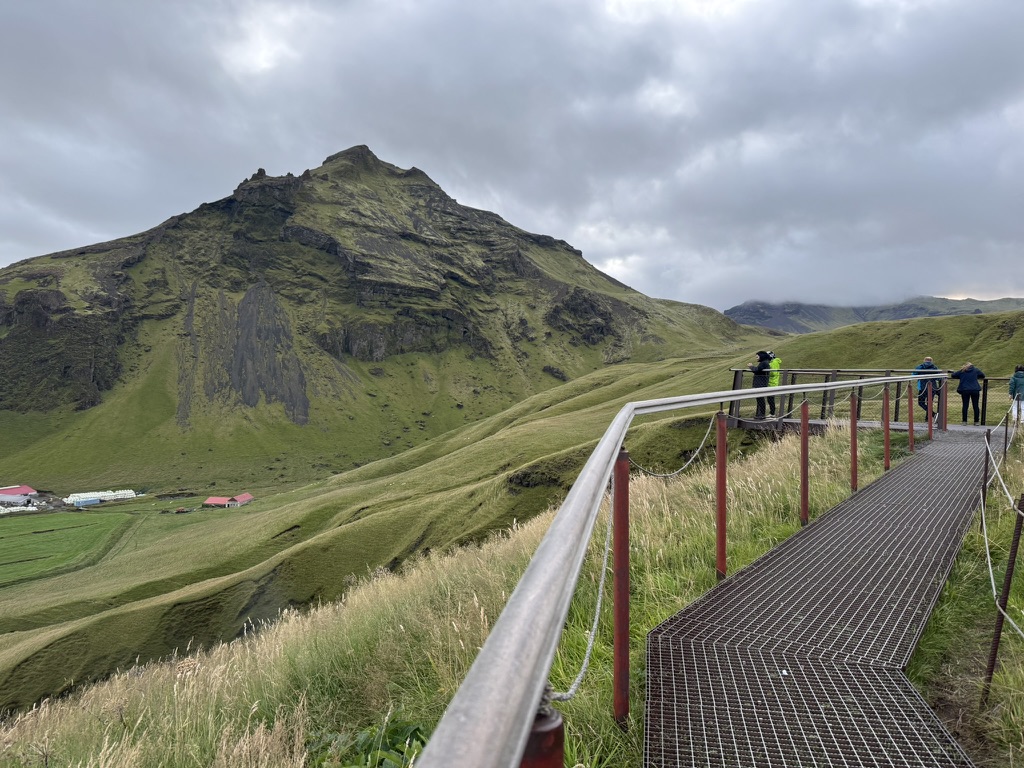
Iceland doesn’t lack waterfalls, as Skogafoss is right around the corner. One of Iceland’s biggest waterfalls is on the Skoga River. At 60 meters tall and 25 meters wide, the waterfall is wedged right in between lush greenery. There is a singular thin metal staircase that leads up the mountain as far as the eye can see. Rams graze right alongside the steps, with no regard for humans’ presence in their environment. As you reach the top of the pathway, there is a small ledge for viewing, looking over the crest of the fall. From the peak, you can view the edges of the mountains in the distance and all the small cars and dots of figures many meters below. The cold breeze compels internal reflection as you stand above the momentous sight.
Straying away from waterfalls, examples of unique views are the beaches, which are composed of completely black sand. The sand is composed of eroded volcanic material, typically basalt rock formed from the cooling and solidification of flowing lava. As the lava hit the cold ocean water, it crystallized into dark fragments, which were further eroded and weathered by the wind and waves. Reynisfjara is one of these beaches, just along the side of the road, near the town of Vík. On top of the rocky monuments that towered over everyone, small birds perched. Soon, they were going to migrate South and seek warmer climates. As it was only the end of August, remnants of green moss and grass remained on top of the cliff. The waves rushed with brilliant speed, creating a quick and harsh ebb and flow. The air was brisk, and the beach was untouched past a few meters away from the entrance point, where most visitors turned back before they reached a distance of more than a few steps. The black beach was composed of both smaller rocks and larger pebbles, all cold and wet from the rushing waves that reached high up the shore.
Similarly, a short drive away was the Diamond Beach, also known as Fellsfjara. Still made up of small black and grey rocks, this beach had an additional marvel. The name of the beach is reminiscent of these ice pieces; these glistening ‘diamonds’ were perfectly clear iceberg chunks that originally came from the Breiðamerkurjökull glacier, near the Jökulsárlón Glacier Lagoon. These chunks float from the glacier and eventually make their way onto shore.
Beyond this, as we move further north, Hverfjall stands in a wide field. With an elevation of 1,378 feet, there is no way to miss it. It is considered a tephra cone (also known as a tuff ring volcano), where it was created by a phreatomagmatic eruption in 2500 B.C.E. It is a crater of one kilometer in diameter made up of rubble and volcanic rock. The hike is steep, but upon reaching the summit, you can see the sediment cave into the ground to form the crater.
Just along the road, Grjótagjá Caves are hidden near Lake Myvatn in Northern Iceland. It is a small lava cave where a geothermal hot spring remains. As tourists all gather to climb inside the crevice to enter and view the spring, the sight is breathtaking. The water has a naturally light blue hue, and if you were to bend down and touch it, it would feel incredibly warm to the touch, as if it were an artificially heated sauna. This warm water made it suitable and appealing for bathing up until the 1970s, but this activity is no longer permitted. An infamous outlaw, Jon Markusson, used to live and bathe in these caves in the early 18th century. When bending down, you could see the steam rise up from the water and warm up the cave. This steam is most famously known for being the inspiration for an iconic scene in the HBO series Game of Thrones.
Akureyi is a bustling city that is beyond the quiet serenity of the outside plains. We stopped there for only a night. That evening, the small town city center hosted a little music festival, where Icelanders crowded in front of the stage that was set up. Many rock and hip-hop musicians played, while people of all ages congregated to view. Surrounding this area were a large number of restaurants from which to choose. In our hostel, even after the festival ended, there were people laughing, talking, drinking, and singing on the streets until the early morning, around 3 a.m. It was unexpected, but the nightlife scene was incredibly prevalent and alive. Bright lights frequently flashed past our windows against the dark skies. Eventually, we woke up after the noise died down and began our trip again. This aspect of Iceland was unexpected, but surprisingly refreshing. It seemed like a separate world from the quiet solitude scenery.
Clashing with the sunshine, the rushing streams of water atop the cliff had created a bright, cascading rainbow.