

At The Bronx High School of Science, curiosity does not end in the classroom. Rather, it begins there. Every year, around 3,000 students walk through its hallways, not just as learners but as budding researchers, thinkers, and innovators in training. The school’s celebrated three-year research program, beginning in a student’s sophomore year, and recognized nationally for producing Regeneron Scholars, national finalists, and even future Nobel laureates, has become one of its defining pillars, turning teenage curiosity into real-world scientific exploration.
For Bronx Science, research is more than an elective, it’s a mindset. During their ninth grade year, every student is given a semester-long Research Literacy course, a foundational experience that teaches them how to question, design, and test the world around them. From designing mock experiments to analyzing real datasets, students learn that science isn’t about memorizing answers, it’s about asking the right questions.
By sophomore year, the program evolves into something more ambitious for those students who are interested in enrolling in the Research program. Students who excelled in their Research Literacy course and show a deep interest in independent inquiry can apply to the three-year research track, a rigorous and hands-on sequence that replaces standard courses such as rhetoric and coding, with an in-depth commitment to scientific study. Around a third of sophomores continue in the program, dedicating the rest of their high school years to the pursuit of a single, original research question.
The research program is designed to mirror the progression of professional science, from early learning to independent discovery. Sophomore students dive into lab techniques, data analysis, and proposal writing while exploring potential mentors and topics ranging from microbiology to number theory. By junior year, independence takes center stage as students refine research questions, conduct experiments, and write academic papers, often presenting their findings in small seminars that mimic the feel of university research groups.
What makes the Bronx Science research program remarkable is its sheer breadth. Students can choose among four primary tracks: Biology, Physical Science and Engineering, Math and Computer Science, and Social Science, each offering a unique path to discovery. Whether it’s studying gene function, building prototypes, modeling algorithms, or analyzing human behavior, every student learns to think critically and creatively.
During the summer, many students work at the Stanley Manne ’52 Research Institute™ or in university labs across New York, applying their growing expertise in professional settings. Senior year marks the culmination of their work: students finalize their papers, analyze results, and submit to national competitions such as the Regeneron Science Talent Search (STS) the nation’s oldest and most prestigious science competition for high school seniors, focusing on original research in STEM fields. Some seniors also submit to NYCSEF, a prestigious science fair organized by the New York City Department of Education, showcasing high school students’ original scientific research. Other seniors submit their projects to Sigma Xi, a professional organization that recognizes and supports the contributions of individuals in the sciences, technology, engineering, and mathematics (STEM) fields.
A major strength of the program lies in its mentorship model. Each student works closely with a faculty advisor and often an external mentor, from professors at Columbia University to researchers at local hospitals. Beyond the school year, Bronx Science’s Summer Research Institutes like the Climate Change and Policy Institute, the Programming Academy, and the Design Institute, offer authentic research experiences for rising sophomores before they commit to the full three-year track.
This hands-on approach builds not just skill, but also character. Students learn to manage long-term projects, face setbacks, and present their work confidently, preparing them for the rigor of college and beyond. Bronx Science’s reputation as a research powerhouse is backed by results: in the 2025 Regeneron Science Talent Search, twelve Bronx Science students were named Scholars, the highest number from any high school in the nation. In the 2026 Regeneron Science Talent Search, five Bronx Science students were named Scholars.
But beyond the awards and accolades, the true measure of the research program lies in the experiences of the people behind it, the students and teachers who bring discovery to life.
Interview with Willa Huber ’26, Senior Research Student
Willa Huber ’26, a senior at Bronx Science in the Biology research track, is in her second year of the program. Her projects have taken her from the school’s Stanley Manne Institute to the labs of Mount Sinai. At Manne, she investigated how the deletion of a specific gene (Cat2) affects nicotine addiction in C. elegans. Huber also found a mentorship at Mount Sinai, where she focused on optimizing an antibody-based construct to improve the internalization of small molecules for diabetes drugs.
Huber didn’t join the program right away. It wasn’t until the spring of her sophomore year that she decided to dive in, and soon discovered a passion for lab work that shifted her career interests from biochemistry to chemical engineering. The best part, she says, has been the hands-on experience at Mount Sinai, which helped her see how classroom knowledge connects to real-world science.
The hardest part? Finding a lab. Huber faced multiple rejections before securing her position, but now views persistence as one of the most valuable lessons that she has learned. She encourages younger students to explore research with an open mind. “You might not find your perfect fit right away,” Huber said, “but that’s part of the process.”
Huber credits much of her success to the guidance of her mentors, especially Max Comet, Biology teacher, and Dr. Allison Davis, Director of the Bronx Science Research Program and Assistant Principal of the Biology Department, whose support helped her navigate challenges and grow as a scientist.
Interview with Dr. Khaled Mahmoud, Department of Biology
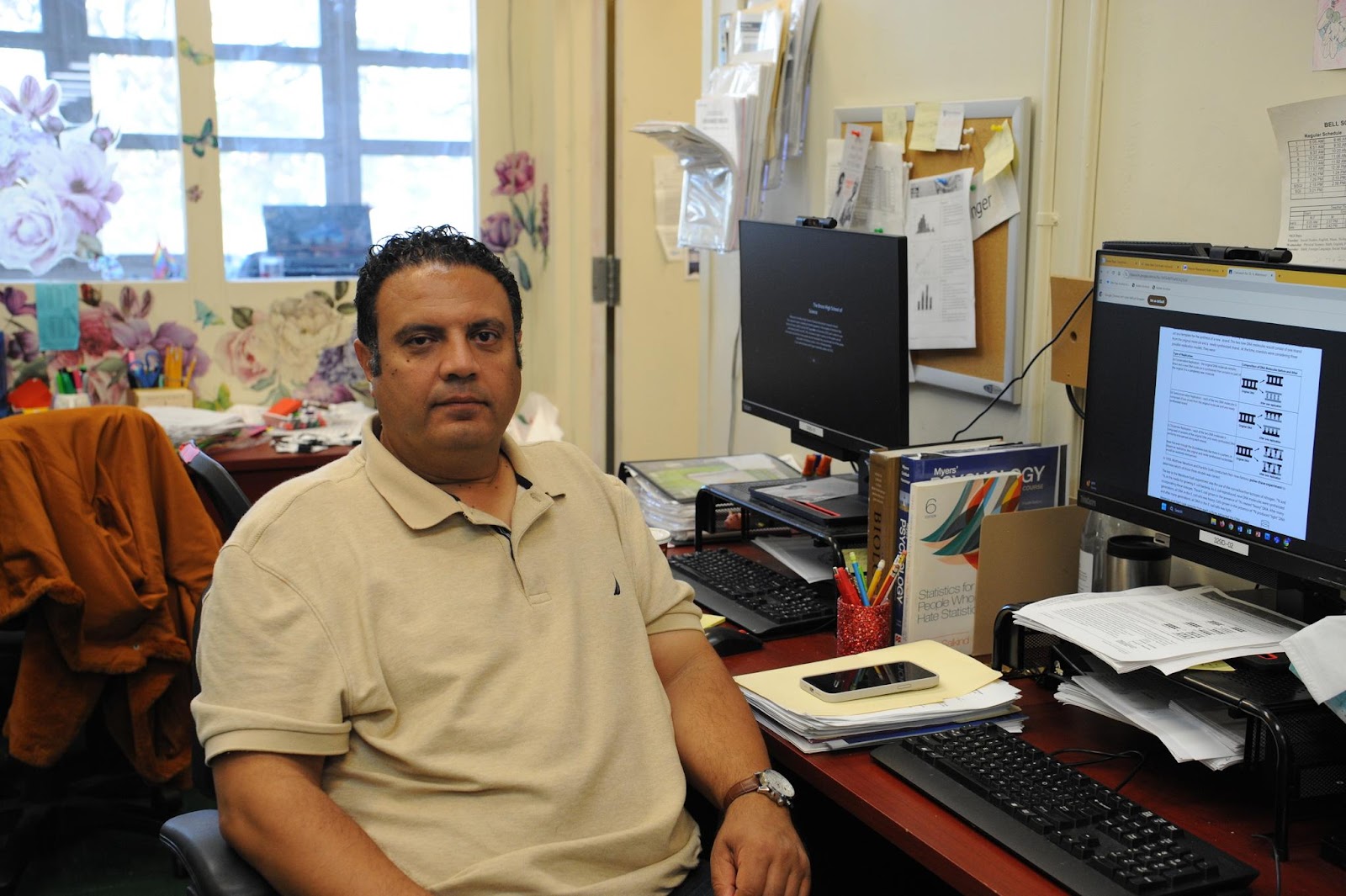
Dr. Khaled Mahmoud has been teaching research at Bronx Science for over a decade, helping students turn curiosity into discovery. With a background in microbiology and immunology, he earned both his master’s degree and Ph.D. in Canada before moving to the U.S., where he eventually joined Bronx Science after several years of teaching at the college level.
When asked why he chose to teach research, Dr. Mahmoud said it comes down to curiosity and discovery, two things that have driven him since his own days as a student. He believes research is at the heart of science, because it pushes students not just to learn information, but to ask their own questions and find answers through experimentation. “It’s about developing ways to think,” he explained, emphasizing that research teaches problem-solving skills that go beyond science and can be applied to everyday life.
What he enjoys most is the thrill of discovery. “You never really know what you’re going to get,” Mahmoud said, describing how even failed experiments can open new paths and ideas. Still, research requires patience. “Sometimes you spend long hours and nothing works,” he admitted, but added that learning to handle frustration helps researchers develop resilience.
Dr. Mahmoud encourages students to pursue research only if they have genuine passion. “You need to love the process,” he said. Doing it just for college applications won’t be enough. His advice? Start early, explore topics that truly fascinate you, and take advantage of opportunities like the Manne Institute or the sophomore research program.
In closing, he reminded students of Bronx Science’s motto: “Discover, inquire, change.” To him, those words capture exactly what research and learning are all about.
By the time Bronx Science researchers graduate, they’ve done more than complete a project; they’ve contributed to real scientific progress. Their names appear on published papers, their findings are presented at conferences, and their ideas inspire others to keep exploring.
Perhaps the greatest impact, however, isn’t found in data or results but in mindset. The research program teaches students to think critically, question boldly, and persist through setbacks. As one teacher, Dr. Mahmoud, described it, “We’re not just teaching students to become scientists. We’re teaching them to think like scientists, to look at the world with curiosity, patience, and integrity.”
That spirit continues to define Bronx Science, fueling a culture where learning and discovery go hand in hand. In the end, the research program isn’t just about competition or recognition; it’s about the joy of finding something new. And for the students who step into those labs each day, discovery is only the beginning.
Below are my extended interviews with Willa Huber ’26 and Dr. Khaled Mahmoud:
Extended Interview with Willa Huber ’26
Hello. So today we’re here with Willa. Please introduce yourself.
Hi, I’m Willa Huber. I’m a senior at Bronx Science, and it’s my second year in the research program.
So what type of research are you doing?
I’m doing Biology Research. I did Biology Research at the Stanley Manne Institute, and then I worked on protein engineering — which is also in the field of biology — at Mount Sinai.
Have you started on a research project? And if so, can we know a bit about it?
Yeah, I’ve done two research projects. At Manne last year, I designed my own project investigating the effect of deleting a gene called Cat-2 and how that impacts the reaction to nicotine in C. elegans and addiction behavior. My project at Mount Sinai focused on optimizing an antibody-based construct to improve the internalization of a small molecule used in diabetes treatment.
So what made you want to join research in the first place?
It’s funny because I didn’t join research during sophomore year when most people do. I decided to apply to Manne in the spring of that year just because I thought it might be interesting. Once I started, I really enjoyed it — it was fun to learn different procedures and do hands-on work in the lab. That’s when I realized it was something I was genuinely interested in, so I asked Dr. Davis if I could join the research program my junior year.
Okay, so what has been the best part of research for you?
Definitely my lab at Mount Sinai. It gave me a lot of insight into what I want to do in the future. Before that, I was pretty sure I wanted to study biochemistry, but being in that lab made me realize I’m more interested in the engineering side of things. My mentor encouraged me to explore engineering programs, so now I’m focused on chemical engineering and the pharmaceutical aspects of that field.
So what has been the worst part of research for you?
Finding a lab and a mentor — that was so stressful. I probably sent around 30 e-mails and got tons of rejections or no responses at all. It was really discouraging, but I wanted a lab so badly that I just wouldn’t give up. It’s tough to face that much rejection, but I’m very glad I kept trying.
That’s great to hear. So would you recommend research for other students?
Absolutely. I really love research. Even though I joined late, it was one of the best decisions I made at Bronx Science. It gives you real-world experience, helps you build connections, and lets you explore what you actually enjoy. Some of my friends joined and realized it wasn’t for them, and that’s okay too — it’s all part of figuring things out. For me, it’s something I definitely want to continue in college and maybe even after undergrad.
So what advice would you give to a student interested in research?
I’d say be open-minded. A lot of people get caught up thinking they have to stick to one category — Biology, Mathematics, Physical Science, or Social Science — but the program is actually really flexible. People switch around, and that’s okay. Some students in social science end up doing wet lab work at places like Mount Sinai.
Also, don’t limit yourself to one super-specific niche when looking for labs. If you only email a few labs that fit that exact topic, you might not get a spot. It’s better to stay open to similar fields — you might end up finding something even more interesting.
Okay, thank you. So do you have any final shoutouts you’d like to give?
All the research teachers are great. I have Max Comet who really cares about students and their projects. And Dr. Davis has been incredibly supportive too. Overall, it’s been a great experience, and I’m really grateful for it.
Okay, thank you very much for doing this interview.
Extended Interview with Dr. Khaled Mahmoud
Hello. So today we’re here with Dr. Khaled Mahmoud, a teacher in the Department of Biology at Bronx Science. So Dr. Mahmoud, what type of research do you teach?
I teach Sophomore, Junior, and Senior Research in the Biology and Physical Science Research Program. I also used to teach Science Research 9, which is a one-semester course for incoming ninth graders.
Can you tell us a bit about yourself in general?
Yes. I did my undergraduate and graduate studies in Canada, specifically in Microbiology and Immunology. I have a Master’s Degree in biology and a PhD in microbiology and immunology. During my graduate studies, I did molecular microbiology research, published several papers, and completed research during my master’s. After moving to the U.S., I taught part-time at a college for a few years, and then began teaching permanently at Bronx Science.
How long have you been teaching research?
At least ten years out of my thirteen years of teaching.
Impressive. So why did you choose to become a research teacher?
As a science teacher, research is the foundation of all topics in science, including social science and math. Everything we teach in textbooks is the outcome of years of research. Instead of just delivering information, it’s better to help students ask their own questions, make inquiries, and find answers themselves.
That’s one intriguing thing about research. The second is that it requires background knowledge, which involves continuous learning. That has always been part of my personality — I love seeking knowledge and learning new things. Research opens the door for that, and I enjoy sharing it with students.
What do you enjoy most about being a research teacher?
The discovery. You never know what you’ll get. Even when you teach students the proper steps to conduct research, it still surprises you. If your hypothesis works, it’s exciting. If it doesn’t, it opens the door to more questions and deeper understanding.
Research isn’t only about science — you can use it to solve any problem if you ask the right questions. I try to teach students how to think that way, so they can use research methods and problem-solving skills in everyday life.
Is there anything you dislike or find difficult about teaching research?
It’s not dislike, but research needs patience. Sometimes things don’t work as planned. You can spend long hours working, and nothing seems to succeed. You might develop a method, look under the microscope, and see nothing. It can be frustrating.
You have to be patient and observant. Research teaches you to handle setbacks and learn from them. Another thing is that some people may think only certain types of research are important, which can lead to arrogance. But all research has value. So while frustration exists, it also builds persistence and humility.
Would you recommend research for students?
Yes, but you need passion before commitment. Ask yourself if you truly enjoy research. It doesn’t have to be in science — it can be in any field. If you don’t enjoy the process, you won’t stay committed.
Research requires patience and genuine curiosity. Doing it only because it looks good on a résumé won’t work. You have to truly enjoy discovery, observation, and learning.
What advice would you give to a student interested in research?
First, find a topic or field you’re interested in — something that excites you. It could be math, social science, physics, or biology. You get a bit of exposure to research in your ninth grade year, then you can apply for the program as a sophomore.
If you like it, continue through junior and senior research. There are also summer opportunities, like the Manne Science Institute Research Program, which runs during the school year and summer. Participate in those to see if research is something you want to pursue.
Any final thoughts before the interview ends?
You see the Bronx Science logo — discover, inquiry, change. My advice is to always seek what you enjoy, because it could lead to your future career. That applies to any field.
Thank you, and that was our interview with Dr. Mahmoud.
Thank you, Aissatou. Good luck!
That spirit continues to define Bronx Science, fueling a culture where learning and discovery go hand in hand. In the end, the research program isn’t just about competition or recognition; it’s about the joy of finding something new. And for the students who step into those labs each day, discovery is only the beginning.