

“This ‘climate change,’ it’s the greatest con job ever perpetrated on the world,” U.S. President Donald Trump stated at the United Nationals General Assembly (UNGA) in September 2025.
When it comes to climate change policy, the United States has had a rocky history. Global superpowers came to their first agreement on lowering greenhouse gas emissions in 1997, with the Kyoto Protocol. The Republican-majority Congress never ratified it. When President George W. Bush took office in 2001, he decided against pursuing the program. Then in 2015 came the Paris Climate Agreement, a treaty between 197 countries to keep the world accountable for cutting greenhouse emissions so that the global temperature would not rise 2 degrees Celsius above pre-industrial levels. Donald Trump withdrew in 2016 claiming it “punishes the United States,” then Joe Biden initiated the rejoining in 2021. On the first day of his second term, Trump penned his signature in thick dark ink, marking the moment the U.S. signed its second executive order of withdrawal from the treaty.
Living under an administration that denies the very existence of climate change, a static buzzing of voices comes from every reaction. Listening closely, you can make out a few words, words that form the question many Democrats have been asking themselves…
What if Al Gore had won?
Al Gore’s Political Rise
In 1948, in Washington, D.C., Albert and Pauline LaFon Gore had a son. They were a gutsy, “up-from-nothing” pair: Albert had worked hard to become a U.S. Representative for Tennessee, and Pauline waitressed her way through Vanderbilt University Law School and was one of the first women to graduate. Gore’s childhood was split between the small humble farm community of Carthage, Tennessee and the daunting city of Washington, D.C., where his father worked and he attended high school. As Al Gore recalls, “Even though I spent more time each year in Washington, Tennessee was home…[and] having two homes allows you to see some things that stand out in relief when viewed from two different perspectives.”
Becoming a politician was a big possibility from day one. As Melinda Henneberger from the New York Times wrote, this expectation of a political career existed “before he was born, and even unto death.” His moment came when Joe L. Evins retired and left the seat of Tennessee Congressman open. Only seven years prior, Gore had graduated Harvard with a degree in government. This was where the seed for his future environmental legislative agenda was planted: Gore took one course by Roger Revelle, who designed the first experiment to measure carbon dioxide in the atmosphere. Gore recalls, “he opened my eyes to the issue and educated me. And it was like a window opening on to the future.” Following college, Gore served as a military journalist in the Vietnam War until 1971, and returned home to work at The Tennessean while attending Vanderbilt’s Divinity School and Law School. Perhaps it was all building up to this moment: Gore spontaneously decided to quit school and run as a Democrat for the U.S. House of Representatives for Tennessee’s 4th Congressional District.
Gore, who had been both the underdog and the son of the man who had lost the same race six years prior, came away with a victory, and three more after that. In a period where climate issues often took a back seat to economic ones, Gore spearheaded environmental legislation – for natural resource preservation, environmental regulation, and contributed to the passing of the Superfund law to clean up toxic waste sites in 1980. In 1984, he won a seat in the U.S. Senate representing Tennessee, whereupon he continued to emphasize the threat of climate change.
Emerging from his father’s shadow, Gore continued to remind himself, “I didn’t want to be elected as his son.” He tried to distinguish himself from his father when he made the decision to run for the Democratic nomination for the 1990 presidential election. He lost the nomination, his son almost died in a car accident, and somewhere in that dark time, Gore began to write Earth in the Balance: Ecology and the Human Spirit. He asked, “Why haven’t we launched a massive effort to save our environment?”
Al Gore’s Vice Presidency
In 1992, Bill Clinton became the Democratic nominee for the presidential election. Rather than following the unwritten rule of choosing a vice president who speaks to another part of the party, Clinton chose a fellow Southern Democrat – Al Gore. Clinton and Gore, forty-five and forty-four respectively, became the youngest ticket the Democratic party had in a long time. Experts argue that this solidified what Clinton ran on – the establishment of moderation and uniformity. However, it is important to note that the two men were not identical. In fact, Bush campaign spokeswoman Torie Clarke stated, “Bill Clinton chose not to serve in the military, so they chose someone who did. Bill Clinton’s got a lousy environmental record, so they chose someone known as an environmentalist. I think they feel insecure about traditional family values and Tipper [Gore’s wife] is a way to make up for that.” Clarke uses this as a critique, yet one can’t help but wonder if this subtle differentiation was their strength.
One thing they indisputably had in common was relative youth. This juxtaposed that of their opponents, George H.W Bush and Dan Quayle. Clinton’s slogan, “For People, For a Change,” reinforced that he and Gore were bringing fresh ideas that Americans needed.
One of these new ideas was creating policy for global warming. In 1992, the UN, with the efforts of more than just Gore, initiated the first supranational meeting about climate change in Rio de Janeiro. In attendance were ten thousand delegates from 172 countries. They met again in Berlin in 1995 where they agreed to finalize the agreement in 1997, which culminated in the adoption of the Kyoto Protocol. When Gore addressed delegates at the Kyoto Climate Change Conference, he firmly stated, “I commit to you today that the United States is prepared to act—and will act.” The United States was beginning to lead a new global mission by setting an example: Gore claimed that the U.S. had a target to reduce emissions by around thirty percent.
That year was the hottest on the global temperature records, meaning, as Gore put it, “More record floods and droughts. Diseases and pests spreading to new areas. Crop failures and famines. Melting glaciers, stronger storms, and rising seas.” For developing countries though, economic struggle stood as the primary obstacle. The Protocol introduced “emissions trading,” in which large companies had to pay for exceeding the emission amount, or stay under it. In this way, the fight to cap emissions could be a business enterprise that further fuels the economy. Furthermore, Gore promised that “One key is mobilizing new investment in your countries to ensure that you have higher standards of living, with modern, clean and efficient technologies.”
When Gore brought that excitement and dedication back home, it was not met well with the Republican-majority Congress, who did not ratify the agreement. The United States, having claimed to be the frontrunner, would be the only industrialized nation not to join the Protocol. When Bush took office, he withdrew from the Protocol, making ratification impossible.
Gore established the Global Learning and Observation to Benefit the Environment (GLOBE) in 1994, which was made to be a hands-on Earth science educational program to teach younger kids about Earth. Now, it has grown into an international platform for research and data about the environment. The Clinton-Gore Administration established “Digital Earth” with NASA, leading to prototypes like Google Earth. This was a huge part of what Gore pushed for – increasing the use of the internet to inform and teach those who typically would not be able to access such. This has evolved into many offshoots, such as NASA’s WorldWind and Digitnext’s VirtualGeo.
Former Secretary of State Warren Christopher once said, “President Clinton consulted with him at every turn…[he] was usually the last person he talked to before reaching a foreign policy decision.” Gore was a “key member” of the Clinton Administration foreign policy making. Although it may seem disconnected from his climate policies, it followed a similar trend: international cooperation to solve an issue.
Gore had a firm role in ending the Bosnian-Serb War. Forty years of oppressive communism in Yugoslavia had weakened under the global phenomenon of the USSR collapsing. Northwest provinces Slovenia and Croatia declared independence. At the same time, dense populations of Serbians within majority-Muslim areas of Bosnia and Herzegovina began establishing themselves as “Autonomous Regions.” Although Croatia, Slovenia, Bosnia and Herzegovina became internationally recognized in 1992, Serbs, majority-Christian-Orthodox, within the Bosnian-Herzegovina territory pushed back with force. They wanted to be a part of the Serb-dominated Yugoslavia, now known as Serbia. They declared their own independent state, Rupublika Srpska, and sought to remove non-Serbs from the territory. This became the Bosnian-Serb war, lasting for three years. There was mass ethnic-cleansing of all Bosnian Muslims, with concentration camps and targeted oppression. It was Gore who convinced Clinton to firmly agree on the NATO air strikes to stop the Bosnian Serbs. Soon after, the war ended with the Dayton Agreement, declaring ceasefire and initiating the signing of this peace accord.
The Clinton-Gore Administration had a hands-on approach to foreign affairs, and the intervention in the Bosnian War is one of many examples. Intervention was rooted in a Cold War mentality of containment. But this idea evolved under the Administration, leading to soothing relations with Russia, initiation of peace treaties in countries like Eritrea and Ethiopia, and settlements like the Northern Ireland Good Friday Peace Accord. The HIV/AIDS epidemic had been dangerously high, and in 1992, there were about 40,000 Americans infected per year. The Administration made the U.S. a key player in international aid for HIV/AIDS, doubling it. Yet these international developments were not all well received by people, and in a survey in 1994, forty-eight of people thought Clinton was doing a poor job handling foreign policy. The enduring question remains, was this Gore’s fault?
The 2000 Election
Just as Al Gore was growing up in the footsteps of his father, so too was George W. Bush. He had bigger shoes to fill, as his father, George H.W. Bush had been the forty-first president of the U.S. Like his father, he too attended Yale, but was not as good a student or athlete. He trained as a pilot in the Texas Air National Guard, where he became a second lieutenant in 1968 and certified pilot in 1970, yet allegedly had a poor military record. He was rejected from University of Texas Law School, and was eventually discharged from duty when he got into Harvard Business School in 1973. In 1975, just as Al Gore was leading up to his House of Representatives campaign as an environmentalist, Bush started his own oil and gas firm. Just as Gore did, Bush experienced highs and lows. His company suffered and was purchased by Harken Energy Corporation; he aptly invested in the Texas Rangers and made fifteen million dollars, and in 1994, he became governor of Texas.
Before 1999, these two men had managed to establish themselves apart from their legacy. When Gore became the Democratic nominee and Bush that of the Republicans, perhaps a small part of themselves were motivated by the unconscious desire to be remembered as more than a son.
As the year 2000 neared, many people had developed the fear of the “Y2K bug” – that computers and massive technology-reliant operations would glitch as the clock switched from 1999 to 2000, in which electronic experts feared devices would fail to detect if the “00” was 1900 or 2000. Rumors had it planes would fall out of the sky, massive power outages would occur, or that digital baking services would erase people’s money. This never happened to such an extent.
Within that mayhem, the biggest fear had yet to be detected – Would the 2000 election define the fate of twenty-first century politics?
Al Gore ran on the slogan of “Prosperity and Progress,” a fight to continue what had been improved by the Clinton-Gore Administration, namely the economy. According to a pre-campaign poll, the GDP had been increasing, and in 2000, fifty-nine percent of people surveyed were “Satisfied with ‘the way things are going in the United States.’” As political scientist James E. Campbell argued, “If conditions are good and the public is happy, they may give the in-party the benefit of the doubt. On the other hand, if conditions are not so good, voters may be looking for reasons to make a change.” Despite the Monica Lewinsky scandal, the Clinton Administration had around a sixty-five percent approval rate. Some argue that Gore was less popular due to his de-emphasis on the economy. In his convention speech, he reminded people, “This election is not an award for past performance. I’m not asking you to vote for me on the basis of the economy we have. Tonight, I ask for your support on the basis of the better, fairer, more prosperous America we can build together.”
Bush promised he was “A Reformer with Results.” In his convention speech, he said, “But times of plenty, like times of crisis, are tests of American character…Our opportunities are too great, our lives too short, to waste this moment.”
Because of this chapter of America’s prosperity, the campaigns of both Bush and Gore could focus on more than money: Medicare, federal budget, taxation, Social Security, and education. Bush advocated for large tax cuts, the individual investments of taxes for Social Security, and state programs and testing to improve education. Meanwhile, Gore sought in-government ways to cut taxes, governmental funding for Social Security, and federal programs to hire teachers and improve schools. Ideological differences were arising too, morphing the Republican party to identify as more conservative, and the Democratic party as increasingly liberal.
Gore once said, “You win some, you lose some. And then there’s that little-known third category.”
On election night, Bush managed to win the interior states, and Gore won fewer states that were more densely populated, on the edges of the country. Ralph Nader, a Green Party candidate, won three percent of the vote, yet his presence on the ballot made it so Gore lost many swing states such as Tennessee and New Hampshire. Patrick Buchanan of the Reform Party also took votes from Bush, but by significantly less than that of Nader.
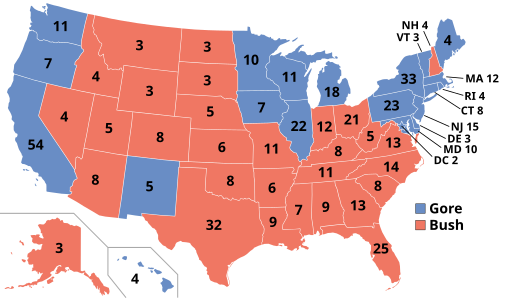
It all came down to Florida. With twenty-five electoral votes, Bush was said to have won by an incredibly small majority in the electoral college. Although he had initially conceded on the phone with Bush, Gore withdrew when he saw that the gap was narrowing – at that time to less than six-thousand votes. In a Florida Supreme Court case, Bush v. Gore, there was a statewide manual recount of forty-five-thousand votes that had been unclear. Due to the “butterfly ballot,” in which voters punched holes next to their candidate, many voters accidentally voted for Buchanan rather than Gore. Other holes that had not been fully punched were hanging on by a thread, referred to as “hanging chads.” The manual recounts were more reliable than that of the machine, yet they required painstaking hours debating the vote intended for each and every ballot.
What was meant to be a choice of all the people soon escalated into the choice of very few. Secretary of State Harris made a November fourteenth deadline of the manual recount, declaring if the votes counted up until then still favored Bush, he would be the winner. The deadline was then moved to November twenty-fifth, and there was an eruption of ethical questions of ignoring votes. The push and pull was hard to follow, and the stalemate threatened the legitimacy of the electoral college. After all, Gore had already won the popular vote. On December twelfth, after many switches between Gore and Bush’s lawyers, Florida Supreme Court, and the U.S. Supreme Court, the U.S. Supreme Court ended the recounts. Gore addressed America the next day in his official concession speech, where he declared, “Let there be no doubt, while I strongly disagree with the court’s decision, I accept it.”
Over a month after citizens cast their ballots, Bush won the electoral vote 271 to 266. Gore won the popular vote by around half a million, and his defeat marked a historical moment as 1888 was the last time the popular and electoral votes did not both go to the winner. It would happen again to Hillary Clinton, when Trump would defeat her in 2016.
As his speech came to an end, Gore said, “I’ve seen America in this campaign, and I like what I see. It’s worth fighting for and that’s a fight I’ll never stop. As for the battle that ends tonight, I do believe, as my father once said, that ‘No matter how hard the loss, defeat might serve as well as victory to shape the soul and let the glory out.’” As Gore accepted his faith in the legitimacy of the American constitution, he looked back onto his father’s words.
Al Gore’s Post-Political Career
Al Gore himself was unsure of what he would do as he stepped out of the political scene for the first time since 1976.
Following that fateful December day, Gore receded from the public eye for around a year. His return was quickly followed by the 9/11 attacks. Data showed that if Gore were to run again, he would be behind Bush due to his popularity rise in his War on Terrorism. When Gore announced this on CBS 60 Minutes, he said, “I personally have the energy and drive and ambition to make another campaign, but I don’t think that it’s the right thing to do. I think the current policies have to be changed. I think that my best way of contributing to that result may not be as a candidate this time round.”
In many ways, he was right. He began to focus on what he had grown famous for – advocating for integration of technology and environmentalism. In 2004, Gore and former head of Goldman Sachs Asset Management David Blood founded Generation Investment Management. A Certified B Corp, this company’s mission is to help people learn to invest in ways that have a positive impact on the environment.
During this time, Gore had been developing a multimedia presentation that he had been touring internationally to raise awareness about climate change. It caught the attention of producers Laurie David and Lawrence Bender, who successfully convinced Davis Guggenheim to make it into a movie – An Inconvenient Truth.
Even the title of this movie is captivating. Honesty is often associated with virtue, and yet this time, it is with struggle and annoyance. That is what global warming is all about. A unique issue that needs to be approached in a revolutionary way. Gore, although perceived as a politician, conducted in-depth research on the human impact on Earth. An Inconvenient Truth won the Academy Award for Best Documentary and Best Original Song, as well as a Grammy for Best Spoken Word Album, Critics Choice Awards, and Humanitas Prize. After winning the Oscar Academy Award, director Guggenheim told the audience, motioning to Gore standing beside him: “All of us who made this film, we did so because we were moved to act by this man…We share this with you.” Gore humbly accepted this award, and even later said “I always give Guggenheim credit for the Academy Award.” It was at this moment, Gore reminded people he was more than a politician.
In 2007, Gore shared the Nobel Peace Prize with the Intergovernmental Panel on Climate Change (IPCC). The Nobel Committee recognized them “for their efforts to build up and disseminate greater knowledge about man-made climate change, and to lay the foundations for the measures that are needed to counteract such change.” They also stated, “[Gore] is probably the single individual who has done most to create greater worldwide understanding of the measures that need to be adopted.”
After this monumental moment, Gore continued to launch initiatives and speak up politically, such as at the UN climate conferences. In 2017, he initiated An Inconvenient Sequel: Truth to Power, directed by Jon Shenk and Bonni Cohen.
Now, Al Gore is seventy-seven years old. Rather than fading into the history books, Gore has spent his life finding ways to advocate for the environment – from his first college class, to a political career, and into public media and social spheres. His ability to overcome a loss and continue to fight for what he believes in proves his legitimacy as an authentic and passionate leader.
The Final Question: What If Al Gore Won?
The sheer closeness of the 2000 election has led many people to imagine an alternate world where Gore had won, because he almost did. In the 2004 hit documentary, Fahrenheit 9/11, director Michael Moore opens with a riveting portrayal of the 2000 election. Only, Al Gore had won. As Moore says, “Was it all just a dream?”
Moore is not the first – nor the last – to step his toes in the risky waters of “what if?” Even though the stream of thoughts that follow are innocent, they are painful. What if this had not happened? Or, what if it did? It is impossible to answer these questions without bias and subjectivity. The policies that Gore could have established can only be imagined. Rather than that, one can look at three inevitable events that continue to shape modern day politics. Seeing how Bush responded and how Gore spoke out gives a glimpse into what could have been present-day reality.
9/11
On September 9th, 2001, Bush was reading “The Pet Goat” to students at Emma E. Booker Elementary School in Florida. Moments before that, he had been informed that a plane had crashed into the World Trade Center. Allegedly, he had thought, “There’s one terrible pilot.” Not too long into the reading, Chief of Staff Andrew Card walked over to Bush, crouched down, and whispered: “A second plane hit the second tower. America is under attack.” 25 minutes later, Bush addressed the country about the “apparent terrorist attack on our country.” Four commercial passenger planes had been hijacked by terrorists linked to al-Qaeda, an Islamic extremist group established by Osama bin Laden. The twin towers of the World Trade Center were utterly destroyed by two of the planes. The third plane hit the Pentagon, and the fourth crashed in an empty field in Shanksville, Pennsylvania after passengers and crew resisted the full hijack. The nineteen from al-Qaeda died, along with three-thousand civilians. These terrorist attacks likely would have occurred no matter who was president. The difference is how he would have approached it.
Bush declared a “War on Terrorism,” that initiated authorization from Congress to “eliminate those who perpetrated the attacks of 9/11.” Bush was firm in his pushback, stating, “Our war on terror begins with al-Qaeda, but it does not end there. It will not end until every terrorist group of global reach has been found, stopped and defeated.” Bush ordered the U.S. invasion of Afghanistan in October, where he sought to target al-Qaeda training camps and Taliban military facilities. Simultaneous to military action was humanitarian aid to citizens of Afghanistan, were decades of invasion and lack of sovereignty devolved into breakdown of law and order. Some have called it “The Graveyard of Empires.” Bush told the world, “The United States of America is a friend to the Afghan people, and we are the friends of almost a billion worldwide who practice the Islamic faith. The United States of America is an enemy of those who aid terrorists and of the barbaric criminals who profane a great religion by committing murder in its name.”
Two years into occupation in Afghanistan, in which many suspected terrorists were held prisoners in Guantanamo Bay, Cuba, the U.S. extended its search to Iraq. A nearby country in the Middle East, Iraq had tense relations with the U.S. that ran back to the Iraqi invasion of Kuwait, and the U.S. response in Operation Desert Storm, also known as the Persian Gulf War. This was launched by Bush Sr. Although that ended in 1991, there continued to be suspicions regarding the presence of “weapons of mass destruction” (WMDs) – “nuclear, biological and chemical weapons, and long-range ballistic missiles.” Bush claimed that Saddam Hussein, the authoritarian president of Iraq, was manufacturing and saving WMDs, and he was involved in an international “Axis of Evil” with Iran and North Korea. There was intense controversy over the use of military force in Iraq, and the UN Security Council pushed back from the request due to the lack of ample evidence. A US-led coalition was formed with around thirty countries, including the UK, Australia, and Poland. Many key allies did not support the war, such as France and Canada, and multiple Middle Eastern countries that had supported the U.S. in the Gulf War. Years later, it was confirmed that the claims to Iraq’s active WMD programs were faulty. At the time, U.S. intelligence agencies said otherwise. What resulted was the invasion of Iraq and overthrowing of their army and regime, as well as the capturing of Saddam Hussein. With the lack of a clear plan, the country devolved into a “secretarian insurgency,” resulting in the civil war between Sunni and Shi’a Muslim factions. In 2011, former-president Barack Obama withdrew troops from Iraq. The war had cost the U.S. three trillion dollars.
Gore was extremely opposed to the war from the beginning. In a speech addressing the war on terrorism, he said, “Like all Americans I have been wrestling with the question of what our country needs to do to defend itself from the kind of intense, focused and enabled hatred that brought about September 11th, and which at this moment must be presumed to be gathering force for yet another attack.” It is here there is a glimpse of what could have been President Gore’s response. It is clear that no matter which leader was in charge, the attacks of September 11th were gruesome and difficult to unpack. He argued that the war in Iraq was a “jump from one unfinished task to another.” America should focus on “Osama bin Laden and his terrorist network, while simultaneously…build an international coalition to join us in taking on Saddam Hussein in a timely fashion.” This international cooperation was key to Gore, and follows his belief of global fight towards climate change as well. He saw that any cooperation “can be severely damaged by unilateral action against Iraq.” Having been one of the only Democrats to support the resolution of the Gulf War in 1991, he noted that “This year, eleven years later, there is no such invasion; instead we are prepared to cross an international border to change the government of Iraq.”
The chaos that ensued following U.S. withdrawal had been predicted by Gore. He had urged Congress to work with Bush to create an “unconditional compliance by Iraq” and understand why Bush supported unilateral action to push forth with the war. He asked, “If Saddam Hussein does not present an imminent threat, then is it justifiable for the administration to be seeking by every means to precipitate a confrontation, to find a cause for war, and to attack?” Had Gore been president, he likely would not have supported Bush’s response to 9/11, and rather initiated the U.S. to “redouble our efforts against al-Qaeda” and “stabilize the nation of Afghanistan after driving his host government from power.” Would this have changed U.S. relations with Iraq before it was too late?
Hurricane Katrina
In 2005, Hurricane Katrina hit the Gulf Coast of the United States and resulted in almost two-thousand deaths and $108 billion in damage. It targeted areas that were majority low-income minority groups. Meanwhile, Bush was on vacation in Texas, allegedly having been on it for twenty-seven days. His staff had not informed him of the event until the destruction was clear to be a crisis. Bush’s initial response to the event was accused of being weak and insufficient, which devastated his reputation as a crisis manager. Over two weeks later in a press conference at the White House, Bush acknowledged his sluggish response: he said it “exposed serious problems in our response capability at all levels of government.” For many, however, it was too late.
Gore responded with criticism of the slow response, “but refused to be interviewed about the mercy missions he financed and flew.” He airlifted around two-hundred-seventy victims from New Orleans, to help save Dr. David Kline and patients at Charity Hospital. Around fifteen years prior, Dr. Kline, a neurosurgeon, had helped save Gore’s son’s life after a near-fatal car accident. This response was linked to his own personal connection, yet provides insight. On September ninth, only a week or so after the hurricane, Gore spoke at the National Sierra Club Convention to address what had happened: “When the corpses of American citizens are floating in toxic floodwaters five days after a hurricane strikes, it is time not only to respond directly to the victims of the catastrophe but to hold the processes of our nation accountable, and the leaders of our nation accountable, for the failures that have taken place.”
2008 Financial Crisis
As Bush rounded in on the end of his second term, it was tarnished by the 2008 financial crisis. It was sparked by many factors: an increasing deregulation and subprime house mortgages which ultimately led to the “housing market bubble” that made it almost too easy for people to purchase homes without really purchasing them. Home loans were tied to hedge funds, credit defaults, and financial contracts. When this housing bubble burst, it brought the U.S. financial industry down with it. Due to the U.S.’s globalized economy, it had a massive ripple effect worldwide. Bush had been constantly encouraging deregulation, although in 2002 began to call for greater regulation. But it was not just him – it was the political culture of the administration, brought on many years before then. In fact, Clinton had signed the Financial Services Modernization Act, that brought down obstacles to financial sector consolidation amongst huge commercial, investment, and insurance banks. As Harvard economics professor Kenneth Rogoff said, the comfort of mass loans is “deeply embedded in the American psyche…[because] when everybody is doing better, it is difficult to see the underlying weaknesses.” By granting loans more frequently, it made housing much more accessible to low-income Americans, but at the same time lacked an institutionalized support-system.
During this crisis, Gore argued for a rebuilding of the American economy: “to wean the nation from its entire electricity grid to carbon-free energy within ten years, warning that drastic steps were needed to avoid a global economic and ecological cataclysm.” This plan would drive energy prices up, and Gore wanted to compensate with a payroll tax cut to make carbon-alternatives more affordable than carbon-emitters. Many entrepreneurs were investing in new technology, bringing the cost of clean-energy down. In this way, perhaps clean energy could actually improve the suffering economy.
The Reality of It All
The breakdown of the economy under the Republican-led administration, which followed the immense prosperity under the Democrat-led one, opened a door for the 2008 Democratic nominee in the new presidential election. This candidate was Barack Obama.
Running against Senator John McCain from Arizona, Obama strengthened his legitimacy by firmly acknowledging the financial crisis at hand. Soon after inauguration, Obama established a $787 billion economic stimulus package, and continued to tackle the crisis.
From this perspective, would Obama have won if Bush had not preceded him? Arguably, there was always the inevitability of three events: 9/11, Hurricane Katrina, and the 2008 financial crisis. Had Gore won in 2000, his approach to each would have been drastically different.
But it is time to face our reality. It was not “just a dream.” Al Gore lost in 2000.
Gore wrote in 1992, Earth in the Balance: Ecology and the Human Spirit: “We can believe in the future and work to achieve it and preserve it, or we can whirl blindly on, behaving as if one day there will be no children to inherit our legacy. The choice is ours; the earth is in balance.”
Gore said it before he needed it most: what is ahead is most important. He might have lost, but his persistent voice should never be.
Moore is not the first – nor the last – to step his toes in the risky waters of “what if?” Even though the stream of thoughts that follow are innocent, they are painful. What if this had not happened? Or, what if it did?