

Originality is defined as an “original thought or action; independent exercise of one’s creative faculties; the power of originating new ideas or methods; inventiveness” according to the Oxford English Dictionary. Creativity is what drives ideas for great art forms. Inventiveness is what brings those ideas into reality. When you take both of those factors away, there is nothing left but words in a book, lines on a paper, and images on a screen.
It is obvious that originality has become a growing issue in our modern world. So many different areas of entertainment are already being affected, and it shows in various ways. That movie that did really well in the box office? Give it three more sequels and a spinoff show. What about the romance novel that readers seem to enjoy? Just tweak the title a bit and write five more books with the exact same plot. Can’t come up with any ideas for your art? Plug a prompt into AI and see what it spits out. There are increasingly easier ways to make ‘creative’ works, and with the way things are progressing now, it doesn’t look like there is a need for originality anymore.
It is not entirely the fault of the authors, filmmakers, and artists, though, for this decrease in originality. New expectations have made it less risky to just reuse an old idea or use AI than to present a new, original idea that may not do well. “The industry is full of creative, passionate people who would love to be making original work,” said Alissa Wilkinson, a New York Times film critic. “Unfortunately the money usually goes to things that seem like ‘safe bets’ — and rarely are those original.” Take Pixar’s Elio, for example: an original movie that released the same day as the live action adaptation of How To Train Your Dragon, a DreamWorks studio classic. Elio grossed about 154.3 million dollars worldwide while the live-action How to Train Your Dragon grossed a whopping 636.3 million dollars worldwide, according to Box Office Mojo. That is around a 1:4 ratio in terms of profit. There were many other factors that caused these results for Elio’s performance, such as lack of advertising and backlash from fanbases concerning the movie’s art style, but the central message is that a live-action movie with the same exact plot as its 2010 counterpart can outperform an original movie by almost four times.
Others may say that not all original movies do badly compared to spinoffs and sequels, and they would be correct too. An original film called Sinners was released in April of 2025 and grossed 367.9 million dollars worldwide, as noted in Box Office Mojo. This is far better than Elio’s statistics but still lower than How to Train Your Dragon’s live-action movie. Sinners’ performance as an original movie goes to show that not all original movies are bound to be failed projects, but one outlier doesn’t prove a lot for the majority. Making an original movie is a gamble on whether it will be successful or not, and more times than not, it’s the latter that happens. It’s much safer and easier to spend money to produce a movie sequel or a franchise that is already well known. As Wilkinson said, “…because they’re less risky, studios like to make them.”
The cinematography area of entertainment is not the only sector that suffers from these problems. Journalism and various writing forms have also been lacking in originality in recent years. Let it be no surprise that AI plays a big role in this issue too. According to a survey conducted by Carlyn Robertson on about 1,200 authors, nearly 45% of authors use AI to assist with their writing. That’s nearly half of writers that have used a tool that is known for its unoriginal nature. Out of that 45%, 60% of those authors use AI frequently somewhere in their process. Just by looking at these statistics, it can be concerning to see how much an artificial intelligence is partaking in writing. Additionally, around 75% of the authors that use AI do not reveal it to their readers. Clearly, this is a huge problem within the writing industry because not only are authors using AI and actively eroding the originality of their writing, but they are also dishonest about their usage of it.
Aside from AI, lack of originality and repetition, whether prominent or not, are also recurring issues in writing. Have you ever read a book and thought its concept was similar to another book? Chances are, it’s not a coincidence. So many different books revolve around similar plots and themes, which are called tropes. When those tropes are reused over and over, they lose their impact on readers and the effect they have on the overall story in a book. While clichés can be described as predictable plots and tropes that have long lost their impact, they can also be as small as a phrase that is used as a quick punchline. The use of clichés has become increasingly popular in recent years. Data from 2015 shows that clichéd phrases such as “over my dead body” have increased in percent of popularity in literature by almost five percent. The use of clichés in itself is already questionable enough due to their non-original nature and underwhelming impact, but if writers continue to excessively use clichés in their writing, there will be no dramatic effect in their works like they may have wanted.
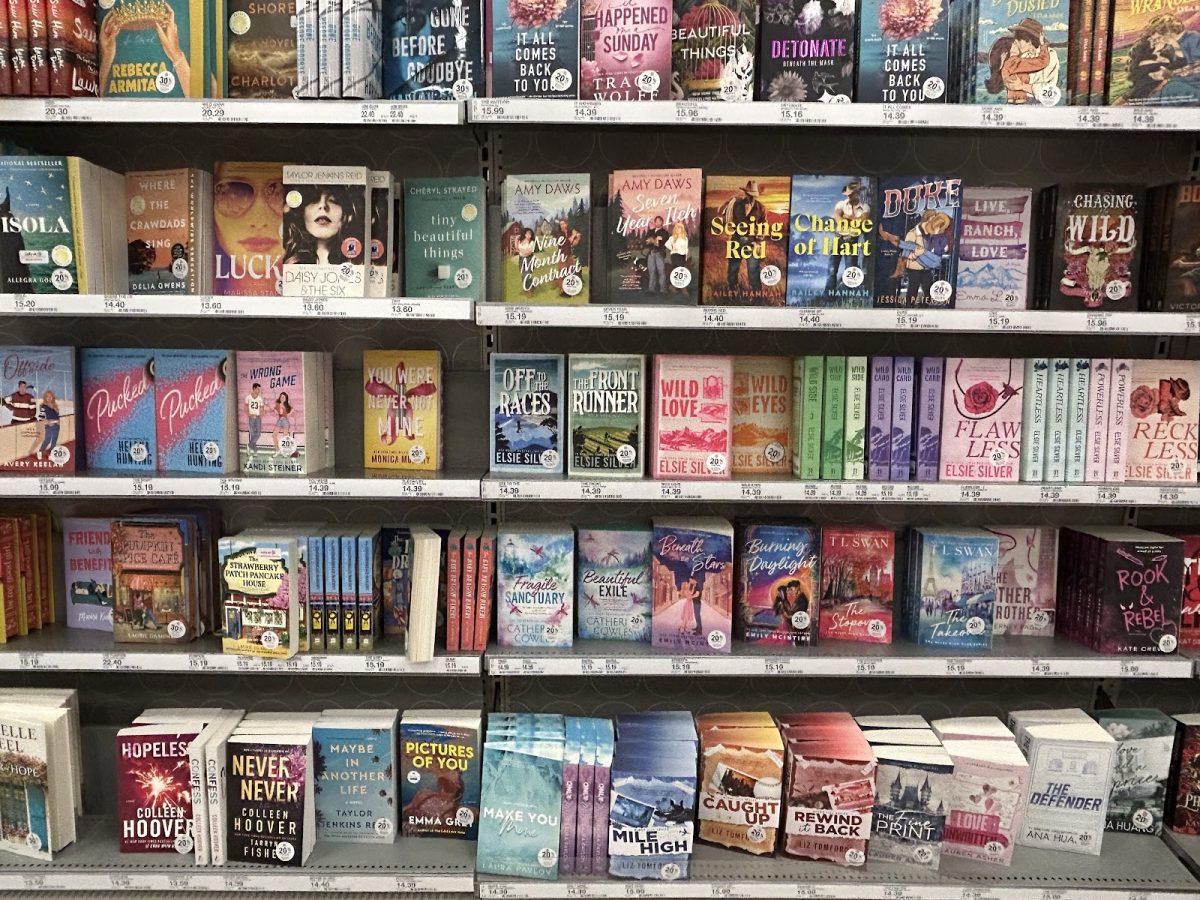
In even worse scenarios, the entire premise of books can be copied from content all the way to cover illustrations. A common example is the problem with “smut novels,” which are books with almost no plot that are instead filled to the brim with romantic and overly sexual content. This type of content is very easy for authors to write over and over due to not needing a complex plot or interesting characters. Once again this idea of taking the easier route in exchange for creative and original content is present. Go to any retailer like Target and you’ll find rows upon rows of these novels. It’s not just a few people noticing this lazy and repetitive production, as some authors themselves have concerns about taking this easier route. A blog from the writing community expresses the concern that writing many sexual scenes should not replace the narrative within a novel. The reason why so many of these books are being produced is easy; authors would rather write a copy-and-paste novel that they know at least a few people will read, compared to an original novel that could be completely ignored after release. Just like the sequels with movies, books with plots that have already been experimented with are more likely to sell better.
This general idea of sacrificing potential originality for a safer bet is shown throughout all areas of creative works, but it is not always the case. Artists were particularly affected by these originality issues even before the rise of AI. Think about it like this: you create several of your own artworks and share them online with others, hoping to gain popularity. The very next day you find your own art has been traced over and relabeled by another person who is leeching off the attention that should have gone to your art. This situation is almost identical to the problems with books that copy each other’s plots. The same can even be applied to social media. Think of all the popular videos that you’ve watched. More likely than not, there are many other videos that were created after those to try and feed off the attention the original ones had gotten. Once again the idea of taking another already explored idea because it’s easier than making your own original work appears.
The question that many may have is whether these problems can be solved, and the answer is complicated. There will always be unoriginality present in these entertainment fields, but there are still so many great original ideas being created every day. Lots of other fields suffer from this problem, yet nothing will change if people’s mindsets do not change. So, when original works become scarce and creativity is nowhere to be found, just ask yourself — isn’t it easier that way?
Creativity is what drives ideas for great art forms. Inventiveness is what brings those ideas into reality. When you take both of those factors away, there is nothing left but words in a book, lines on a paper, and images on a screen.