
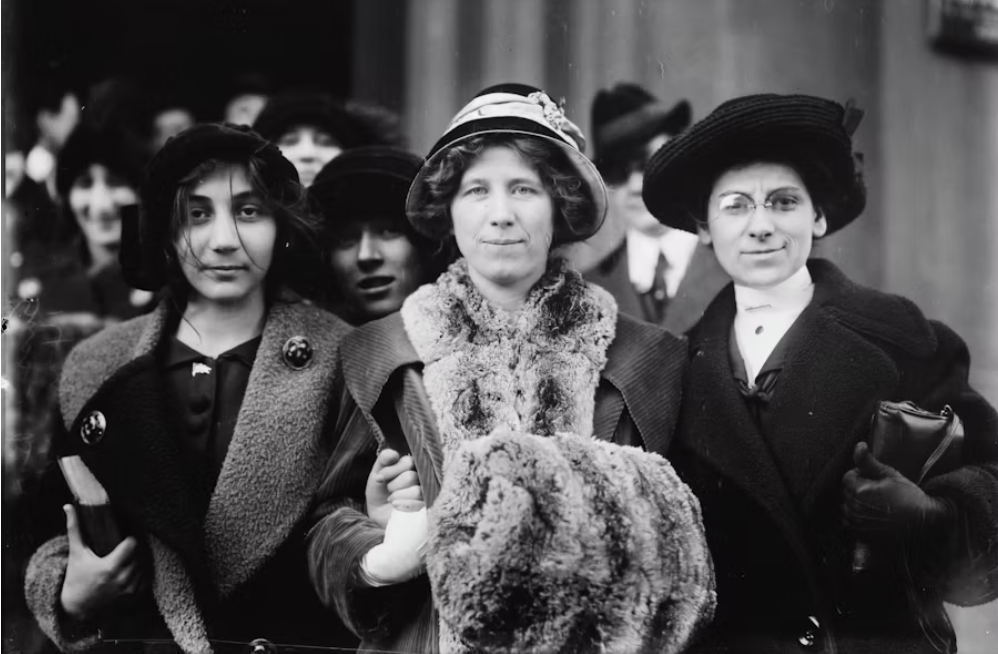
In 1848, sixty-eight women and thirty-two men gathered in Seneca Falls, New York, to sign the Declaration of Sentiments. With that bold act, the United States witnessed the official birth of first-wave feminism — a movement that demanded nothing less than a complete reimagining of women’s place in public life. On a bright August morning seventy-two years later, the 19th Amendment was ratified, granting women the right to vote. Crowds celebrated in the streets, and newspapers heralded the dawn of equality. Yet for millions of women — especially Black, Indigenous, and immigrant women — true equality remained out of reach. The ink on the amendment was barely dry before poll taxes, literacy tests, and racial violence made clear that this “universal” victory was, in practice, anything but universal.
For more than a century, feminism in America has been heralded as a movement for equality, a collective struggle to dismantle patriarchy and empower women. But beneath that banner of solidarity lies a more complicated truth: the movement’s history is also one of exclusion, erasure, and conflict. From the suffrage marches of the early 1900s to the digital campaigns of the #MeToo era, American feminism’s progress has often been shadowed by a central question: Who is truly included in the promise of liberation?
The Divided Beginnings
The first wave of feminism, often celebrated for securing women’s right to vote, was in many ways a segregated crusade. Its most visible leaders — Susan B. Anthony, Elizabeth Cady Stanton, and others — invoked the language of universal rights while drawing unmistakable racial boundaries around whose freedom was worth fighting for. Stanton, when faced with the possibility that Black men might gain voting rights before White women, protested that it would leave educated White women “degraded.” Anthony forged alliances with openly racist politicians if it served the cause of White woman suffrage. These were not footnotes but fundamental features of the movement’s early direction.
Meanwhile, Black women mobilized their own organizations — newspapers, clubs, and political societies — to insist that equality meant full equality. Ida B. Wells, the formidable journalist and anti-lynching activist, embodied this defiance. When she traveled to Washington, D.C. to join the 1913 Woman Suffrage Parade, she was instructed to march in a segregated section behind the white delegations. She refused. Instead, she slipped into the Illinois delegation mid-route, her presence a quiet but unmistakable indictment of a movement that preached equality while practicing hierarchy.
For Wells and for educator and activist Mary Church Terrell, the struggle was not merely double the work — it was two separate battles waged simultaneously. They confronted the patriarchal order that denied women full citizenship and the racism embedded within the feminist movement itself. Terrell wrote that Black women faced “a double burden,” though she might well have added that they were too often forced to carry that burden alone. Their activism ensured that feminism, even at its most exclusionary, could never fully ignore the challenge of racial injustice — though many White suffragists did their best to try.
The Second Wave and Its Blind Spots
By the 1960s and 1970s, feminism surged anew. The second wave sought to expand the meaning of equality: reproductive freedom, workplace protections, sexual autonomy, and legal rights across every corner of public and private life. Simone de Beauvoir’s The Second Sex laid philosophical foundations, while Betty Friedan’s The Feminine Mystique became a bestseller by articulating the discontent of suburban housewives who seemingly had everything — except fulfillment.
But not all women saw themselves in Friedan’s diagnosis. Black women, Latinas, working-class women, and queer women recognized that liberation was not simply a matter of escaping domesticity; many were already laboring outside the home, often in the very households where white women sought relief from cooking and cleaning. The problem that “had no name” turned out to have many — poverty, racism, homophobia — and those problems did not disappear once a woman found a career.
Challengers from within the movement made this point unmistakably clear. The Combahee River Collective, a group of Black feminist thinkers and activists, issued a groundbreaking statement in 1977 that declared “the major systems of oppression are interlocking.” Audre Lorde warned that dismissing difference within feminism was not a harmless oversight but a form of violence. “There is no such thing as a single-issue struggle,” she wrote, “because we do not live single-issue lives.” These voices insisted that feminism confront every form of inequality if it wished to see any form of true freedom.
Furthermore, Latina feminists added dimensions the movement had long ignored. Cherríe Moraga and Gloria Anzaldúa described how race, culture, sexuality, and language shaped women’s lives just as profoundly as gender. They argued that feminism that was unable — or unwilling — to recognize these forces risked becoming a new gatekeeper rather than a liberator.
The result was a necessary reckoning: second-wave feminism had opened doors, but often only for those already close to the front of the line.
Global Voices and the Third Wave
In the 1990s, a new generation appeared ready to rewrite the movement’s script. The third wave embraced a wider cultural stage — riot grrrl punk zines, college campuses, and early internet forums — where feminism became louder, more self-aware, and sometimes delightfully irreverent. Writers like Rebecca Walker insisted that feminism belonged to young women too, not only the veterans of the 1970s.
Yet the movement continued to mirror the strengths and shortcomings of its predecessors. Too often, U.S. feminism assumed its own story to be the default. Postcolonial scholars such as Chandra Talpade Mohanty challenged this assumption head-on. In Under Western Eyes, she criticized the habit of treating women in the Global South as a single, helpless category in need of Western rescuers. Real progress, she argued, must begin by listening to women whose social and political contexts differ drastically from those found in the U.S.
Within the United States, the third wave also broadened feminism’s cultural footprint. Movements took shape around issues like LGBTQ+ rights, sexual assault awareness, media representation, and body autonomy. The boundaries of feminism became more flexible — but flexibility alone could not resolve old tensions. Inclusion remained a project in progress.
The Digital Turn and Intersectional Reckoning
The arrival of social media transformed feminist organizing with breathtaking speed. Hashtags like #YesAllWomen, #TimesUp, and #MeToo turned everyday experiences of harassment into a national reckoning. Stories once relegated to quiet conversations — or buried entirely — suddenly held public space. Survivors did not need a newspaper column or a courtroom victory to be believed. They only needed a phone and the courage to speak out.
Yet the viral rise of these movements also revealed how unequal these platforms could be. Tarana Burke, a Black organizer who coined “Me Too” in 2006 to support survivors of color, initially saw her work overshadowed when white Hollywood figures amplified the phrase. Only after pointed efforts did the movement’s public narrative center on Burke’s decades of labor. Her story is a reminder that silence is not the only threat; misattribution and selective celebration can erase people just as effectively.
Digital feminism expanded participation more than any previous wave, but it also exposed new hierarchies. Algorithms rewarded the sensational, celebrity voices drew disproportionate attention, and harassment became a weapon wielded against those speaking uncomfortable truths. The struggle for equality was still very much ongoing — just conducted on new terrain.
Listening, Not Leading
Today’s feminism is often labeled as a fourth wave: intersectional, digital, and more aware — at least in principle — of the many forces shaping women’s lives. The current movement speaks in multiple voices and inhabits countless spaces: from campus protests to domestic labor unions, from Indigenous land defenders to disability justice advocates. It is less interested in a single national narrative and more invested in recognizing that liberation must look different depending on where one stands.
Across U.S. history, some feminists have been praised for boldness while others were punished for having the very same trait. Some rights were celebrated once white women could access them, even as the door was slammed behind them to keep others out. Progress has never marched in a straight line; it has lurched forward, stumbled, and been redirected by those whom mainstream feminism ignored.
The hopeful truth is that this self-correction has always come from within. The movement’s greatest transformations have been sparked not by comfort but by criticism — from those who demanded a feminism large enough to hold them. Each push for broader inclusion has forced a redefinition of equality itself, making the movement stronger, wiser, and, slowly, more honest.
The future of feminism in the United States may depend less on rallying cries and more on humility: a willingness to recognize that listening can be as revolutionary as leading. As long as the movement continues to expand who is seen, who is trusted, and who belongs at the center of its story, it will inch closer to fulfilling the aspirations of Seneca Falls — not the partial victory that celebration remembers, but the fuller justice that history demands.
If the 19th Amendment marked a beginning — not an end — then the next century of feminism must be defined not by who leads the march but by who is finally invited to walk beside them. Only then will the promise of equality ring true for every woman the Constitution claims to protect.
In 1848, sixty-eight women and thirty-two men gathered in Seneca Falls, New York, to sign the Declaration of Sentiments. With that bold act, the United States witnessed the official birth of first-wave feminism — a movement that demanded nothing less than a complete reimagining of women’s place in public life.