

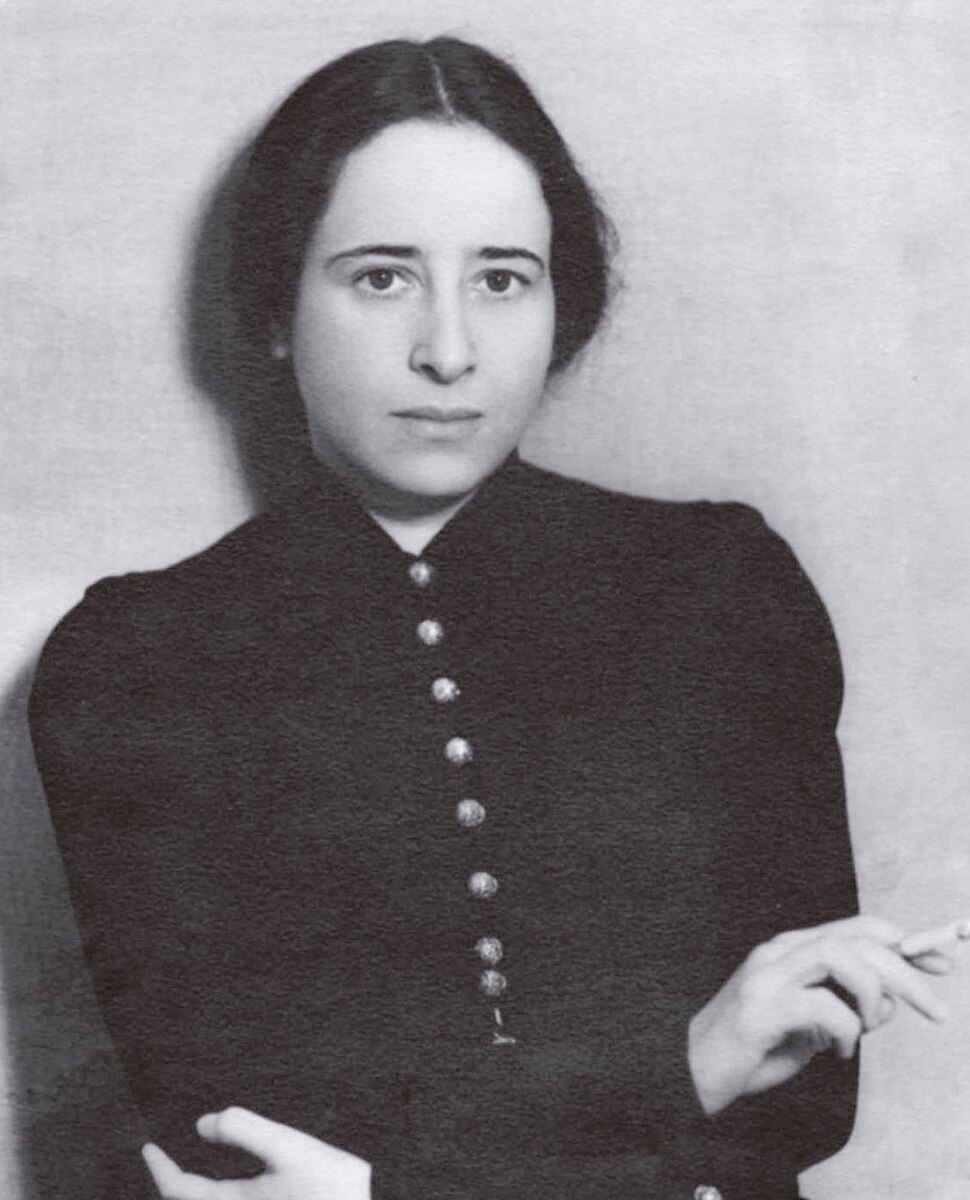
Born in Hanover, Germany, in 1906, Hannah Arendt studied philosophy at the University of Marburg, where she published her dissertation entitled Love and Saint Augustine. After fleeing Germany, she was detained in a French Nazi camp, but escaped to New York in 1941. From there, she served as Executive Director of the Jewish Cultural Reconstruction and authored a series of works on antisemitism, writing for Aufbau and Schocken Books. It was there that she wrote and rewrote a genius behemoth The Origins of Totalitarianism, releasing the book 1951 and publishing her third edition 1967.
Before reading The Origins of Totalitarianism, I wanted to understand the context surrounding the book from an expert, so I contacted the Founder and Academic Director of the Hannah Arendt Center for Politics and Humanities at Bard College, Roger Berkowitz.
He was initially impressed, though not enamored with Arendt’s writing, which he had studied throughout his education. His engagement with her work deepened when he began teaching at Bard, where Arendt is buried and where her personal library is housed. This connection grew even stronger when he was asked to organize a conference on Hannah Arendt for the centennial celebration of her birth at Bard in 2006.
“I invited some really smart people that I knew who had read Arendt but were not people who were people who wrote about her as academic scholars.” He asked, “What is politics, Judaism, and civil disobedience? The conference went brilliantly.” With the conference’s success, he was officially appointed Director of the Hanna Arendt Center.
Berkowitz felt surprised to find himself in the newfound position. Following his appointment, he taught a seminar on The Origins of Totalitarianism in order to immerse himself in her work. “It was one of those magical seminars here. You know, thirteen people took the class. Every single one of them more brilliant than the other. And we just did nothing but read The Origins of Totalitarianism…Over the course of the semester, I came to realize that it was the most brilliant book I’d ever come across. And that not only everything else that I think she wrote later in her life was prefigured already in Origins. I saw it related to almost everything that I could think of politically, philosophically, and with life questions. And that became the origin of the Arts Center.”
“I mean, one of the things that I think is fascinating is that she’s not a philosopher…Philosophers deal with the concept of being. She wrote about the world,” said Dr. Berkowitz. Her writing is about totalitarianism, prejudice, political fears, and a swath of intersections between those concepts.
Arendt strives to find the causes behind the rise of totalitarianism and its connections to antisemitism throughout The Origins of Totalitarianism. Loneliness has always existed, but, as Berkowitz muses, “Suddenly, in the 20th century, there was a loss in God, loss of family structures, the loss of traditions. Suddenly, without the structures of meaning and belonging, we had structured them for…you know, two, three thousand years. People have always been members of a church, or of a people, or of a family, or of a clan. And suddenly they emerged as individuals. You know, the very word individualism emerged in the nineteenth century. And so these individuals did not have belonging in something. And so, they were what she calls atomized, lonely individuals. And what they needed was to feel part of something. And so politics was able to provide them with a sense of meaning and belonging. They had to be part of a movement. And totalitarianism was the answer. Totalitarianism became this need for a new kind of government based on the need to totalize the whole world under one idea. That would give people a sense of meaningfulness.”
It is hard to not draw parallels between this idea and our current online world. Much proverbial ink has been spilled over how social media isolates people. Social media algorithms create a tailored reality that, with people spending hours upon hours online, leaves people isolated and ultimately, lonelier. A Harvard study noted that people found technology to be the leading cause of loneliness. Social media algorithms create that “atomized” lifestyle that Arendt has warned about.
Every day, the Trump administration pushes boundaries to further erode our sense of normalcy. The National Guard in Chicago? Strange, bizarre, and arguably an outright authoritarian overreach of federal power. But it has already happened when the National Guard invaded Los Angeles, and before that in Washington D.C. President Trump posted an AI generated image of himself dropping fecal matter on protestors for October 19th’s No King’s protest. Each AI-generated video is a bizarre tool that conditions us to accept theatrical, absurd, and highly politicized content from the official U.S. instagram as commonplace, further normalizing an antagonistic relationship between Trump and the left. We also see the scapegoating of certain minorities to draw people into self-righteous outrage; “illegal aliens” are responsible for rampant crime and economic struggles. Meanwhile, “Gender ideology” causes the “chemical mutilation” of children. Does it not evince an authoritarian regime when without warning the president can lie about his intentions and unilaterally decide to destroy the East Wing of the White House without input from the people, other branches, or oversight committee on a random Tuesday? It is a hyperbolic misnomer to call Trump Hitler, but it is equally foolish to dismiss these escalations as benign.

Hannah Arendt articulates a problem that frequently comes up when discussing totalitarianism: “There has been a tendency to simply equate totalitarianism with its elements and origins, as though every outburst of antisemitism or racism or imperialism could be identified as “totalitarianism.” This fallacy is as misleading in the search for historical truth as it is pernicious for political judgement.” (Arendt, 17). Likewise, she articulates that no totalitarian government will look exactly like another, and how seeking one-to-one similarities hinders our understanding of impending threats.
Berkowitz now holds conference each year about The Origins of Totalitarianism, each discussing a different theme of the book and how it relates to present-day issues. Through these discussions, people at Bard can view that democratic discussion as a fundamental opposition to the absolute conformity of totalitarianism.
One such conference was about privacy and totalitarianism, which Arendt discusses in Chapters 10, 12, and 13 of her book. As of now, it seems people are almost ubiquitously willing to sacrifice their privacy for the convenience and utility that services provide. It’s not laziness or carelessness on behalf of the consumer — it’s by design. It’s no coincidence that tech companies let people scroll through the terms of service to the bottom to click accept and employ unnecessarily wordy and confusing language within their terms. It’s unreasonable to expect every person to carefully read through the terms of service. Likewise, it should be unsurprising that companies incessantly ask us to “accept cookies” in order to continue accessing a website.
Arendt continued writing for the remainder of her life following The Origins of Totalitarianism. As Berkowitz told me, “The rest of her books are an attempt to articulate alternatives to totalitarianism that could provide a free people with meaning and belonging without turning to ideological conformity.” Indeed, following The Origins of Totalitarianism, she wrote Men in Dark Times, On Violence, and other works that explored freedom and responsibility in modern society.
For those that want to learn more about “ The Origins of Totalitarianism, Dr. Berkowitz hosts a podcast for which he and about 250 students and members of the Hannah Arendt Center read and discuss The Origins of Totalitarianism. We the people do not necessarily have attend academic conferences, but it is essential that people continue to think critically and engage academically with the world around them and understand historical patterns as they reemerge in today’s society, lest we repeat them.
“Over the course of the semester, I came to realize that it was the most brilliant book I’d ever come across. And that not only everything else that I think she wrote later in her life was prefigured already in Origins. I saw it related to almost everything that I could think of politically, philosophically, and with life questions. And that became the origin of the Arts Center,” said Dr. Roger Berkowitz. the Founder and Academic Director of the Hannah Arendt Center for Politics and Humanities at Bard College.