

We trekked through overgrowth of fern on long untrodden ground. The terrain shifted between patches of thickets and large blankets of weeds, where under me a strip of shorter grass hinted at a grown-in trail. It was the trail we had been following for the last ten minutes, which snaked through the greenery in a way that nearly seemed intentional, although it was just as likely we weren’t on any man-made path at all. Whether we were going anywhere, however, didn’t matter much to anyone. On my left, a small swamp dotted with lily pads and algae emerged from the very back of a block of trees, and we rejoiced at its sight; it was Half Moon Lake, from an angle I’ve never seen before.
The patch of land we stood on was supposedly a Boy Scout camp that had been abandoned some 60 years ago. Yet after three miles of walking, I realized just how sorely I underestimated the extent of its erasure: there was no trace of a tent, campsite, or any established structure for me to cling the name Old Aquehonga to. This was also not the first abandoned camp that I had visited — Ranachqua, shut down in 2022, very obviously lived a vibrant past of dining hall chants and tetherball games. Camp Kernochan and Kunatah still had structures after 20 plus years of inactivity. But in the case of Old Aquehonga, it took just 60 years for a part of Ten Mile River history to become shrouded almost entirely in greenery. Perhaps the other three camps were merely waiting to experience the same finale: a slow, utterly anticlimactic disappearance.
By the time we reached the Half Moon Lake shoreline — more so the last piece of dry turf before the mesh of mud and algae — a much more familiar camp came into view. A small red flag waved from the furthest distance I’ve ever seen it from, and the sound of rowboats thudding against the dock was practically inaudible.
“I’ve never seen Aquehonga from here,” I remarked.
I realized I was alone in my realization. The four other counselors that embarked on this trip were far more versed in the land’s geography than I was, so here returned the recurrent feeling of never knowing quite as much as those around me. From a distance, if one were to squint at the group and cover my silhouette with their thumb, everyone was palpably interconnected — either as Cub Scouts, through early summer camp experiences, or, now, as some of the main directors of camp. They dressed in green khaki Scout pants with T-shirts from various Scouting endeavors, I wore none of the sort.
“Look — there’s the old dock,” Jack pointed towards the dock he had been vaguely referring to throughout the beginning of the hike, and I desperately scanned the shoreline to try to locate it.
“How are we supposed to get that wood?” My cousin stared out at the lake.
“There’s not much of it.”
“We’ll come back for it — what a waste,” Walker stepped in.
“You think you could use it?”
“Yeah? I think. We could also hand it to Services or, worst case, burn it all.”
My eyes fell on a series of planks sticking out of the water, some upright in the mud and others mostly submerged. In the middle of the sparse scatter of planks, there was a singular wooden piling — jagged on the top, significantly moss-covered, and likely rotted down the middle. As the first piece of manmade architecture we came across, the dock’s remains certainly gave us a warm welcome to Old Aquehonga’s Aquatics area, the place where Scouts once learned lifesaving techniques and a strong swimming ability with the lifeguards.
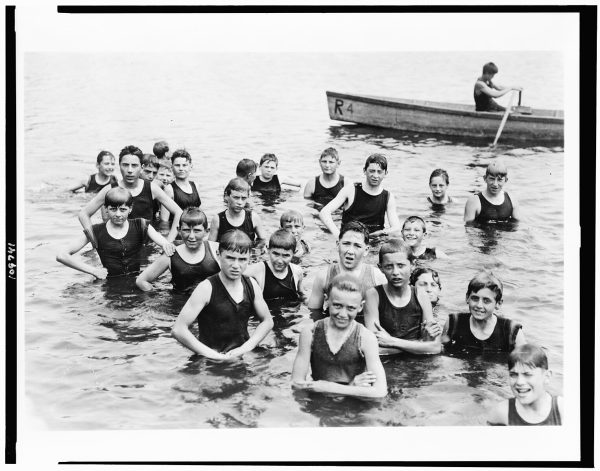
See, I didn’t know much, if anything, about Old Aquehonga just minutes before our journey. My cousin was the one who suggested I embark on the hike in the first place, and a small crowd accumulated just minutes before our departure. I found out — Old Aquehonga, more colloquially, Old AQ, was the predecessor of one of only two camps left along Ten Mile River. Half Moon Lake just happened to be the division between what Aquehonga was before and after it relocated, the juxtaposition displaying what rapid growth could do to the Boy Scouts. I like to think of the overgrown land in its previous form: once bustling with so much life the trees bent outwards to make way for the rush of 12 year olds, with trimmed grass and packed dirt roads marking constant use. Overwhelmed by activity, the camp must have demanded they relocate to accommodate, effectively closing the much smaller Aquehonga and opening the newer, more expansive camp.
The difference between the camps today is pretty obvious, or, ironically, not obvious at all — Old AQ lies on the side of Half Moon Lake so softly that few know of its existence.
While none of us were alive to experience Old AQ, practically all but myself were alive to know, or at least hear of, the bustle of Ranachqua, Kunatah, and Kernochan. Still, we weren’t quite old enough to know a time when Scouting was not losing its significance every year. Old AQ stands out not solely because of its age, but because of its happy ending — nearly every camp after it shut down out of a lack of funds and turnout, painting a fake sort of nostalgia when standing before the dock’s remains. The optimism for the future of Scouting has dissipated significantly since then, and the lonely piling gave a connotation of something much more positive than the still intact buildings at Kunatah and Kernochan.
I did visit Kunatah. In the summer of 2024, three other counselors and I took our bikes up to the abandoned camp, looking for something to entertain ourselves on a slow Saturday. I remember biking up an immensely steep hill to get to the entrance of the camp, which funneled into a couple of criss-crossing dirt roads that still appeared to be relatively in use. We followed the road until we reached the dining hall; the grass immediately beside the road was fairly trimmed, a stark contrast to the wild brush concealing the brown log cabin.
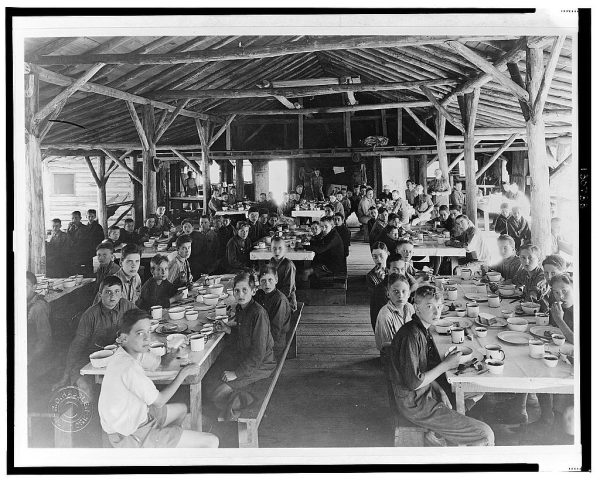
I forgot who suggested we go inside, but our buzz of excitement followed immediately. Throwing our bikes onto the dirt, we pushed through a couple square feet of overgrowth, dragging our legs through hidden thornbush to get to a large wooden door. The door opened with little resistance, and it creaked softly as it gradually revealed the humble interior: a single room much larger than we expected, lit by streams of sunlight that shone through the cracked windows. I took in the surroundings: no tables, benches, or kitchenware were to be seen — likely because abandoned structures often have their contents taken and repurposed by Scouts. All that was left was a variety of wooden signs hanging in rows from the rafters, each painted with names, fingerprints, and small illustrations to mark each Troop’s visit. These wooden signs are traditional at dining hall camps, commonly receiving small additions each summer a Troop returns to camp — such as new names or a dangling block of wood indicating the year. The latest year written on a sign was 2007.
We moved to the inside of the kitchen. This part of the dining hall suffered the greatest from its abandonment — crumbled stone scattered across the concave floorboards, bits of dirt and grass peeked through the ground, and old cooking structures appeared to have degraded years ago. At the very back of the kitchen there was a small section of brick wall painted white, lined neatly from top to bottom with names none of us could recognize. We took in the list of names silently: the counselors likely never anticipated their signatures would be the last remnant of their visit.
The morning we hiked to Old AQ, I made the wretched decision to wear shorts. As we trekked away from the lake, I suddenly acknowledged the intense stinging sensation that traveled down my legs, which intensified with every scratchy weed that I passed through. After nearly three miles of walking, and after stepping past countless horseflies and mosquitoes, I was now suffering the consequence of my poorly thought-out outfit. By the time we stumbled upon a tiny clearing, consisting of just one picnic bench, I laid on the grassless dirt in relief — my second poor decision.
Analynn sat on the picnic bench, then looked over at my position on the floor, saying, “I wouldn’t do that.” I glanced back, confused. “You might get Chinch bugs in your hair…”
“What?” I sat up immediately, urgently rubbing the back of my head. “What are those?”
“They’re like these little bugs…”
“What? Are they in my hair?”
“No, you’re fine. They’re not everywhere.” She wore a bemused expression. I threaded my fingers through my hair as a final reassurance.
That would have been the second time that I got bugs in my hair. The last time was when I accidentally laid on a colony of ants by the pool house, and I sat for over 20 minutes pulling ant after ant out of my hair. Perhaps I seem foolish by now. When surrounded by Scouts who have worked at camp for 8 to 11 plus years, I considered myself an outlier after my measly 3 years at camp. Yet I am only a piece of a much larger phenomenon, which is that the current generation of Scouts do not return to any Scouting event — but for this purpose, summer camp — nearly as often as they did just years ago. We could be generally classified as “New Scouts” and “Old Scouts.” The Old Scouts tend to return year after year — some for 10 years, and some for as long as 40-60 years. Yet when looking towards the New Scouts, most work at summer camp for only one year, then never return. From observation alone, the New Scouts often grow bored after just 2 consecutive years of running camp, thus few remain long enough to become directors or members of the administrative team.
There are a couple reasons for the lack of retention, which could be vaguely presumed to be associated with low pay. Salaries currently range between $500 to $3,000 for a full 8 weeks at camp, which totals to under $1 per hour when considering that staff are on duty 24/7. If a Scout goes missing, a bear comes to camp, or another emergency arises, the staff is required to act accordingly no matter the hour. Still, low pay is nothing new. Working at camp was always regarded as something done for the joy of it, but New Scouts either don’t feel that joy as greatly as Old Scouts, or they place a greater priority on monetary gain than summer camp fun. It would be a half-truth to declare that all Scout camps shut down because Scouts didn’t want to attend anymore. It is an issue with all of Scouting America, where Troop numbers are dwindling and Scouts rarely grow up to become Scoutmasters or other leaders. Perhaps it expands into an issue of the modern era. The outdoors is an outdated pastime, far too mundane and understimulating to replace the exciting technological world.
I got bugs in my hair — twice, almost — because I’ve only been a Scout for three years. I don’t actually know what Chinch bugs are. I’m an urbanite that didn’t grow up with the Scouts, now thrust into an environment where everything is unfamiliar. Yet I am not alone — most New Scouts may feel decades behind in terms of breadth and depth of knowledge of the outdoors. But once the Old Scouts are done spending time at summer camp or serving leadership positions in their troops and councils, who is left to designate years of their life to the Scouts? The picture of a Scout today is much different from what it was decades ago. Today’s Scout may not know much about forestry, animal prints, knot tying, or Scouting history. Yet unfortunately, it seems that a weak grasp on core Scouting values and skills is now normalized to the extreme.
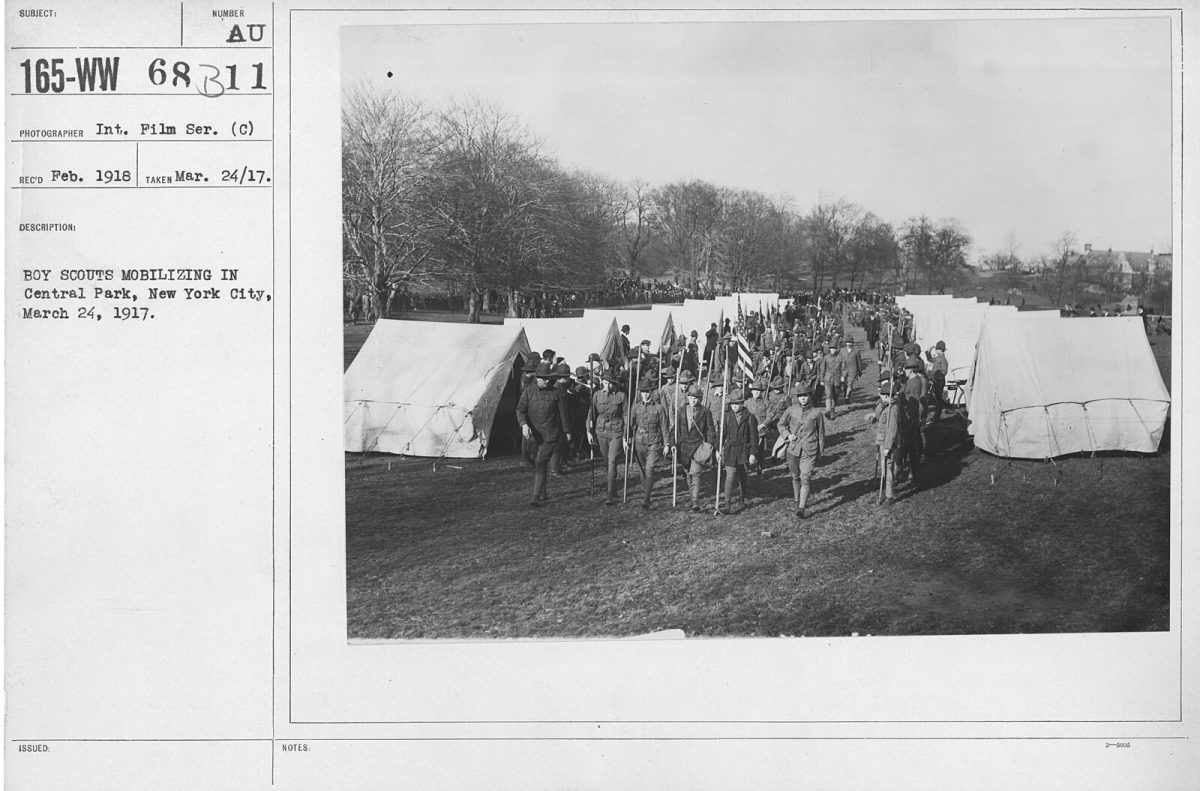
Anyone familiar with this narrative of the dying Scouts may recognize that I haven’t yet addressed the elephant in the room. When I mention a decline in Scouting engagement, perhaps I haven’t yet scaled the sheer enormity of the issue. From the year 2019 to 2020, Scouting membership dropped from nearly 2 million to approximately 1 million members. For a near 50% decline in membership to happen in just one year is unprecedented, though it is also important to note that this occurs after a huge decline from the Scout’s peak of 5 million members in 1972. So, what happened in 2019? The list goes on — the welcoming of girls and openly gay boys into the Boy Scouts, the pandemic, a $2.4 billion sexual assault lawsuit repaying 82,000 victims, and their ultimately filing for bankruptcy, pushing yearly dues to a cost upwards of $85.
That all ushers in a lot of room for commentary, which has scattered itself across the internet in bouts of outrage following the familiar opening sentence, “Former Eagle Scout here.” Millions of Scouts write with heartfelt nostalgia, writing about the “woke-ification” of the Scouts due to the welcoming of girls and gay boys into such a rugged (and predominantly Christian, for that matter) environment — but a 50% decline? It is unlikely that could be attributed to just one thing. Even after the pandemic ended, Boy Scout attendance has remained stagnant with projected upward trends of possibly 3%. Some remark that the Boy Scouts are damaged beyond repair. Yet if a decline in attendance has been happening since the 1970s, there is evidently a much greater force propelling the Scouts into its demise. One could call it a mix of Scouting stigma, technology booms, and new extracurricular opportunities. It was never “cool” to be a Boy Scout. Nor is it preferable to the comparatively stimulating environment of an ever-urbanizing world.
I remember watching two engaged members in the Scouts — a Scoutmaster and a much younger staff member — perform handshake after handshake in front of me. They met just minutes ago, and now they were exchanging every Scouting handshake they knew, interlocking fingers and classifying each one as it was performed.
“You remember the Cub Scout handshake?” the Scoutmaster started.
“Oh, yeah. That’s the one with the…” They each pressed two fingers against the other’s wrist.
“Yup. This one’s the general Scout one.” They took a couple seconds to rearrange their fingers. “And this one’s the Order of the Arrow one.”
“Oh, I kinda remember that one.”
“And the Vigil one?”
I watched them for a couple minutes, utterly confused. I was at the end of my first year as a Scout, and already the distinction between Old and New Scouts was palpable — I just hadn’t conceived the two classifications yet.
Just three years later, I joined the Order of the Arrow — generally, the National Honor Society of Scouting — and I can firmly state that I am still awfully uneducated on the topic of handshakes. I have even questioned if that exchange even existed in the first place, or if I merely manifested that memory sometime while I mulled over my Scouting career. It is small exchanges such as those that are disappearing, and in a haze of existential dread that hadn’t quite hit me at the time, I left that interaction feeling a little lost. I wondered how much catching up I needed to do, though I didn’t yet realize that I was under the same umbrella as all the other New Scouts. Most Scouts my age were rarely going to grow up as knowledgeable as that Scoutmaster. Whatever information I learned then may never make its way back to me again, and to that, I felt deeply disheartened.
One of the most notable features about Old Aquehonga was the patrol cooking method, which was effectively preserved when New Aquehonga refused to construct a dining hall. The patrol cooking method was a simple, teamwork-oriented way to cook. Troops were split into smaller groups called patrols, where each patrol was responsible for designating a couple of Scouts per meal to cook and/or clean. Today, the patrol cooking method remains relatively unchanged. Patrols make their way over to the Commissary to gather their cooking ingredients and supplies, then bring them over to their campsites to cook over their sheepherder stoves and campfires. As it orally made its way to me, Baden Powell favored the patrol method for the cooperation it mandated, which is not present in dining halls when Scouts receive food from hands as ambiguous as the Onceler’s. There was something so inherently Scout-like at patrol cooking camps, yet still they are declining faster than the widespread dining hall camp.
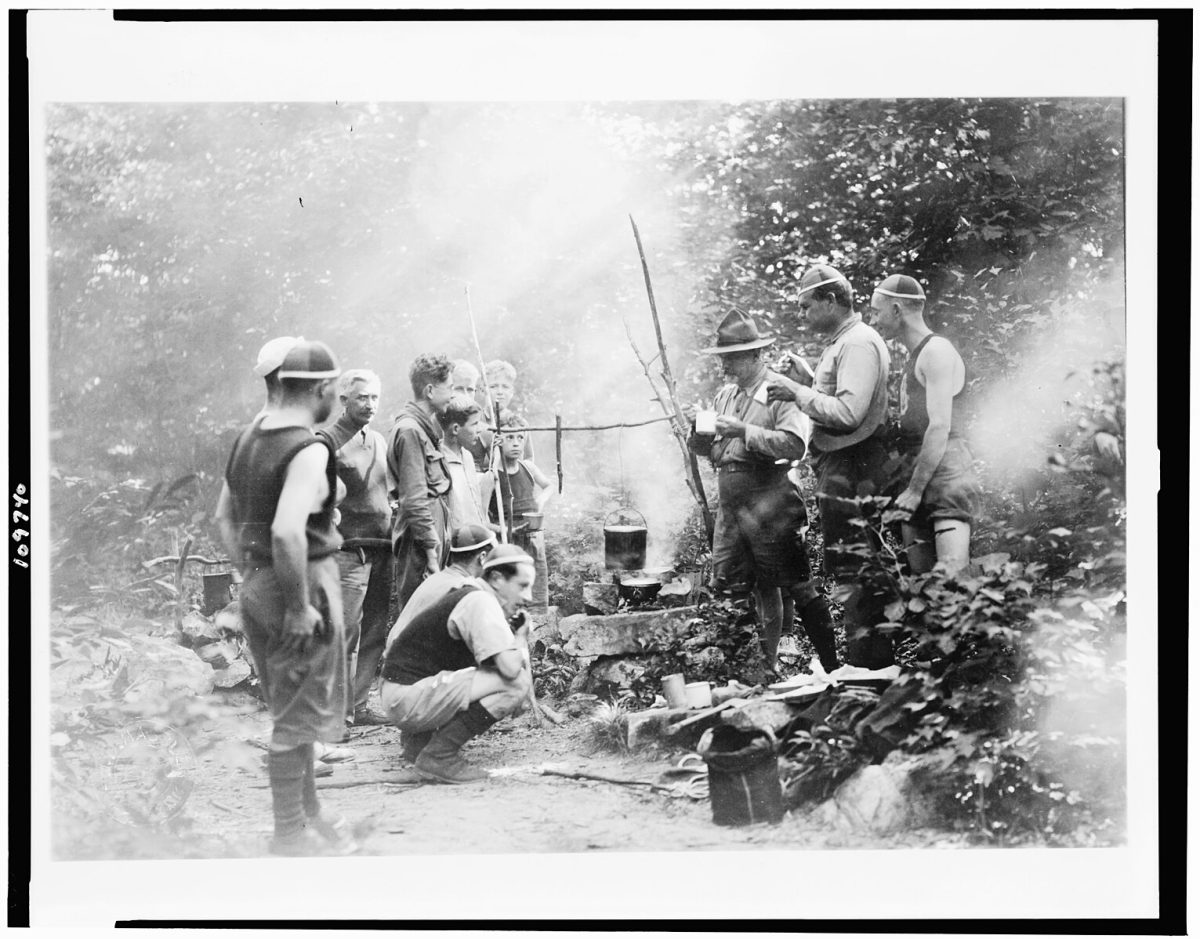
I stood before a large stone furnace, the largest, most conspicuous structure we saw on our Old AQ hike. It was surprisingly intact after decades of use and decades more of disuse, characterized by a slightly eroded hearth below a tall chimney of stone. Truly, I don’t actually know what this furnace was used for. My first guess went immediately to patrol cooking, which isn’t too far-fetched at all — it was easy to imagine a group of small, fussy Boy Scouts lined up here with mess kits and camping hot cups in their hands. These were the same boys that competed against each other in gaga ball pits, performed campfire skits at night, and struggled through the coldest camping nights with swallowed words of protest. It was an experience I almost related to, but still couldn’t quite wrap my head around.
Most Boy Scout narratives pre-2000 radiate that quasi-relatable feeling. One such narrative was by Mike Rowe in a blog post, where he writes about a game called “British Bulldog.” The game is similar to “Sharks and Minnows” — one Scout stands in the middle of the room, and 25 or so Scouts charge past him with the hope of not getting caught. If the Scout in the middle catches anyone, he has to lift him into the air for long enough to say “1, 2, 3, British Bulldog!” The British Bulldog-ed Scout joins the Scout in the middle, and the game continues. Of course, variations of British Bulldog are still played today in Troops and Scout Camps, but certainly not to the intensity Rowe described: then, most Scouts walked away with black eyes, bruises, scrapes, or bloody noses.
Another narrative that I read was by Mitchell Slepian, found amongst the blogs on the Ten Mile River Scout Museum website. He wrote about the countless nicknames Scouts created and garnered, including, as Slepian writes, “Dentist, Space Ace, Fireball, Bubba, Rock-N-Roll (R-N-R) and thousands of others. No, we had millions of others.” He also remarked that some could be insulting, but that was merely the output of a kid’s free-roaming imagination. It’s surprising how many nicknames would not be tolerated today. I could only think of one nickname we created, “Tinkerbell,” though we were urged to stop and call him his real name after some time.
That furnace knew a much different Boy Scouts, and due to the dense border of forestry around it, it lived its retirement shielded from today’s Scouting America. It may not know that the traditions, games, and customs that shaped Scouting have significantly diminished just one lake away. Nor would it know to what extent Scouting has been trivialized, indebted, and weakened. It is no longer as rugged, nor as “manly.” The internet today is hardly flooded with blogs as nostalgic as the above, but rather critical, often resentful articles. Some condemn the current Boy Scouts of America, which is now rebranded to Scouting America to more readily welcome girls. Others lament that the decline was inevitable, and wished it was foreseen sooner. No matter the reaction to the current state of the Boy Scouts, there is a collective feeling that wishes for its regrowth. It is unwise to narrow in on the loss of 1 million members in 2019. Scouting has been on the decline since 1970, wrought by a global disinterest in outdoor recreation. So, amid a generational drift, what is left?
A year or two ago, I remember going on a whitewater rafting trip with my Troop — yet I would use the word “whitewater” sparingly. The river that day was not white but a dark blue, indicating slow moving currents that hardly carried us without vigorous paddling. We rafted for nearly ten miles on those waters. By mile three, my arms ached and my back was stiff, which was already tiring without counting the whines and snarky comments from our younger girls. It reached a point when my Scoutmaster snapped, “If this isn’t for you, I’d rather you joined the Girl Scouts!” Even today, she still reflects on that experience. That girl has long left our Troop, though her story is repeated occasionally to new Scouts as a warning for what Scouting entails.
There are plenty more experiences that today’s New Scout could ramble on about, so many that I would not be able to compile them all in a single conversation. Scouts can attend the National Jamboree, go backpacking at Philmont, join the Sea Scouts, participate in a Venturing Crew, attend the National Youth Leadership Conference, join the Order of the Arrow, or participate in any other activity that is even vaguely Scouting-affiliated. Summer camp is just one offering among the wide array of activities in the Scouts, and to limit one’s perception of Scouting solely to camp is incorrect. I know that I am grateful that I am allowed even a glimpse of Scouting. Though girls were only allowed into the organization later into my life, the experiences and life skills that I’ve learned in four short years are indelible, and often once-in-a-lifetime.
That being said, did The Boy Scouts of America dig itself into its own grave? Not quite. Not only was the pandemic, lawsuit, and more largely out of their control, but contrary to the belief of the 1 million departed Scouts, there were few changes the organization could have realistically implemented to mitigate their decline. Tried and tired arguments about profit-hungry Scouting executives still propagate the internet, though that doesn’t quite account for the fact that the net revenue of the organization fell from $319 million to $188 million in just three years (2019-2022). It is an endless, self-perpetuating loop: as Scouts leave, net revenue falls, and as revenue falls, the Boy Scouts can only drive costs up higher to stay afloat. I still wish I knew a Boy Scouts of America that I could be nostalgic for. Yet when that nostalgia inevitably arrives, perhaps some decades past the day I age out of the organization, I hope it isn’t quite the same as the declinism around me today. Truly, there must be an out for Scouting.
The walk home was not particularly memorable. The sun moved from its peak position in the sky to a slightly lower, late afternoon spot. I was tired, hungry, and yearned for a shower and a comfortable chair, all of which would be available to me at our campsite. Though tomorrow’s work pressed at my conscience, I silently regarded the tent, cot, sleeping bag, and pajamas waiting for me. So, for the last time that day, we tread on that rarely trodden path, fighting through overgrowth while searching hopefully for a clearing. And when that clearing did arrive, it offered little fanfare — we still had to follow the dirt road for just a bit longer to finally arrive home. Nevertheless, we were officially off Old AQ grounds. We still had our living camp to tend to. Our work was never done, so with still-purposeful strides, we approached one of the last two camps on Ten Mile River. I was just about ready to collapse with relief.
Yet when that nostalgia inevitably arrives, perhaps some decades past the day I age out of the organization, I hope it isn’t quite the same as the declinism around me today. Truly, there must be an out for Scouting.