

What is the National Aeronautics and Space Agency’s (NASA’s) main goal? It’s not space exploration; at least not anymore. On August 28th, 2025, President Donald Trump issued an executive order that reclassified NASA’s directive as similar to an intelligence agency, putting it in a similar group of agencies like the National Security Agency (NSA) and the Central Intelligence Agency (CIA). The purpose of the executive order, as stated by Trump, is to “enhance the national security of the United States.”
This order would force NASA to change the way it operates itself and affect what rights its employees have. Executive orders are not pieces of legislation, but they are explicit statements from the president that tell federal agencies and departments under the executive branch how to interpret or implement the laws passed by Congress. In this executive order, Trump is labelling NASA’s objectives as being directly tied to national security work, which now includes functioning similarly to an intelligence agency, though not entirely.
This order would cause NASA to primarily focus on projects that are more aligned with what the president interprets as the agency’s main focus.
In addition to having its mission directive changed from science research to intelligence gathering, NASA is also under threat of having its budget being cut, from $24.8 billion to $18.8 billion. This represents a 24% budget decrease, the smallest NASA’s budget has been since 1961. This would put strain on current and future NASA missions, such as the on-going efforts to develop the Nancy Grace Roman Telescope, maintain Voyager 1 and Voyager 2, and even impact the ability of NASA to complete rover missions on Mars.
The Mars rover Curiosity discovered “leopard spots” on Mars which provided strong evidence for life on the planet. However, NASA was not able to return samples, one reason being that the White House claimed that sending samples back would be unaffordable.
NASA’s Office of Science, Technology, Engineering, and Mathematics (STEM) Engagement, known for providing internships to high school and college students, is also requested by the president to receive a funding cut of $143 million, with the justification being that “NASA will inspire the next generation of explorers through exciting, ambitious space missions, not through subsidizing woke STEM programming and research that prioritize some groups of students over others and have had minimal impact on the aerospace workforce.”
One of the agency’s largest projects, the Artemis program, is also facing issues, meanwhile adversaries like China are ramping up efforts to go to the Moon.
The Artemis Missions
The Artemis program is a major space initiative that aims to establish a permanent American presence on the Moon. Initiated in 2017 under the first Trump administration, Artemis was divided into three separate launches: Artemis I, Artemis II, and Artemis III.
Artemis I was an un-crewed, automated launch of the Space Launch System (SLS) rocket and the Orion Spacecraft orbiter that occurred on November 16th, 2022. The launch was meant to prove that the SLS, the most powerful spacecraft ever built, and the Orion Spacecraft, the shuttle meant to carry the astronauts, were safe and viable. Artemis I’s success was critical in allowing NASA to continue the program.
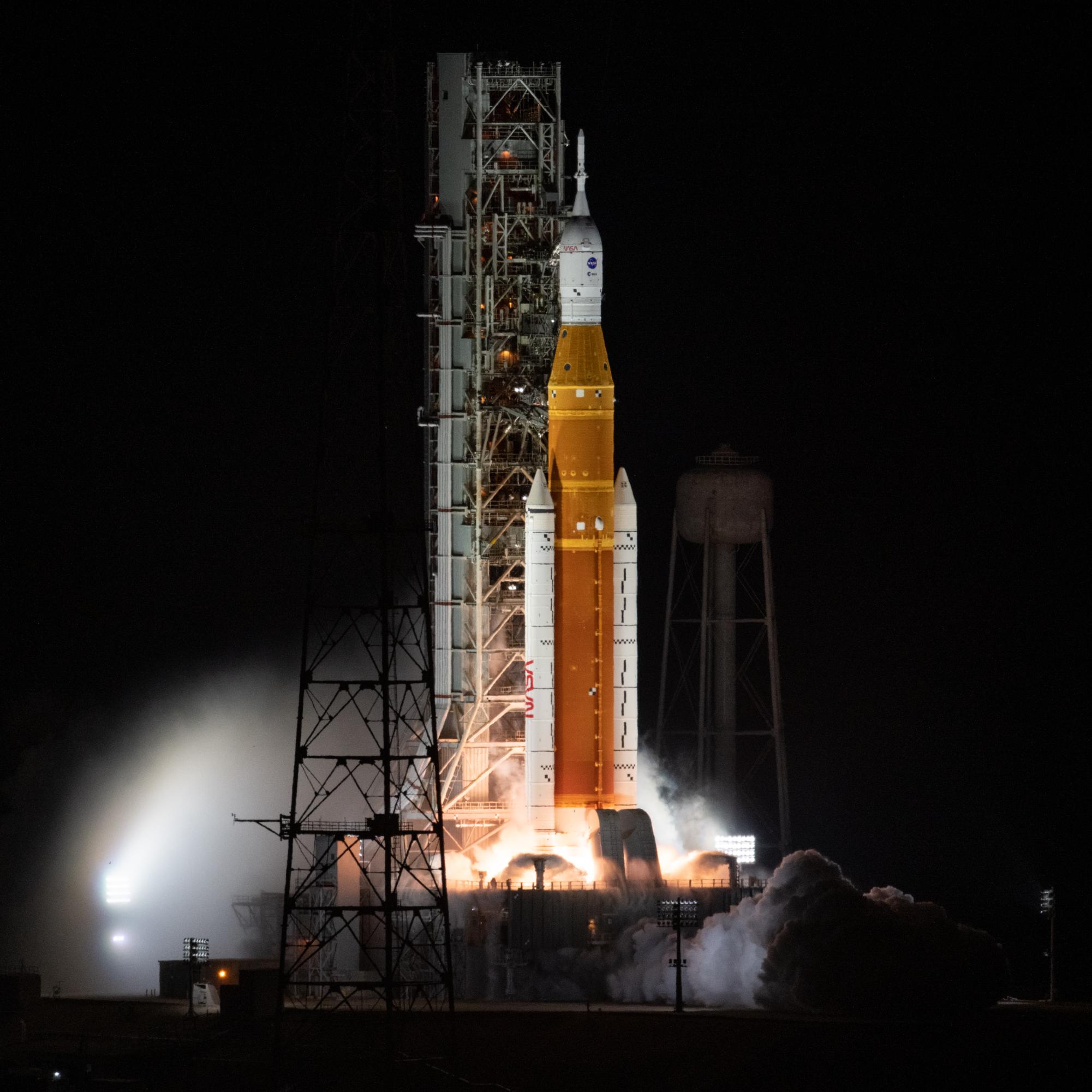
The second launch will be Artemis II; the target launch date is currently February 5th, 2026. It will be the first crewed mission to the Moon since Apollo 17 — the last Apollo mission, which launched on December 7th, 1972. Artemis II will slingshot astronauts around the Moon and back in a 10-day mission using the Orion spacecraft, which will be launched into lunar orbit by the SLS. This mission will give NASA and Congress the confidence they need to move forward with the next stage of the project: Artemis III.
This launch is meant to land American astronauts back on the Moon’s surface for the first time since the Apollo program’s end. The launch is currently scheduled for 2027, as it will use NASA’s current Orion spacecraft in tandem with the Human Landing System (HLS).
In April 2021, SpaceX was awarded the $2.9 billion contract to design the HLS, which planned to launch a modified Starship rocket to vertically land on the Moon’s surface. The Human Landing System is a lander that is meant to act as a better alternative to traditional lunar landers, which follow similar designs as the Apollo lunar modules. The Lander will follow a similar design philosophy as the Starship rocket.
The program was intended to rekindle the efforts of the previous Constellation project, which was initiated by George W. Bush in 2005, with the goal of returning American astronauts to the Moon. However, the program was soon cancelled in 2010 once Barack Obama was elected, as a congressional committee found that the project was growing exceedingly expensive and it drained resources from other NASA programs.

NASA and SpaceX’s Relationship
President Obama turned to the private sector for cheaper, more affordable space launches going forward. Obama’s bet on the private sector would pay-off, as SpaceX emerged as a major competitor in the space sector by creating the Falcon 9 and Falcon Heavy rockets. The company is currently designing and perfecting its Starship rocket. All of SpaceX’s rockets are reusable which dramatically reduces the cost of space launches.
NASA has relied heavily on SpaceX for a very significant portion of its activities since the rockets’ creation. In 2024, over 95% of U.S. space launches were conducted by SpaceX, with NASA contracting them to use their reusable rockets for resupply missions to the International Space Station (ISS) or sending satellites into orbit.
Given the success of SpaceX’s innovation and attractive cost efficiency, NASA awarded SpaceX a $1.15 billion contract in 2022 that aims to enhance the Starship rocket to be able to travel beyond Earth’s atmosphere and provide in-flight resupply missions for the HLS, and for future missions to the planned Gateway Space Station. This is a permanent space station, similar to the ISS, that will facilitate future deep-space missions that include missions to Mars. The Gateway Station will also allow NASA to begin setting up a permanent lunar base, which has been a dream of the agency since the Apollo program, with even the Gateway Station sharing similarities with some of NASA’s old concepts.
However, as of the time of this article’s publication, SpaceX has not been able to design a spacecraft that can leave low-earth orbit, which is identified as being between 160 km to 1,600 km above Earth’s surface. The Starship rocket has failed to achieve this feat, which was one of the main selling points of SpaceX winning the contract with NASA in first place.

Because of this, the aerospace company is running the risk of losing their contract with NASA. The Trump administration is not satisfied with the slow progress. On October 20th, 2025, acting NASA administrator Sean Duffy announced that he does not believe SpaceX will be able to deliver the modified Starship in time enough to beat China in the race back to the Moon.
This is the position the Artemis program is currently at, as of January 2026. However, there are other reasons the program has been postponed for so long, and could continue to be, if it is plagued by further politicization.
Politics and Space Exploration
When Donald Trump ordered NASA, among other departments, to focus on acting as an intelligence agency, it gave the Trump administration power to prevent unions from representing federal workers at these departments. Because of the change in directive for NASA, it was exempted from federal collective bargaining rights that federal workers were entitled to under the Civil Service Reform Act of 1978.
The right to collective bargaining is the right employers have to negotiate contracts to determine benefits, salaries, hours, and other terms of employment, when represented by a worker’s union. In the act, the only way a federal agency could be exempted from collective bargaining rights is if the agency-in-question is critical to national security.
The two major unions at NASA, the International Federation of Professional and Technical Engineers (IFPTE), and the American Federation of Government Employees (AFGE), represent around 53% of NASA’s workforce.
On September 18th, 2025, exactly three weeks after Trump’s executive order was issued, NASA’s Office of the Chief Human Capital Officer notified members of NASA’s labor unions that they are no longer entitled to their collective bargaining agreements and that NASA is no longer obligated to recognize the unions as the exclusive representatives of their workers.
This is not the first time the Trump administration has fought against union rights, as on March 27th, 2025, Trump signed the executive order entitled ‘Exclusions from Federal Labor-Management Relations Programs.’ This bars over twenty federal agencies and departments from granting their employees the right to form, join, or assist labor organizations.
What is the justification for this? All of the mentioned federal agencies and departments are identified to be primarily focused on intelligence, counterintelligence, and national security work. Such departments include the Environmental Protection Agency, the Department of Veteran Affairs, and the Food and Drug Administration.
However, the move against NASA’s labor unions could be politically motivated, as the IFPTE has been incredibly vocal against Donald Trump’s anti-union actions, and been successful in challenging them. On September 30th, 2025, a District Court in California issued a preliminary injunction, an order meant to preserve the status quo before the order being challenged was signed.
This prohibited the March 27th, 2025 executive order from taking effect at the Department of Defense and the Environmental Protection Agency. The California judge, Judge Friedman, concluded that the president had gone beyond his legal authority and found evidence of political retaliation against the unions affected by the initial executive order.
NASA was not included in the original executive order barring labor unions from representing federal workers. However, this changed with Trump’s August 2025 executive order that now includes NASA. The IFPTE is actively challenging this with an ongoing lawsuit against the executive order.
The significance of this is that the IFPTE represents a significant portion of engineers, technicians, and researchers at NASA who are contributing to the Gateway and Orion spacecraft’s development. Barring these workers from their bargaining rights increases the risk of worker retaliation against the Trump administration or cause employees to leave, however, it also makes striking illegal.
NASA has already suffered a “brain drain” as the Trump administration aims to cut NASA’s budget harshly. As of early October 2025, around 4,000 NASA employees, representing 20% of its entire workforce, have left.
The integrity of NASA’s acting administrator Sean Duffy is also being brought into question. He has expressed interest in transferring NASA to falling under control of the Department of Transportation, which he is the secretary for. Duffy has expressed privately that he is interested in keeping his role at NASA.

However, Donald Trump has recently re-nominated Jared Issacman, billionaire CEO of Shift4 (a tech company focused on digital payments), to be director of NASA. In a Truth Social post, Trump wrote, “Jared’s passion for space, astronaut experience, and dedication to pushing the boundaries of exploration, unlocking the mysteries of the universe, and advancing the new space economy, make him ideally suited to lead NASA into a bold new Era.”
Issacman was previously nominated by Trump in December 2024, but was pulled from nomination due to his previous affiliations, being a member of the Democratic Party, and having close ties with Elon Musk, with whom Trump had a feud with in early 2025. Currently, Issacman is one of the most prominent private astronauts, meaning he has been to space privately, with the help of SpaceX.
At the same time of Issacman’s re-nomination however, Sean Duffy reopened the contract with SpaceX to competitors like Blue Origin. This was seen as a move to appease Donald Trump over his former rival, Elon Musk. Musk soon took to personal attacks critiquing the Secretary of Transportation, calling him “Sean Dummy.”

These are only a few of the issues currently plaguing NASA. Now that the U.S. Government has reopened and NASA’s budget has been revised, the space agency’s most important programs in astronomy and space exploration could be threatened as a result of political skirmishing.
The United States was once the world’s leader in space and hailed as an engineering powerhouse. Yet in recent years, the reputation that the United States has built has been degrading, since NASA’s new goal — intelligence and national security work— seems redundant, due to the Space Force existing to cover that role.
The United States Space Force is the sixth branch of the U.S. military. It was established by President Trump and former Vice President Mike Pence on December 20th, 2019. The Space Force was created with a goal to focus on space-based threats from foreign nations, such as anti-satellite weapons, electronic warfare, and ballistic missiles.
Donald Trump and his administration have gone as far as banning Chinese nationals from participating at all in NASA, due to the renewed Space Race becoming heated. If the U.S. is to remain an engineering powerhouse and respected as a technological superpower, politicization of scientific departments like NASA need to be addressed.
It is important to note that this is an on-going issue and there are new pieces of information coming out. Just recently on November 12th, 2025, NPR reported that doors to essential lab rooms have been locked and have lost access to specialized equipment that is essential to maintaining the NASA Goddard Space Center in Maryland. Several workers were interviewed yet remained anonymous out of fear of losing their jobs for speaking out. One worker, Casie McGrath, did come publicly in the interviews as said that she fears the White House is trying to cripple the center’s capabilities and are being attacked by the White House. As of November 21st, 2025, the Goddard Space Center will also be reduced in size by 25%, closing 100 labs and 13 buildings, as NASA’s proposed budget that will cut funding by 24% is being reviewed again.