
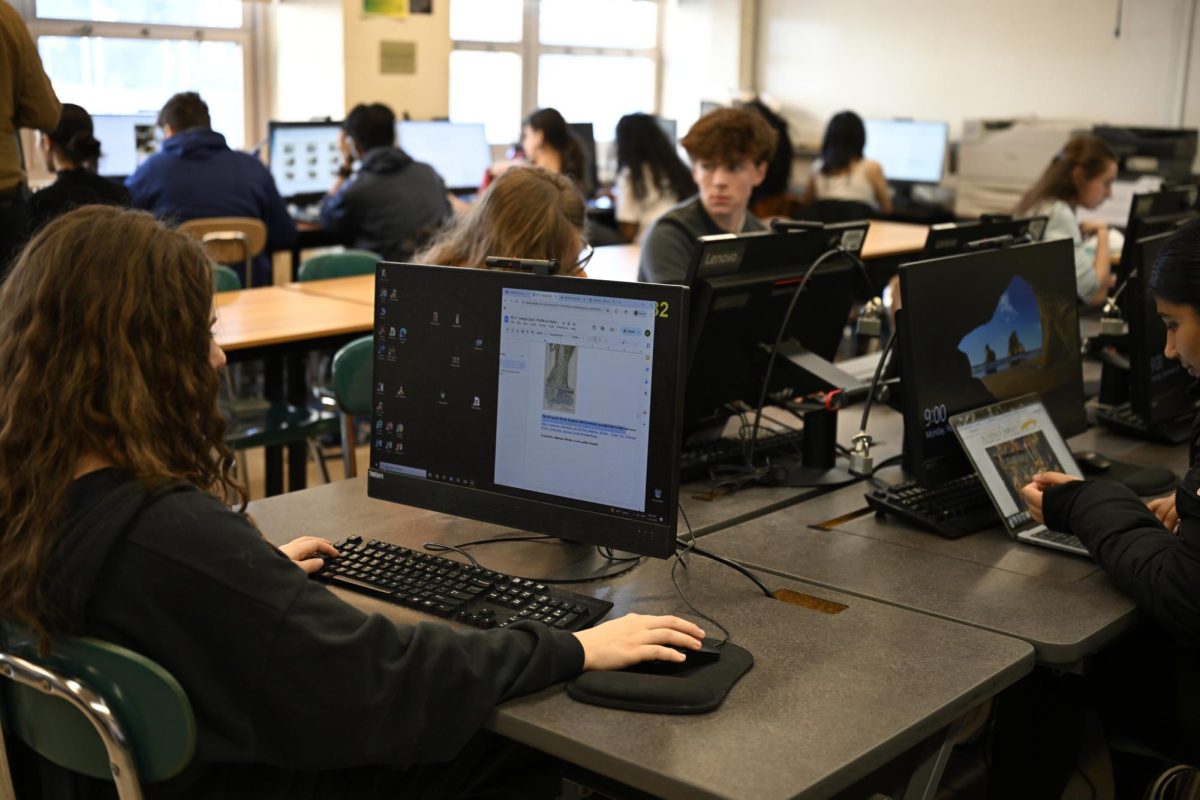
At Bronx Science, Room 214, the Journalism classroom, is perpetually abuzz with the whir of computers and the click-clacks of typing. Among the chaos of exams and deadlines, the class is a sanctuary for students to freely write about what matters to them. From reviews of our favorite pizza spots, to coverage of our participation in the student-organized, anti-dictatorship “We the Students” protests, citizens too young to vote still contribute to democracy, asking hard questions and voicing their opinions.
Yet, by technicality, our right to write these articles is not protected under state law.
Across New York public schools, high-schoolers’ ability to write any article is up to the discretion of individual schools. Administrators can abuse their power of prior review to censor stories for virtually any reason. A piece about LGBTQ+ rights, climate protests, or neglected school needs could be pulled, and students would have no legal pathways to challenge the decision or even request an explanation.
This power traces back to the 1988 Hazelwood v. Kuhlmeier decision, where the Supreme Court ruled that school-sponsored publications are subject to administrative control. The Court reasoned that because schools act as publishers, they may restrict content that interferes with educational goals. It declared that school papers are not “public forums” for students to share views, but an extension of classroom learning, where articles should be published for the purpose of meeting subjective journalism class requirements. This repealed some of the protections established in the 1969 Tinker v. Des Moines ruling, which affirmed that students do not “shed their constitutional rights to freedom of speech or expression at the schoolhouse gate.” In doing so, the courts set a precedent which continues to muffle young voices.
Since the Hazelwood decision, eighteen states have passed “New Voices laws” — laws that cement student journalists’ right to freely report, provided that their work is not libelous or disruptive. They have restored to students what the constitution promises: free speech and a free press.
But this legislation does not exist in New York.
Despite being the birthplace of some of America’s most iconic and unfettered press, from the New York Times to the New Yorker, New York does not grant protections to its young journalists.
New York State Senate Senator Brian Kavanagh currently sponsors Senate Bill S68, a “New Voices” bill pending in the New York state legislature. The first draft of a “New Voices” bill was introduced to the state senate in 2017, and Kavanagh picked it up in 2019.
He said his support for the bill is rooted in both civic responsibility and education.
“Responsible journalism has a really important function in our society, and we [the United States] have a long tradition of allowing journalists to do their work and be independent of censorship,” Kavanagh said. “If a school is going to have a newspaper, they ought to take that seriously, and they ought to give the journalists the right to express their point of view and report the news as they see it.”
Senate Bill S68 would ensure that journalists in New York public schools have the final say in what they write and publish. This, however, is not without guardrails. Schools can still intervene in cases of libel, privacy invasions, or genuine disruption. They simply can no longer censor to prevent discomfort.
Resistance to the bill typically comes from school administrators who fear an independent student press could spark negative publicity for the school itself.
“There’s concern that students may publish things that are irresponsible,” Kavanagh said. “There is some concern for school administrators that if this is the official school newspaper, and there are opinions or news coverage in that paper that parents or other people in the community find problematic, that they’ll cause problems for the school.”
These fears are not entirely unfounded. The line between thought-provoking insights and possibly contentious content is not always clear, especially among students who are not trained professionals. In our country’s charged political climate, opinions shared in good faith can easily be misconstrued or seen as offensive. But a school newspaper also reflects a diverse student body with a multitude of identities and lived experiences. While articles about political conflicts may be sensitive and elicit strong reactions from readers, avoiding these subjects does not make them cease to exist.
Administrators also have concerns for when student journalism turns inwards, and students begin to report on issues within schools. Many school officials fear their schools receiving bad publicity for articles about ceiling leaks or cockroach infestations. Yet, if anything, these investigations demonstrate a student’s investment in their school’s wellbeing, not a commitment to its downfall. Writing about controversial topics is not inherently irresponsible.
Kavanagh said that he holds a similar view: “I think that [freedom] both makes newspapers better and also makes the experience of being a student and learning how to be a journalist more effective and more like the real world.”
And student journalists do already live in the real world. They follow political debates and understand the issues that affect their schools in ways their adult counterparts may not. The stories they produce have real impact: they can spark productive discussion among the student body or prompt meetings with administrators to address school-centered problems. Censoring publications does not shield students from these problems, but it hinders their ability to process their observations and engage in meaningful dialogue.
Katina Paron, an advocate for “New Voices” in New York, has spent the past eight years working with legislative sponsors and engaging students in efforts to protect their rights as journalists. She has witnessed schools censoring student papers to conceal administrative flaws, a move she considers misguided.
“If someone wrote about the rats in the kitchen, you should probably focus your attention on getting the rats out of the kitchen,” Paron said. “Don’t get mad at the messenger.”
Censorship does not fix problems, it simply buries them. Instead of protecting learning environments and the reputations of schools, prior review teaches avoidance. A student reporter told that their investigation is “too critical” learns not to dig deeper. A writer whose editorial is labeled “too opinionated” learns that honesty has limits. In trying to control the narrative, schools create journalists who are hesitant to question authority, something Paron said she has seen in her work.
“Young people I was working with who were high school journalists didn’t necessarily feel like they had the power to ask the questions they needed to ask and demand answers from authority,” Paron said. “That creates a culture of fear for the students.”
This often promotes self-censorship, where students become conditioned to keep quiet.
“They’re learning to not have the ideas, not to write the stories that need to be written, because they’re used to being told no,” Paron said. “It’s not fertile ground for young people to grow into active engaged citizens if they’re not given that right when they’re young.”
While the “New Voices” bill would help to curb this and promote journalistic independence, its passing is currently at a standstill. Yet activists refuse to give up.
“There’s some kind of waiting to see what’s happening before we can take [legislative] action,” Paron said. “But the hope hasn’t died.”
In a time when newspapers are rapidly dying and journalists are increasingly under scrutiny, it’s crucial that student journalists continue to write. The “New Voices” bill may be stalled, but its mission of encouraging the next generation to ask hard questions and use their voices endures.
“This is a strange moment in the way information flows, you’re getting a lot of information that is intended to distract you from what’s going on or deceive you,” Kavanagh said. “My hope is that student journalists, even if they’re fighting battles about their freedom to publish their newspaper, are engaging in journalism and asking hard questions and calling the facts like you see them.”
The right to write is not a teenage luxury, it is a necessity to promote critically-thinking citizens. The process of investigating and questioning authority is at the heart of democracy.
At Bronx Science, when a new issue of The Science Survey is published, students, faculty, and parents all share a sentiment of quiet awe. While articles may be imperfect, every story holds curiosity and courage. This encapsulates the importance of free student journalism — it is more than just classwork, it is a space for young people to be their own advocates.
“Responsible journalism has a really important function in our society, and we [the United States] have a long tradition of allowing journalists to do their work and be independent of censorship. If a school is going to have a newspaper, they ought to take that seriously, and they ought to give the journalists the right to express their point of view and report the news as they see it,” said New York State Senate Senator Brian Kavanagh.