
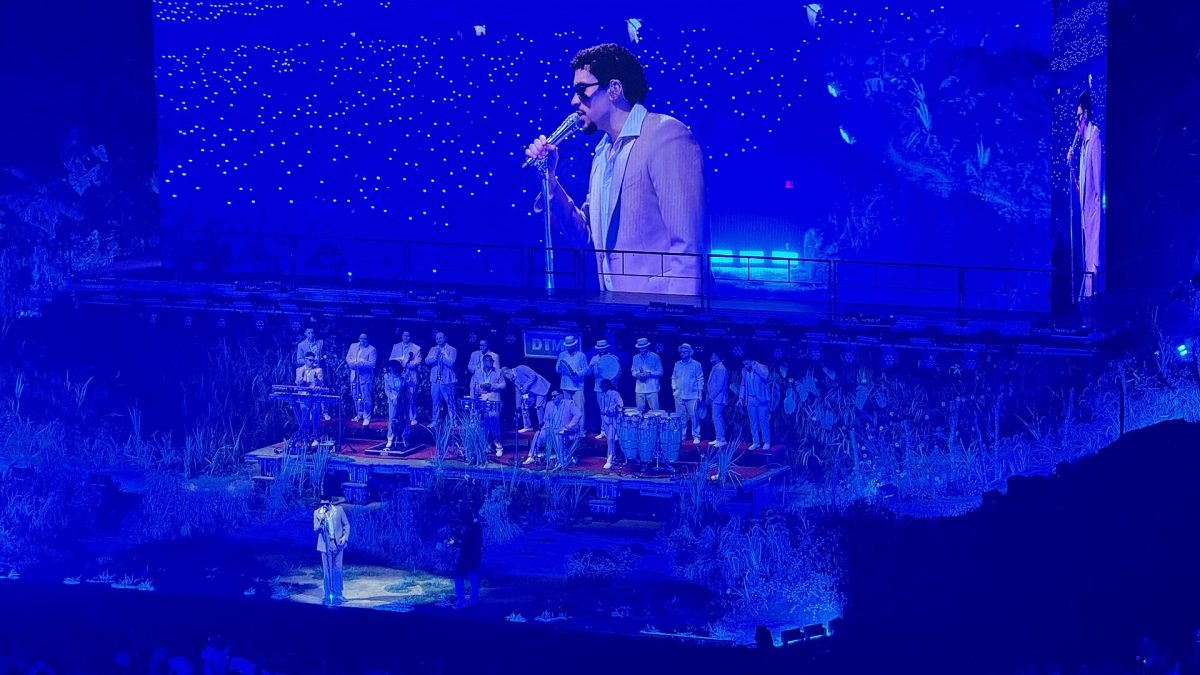
“I always knew I could be big and successful being Puerto Rican with my music and my slang… with my culture. So yes, I was working to reach the most places that I can, but at the same time keeping my essence, my roots,” Bad Bunny remarked in a recent New York Times interview.
Bad Bunny has transformed pop music by staying true to himself and representing his Puerto Rican culture unapologetically throughout his entire career. His lyrics, style, and sound are all direct reflections of himself and his childhood. By writing songs entirely in Spanish and using rhythms that originated in Puerto Rico, Bad Bunny has created a name for himself without altering any part of his identity.
Benito Antonio Martinez Ocasio, known professionally as Bad Bunny, was born on March 10th, 1994, in Vega Baja, Puerto Rico, 30 miles west of San Juan. Music was always an important part of his life. His parents would play him salsa and merengue songs by artists such as Hector Lavoe and Juan Gabriel, instilling his love for classical Latin music at a young age. In the early 1990s, the genre of Reggaeton, a blend of Hip Hop and Latin music, was invented. This introduced young Bad Bunny to the multifaceted world of music. “The first album that I got was Vico C. That’s an OG legend rapper from Puerto Rico. That was the first time that I listened to rap music and urban music, and I liked it. Then, the first time I listened to Tego Calderon was when I said, ‘when I grow up, I want to be like this,’” Bad Bunny explained when asked about his influences in his early childhood.
In 2016, Bad Bunny released his first single, ‘Diles’ on SoundCloud, and producers reached out to him. Since then, his career began to skyrocket as he released many more successful singles. In 2018, Bad Bunny won his first award: his debut album, X 100pre, won Best Urban Music Album at the 20th Latin Grammys. In 2020, Bad Bunny released his second album, YHLQMDLG, and earned his first Grammy for Best Latin Rock, Urban or Alternative Album at the 63rd Grammy Awards.
While Bad Bunny may have started out winning awards that pertained specifically to the Latin aspect of his music, his songs have reached a much wider audience. The majority of the people who stream Bad Bunny’s music do not speak much Spanish. He has been able to make a name for himself due to the versatility and nostalgia of his songs and melodies. His music combines reggaeton and other classic Spanish influences, such as salsa, classic Caribbean rhythms, and Latin Trap.
One of his main inspirations is a Puerto Rican music genre called Plena. “Plena is one of the oldest rhythms on the island, and I like it because I bring the original plena… pero también lo fusioné y jugué con los sonidos (but I also fused it and played with the sounds),” Bad Bunny explained. He mentions that his song DeBÍ TiRAR MáS FOToS feels like a “new plena” to him.
While Bad Bunny’s music is more mainstream, it has become a staple in the homes of many Hispanic (and non-Hispanic) households. And because his music combines a variety of old and new sounds, people of all ages can find themselves in the music. “I was told not to step foot in Miami to visit them until I had listened to his new album in its entirety,” Valerie Lorenzo ’26 recalls her family’s reaction to the new Bad Bunny album, DeBÍ TiRAR MáS FOToS.
Bad Bunny’s impact and ability to make a name for himself in a space where people may not have exposure to culture like this. “You don’t need to speak the language to get the vibes”, Mia Almanzar ’26 said. When you make good music that explores the deepest parts of yourself and your history, people will listen.
But Bad Bunny’s activism and representation has extended farther than just the melodies of his songs. His activism also reflects a deep commitment to Puerto Rico. Bad Bunny has consistently spoken out about political corruption, government mismanagement, and disaster response failures on the island. After Hurricane Maria and during protests against then Governor Ricardo Rosselló, he used his platform to raise awareness and encourage civic engagement. Unlike celebrities who remain neutral to protect their brand, he has risked commercial comfort to align himself with social movements. This stance has strengthened his credibility as not just an entertainer but a voice for his community.
In 2026, amidst the uncertainty of immigrants losing their stability and livelihoods due to the increase of ICE raids, Bad Bunny was given the opportunity to perform at and headline the SuperBowl Halftime Show. In classic Bad Bunny fashion, he utilized this show to make a statement about unity and to celebrate many cultures.
Despite the tensions leading up to his performance, with many unsure if they would enjoy it if they did not understand Spanish, Bad Bunny was able to execute a performance that garnered nearly 100 million viewers across solely the United States. The performance opened with aerial shots of a field of sugar cane, each bunch containing a human operator. He began the show with his hit, “Tití Me Preguntó,” one of his more upbeat songs as we follow him though a winding maze of sugar cane, spotting men and women alongside him cutting down the stalks, representing the enslavement of Puerto Ricans in the 1500s by the Spaniards.
The show continues as Bad Bunny sings through the field, with plenty of nods to Puerto Rican and Hispanic culture including piragua and coco frío stands, nail salons, and men playing dominoes. as well as a tribute to the island’s power outages with dancers on top of electrical poles. “I found myself pointing out things throughout [the halftime show] that me and my family recognized,” Lorenzo ’26 said.
The attention to detail and emphasis on culture is what truly made this halftime show so memorable. Bad Bunny took his opportunity in the spotlight to bring light to topics he found important: unity and culture. With a sea of flags following behind him, Bad Bunny left the audience of the halftime show with the message that ‘America’ represents a celebration of cultures as he lists countries from South America and North America alike. In the current political climate, Bad Bunny’s focus on activism and joy has made him such an important artist to have in the spotlight.
Bad Bunny has also become well known for his tendency to dress outside of the norm, according to typical gender stereotypes. He consistently talks about his comfortableness in wearing dresses and skirts, occasionally wearing them in solidarity to make a broader political statement. He is not afraid to let others see him in a light that may seem to de-masculinize him. In a Rolling Stone interview, Bad Bunny claimed, “I have always felt like there [was] a part of me that is very feminine… But I never felt as masculine as I did the day I dressed up like a drag queen.” As seen in his “Yo Perreo Sola” music video, he portrays himself in a black wig and a red leather dress, representing a woman who is confident in herself.
Bad Bunny’s insistency on staying true to himself and speaking up for what he believes in has made his music and his career as a whole extremely authentic. His story proves that you do not have to compromise any part of yourself to be successful; sometimes authenticity is exactly what is needed.
Bad Bunny’s insistency on staying true to himself and speaking up for what he believes in has made his music and his career as a whole extremely authentic. His story proves that you do not have to compromise any part of yourself to be successful; sometimes authenticity is exactly what is needed.